


Much more than just a notebook, a journal or diary is a true ally for your child's emotional well-being. It's a safe and personal space where they can freely explore their thoughts, dreams, and anxieties, with just a pencil and a few blank pages.
Why a simple notebook is a treasure for your child
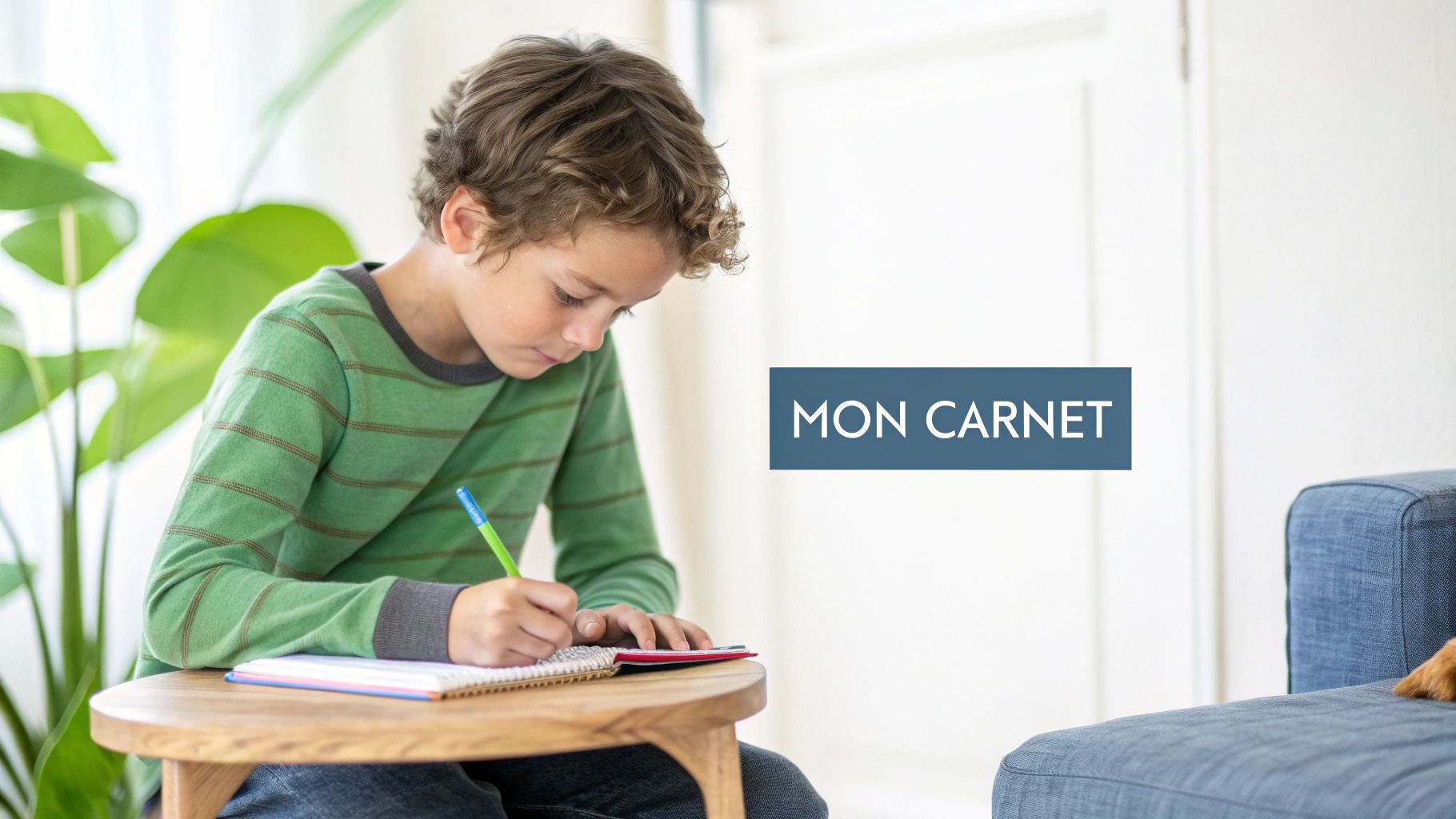
In a daily life that's often hectic and hyper-connected, a notebook offers a pause, a little bubble of calm. It's neither a duty nor an obligation, but a secret garden all their own. For a child between 6 and 12 years old , juggling strong emotions like frustration, immense joy, or deep sadness can be a real whirlwind. The notebook then becomes a silent confidant that never judges.
This personal space allows him to put words or drawings to what he feels inside. This is an essential first step in developing his emotional intelligence. By putting his thoughts on paper, he learns to recognize them, understand them, and, little by little, to better manage them.
A playground for creativity and self-confidence
But a notebook isn't just for confiding secrets! It's also a blank canvas for the imagination. Your child can draw fantastical worlds, write short stories, invent whimsical characters, or simply doodle for fun. This complete freedom, without any expectation of a specific outcome, is a wonderful way to develop creativity and confidence in their own ideas.
In concrete terms, here's what this brings him:
- An outlet for emotions: The journal allows him to express what's on his mind, which helps reduce stress and anxiety. Practical tip: If your child is angry, suggest they "draw their anger" in their journal, without worrying about the result.
- A confidence boost: By seeing his ideas take shape, he learns to value what he thinks and his vision of the world.
- A stimulation for your brain: Organizing your thoughts to write them down or draw them is an excellent exercise to strengthen your ability to think and find solutions.
The idea isn't to make your child a great writer, but to help them feel good about themselves. It's a simple tool for learning about oneself, a skill that will be valuable throughout their life.
As a parent, your role is simply to offer this tool and encourage him with kindness. The goal isn't to read what he writes, but to show him that his thoughts and feelings matter. It's a quiet gift that nourishes his inner world and strengthens his resilience, day after day.
Handwriting, a real asset for its development
In a world where screens are everywhere, picking up a pencil and writing by hand is much more than just a school exercise. It's a real workout for your child's brain. Every time they form a letter, every time they trace a word, they are building and strengthening neural connections crucial for their concentration and memory.
Imagine writing as a mental construction game. To form a simple sentence, your child must first think about what they want to say, remember the shape of the letters, and then coordinate the small muscles in their hand to trace them, all while staying focused. This sequence of actions engages their working memory, attention span, and ability to structure their ideas.
Putting words to one's emotions
Beyond its cognitive benefits, a diary or journal becomes a wonderful space for expression, essential for emotional well-being. By putting their feelings down on paper, whether through words or drawings, your child learns to identify and name their emotions. A simmering anger inside becomes much more manageable (and less overwhelming) when depicted as a bright red volcano.
Simply verbalizing or visualizing what's happening inside is a key step. It creates a little distance between him and his emotion, allowing him to observe it with some perspective. This is the very first step in learning to manage his feelings, rather than being overwhelmed by them.
A journal offers your child a safe space where they have the right to feel all their emotions without being judged. They discover that their joy, sadness, or anger are all legitimate and that they have the tools to understand them.
Tangible benefits, day after day
This habit, so simple to implement, can bring about changes that you will quickly notice in your daily life.
- Better manage frustrations: Instead of shouting or stamping his feet, he can take out his notebook to "get it off his chest" and lower the pressure.
- Developing empathy: By learning to understand one's own emotions, one will be better able to recognize and respect those of others.
- Boosting self-confidence: Seeing one's thoughts and stories take shape on paper is incredibly rewarding and strengthens one's self-esteem.
Ultimately, this practice is far from new and is rooted in a long-standing tradition. In France, our attachment to paper is particularly strong. Did you know that 78% of French people still prefer reading a physical book rather than a digital version? This figure, taken from statistics on digital usage , clearly demonstrates our need for this tangible medium to reflect and remember. It is therefore quite natural that journals and notebooks become precious objects, tangible companions that bear witness to your child's inner journey.
How to choose the perfect notebook for your child
Finding the right notebook is much more than just a back-to-school errand. It's a bit like choosing a confidant for your child, a space all their own where they can feel free. The right notebook can truly make a difference and inspire them to open up, create, and grow.
The secret to getting your child to truly love their notebook? Make choosing one a shared experience. Go to the store together, let them touch the different textures, compare the colors, and imagine what they could draw or write in it. If they feel involved from the start, there's a good chance they'll see the notebook as a real companion.
Adapt the notebook to your personality
Every child is a world unto themselves. Their notebook should reflect that! The idea is to find the format that perfectly suits their way of expressing themselves.
-
For the keeper of secrets (ages 8-12): The classic diary with a small lock remains a safe bet. It offers that symbolic and secure space, so important for confiding without fear of being read.
-
For the budding artist (6-10 years old): A sketchbook, with thick, all-white pages, is ideal. It will encourage them to scribble, paint, or even glue in treasures, transforming their emotions into images.
-
For the big dreamer (all ages): A simple lined notebook will give him a framework to put his stories on paper, list his crazy ideas or note down his dreams of the night.
-
For the little optimist (7-12 years old): Have you thought about a gratitude journal? With its dedicated sections, it helps to notice and note the little joys of everyday life, a great habit to cultivate a positive outlook on life.
This decision tree can give you a clearer idea of how each type of journal can support your child's well-being.
The image clearly shows that, regardless of its form, a notebook is a great tool to help a child channel their thoughts and emotions in a positive way.
To help you see things more clearly, here is a small summary table.
What type of notebook for which child?
This table compares different types of notebooks to help you choose the one best suited to your child's age and interests.
| Notebook type | Ideal for the age | Main objective | Advice for parents |
|---|---|---|---|
| Diary (with padlock) | 8-12 years old | To offer a private and secure space to express one's emotions and secrets. | Reassure him that this space is his and that you will respect his privacy. |
| Sketchbook | 6-10 years old | Encouraging creative and artistic expression, transforming emotions into images. | Also provide him with colored pencils, markers or stickers to stimulate his imagination. |
| Classic lined notebook | All ages | Structuring thought, writing stories, poems or simply lists of ideas. | Suggest fun "writing prompts" like "If you could talk to animals, what would you say to them?". |
| Gratitude Journal | 7-12 years old | Cultivate positive thinking by focusing on the good moments of the day. | Make it a little evening ritual, by also sharing something you are grateful for. |
Choosing the right notebook is first and foremost about listening to your child and observing what motivates them.
Think practically and responsibly
Beyond the look, a few practical details can make all the difference. An A5 format is often perfect: small enough to slip into a bag, but large enough to write comfortably. A soft cover with rounded corners is also more pleasant to the touch and more durable for slightly rough little hands.
The important thing is not to find the most expensive or sophisticated notebook, but the one that whispers in your child's ear: "I am your space, you can tell me everything."
It's also a great opportunity to discuss values that are important to you. Today, we're seeing more and more notebooks made from recycled or FSC- certified paper. By choosing an eco-friendly notebook, you show your child that even a small daily action can have a positive impact, an important value in their development. To learn more about the underlying trends, you can take a look at some analyses of the stationery market .
Ultimately, the perfect notebook is simply one that your child will enjoy opening. Whether it's to jot down a frustration, draw a funny monster, or celebrate a small victory, they should see it as an invitation to be themselves, unfiltered and without judgment.
How to make reading the newspaper a pleasant family ritual?
To help your child truly develop a love of writing, the secret is to gently integrate it into the family's daily routine. The idea isn't to add a new "chore," but rather to create a little moment of pause and sharing, a bit like a bedtime story.
By making journaling a ritual, you show them that taking care of their thoughts and emotions is just as important as brushing their teeth. You're giving them a healthy habit that can stay with them for life. It's a tremendous gift for their future well-being.
Establish a regular "notebook time"
To establish a habit effortlessly, consistency is your best ally. No need to spend hours on it! A few well-chosen minutes are enough to create a pleasant moment.
Why not try a ten-minute "journaling time" after dinner, or just before bed? It's a peaceful interlude, away from screens. You can put on some soft music, and everyone, young and old, can immerse themselves in their own journal. The atmosphere should remain relaxed, without any pressure.
Here are some ideas for family rituals:
- The weekend pride notebook: On Sunday, everyone writes down or draws a small thing they were proud of during the week.
- A little evening pleasure: Before going to sleep, take a minute to write down one positive thing that happened during the day.
- Family doodling: We put on some music and draw whatever comes to mind, without trying to create a work of art.
You are their best role model! Seeing their parents enjoy writing or drawing is the strongest invitation. When your child watches you with your own notebook, they understand that it's not just a "school thing," but an activity that's good for adults too.
Create a climate of trust, without any judgment
For the notebook to become a confidant, your child must feel completely safe. This means they should never fear being judged, neither on what they write nor on how they write it.
Repeat to him often that there is no "right" or "wrong" way to keep a journal. Spelling mistakes, crossed-out words, slightly wobbly drawings... none of that matters here. The only goal is to let out what's inside.
Reassure her that her notebook is her private sanctuary and that you will never read it without her permission. It is this trust that will give her the freedom to confide in it fully and to make this simple notebook a true friend.
Ideas for overcoming writer's block
Ah, the dreaded blank page... It can be just as intimidating for a child as it is for us adults. Faced with this empty sheet of paper, the question "So, what are you going to write?" can quickly become a real headache and turn a moment of pleasure into a chore. The idea isn't to put pressure on them, but rather to make this notebook a true playground.
To achieve this, we simply need to change our approach. Let's forget the classic "tell about your day," which sounds a bit too much like a school assignment. Instead, we can offer more fun and creative starting points. These little tricks transform writing or drawing into a much more enjoyable adventure than an obligation.
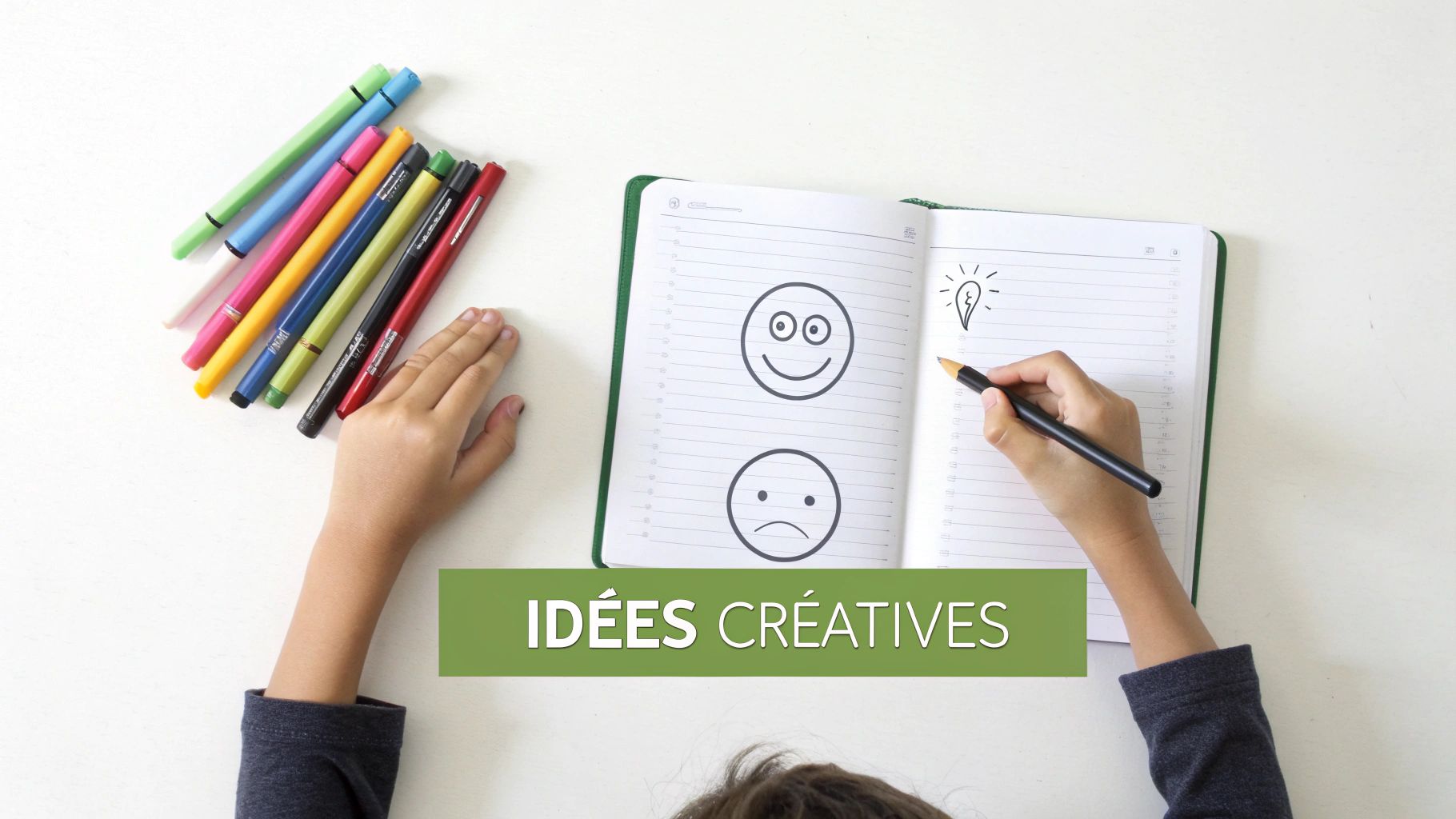
Some ideas to get the brainstorming machine going
To help your child get started, here's a little toolbox of ideas designed to be simple and fun. The goal is to show them that their journal or notebook can become anything they want it to be.
-
The emotions barometer: Suggest that they draw the "weather of their heart." A color can represent a mood: yellow for joy, blue for sadness, red for anger... They can then create a large, colorful cloud that tells how they feel, without even needing to write a single word.
-
The Three Words Game: Choose three words completely at random, like "dragon," "cake," and "star." Their mission, should they choose to accept it? Invent a short story, even just two or three sentences, that uses these three words. It's a fantastic exercise for unleashing the imagination while having fun.
-
The express gratitude journal: Every evening, he can write down or draw three small things that brought him joy during the day. It could be a hug, a delicious dessert, or playing a game with a friend. It's a simple habit that helps him see the good things in everyday life.
Moreover, this desire for more personal and creative materials reflects a broader trend. Families are looking for more than just writing tools; they want genuine means of expression that foster their children's well-being and creativity. You can learn more about this evolution in the stationery market .
The most important thing is to take the pressure off. Your child's notebook isn't a place where they have to perform, but a space for exploration. Every doodle, every list, every little story is already a victory.
How to turn your notebook into a real treasure
To take it a step further, you can encourage him to see his notebook as a kind of treasure chest. The goal is for him to fully own it and find pleasure in it every time he opens it.
A few more ideas:
- The explorer's notebook: During a walk in the forest or park, he can stick in a leaf he found pretty, draw a funny insect or note the sounds he heard.
- Wacky lists: Suggest that he make lists on themes that make him laugh: "My 5 favorite superpowers", "The 3 things that make me laugh the most" or "The list of all my favorite desserts".
- The dream box: He can dedicate a page to his dreams. He draws or writes down the ones he remembers, even the strangest and craziest ones.
Each of these prompts is an invitation to play with words and colors, without any rules. By varying the suggestions, you will help your child see that their notebook is an infinite world of possibilities, where they, and they alone, are the captain of the ship.
The notebook: a gift to build confidence
When you give your child a notebook and some pencils, you're giving them much more than just an object. It's actually a wonderful tool to help them discover themselves, put words to their emotions, and grow up with more confidence.
As we've seen throughout this guide, the idea isn't to turn your child into a future writer. The primary goal of journals and notebooks is to nurture their well-being, to give them a space of their own where they can express what's bubbling inside, without ever fearing judgment.
It's a very simple, yet incredibly powerful way to help him cultivate his confidence and creativity. He gradually understands that his thoughts are important, that his emotions are valid, and that he has the power to manage them.
Our final piece of advice to get you started
Take it easy. The key is not to strive for perfection, but simply to take that first step with joy and kindness.
Don't see this as just another task to add to your list. Think of it instead as a special moment, a little ritual that will strengthen your bond and offer your child a gift for life: self-knowledge.
Here's how to get started without any pressure:
- Choose the notebook together: Make this purchase a little adventure. Let your child choose the color, format, and design they like.
- Establish a simple first ritual: Ten minutes after dinner or before bed is perfect. The important thing is that it doesn't feel like a chore.
- And watch the magic happen: Be patient, encourage their efforts, even if it's just a few scribbles at first.
One day, these filled pages will become a priceless treasure. They will be a precious testimony to her inner world and a tangible memory of her childhood.
Do you have any questions? This way!
Embarking on the adventure of keeping a journal with your child often raises a few questions. That's perfectly normal! Let's untangle the most frequently asked questions together so that this experience can be a shared pleasure.
My child doesn't like to write, what should I do?
Above all, don't turn the notebook into a new school assignment. If writing is a block, the idea is to get around the obstacle creatively. What matters is the expression, not the method!
- Drawing is key: A picture is worth a thousand words, as they say. Suggest that they draw about their day, glue pictures cut from a magazine, or use stickers to express an emotion.
- Short lists: Sometimes, starting with a blank page is intimidating. Simple lists can help. "Three things that made me laugh today" or "My current favorite song" are great starting points.
- Lead by example: If your child sees you enjoying doodling in your own notebook, there's a good chance your enthusiasm will be contagious.
At what age can one start?
There isn't really an ideal age. The best indicator is your child's desire to tell stories, to share, even if they haven't yet mastered writing.
From the age of 6 or 7 , a "drawing journal" is a perfectly suitable starting point. Children can recount their adventures in pictures, without the pressure of words. The period between 8 and 12 years old is often a pivotal time: writing becomes easier, and the need for personal space to understand their emotions grows stronger. The best approach is to observe your child and suggest the idea at the right moment, without ever forcing it.
The golden rule is to respect their privacy. A diary is a personal safe. Reading it without their permission breaks a fundamental bond of trust.
From the very beginning, be very clear: his notebook is his own private world, and you will never look in it. If he decides on his own to share a passage with you, welcome this moment with gentle and non-judgmental listening. It is this sense of security that will give him the freedom to truly confide in it.
The My Book Story notebook was specifically designed to guide your child step by step. Thanks to its fun and positive activities, it makes writing a real game and helps your child gain confidence, page after page.
Discover the My Book Story notebook now!