


You may have heard of a gratitude journal, but what does it really mean for a child? It's quite simple: it's a notebook, a space of their own, where they can write, draw or just reflect on the little things that made their day better.
Think of it as her own treasure box of happy memories . It's a wonderful tool to help her, as a parent, cultivate her emotional well-being and give her the keys to better cope with the little everyday challenges.
What is a gratitude journal for a child?
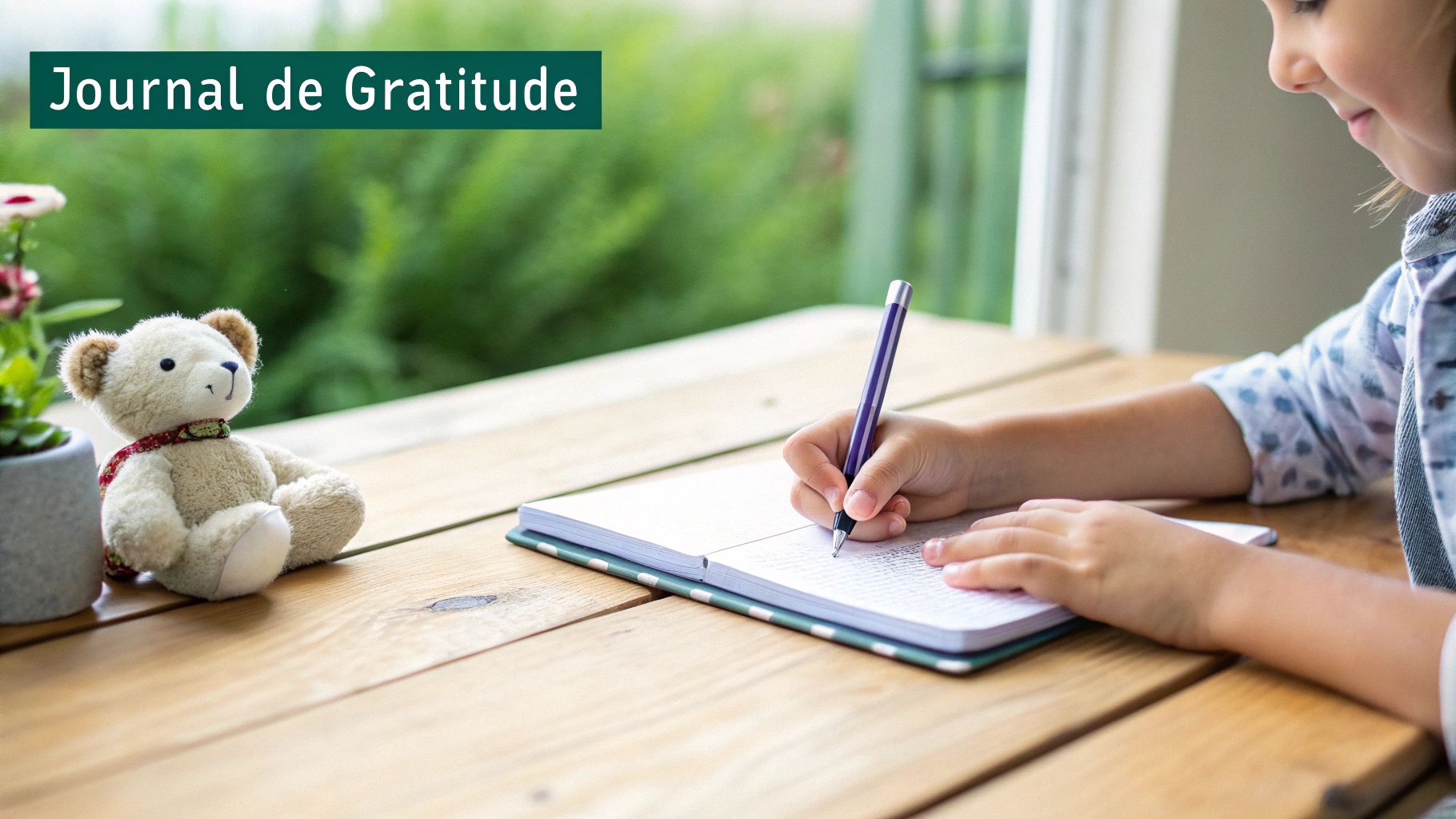
For a child between 6 and 12 years old , the idea of a gratitude journal might seem a little abstract at first. However, in practice, it's a very concrete and fun activity. Forget about homework! It's more about creating a warm little ritual, a special moment where your child feels safe to explore their feelings.
Imagine this journal not as just another notebook, but as a secret garden. Each day, your child plants a little seed of positivity in it. They write down what warmed their heart, what made them proud, or what comforted them.
No need for grand pronouncements. It can be as simple as the taste of their favorite cake, a big hug when coming home from school, or the joy of finally completing that complicated drawing.
A creative and personalized approach
What sets this journal apart from a traditional diary is its focus on the positive. The goal isn't to recount the entire day, but to extract the gems, the little bright moments.
And for a child, it goes far beyond words! Writing can take much more creative forms, adapted to their age and personality:
- The gratitude drawing: This is perfect for younger children or those who express themselves better with crayons. They can draw a person, an object, or a scene that brightened their day.
- The "little joys" list: Encourage your child to list three simple things. For example: "the sun warming my face" or "when I won the card game with Grandma".
- The thank-you jar: Here's a fun variation. Write your gratitudes on small slips of paper and place them in a jar. It's a real family treasure to rediscover later, on a slightly gloomy day!
Gratitude isn't about pretending difficulties don't exist. Rather, it's about learning to see the good even when everything isn't perfect. It's a true emotional skill, and like any skill, it can be learned and developed with practice.
By incorporating this small habit into your family routine, even just a few minutes a day, you're giving your child a wonderful tool for growth. It's a gentle and effective way to develop their emotional intelligence, boost their self-confidence, and build a solid foundation for their future well-being.
How gratitude transforms your child's brain
Practicing gratitude isn't just a matter of politeness. It's a real workout for your child's brain, a bit like a superpower that gets stronger every time they take a moment to appreciate the little things around them.
This simple habit helps create new connections in his brain, encouraging him to focus more naturally on the positive. By noting what he is grateful for, he trains his mind to actively seek out moments of joy, even when the day has been a little challenging.
A shield against stress and anxiety
Simply writing down or sharing three positive things before bed can work wonders. This little evening ritual helps calm the whirlwind of thoughts and chase away nighttime anxieties. The result? Your child's sleep is often much more restful.
By focusing on the positive moments of his day, he lowers his cortisol levels, the infamous stress hormone. It's a simple yet incredibly effective tool to help him bounce back better from everyday challenges, like a bad grade or a minor argument in the playground.
This mental exercise helps your child build what psychologists call a positive attention bias . Instead of dwelling on what's wrong, their brain gets used to noticing and appreciating small victories and moments of happiness.
Strengthening empathy and self-confidence
Gratitude doesn't just benefit oneself; it also opens the heart to others. By recognizing what they receive from others—a smile, a helping hand, a compliment—your child develops empathy. They learn to recognize kindness and how precious the people around them are.
Gratitude changes the way your child sees the world. They understand that their happiness doesn't depend solely on great achievements, but also on the richness of the little things in everyday life. This is the key to strong and lasting self-esteem.
This regular practice strengthens his sense of connection to others and the world. He realizes he is part of a support network, which fosters a sense of security and belonging essential for healthy development. Moreover, interest in these well-being tools is on the rise in France, particularly because studies show that approximately 25% of French people report suffering from anxiety disorders. Simple practices like gratitude journaling are increasingly seen as an effective preventative measure from a young age. To learn more about well-being in France, you can consult the statistics on the INSEE website .
Embarking on the adventure of newspaper publishing, gently

The idea of introducing a gratitude journal into your child's routine might seem wonderful, but it's crucial that it doesn't become just another chore. The goal is to create a pleasant little ritual, a moment of sharing that everyone looks forward to, not a task to add to an already busy schedule.
The trick is to keep things simple and flexible. There's no perfect method. The important thing is to find what works for you and your family, so that this moment becomes a true bubble of connection.
Finding the right time and the right place
Timing is key to making this new habit stick. For many families, the ideal time is in the evening, just before bedtime. It's a wonderful way to calm minds after a busy day and end on a positive note.
This little evening ritual helps to chase away minor anxieties and replace them with comforting memories, which is perfect for a good night's sleep. But if your evenings are already too busy, don't panic! Other times work just as well:
- In the morning at breakfast , to start the day off right.
- On returning from school , to discuss quietly what happened.
- During the evening meal , to make it a topic of conversation for the whole family.
Choose a quiet, comfortable spot where no one will disturb you. It could be on your child's bed, in a soft armchair, or even in a fort you've built with sheets in the living room!
What medium should you choose to motivate your child?
Choosing the right notebook is also super important to encourage your child to get started. A simple notebook will do, of course, but something a little more special can really make all the difference. Let your child choose a notebook they love, with their favorite color or favorite character.
A personalized book, where your child becomes the hero of their own story, is a truly fantastic way to motivate them. It transforms the exercise into a real adventure, making the experience much more personal and fun. The important thing is that the book itself inspires them to express themselves.
We're not looking for performance, but connection. The idea isn't to fill pages, but to create a safe space where your child feels free to share their emotions, knowing they will be listened to without being judged.
How do I start the conversation?
Sometimes, a blank page can be a little daunting. To help your child get started, ask them simple, open-ended questions that encourage them to think about their day in a fun way.
Here are some ideas to break the ice:
- "What's the funniest thing that happened to you today?"
- "Tell me something that made you smile."
- "Has anyone been particularly kind to you?"
- "What's the prettiest sound you've heard today?"
These simple questions help focus on the little joys of everyday life rather than big events. Remember: the most important thing is to keep this time light, fun, and centered on sharing. By cultivating this pressure-free atmosphere , the gratitude journal will become a true treasure for your child.
Keep the magic alive with creative ideas

So, the gratitude journal ritual is in place. Great! But the real challenge now is keeping that little flame burning brightly over time. To prevent this moment from becoming just another chore, it needs a little spice.
Think of the journal as a play area, a kind of secret hideaway where imagination has free rein. The goal isn't just to tick a box before bedtime, but to make your child look forward to that moment with genuine curiosity.
Simple questions to spark inspiration
Sometimes, all it takes is a little nudge to get things going again. The famous question, "What are you grateful for today?" can get a bit tiresome after a while. So why not try more targeted and fun questions, often called prompts ?
These little prompts guide your child's thinking towards details they wouldn't have thought of on their own.
Here are some ideas to liven up your routine:
- The five senses: What's the best thing you've tasted today? The prettiest sound you've heard?
- The outside world: Tell me about something you saw outside that made you smile (a rabbit-shaped cloud, a super colorful flower).
- People around you: Think of someone who has been kind to you. How could you tell them?
- Your achievements: What are you most proud of today, even if it's something small?
With these questions, the journal transforms into a treasure hunt for little joys. Your child learns that gratitude is truly hidden everywhere, in the smallest corners of their day.
Fun activities to add variety to the enjoyment
To take it a step further, you can suggest weekly themes or creative activities that go beyond simple writing. The idea is to make the journal a space for expression that grows and evolves with your child.
A gratitude journal is a bit like a personal treasure map. Each page is a new discovery that reveals to the child the richness of their world and their emotions.
Here are a few simple ideas to renew the experience:
- The Thank You Jar: Every day, your child writes a short note of gratitude on a colored piece of paper and puts it in a jar. It's very visual and incredibly satisfying to see the jar fill up! Once a month, you can pick out a few notes and read them together.
- Drawing happiness: For younger children or those with an artistic soul, drawing is a fantastic means of expression. Simply suggest that they draw the person or thing that brightened their day.
- The thank-you letter: Once a month, help him write or draw a small card to thank someone special (a grandparent, a friend, his teacher). It makes gratitude tangible and strengthens bonds.
Cultivating a positive mindset is a growing trend in France. According to an Ipsos survey, 73% of French people say they are happy, and many rely on rituals of appreciation to maintain this well-being. You can learn more about French happiness and their habits to find inspiration.
To help you adapt the activities, here are some suggestions depending on your child's age.
Gratitude activities adapted to your child's age
This table offers ideas for differentiated activities and 'prompts' for children aged 6-8 and 9-12 to maintain their engagement.
| Characteristic | For ages 6-8 | For ages 9-12 |
|---|---|---|
| Preferred format | Drawings, collages, very short sentences with the help of an adult. | More developed writing, lists, short paragraphs, simple poems. |
| Examples of prompts | "Draw the person who made you laugh the most today." "What is your favorite color and where did you see it today?" | "Think of a challenge you overcame. What did you learn about yourself?" "Describe a time when you felt completely at peace." |
| Creative activity | The thank you jar: Write a word on a colored piece of paper and put it in a jar. | The thank you card: Write a detailed letter to someone and mail it. |
| Level of reflection | Focused on concrete and sensory things (a good cake, a hug). | Ability to think about more abstract concepts (friendship, perseverance, luck). |
Adapting the content is key to ensuring that the gratitude journal remains a relevant and appreciated tool as your child grows and their worldview evolves.
Create a unique memory with a personalized book
What if we transformed the gratitude journal into a real adventure, far more memorable than a simple notebook? Imagine a book where your child isn't just a reader, but the hero of their own story. It changes everything.
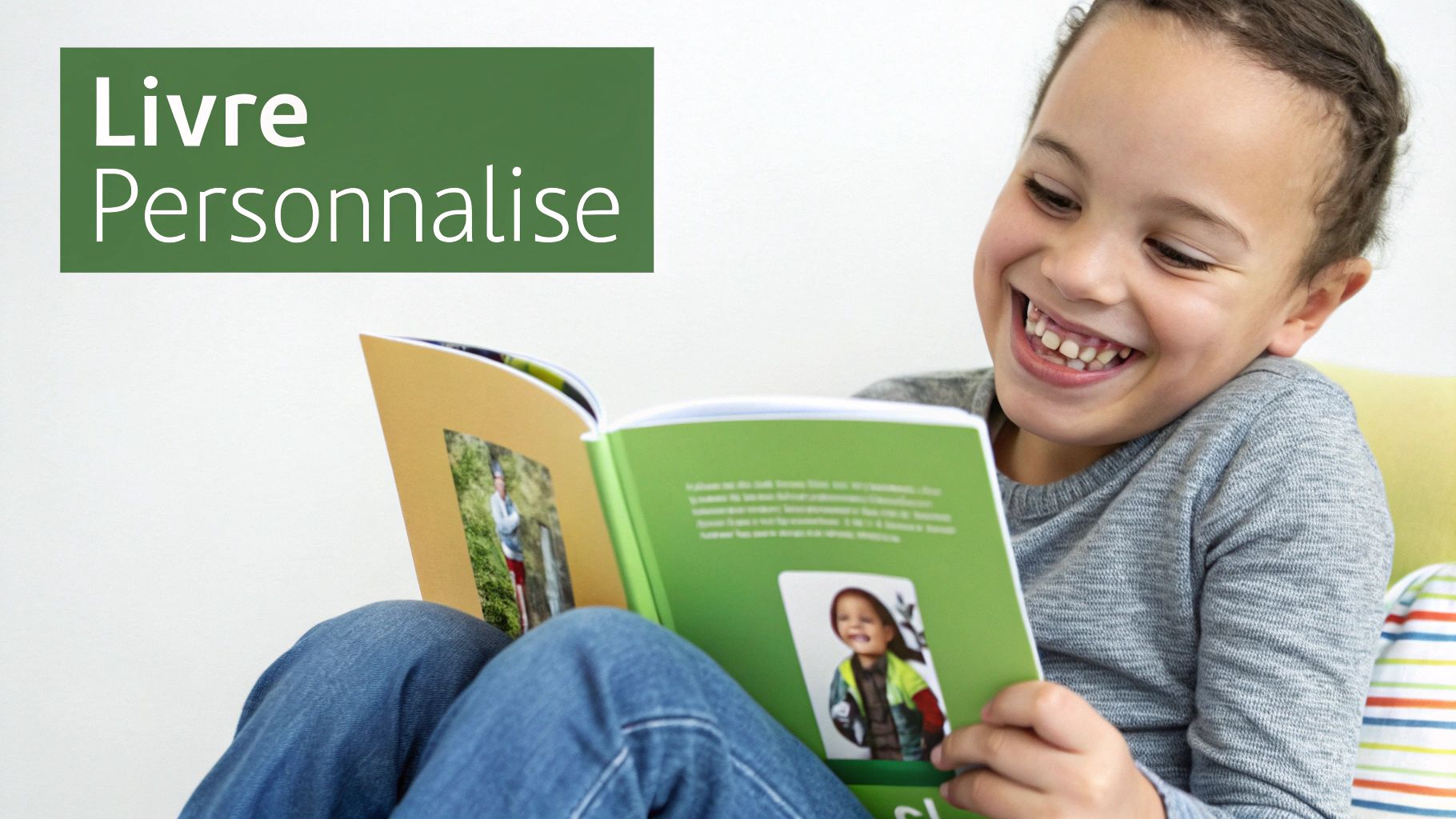
When a child sees themselves as the main character in a quest, their involvement takes off. It's no longer just an exercise to complete, but an exciting story they can't wait to continue, day after day.
The impact of personalization on child development
Personalization is key to capturing attention. A book like My Book Story incorporates elements that speak directly to your child. The experience then becomes deeply personal, and therefore much more engaging.
Rather than answering vague questions, he explores themes like resilience and curiosity through a journey that reflects his own experience. Gratitude then becomes a skill he truly embraces.
A personalized book is not just a keepsake, it's a treasure. It becomes a tangible testament to their development, a precious memory they can reread later to remember their progress and the little joys of their childhood.
Combining reading, creativity and personal development
This approach is brilliant because it blends several essential aspects for a child's development. It encourages introspection, of course, but also reading and creativity. Each page becomes a space for free expression: writing, drawing, dreaming.
This is how a personalized book tangibly enriches the experience:
- It boosts self-esteem. The child sees clearly that he is the protagonist of his own growth.
- It stimulates the imagination. Inspiring chapters invite the reader to explore and dream big.
- He creates a unique family ritual. It's a real moment of sharing around an object that truly belongs to him.
Ultimately, such a book isn't just for recording moments of gratitude. It helps your child build confidence, better understand their feelings, and cultivate an optimism that will stay with them throughout their life.
What if gratitude became a family affair?
For the benefits of a gratitude journal to truly take root and last, it's best not to leave it isolated in a corner. The secret is to make it a value shared by the whole family. Imagine a home where gratitude fills the air, creating a caring atmosphere where everyone feels truly seen and appreciated.
These small, everyday rituals, seemingly insignificant, become true emotional pillars. They show your children that gratitude isn't just a task to tick off in a notebook, but a way of being, of seeing the world, and of interacting with others. It's a gift for life that forges even stronger family bonds.
Simple rituals for a joyful home
No need to turn everything upside down! Incorporating gratitude into your family routine just requires a little motivation and creativity. Here are a few easy and fun ideas to try tonight:
-
The Little Joys Round Table: At dinner, instead of the classic "How was your day?", start a new ritual. Everyone shares one small thing that brought them joy today. It's a simple yet powerful way to reconnect after a busy day and steer the conversation toward the positive.
-
The Gratitude Wall: Set aside a small corner of the fridge or a corkboard. Whenever someone wants to say thank you for something, they write it on a colorful sticky note and display it. Watching this wall grow day after day is a real source of pride and joy for the whole family.
-
The "Thank You" Card Workshop: Once a month, get out the markers, stickers, and colored paper for a creative family session. Everyone makes a pretty card to thank a friend, a teacher, a neighbor, or even the mail carrier. This makes gratitude tangible and transforms it into a thoughtful gesture.
By making gratitude a daily conversation, you give your children the words to express their positive emotions and to see the good around them. It's no longer a chore, it's a reflex that comes from the heart.
This positive family dynamic has repercussions far beyond the home. By learning to recognize what others bring to their lives, children develop a sensitivity that can nurture future civic engagement. Moreover, this idea is supported by larger-scale initiatives. Some reflections on engagement in community projects demonstrate how these values, cultivated from a young age, are essential for strengthening social bonds. Ultimately, these small gestures at home are the seeds of a more active and caring citizenship.
Questions? We'll answer them!
Embarking on the adventure of a gratitude journal with your child is wonderful, but it's perfectly normal to have some questions along the way. Let's look at the most frequently asked questions together so that this time remains a pleasure.
What if my child doesn't want to write?
Ah, the famous "I don't feel like writing"... It's a classic, especially after a long day at school! The golden rule: never force it. The goal is to create a moment of sharing, not just another chore.
If a pen doesn't appeal to him, no worries. There are plenty of other ways to express himself:
- The drawing: "What if you drew what made you most happy today?" A picture is sometimes worth a thousand words.
- The discussion: Sometimes, just talking about it is already a huge step. Simply ask him the question and listen.
- The reporter game: Take out your phone and start the voice recorder. Ask them to tell you about their "fun" of the day as if they were a journalist.
The most important thing is to help him identify what made him happy, no matter what form it takes.
Do we have to do it every day?
Not at all! Regularity is good, but pressure is not. The idea is to create a gentle habit, not a stressful obligation.
To start, aim for two or three times a week . A quiet evening, the weekend... Choose the time that suits you best. You'll see, if the ritual is enjoyable, it's often the child themselves who will end up asking for it more often.
Remember: a journal filled with a smile twice a week is better than one filled with a sigh every night. Joy above all!
My child always writes the same thing, is that normal?
Yes, and it's very common! "I played with my friends," "Dinner was good"... Children have their little routines. To help them see gratitude in other ways, you just need to change the rules of the game a little.
Rekindle their curiosity with more specific questions or themes. For example, one week could focus on "sounds I like to hear" or another on "people who helped me this week." This will help them realize that little joys are hidden absolutely everywhere.
To support you and make this activity an even richer adventure, the My Book Story journal is a fantastic ally. With its fun activities and inspiring themes designed over 12 weeks , it guides your child step by step. It's the perfect little boost to transform this ritual into an unforgettable memory. Take a look to see how it can enrich your experience .