


We often hear about " quality time ." But what does it really mean? Far from being a complicated concept, it's quite simple: it means giving your child your full and undivided attention , without distractions.
Quality time isn't just about being physically in the same room. It's a moment when you choose to disconnect from everything else—phone, work, mental load—to truly connect with your child. Even if it's just for a few minutes.
What exactly does quality time with family look like?
Quality time is first and foremost an emotional investment. Think of it like watering a plant: you can leave it in the rain (it's better than nothing), or you can take the time to give it exactly the water it needs, with care. Being present but distracted is like the rain. Quality time is targeted watering, the kind that nourishes deeply.
The key idea is that the value of this moment is not measured in hours, but in the depth of connection . It's that precise moment when your child feels they are the most important person in your eyes.
The difference between being there and being truly there
You can spend an entire evening next to your child on the sofa without truly sharing a moment together. There's a world of difference between mere physical presence and genuine connection. That's the key difference between shared time and quality time.
To make things clearer, here's a small comparison table:
| Appearance | Shared time (Passive presence) | Quality Time (Active Connection) |
|---|---|---|
| Attention | Divided, often on a screen or elsewhere | 100% focused on the child and the activity |
| Communication | Superficial, closed-ended questions ("How was school?") | Active listening, dialogue, open questions |
| Emotions | Distant, little emotional sharing | Authentic sharing of feelings, empathy |
| Objective | "To make an appearance" | To create a connection, to share an experience, to understand each other |
| Example | Watching TV together, each absorbed in their own screen | Building a Lego castle together, laughing and collaborating |
This painting clearly shows that magic happens when we shift from simple presence to intentional and active connection.
The real secret to quality time isn't planning extraordinary outings. It's transforming everyday moments into precious memories, simply through the power of your attention.
This image perfectly illustrates the difference between spending time next to each other and spending time with each other.
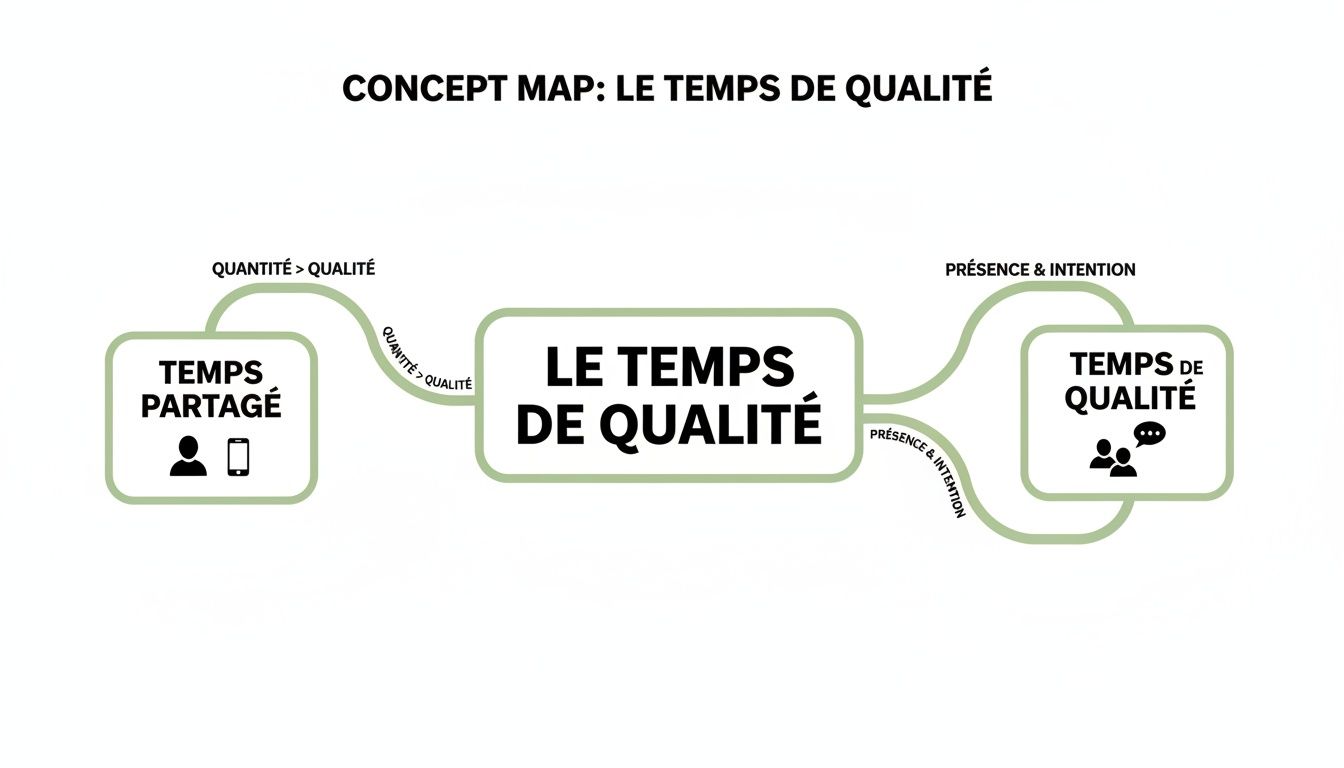
It's clear that quality takes precedence over quantity. It's this attentive presence that builds a strong and lasting bond.
This approach aligns with the core principles of positive parenting , which emphasizes understanding and strengthening relationships to foster harmonious development. These moments of mindfulness build the emotional security, creativity, and self-confidence your child needs to thrive.
What are the benefits of quality time for your child?

Investing quality time with your child aged 6 to 12 is one of the greatest gifts you can give them. These moments aren't just fun times; they are the true foundation of their well-being and development.
Every time your child feels that you are truly there for them, they receive a very powerful message: "I am important, what I think and feel has value." This is how, little by little, solid self-esteem is built.
A foundation of trust and emotional security
When a child regularly shares special moments with their parents, they feel safe. They know they have a safe haven, a refuge they can rely on, whether it's to celebrate a good grade or to dry their tears after a disappointment.
This deep connection gives him the courage to explore the world and take risks. He knows he has a safety net. That famous resilience, that ability to get back up after a setback, draws its strength directly from this feeling of being unconditionally supported.
- Easier communication : These moments create a bubble of trust where your child dares to open up without fear of being judged.
- Better emotional management : By talking with you, he learns to put words to his inner storms, a crucial first step in learning to manage them.
- More self-confidence : Feeling listened to and valued convinces him that he has value, quite simply.
Quality time is a bit like an emotional shield. It won't prevent life's hardships, but it will give your child the tools to cope better with them.
A playground for creativity and life skills
But that's not all! Beyond the emotional aspect, quality time is a fantastic driver of learning. Whether you're building a fort, inventing a whimsical story, or baking a cake, every shared activity is a life lesson in disguise.
These moments stimulate his natural curiosity and his ability to find solutions. He learns to cooperate, to let his imagination run wild, and not to give up at the first obstacle.
Moreover, family well-being is an essential component of happiness. Life satisfaction is a key indicator for families seeking to create a nurturing environment for their children. A tool like a journal dedicated to expressing emotions, such as My Book Story , can contribute to this. It helps children identify and express their feelings in a fun and structured way, thus promoting their long-term well-being. To learn more, you can consult the quality of life indicators on the INSEE website .
By viewing quality time as a moment of exchange and creation, you offer your child much more than a simple memory: you pass on skills that will stay with them throughout their life.
Finding one's place in a minister's agenda
Between work, running the household, and a thousand other things to remember, the very idea of finding time for "quality moments" can quickly seem like an insurmountable challenge. We tell ourselves it's impossible. But the secret isn't to invent 30-hour days. It's to rediscover the value of the minutes we already have.
The idea is to focus on the intensity of the connection , not the duration. Believe me, five minutes of genuine, undivided attention are worth far more than an hour spent together with your mind elsewhere. It's simply about transforming small, everyday moments into those that truly matter.
How to turn constraints into opportunities?
Instead of seeing your schedule as an enemy, see it as a playground. The goal isn't to add another "quality time" item to your to-do list, but to change your perspective on what's already there.
Here are a few simple suggestions to try:
- The "weather check-in": When you get home from school, take 5 minutes to ask them about their "inner weather." Sun? Clouds? Storm on the way? It's a super fun and indirect way to open the door to their emotions of the day.
- Chores done together: Folding laundry or preparing dinner can become fun. Put on some music, set each other little challenges... and voilà, the tedious task transforms into a moment of connection.
- The screen-free evening ritual: Put away tablets and phones for 10 minutes of reading together, a short chat about the day's dreams, or just a big, silent cuddle. This little moment of calm just before bed is a super important anchor of security for them.
Working from home, in particular, has turned everything upside down, sometimes blurring the lines between work and personal life. For us parents, it has become vital to know how to disconnect from screens in order to better reconnect with each other. A tool like the My Book Story journal can help structure these moments, providing a pretext for talking about emotions together and understanding each other better. To delve deeper into the subject, you can read this article on quality of life while working from home .
The real challenge isn't finding time. It's protecting our attention during the time we have. It's an active choice, at every moment.
Create reassuring rituals
Family rituals, even the smallest ones, are true guiding lights in a child's life. They provide a predictable and stable framework that is incredibly reassuring, especially between the ages of 6 and 12, an age when everything changes so quickly for them.
And no, planning these moments doesn't kill spontaneity! On the contrary, it ensures they have a cozy place in the whirlwind of the week. To help you free up time and mental space, good time management software can make a real difference. By optimizing your office hours, you simply gain more availability for your family.
The important thing is to find what works for your family, without putting pressure on yourself. The special Saturday breakfast, the Wednesday walk after dinner, the Friday "games night"... These simple little rituals are the memories your child will cherish for a lifetime.
Activity ideas to nurture your connection
Feeling uninspired? It happens to everyone. Defining quality time is one thing. Putting it into practice amidst the daily whirlwind is quite another. So, to help you out, here's a treasure trove of concrete ideas, designed to fit even the busiest schedules and the needs of your children.
Just keep in mind that the goal isn't to embark on complicated projects. No, the idea is to share an authentic moment. Often, it's the simplest things that create the strongest memories.
Micro-adventures for weeknights
Even when time flies, you can always find 15 minutes to truly connect. These little rituals, slipped into the evening routine, forge strong bonds without adding pressure.
- Dinnertime creative challenge: While you eat, ask your child to tell you the story they read at school. Your mission? To invent a completely wacky ending together!
- The express card game: A quick game of Uno or War just before brushing your teeth, and presto, you unwind the little tensions of the day with a burst of laughter.
- The duo in the kitchen: Preparing the afternoon snack or lunch box for the next day together is a great way to collaborate and entrust them with small responsibilities.
Of course, the weather sometimes throws a wrench in the works. Weather events remind us that outdoor activities are not always guaranteed, as can be seen in the weather reports from Météo-France .
On rainy or sweltering days, a tool like the My Book Story journal becomes a precious ally. It offers a creative haven indoors, where your child can draw, write, and express their emotions. A day spent indoors then transforms into a wonderful opportunity to reconnect and share.
Longer projects for the weekend
When the clock isn't so tight, you can embark on slightly more elaborate adventures. The kind that stimulate creativity and teamwork, and leave lasting memories.
A weekend isn't meant to be filled, but to be lived. A single activity, shared with genuine presence, can recharge the emotional batteries of the whole family for the week ahead.
Here are some ideas to transform an ordinary afternoon into a magical moment:
- Build an epic fort. Sheets, cushions, clothespins... We're bringing out the big guns to build the most incredible fortress in the living room!
- Organize a treasure hunt. Hide a small "treasure" (a book, a nice treat) and imagine some simple riddles to find it in the house or garden.
- Create a puppet show. Take some old socks, draw faces on them, and together invent a completely wacky play. Perfect for sparking the imagination!
Each of these ideas, whether it takes five minutes or an hour, is an opportunity to strengthen your bond. Ultimately, it doesn't matter what you do. The important thing is to do it together , with full and undivided attention.
Give structure to your rituals with a shared journal

No matter how well-intentioned we are, the whirlwind of daily life often sweeps us away. That's where a simple tool can work wonders by giving concrete form to your quality time. A shared journal, for example, becomes much more than just a notebook: it's a true bridge between you and your child.
Imagine this little ritual at the end of the day. Instead of asking vague questions, you sit side by side, the My Book Story journal open between you. It's no longer an interrogation, but a genuine moment of sharing, guided and fun.
Make journaling a ritual of connection
The My Book Story journal is specifically designed to gently initiate conversation. Each day, it invites your child to put words to their inner world, providing a perfect opportunity for you to connect.
This simple gesture can transform into a truly powerful ritual. It serves as a pretext to talk about subjects that might otherwise remain swept under the rug.
The journal is not an end in itself, but a starting point. It gives your child permission to express themselves and you the opportunity to listen without judgment. In this way, you create a safe space where deeper conversations can emerge.
When your child circles an emotion they felt during the day or notes a small moment of happiness, they're not just doing an exercise. They're offering you an opening, inviting you into their world to better understand what they're going through. That's the essence of a successful quality time together.
Unleash your creativity together
Beyond emotions, creativity is an incredible way to build rapport. The drawing or free writing pages in a journal are a great opportunity to create something together.
Far from being a solitary assignment, this page can become your shared playground. The important thing is not the final result, but the experience you share.
Here are some ideas for using the creative page and spicing up your quality time :
- Drawing together: Start a drawing, then let your child continue it, and so on. The visual story you create will be unique, and most importantly, it will be yours.
- Storytelling with four hands: One of you writes the first sentence of a story, then passes the pen to the other to finish it. Guaranteed laughs!
- The little artistic challenge: Choose a theme, such as "draw your wildest dream", and everyone draws their version on the same page.
By using this medium, the journal is no longer just an object. It becomes the heart of your rituals, the one that structures your exchanges and nourishes your bond, day after day.
Mistakes to avoid for successful quality time

Even with the best intentions, our shared moments can sometimes become a source of stress, for us as well as for our children. This is often due to a few deeply ingrained habits. Becoming aware of them is already a big step towards avoiding them and ensuring that this precious time truly bears fruit.
The most common pitfall? Trying too hard. We imagine that quality time has to be spectacular: an incredible outing, a super complex board game, an activity that's out of the ordinary. As a result, we put enormous pressure on ourselves and miss what's truly important.
Quality time isn't about performance, it's about presence. A simple chat about the day, a fit of laughter while preparing a meal, or a story read aloud together, is worth more than all the organized outings in the world.
The other major enemy of connectivity is, of course, digital distraction. That phone lying around on the table, even on silent mode, is an invitation to escape. One glance at a notification, and poof, the little bubble you were creating has just burst.
Beware of hidden intentions
A crucial point is to keep these moments authentic. Sometimes, without even realizing it, we disguise this shared time as a lesson or an interrogation. We want to know, correct, teach. The child senses this immediately and is likely to become defensive. The idea isn't to give them a test, but simply to be with them.
To ensure these moments are truly successful, here are a few mistakes to watch out for:
- Turn the moment into a lesson: Let go of the urge to correct their behavior or teach them something at all costs. The goal is sharing, not pedagogy.
- Ask lots of questions: Instead of bombarding him with "So, how was school?", start by telling him a little something about your own day. This will open the door for him to share his own, without feeling pressured.
- Keep distractions out of reach: The simplest and most powerful gesture? Put your phone in another room. This shows it that, during this time, it is your one and only priority .
By simply paying attention to these small details, you create a reassuring environment. A space where your child will truly feel free to be themselves, without judgment. That's where the magic happens and your bond is strengthened for good.
The questions you ask yourself about quality time
Even with the best intentions, we often encounter very practical questions when trying to implement those coveted quality time moments. Let's untangle the most common questions together to help you move forward with confidence.
How much time should be devoted to it each day?
Forget the stopwatch. This isn't a race, it's a date. Consistency and intention matter far more than duration. Believe it or not, fifteen minutes of complete and sincere attention each day can be far more beneficial than an hour spent together where everyone's mind is elsewhere.
The idea is to sprinkle these little moments into your daily life, like chatting for 10 minutes after school. Then, try to block out one or two longer periods during the week for an activity you really enjoy.
What if my child doesn't seem motivated?
Above all, don't force anything. Quality time is an invitation, never an obligation. The best thing to do? Genuinely engage with what captivates him, right now.
The goal is not to do an activity for your child, but rather with them. Sometimes, simply sitting quietly beside them while they draw or play with Legos is the greatest act of attention you can offer.
By entering her world without trying to impose your own, you simply show her that you are there, available and without judgment.
What do you do when you have several children?
It's all about finding the right balance between spending time together as a family and one-on-one time. The secret is to alternate between the two intelligently.
- Tribal moments: A board game night, a bike ride or preparing dinner as a team… These activities strengthen family spirit and create shared memories.
- One-on-one time: Try to set aside small periods of time just for one child. Even 10 minutes of reading together before bed is enough to make them feel unique and special to you.
Give your child their own space to express their emotions and build their confidence. The My Book Story journal was designed to transform each day into a new opportunity for sharing and creativity. Discover how this tool can enrich your family rituals .