


Keeping a journal is more than just an activity; it's a powerful tool to help children aged 6 to 12 grow. As a parent, you're looking for ways to support their emotional well-being , build their self-confidence , and nurture their creativity. Journaling is a simple and effective way to lay a solid foundation for their future development.
Why journaling is an essential adventure for your child
Imagine a secret garden, a space just for your child. A place where they can explore their thoughts, untangle sometimes complicated emotions like anger or sadness, and celebrate their small victories, without any pressure. That's exactly what journaling is.
Much more than a simple writing assignment, it is a conversation with oneself, a true inner adventure that promotes personal growth .
For children aged 6 to 12 , this period is a whirlwind of new experiences: school, friendships, self-discovery. Journaling then becomes a precious companion, a family ritual that helps them navigate these years of great change.
The 3 superpowers of journaling for child development
Keeping a journal is a bit like giving your child superpowers to help them grow up well. This practice rests on three fundamental pillars that transform simple pages into a true tool for personal development .
- The power to tame emotions: Putting words or drawings to a feeling helps the child understand it and gain perspective. This teaches them to manage their feelings without being overwhelmed, a key skill for their emotional intelligence .
- The power of boundless imagination: A blank page is an invitation to create, without rules or constraints. Your child can let their imagination soar, invent stories, draw fantastical worlds, or simply scribble down their dreams, far from screens.
- The power of self-belief: As the days go by, the journal becomes a record of her successes and strengths. Rereading her accomplishments, even the smallest ones, reminds her of her worth and builds a solid and lasting self-confidence .
This mind map perfectly illustrates how journaling creates a virtuous circle between emotions, confidence, and creativity.
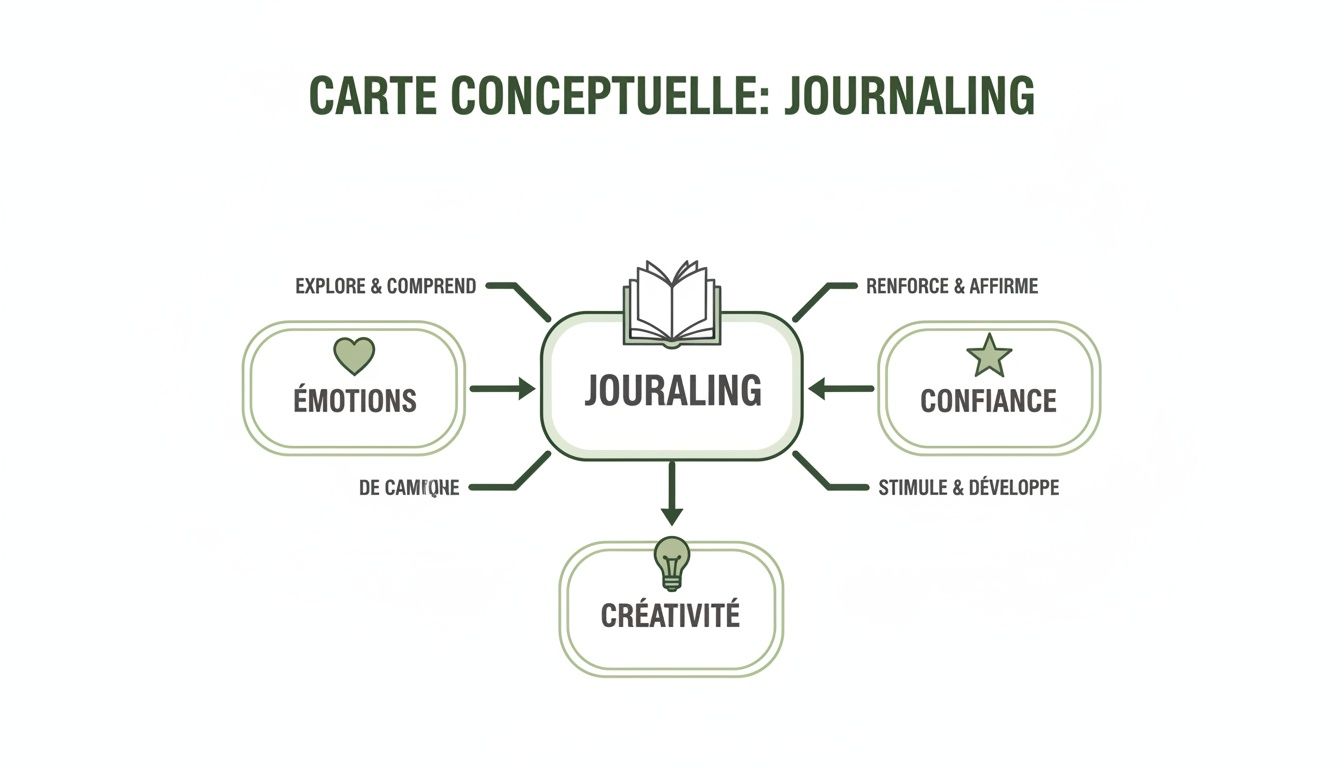
It is clear that these three areas are not isolated. On the contrary, they feed off each other through this regular practice.
By making introspection a creative game, journaling gives your child the tools to flourish. The goal isn't perfect writing, but simply to offer them a space to be themselves.
Developing your child's emotional intelligence
Emotional intelligence is the ability to recognize, understand, and manage one's own emotions. For a child between the ages of 6 and 12, the inner world often resembles unpredictable weather. A journal then becomes a kind of personal barometer, helping them to put a name to what they are experiencing.

By putting words or drawings to what he feels, your child makes the emotion concrete. Simply naming a feeling is already a first step towards understanding it. This creates a small distance that is often enough to lessen its intensity and prevent tantrums.
This habit, integrated as a family ritual , gradually builds the foundations of resilience. A child who learns to identify their sadness or frustration will find it easier to find solutions to feel better. This is a valuable skill for their personal development .
Turning introspection into a game: tips for parents
For this practice to work, it must remain enjoyable. It's not a school assignment, but a time for exploration. As a parent, your role is to transform this time of introspection into a game, with fun questions that stimulate their curiosity.
Here are some examples of activities to do with your child :
- Inner weather: "What's the weather like in your heart today? Bright sunshine of joy, a storm of anger, or clouds of sadness? Draw it!"
- Drawing emotions: "If joy had a face, what would it look like? And boredom? Draw them together."
- The anger thermometer: "On a scale of 1 to 10, how angry are you? Color the thermometer to show. What could bring the temperature down?"
These simple questions open the door to deeper discussions, without ever seeming intimidating. They give your child a creative and personal way to express feelings that are sometimes complicated.
By learning to decode their own emotions, your child develops a key skill: knowing how to clearly communicate what they feel. This is a major asset for their well-being and for the quality of their family and friendships.
The journal thus becomes a safe space where he can practice being honest with himself. He discovers that there are no "good" or "bad" emotions. They all have their place and something to tell him.
For example, after an argument at school, writing or drawing about their sadness can help them understand why they feel hurt. This awareness is the first step toward finding a solution to the conflict.
Building self-confidence, page by page
How can a simple notebook help your child build self-confidence ? It's simple: their journal becomes their own mirror. A mirror that reflects a positive image of themselves, highlighting their qualities, efforts, and successes.
In his notebook, every little victory counts. He becomes the hero of his own story. It's a space of his own, safe from comparisons and academic pressure.
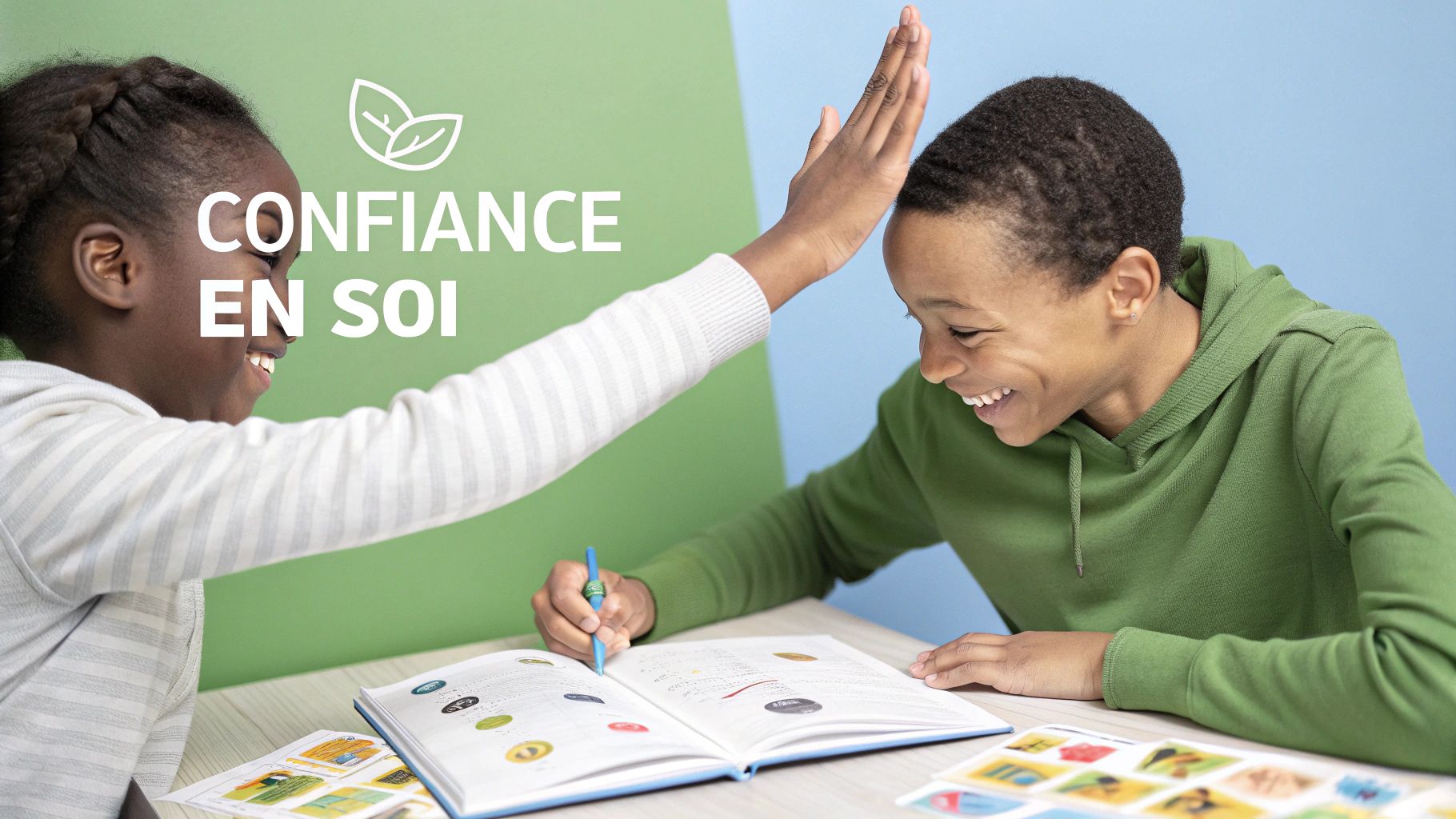
Imagine if, every day, he took the time to write down one thing he was proud of. Little by little, he would build up a veritable collection of his strengths. And on days when he doubted himself, he could simply flip through those pages to remind himself what he was capable of.
Studies on child development show that regularly keeping a gratitude or success journal visibly improves self-esteem. Visualizing one's achievements fosters a lasting sense of competence.
Establish a family ritual to celebrate successes
For this to work, it shouldn't feel like a chore. The secret is to make it a simple and fun habit, a little family ritual . The idea is to focus on the positive and value the effort, not just the results.
Here are some practical tips for parents :
- The Pride Jar: Every evening, your child writes down something they are proud of on a small piece of paper (an effort at school, a kind gesture, etc.) and puts it in a jar. On the weekend, you read these little notes together. It's a wonderful moment of sharing and celebration!
- The "My Superpowers" page: Suggest that he dedicate a page of his notebook to his qualities. Is he a loyal friend? A LEGO champion? A joke pro? Help him identify his strengths and name them.
- The week's positive summary: Take 10 minutes on Friday evening to look through his newspaper with him. Ask him to show you a drawing or a sentence that represents a good moment from his week.
These little rituals teach him to recognize his own worth. And beyond writing, there are plenty of simple tools to boost a child's self-confidence and help him thrive.
By putting their successes and qualities down on paper, your child is doing more than just filling pages. They are building a reserve of confidence, proof of what they are capable of. It's a treasure they will keep throughout their life to face challenges with greater composure.
Cultivating one's creativity, away from screens
In a world where screens are omnipresent, providing a space for free expression is essential for a child's development . Keeping a journal is a wonderful creative and personal alternative, a playground for their imagination.
A simple blank page, without notifications or apps, is a true invitation to create. No rules, no judgment. This is where creative thinking awakens and your child can transform their ideas into drawings, stories, or wacky inventions.

The benefits of these "disconnected" activities for cognitive development are very real. Excessive screen time can limit attention span and divergent thinking, as highlighted by several studies, including the one mentioned by Nice-Matin. Journaling offers a necessary break, stimulating different areas of the brain than those activated by screens.
Small challenges to spark the imagination
To help your child get started, turn this moment into a game. Creative challenges are perfect for overcoming writer's block and unleashing their imagination.
The idea isn't to strive for perfection, but to have fun exploring. As a parent, you can present these challenges as games.
Here are some fun examples to get you started:
- Unlikely dialogue: "Imagine your cuddly toy could talk to the moon. What would they say to each other? Draw their conversation in speech bubbles."
- The magic invention: "Draw a machine that transforms vegetables into candy. How does it work?"
- The Secret World: "If there were a secret door under your bed, where would it lead? Describe or draw this hidden world."
- The life of an object: "If your sneakers could talk, what adventure would they tell today?"
These simple exercises show that journaling is much more than just writing. It's a gateway to creativity .
The newspaper becomes a true laboratory of ideas. Children learn to think differently and cultivate their curiosity. It is in this space of freedom that they forge the creative skills that will accompany them throughout their lives.
How to integrate journaling into your family routine
Introducing a new habit into daily family life may seem complicated. But integrating a journal into your family life is above all about creating a small ritual of connection , a moment of shared calm.
The key is finding the right moment, one that fits naturally into your day. For some families, it's perfect right after snack time. For others, the ideal moment is just before bedtime stories, to let go of the day's thoughts and unwind.
The environment also matters a lot. A small, cozy corner is more than enough.
Creating an inviting space: our tips
To help your child make this moment special, prepare a small box with all the necessary materials within easy reach.
- A variety of materials: Coloured pencils, markers, stickers, and why not old magazines for collage? Show that all forms of expression are welcome.
- An attractive notebook: A guided journal with colorful pages and activities is often more inviting than a simple white notebook.
- A soft atmosphere: A large cushion on the floor, a small lamp... A few details can transform these few minutes into a real bubble of well-being.
Your involvement is paramount. Take a notebook and sit beside your child. This shows them that this moment is precious to you too. Your mere presence is the most powerful encouragement. It's a family ritual that strengthens bonds.
Consistency, not perfection
The effectiveness of a newspaper is not measured by the number of pages filled, but by its regularity.
Set a simple and realistic goal: 5 to 10 minutes a day , a few times a week, is enough. This small amount of consistency is much more beneficial than one long session once a month.
If your child isn't very motivated at first, don't force them. Simply suggest they draw a picture of their mood or stick on a sticker. The goal is to make their journal a friend. With a little time and without pressure, you'll see that the journal will become a much-anticipated ritual, a cherished moment of pause and family connection .
We answer your questions about the children's newspaper
As a parent, you surely have questions. It's normal to want to ensure the experience will be positive for your child's development . Let's address the most common concerns together.
How to get started in practice?
The idea of starting a new routine can seem daunting. Rest assured, it's simpler than it looks.
At what age can my child really start?
The ideal age is around 6 , when children start to feel comfortable with writing. But there's no hard and fast rule. A younger child who loves to draw can have their own "scribble book," a wonderful form of personal expression. The important thing is to give them a way to express what they feel, whether through drawing, collage, or a few words.
What if he doesn't like writing at all?
This is a common fear among parents! The good news is that a journal isn't an essay. The goal is self-expression, not perfect spelling.
The goal is not to create a masterpiece, but to offer a safe space where emotions can take shape. A drawing, a collage, or even a simple sticker can say far more than a long paragraph.
Feel free to suggest other creative avenues to him/her:
- Drawing: It is the universal language of childhood.
- Collage: Suggest that he/she cut out images from old magazines to create a "mood page".
- The lists: "Three things that made me smile today", "One thing I learned".
Respecting one's private garden
Trust is the foundation of everything. For your child to feel free and safe, it is crucial to respect their privacy from the start.
Can I read his diary?
The answer is simple: no , unless he invites you to. This journal is his own world. Explain clearly from the start that this notebook is his private space and that no one will read it without his permission. It's a fundamental lesson in respecting privacy.
You can, of course, invite him to share a drawing he's proud of. This openness, initiated by him, will strengthen your bond and your connection.
What is the difference between this and a traditional diary?
For a child, a completely blank page can be intimidating. The fear of not knowing what to say is a real obstacle.
A guided journal, like My Book Story , provides a reassuring structure. It poses questions, suggests themes, and offers creative activities that stimulate reflection without ever imposing it. It's a springboard: there's a framework to launch into, but the freedom to jump as you wish. The experience immediately becomes more playful and accessible, fostering the child's personal growth .
Give your child a companion to explore their inner world. The My Book Story journal is designed to guide 6-12 year olds on this adventure, transforming journaling into a creative and fulfilling game.
Discover the My Book Story notebook and start your adventure today!