Your Life, Your Drawing: Help your child become the creator of their own life
Share
What if we saw life as a blank page, a creative project where your child is the hero of their own story? That's the idea behind the "your life, your design" approach. We're not talking about career plans for 8-year-olds, but rather giving them the tools to explore their passions, sketch their dreams, and build, step by step, a life that truly reflects who they are.
It's a way to transform the small and large challenges of daily life into opportunities to develop self-confidence and creativity.
Becoming your child's guide in shaping their life
As a parent, your role isn't to draw the map for them, but to provide a compass. You're there to guide them, encourage them, and create an environment where they feel safe to explore. The "your life, your design" philosophy is based on this parent-child partnership. You create a nurturing space and provide them with tools, like the My Book Story creative journal, so they can discover, without fear, who they are and what inspires them.
This approach is particularly powerful for children aged 6-12 . It's a pivotal age, a time when personality, self-confidence, and worldview are being developed. By introducing them to this way of thinking now, you're giving them a solid foundation for their future well-being.
The tangible benefits for child development
When a child sees themselves as the "designer" of their life, they develop emotional and creative skills that will serve them forever. They no longer passively experience events; they learn to interact with them.
In practical terms, what does this change for him?
Increased self-confidence. By realizing that he can influence his path, he feels more capable and bolder in the face of new challenges.
Better management of emotions. This process invites him to observe what he feels and to put words or colors to his emotions, a key step in developing his emotional intelligence.
Greater resilience in the face of difficulties. A "mistake" is no longer a failure, but a learning experience. This perspective changes everything and helps him recover more quickly after a disappointment.
Creativity and problem-solving skills. Designing one's life is a game! Your child learns to imagine different scenarios and think outside the box to solve everyday problems.
This chart summarizes the fundamental concepts to help your child build their vision of life.
The 4 pillars of the 'Your life your design' approach for parents
Pillar
Goal for the child
Example of a parent-child activity
Curiosity
To open oneself up to the world, to explore one's interests without judgment.
Visiting a museum with an unexpected theme, trying a new cooking recipe together.
Experimentation
Dare to try new things, prototype your ideas.
Create a "crazy ideas box" where you write down everything you would like to try, even the impossible.
Collaboration
Learning to ask for help and to be inspired by others.
Working on a creative project as a family, such as building a cabin or writing a story together.
Adaptation
Understand that plans can change and that this is normal.
Talk about your own career changes and how you adapted to them.
By integrating these four pillars into your daily life, you foster a positive and proactive mindset in your child.
The "your life your design" approach is not a rigid method. It is above all an invitation to a journey, an exploration where the path taken is as important as the final destination.
Ultimately, this philosophy changes the family dynamic. It creates a home where dreaming is allowed, where trying is valued, and where everyone feels capable of forging their own path, at their own pace.
Helping your child explore what they are passionate about
Every child is a little world filled with hidden curiosities and talents, just waiting for the spark to ignite. Your role as a parent is to provide those sparks. Not by laying out a single path for them, but by showing them all the possible paths available. This is precisely where the "your life your design" approach begins: with the joyful exploration of what makes your child tick.
The goal isn't to find "the" passion that will define his entire life. Rather, the idea is to help him identify the activities that nourish him, energize him, and make him feel good. It's by becoming aware of these moments that he gradually builds a solid confidence in his own tastes and abilities.
Forget the classic questions
Asking an 8-year-old, "What do you want to be when you grow up?" can be really intimidating. To help them connect with what they truly love, it's best to use more creative and playful approaches. Introspection then becomes a fun game.
Here are some practical tips for parents:
The Sparks Journal : Suggest that your child write down or draw a moment each day when they felt incredibly happy, proud, or completely absorbed in what they were doing. After a few weeks, look together at what comes up most often. This is very revealing of their sources of positive energy.
The Treasure Map of Talents : Take a large sheet of paper and draw your child in the middle. All around it, create "islands" for each thing they love to do or have a natural talent for. There could be the Island of Kindness, the Mountain of Perseverance, or the Forest of Imagination. This helps them visualize their strengths as real treasures.
These simple tools help to highlight qualities that aren't necessarily "academic," such as empathy, curiosity, or the ability to make others laugh. And yet, these are fundamental to a child's development.
Create a space to dream, without any judgment
For a child to dare to share their dreams, even the wildest ones, they must feel completely safe. Your attentive listening and kind curiosity are your best tools as a parent.
When your child tells you about an idea, resist the temptation to judge it or immediately bring it back down to earth. If your 7-year-old son tells you he wants to become a "time machine inventor," don't tell him it's impossible. Instead, ask him, "That's a great idea! What would your first time machine be like? And where would you go first?"
The important thing isn't whether the dream is achievable, but rather to value the creative drive behind it. It's by exploring these limitless ideas that your child learns to trust their imagination—a key skill for designing their own life.
By asking questions with genuine interest, you show them that their ideas have value. You nurture their ability to think differently. This exploration is at the heart of the "your life, your design" philosophy, where every idea is a possibility to be discovered.
Building a life vision with a creative journal
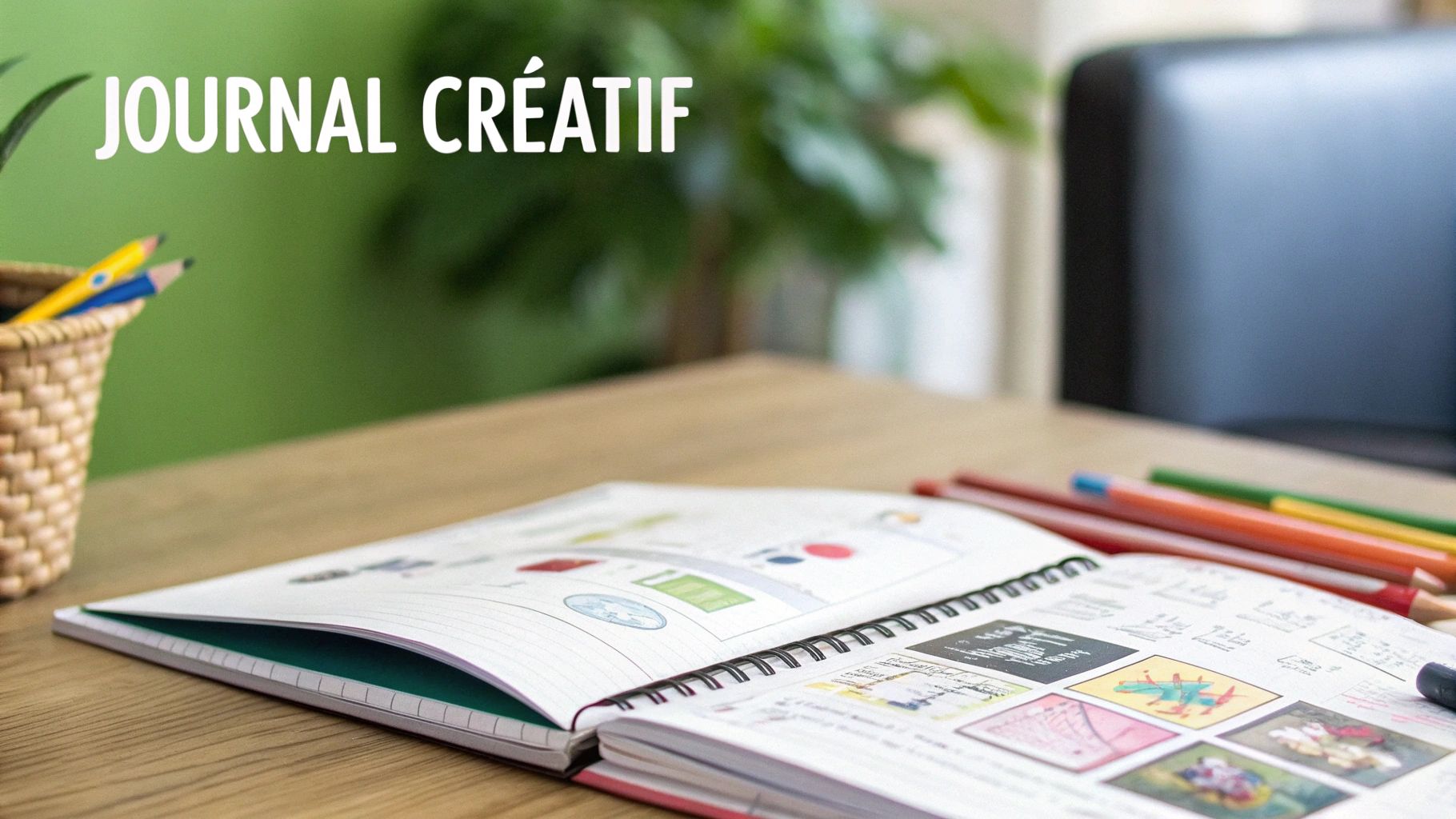
Once your child begins to identify what inspires them, they need a space to explore those ideas. A creative journal is much more than just a notebook. It's a true workshop for imagining the future, a haven where they can sketch the outlines of their dreams without fear.
This is where the heart of the your life your design approach lies: transforming imagination into a concrete vision that truly belongs to the individual.
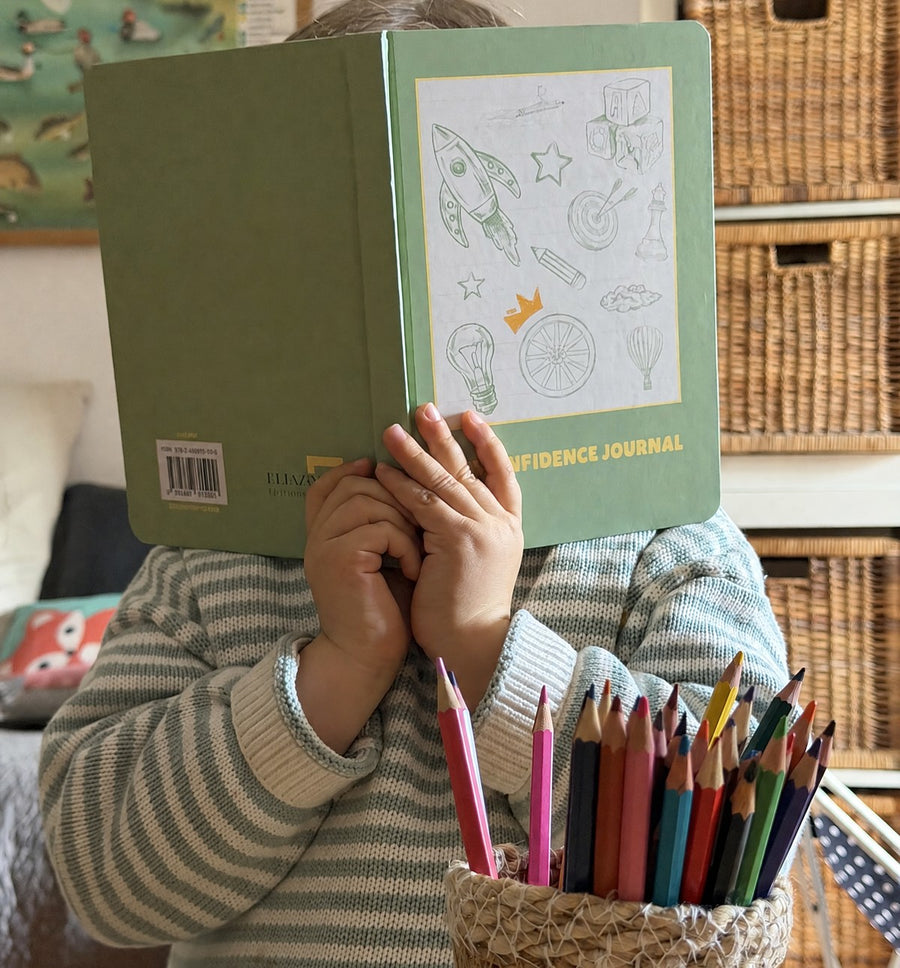
A journal like My Book Story then becomes an incredibly powerful tool. The goal isn't to map out an 8-year career plan! The idea is to give him the freedom to visualize the life he'd like to lead, without any limitations. It teaches him a fundamental lesson: his dreams have value and deserve to be explored.
The magic of creative visualization
Visualization isn't a complicated concept. For a child, it's like a superpower that makes their ideas almost real. A journal is the perfect canvas for this exploration, as it blends writing, drawing, collage...
This creative approach removes all the pressure of having to find the "right" answers. Because in reality, there's no wrong way to dream.
Drawing : Your child can doodle their ideal room or a perfect day. Drawing unleashes the imagination and makes abstract ideas much more concrete.
Collage : Offer him old magazines so he can cut out images that speak to him (places, animals, colors...). This little "vision board" in his notebook helps him visually assemble the pieces of his inner world.
Writing : He can invent short stories where he is the hero, or list his "superpowers" (like being super strong at hugs or knowing how to make everyone laugh).
These fun little exercises allow your child to explore possible futures in an entertaining way. This is a key step in the "your life, your design" method.
Asking the right questions to guide exploration
To enrich their journal, the questions you ask as a parent are crucial. They should open doors, not close them. The goal is to pique their curiosity, not to get a definitive answer.
A creative journal is a dialogue between the child and themselves. Your role is simply to start the conversation with questions that invite daydreaming and exploration.
Here are some ideas to inspire him:
"If you had a magic wand, what would you change in the world?"
"Draw or describe your perfect holiday day. Where would you be and who would you be with?"
"Imagine you invent a new holiday. What would it be called and what would we do on that day?"
"What is the bravest thing you would like to do someday?"
Establish a small family journalism ritual
To make this practice a regular habit, it's best to turn it into a pleasant family ritual. Choose a quiet time, free from screens and distractions. Sunday afternoon, for example. The important thing is that it's a time without pressure or judgment .
And why not keep your own journal at the same time? Sharing this activity strengthens your bond and shows your child that self-exploration is a lifelong adventure. It's not a school assignment, but a special moment to connect with yourself and, together, imagine the future.
Turning obstacles into life lessons
Challenges are part of a child's life. An unexpected bad grade, an argument in the playground... these are inevitable moments. The "your life, your design" philosophy invites us to change our perspective: what if these moments weren't failures, but opportunities to learn?
This is a unique opportunity to teach your child a fundamental life skill: resilience.
Rather than trying to eliminate the difficulty, your role as a parent is to help your child observe it with curiosity. Every obstacle is a source of information about what works, what doesn't, and what could be done differently next time.
By adopting this stance, you show them that mistakes are not dead ends, but stepping stones to new ideas. This is the very heart of a growth mindset, where challenges become opportunities for growth.
Communicating to understand and respond
When faced with a setback, our first instinct is often to want to console the child by minimizing their emotion. However, to help them transform this experience into a lesson, there is a much more constructive approach: asking open-ended questions that invite them to analyze the situation without judgment.
Let's imagine that your child is sad after an argument with a friend:
Instead of saying, "Don't worry, it will pass," try asking, "What made you the saddest about this whole thing?"
Rather than taking sides, explore with him: "If you had a magic wand, what would you have done or said differently?"
To guide them towards action, you can suggest: "What if we imagined three ways to fix things? Even the craziest ones! Which one would you most want to try?"
This way of discussing things teaches him to break down a problem, to put words to his emotions and, above all, to actively seek solutions. He becomes an active participant in the situation instead of a passive recipient of it.
Creative tools to strengthen your resilience
Learning to overcome obstacles can also be a game! The idea is to take the drama out of the situation and use your creativity to find a solution.
A "failure" is just a rough draft in the grand story of his life. By teaching him to see each obstacle as a step in the creative process, you empower him to rewrite the next chapter.
Here are two fun activities inspired by the "your life your design" method, to try as a family:
The solution tree: Take a large sheet of paper and draw a tree. The trunk represents the problem (for example: "I can't finish my puzzle"). Each branch becomes a possible solution: "ask for help", "take a break", "start with the corners"... This simple visualization helps them understand that there are always several paths.
The hero's story: Suggest that they invent a story where a hero faces a problem similar to their own. How will this hero overcome the challenge? Gaining some distance from their own problem allows them to explore solutions more freely and creatively.
These small tools instill in him the idea that he is resourceful. He learns that even when things are difficult, he has the ability to devise a better continuation for his story.
Building trust with family rituals
Rituals are like the soundtrack of family life. These regular little gatherings create a sense of security and belonging, an essential foundation for a child. In the "your life, your design" philosophy, these moments become true pillars upon which they will build and strengthen their confidence, day after day.
Far from being mere habits, rituals are positive anchors. They remind your child that they are part of a team, a close-knit group where they can explore who they are, celebrate their successes, and talk about their doubts without fear of judgment. It is in this consistency that they find the certainty of being loved and supported.
Create together traditions that reflect who you are
For a ritual to truly come to life, it must be meaningful to everyone. The trick? Design it with your children, not just for them. By involving them in creating these moments, you show them that their opinions matter. This fosters their sense of belonging and motivates them to participate.
This co-creation approach is in itself a wonderful exercise in family life design. It's about asking ourselves together the question: "What would make us feel good and even more connected?"
Some practical tips for parents:
Sunday family meeting. Just take 15 minutes each Sunday evening. Everyone can share a small success from the past week and an intention for the week ahead. It's a wonderful time for listening and supporting each other.
The Pride Box. Take a jar or box and decorate it as a family. Every time someone is proud of something, they write it on a small piece of paper and slip it inside. Once a month, open the box and read all these little successes aloud. It's a great way to celebrate victories.
The "Passion" Night. Once a month, a family member has free rein to organize an evening based on a theme they're passionate about. Does your child love dinosaurs? Prepare a "prehistoric" meal and watch a documentary together.
A successful ritual doesn't need to be complicated. It's simply an intentional, repeated moment that says, "We are together, and this matters." This consistency is the best foundation for emotional security.
Rituals to prepare for the world of tomorrow
Integrating these habits goes far beyond simple family tradition. It's a way to prepare our children for a constantly changing world. Social dynamics, for example, are constantly evolving. In France, with a fertility rate of 1.62 children per woman and an aging population, the need to create strong and intentional bonds is more important than ever. Learning to create one's own life also means learning to adapt to this context. To better understand these issues, you can consult French demographic data on this detailed information website .
By cultivating these rituals, you convey to your child the importance of human connection and mutual support. You give them the tools to design their own life, in harmony with their surroundings and the transformations of society. These shared moments are the foundation that will give them the strength and confidence to forge their own path.
Some questions you may have about the Your Life Your Design method
Embarking on a new adventure like Your Life Your Design with your child can raise a lot of questions. That's perfectly normal! Here are some answers to help you support them with complete peace of mind.
At what age should I start?
The ideal time is often between 6 and 12 years old . It's a magical period when children's imaginations are at their peak and they are just beginning to build their identity and self-confidence.
For younger children, between 6 and 8 years old, focus on play, drawing, and anything highly visual. With older children, from 9 to 12 years old, you can begin to explore slightly deeper themes, but always keep fun as the guiding principle.
My child hates writing, what can I do?
Excellent question! If your child is stuck staring at a blank page, don't force them. The strength of the "your life, your design" approach lies in its flexibility.
There are a multitude of other equally valuable ways to help him explore his ideas:
Drawing or painting: A few pencils are enough to convey an emotion or imagine a scene.
Collage: Suggest that he/she cut out images from old magazines to create a "picture of his/her dreams".
Audio recording: With a phone, he can record himself and tell his ideas, like a spoken logbook.
Construction: What if we used toy bricks to build the ideal house or to represent the solution to a problem?
And if he's not motivated?
Motivation isn't always there. If you sense your child is losing interest, let go of the final goal. The aim isn't to "finish" a notebook or "produce" something, but to share a good time as a family.
The "your life your design" approach isn't just another chore. It's an invitation to play. If you don't feel like it, it might simply be a sign that you need to change activities or take a break.
Consider mixing things up, offering short sessions, and turning them into a fun ritual. And above all, show your own enthusiasm. Your energy is contagious.
Won't that put pressure on him?
This is a legitimate parental concern. Rest assured, the idea is absolutely not to aim for performance. Your Life Your Design is not a race to see what he will do later, but a journey to discover who he is, here and now.
Emphasize that there are no right or wrong answers. All ideas, even the most outlandish, have their place. This is their space of freedom, a place where they have the right to dream, to make mistakes, and to change their minds. By valuing the process and the simple pleasure of creating together, you eliminate any pressure.
So, ready to offer your child a space to dream, create and grow in confidence? The My Book Story journal was designed exactly for that: it's the perfect companion to put the "your life your design" philosophy into practice on a daily basis.