


"Mom, Dad, I'm bored..." Every parent knows this little phrase. And our first instinct is often to search for THE perfect idea to keep our child occupied. But what if the best answer was to help them find their own solutions?
Far from being a problem to be solved, boredom is a real opportunity for your child's development . It's an empty space just waiting to be filled by their imagination. It's the perfect time to cultivate their creativity, self-confidence, and independence.
Boredom: what if it were an opportunity for your child?
In our world where everything is planned, boredom has a bad reputation. It's seen as a void that needs to be filled urgently. Yet, for a child between 6 and 12 years old , this "void" is a precious mental space, an incredibly fertile ground for the wildest ideas to take root and for self-discovery to flourish.
When your child complains of being bored, they aren't necessarily asking for a ready-made solution. Rather, they're expressing a need to find an activity that has meaning for them . Instead of reaching for the tablet, see this moment as an invitation to an inner adventure, a key step in their personal development.
This is a golden opportunity for him to learn to draw on his own resources. This skill, acquired during childhood, is a cornerstone for building self-confidence and the ability to bounce back later in life.
What is the role of the parent in dealing with boredom?
Your mission, should you choose to accept it, is not to be a 24/7 holiday club entertainer. Your role is rather to cultivate an environment where your child feels safe to explore independently. This means that you sometimes have to resist the urge to fill every silence, which, we admit, isn't always easy!
By allowing him to go through this brief moment of discomfort, you are giving him an invaluable gift for his development.
Boredom is the fuel of the imagination. It is in this apparent calm that incredible stories, artistic projects, and profound reflections are born. As parents, our role is to protect this space.
Accepting that your child is bored sends them a powerful message: "I trust you, I know you're capable of finding your own solutions." This is a real boost to their self-esteem and independence.
The hidden benefits behind a simple "I'm bored"
Behind this seemingly innocuous phrase lie true treasures for your child's development. When given a little space, away from overstimulation, children learn to:
- Unleashing their creativity : Without guidelines, a simple cardboard box becomes a castle, and orphaned socks are transformed into puppets.
- Gaining autonomy : They learn to make their own choices, take initiatives and trust themselves.
- Better managing their emotions : Boredom can be frustrating. Learning to overcome it alone develops patience and resilience.
- Learning about oneself : These moments of pause are essential for introspection. It is there that a child discovers what they truly love, their budding passions.
Here is an overview of approaches to transform your child's boredom into a constructive moment, focused on their development and well-being.
Turning boredom into opportunity: 4 key approaches
| Parental approach | Benefit for the child (6-12 years old) | A concrete example to get started |
|---|---|---|
| Letting go and trusting | It develops autonomy and creativity. The child becomes an active participant in their free time. | Reply: "I'm sure you'll come up with a great idea on your own!" and remain available in the background. |
| Create a conducive environment | Encourages spontaneous exploration without depending on an adult. | Provide a "creation box" with various materials (cardboard, string, glue, fabric...). |
| Discussing emotions | Helps to name the feeling of boredom and to defuse it. Strengthens emotional management. | Ask: "How does it feel to be bored? Is it like a cloud floating in your head?" |
| To offer "suggestions" rather than solutions | It stimulates the imagination without imposing an activity. The child remains in control of the game. | Throw out a vague idea: "What if we imagined a new rule for a game we already know?" |
In short, by simply changing our perspective, we can transform a recurring complaint into a key stage of growth. This guide is here to give you concrete tools to make these moments cornerstones for your child's development.
Awaken creativity with simple and fun games
When your child sighs, "I'm bored…", it's often a sign that their imagination is ready to take flight. Creativity is your best ally in these moments. Forget expensive materials or complicated preparations; the activities that most boost self-confidence are often the simplest. It's the perfect opportunity to show them how to transform the everyday into something extraordinary.
The goal isn't to become a full-time entertainer, but simply to spark something. Sometimes, a small suggestion is all it takes to transform a dreary afternoon into an unforgettable adventure.
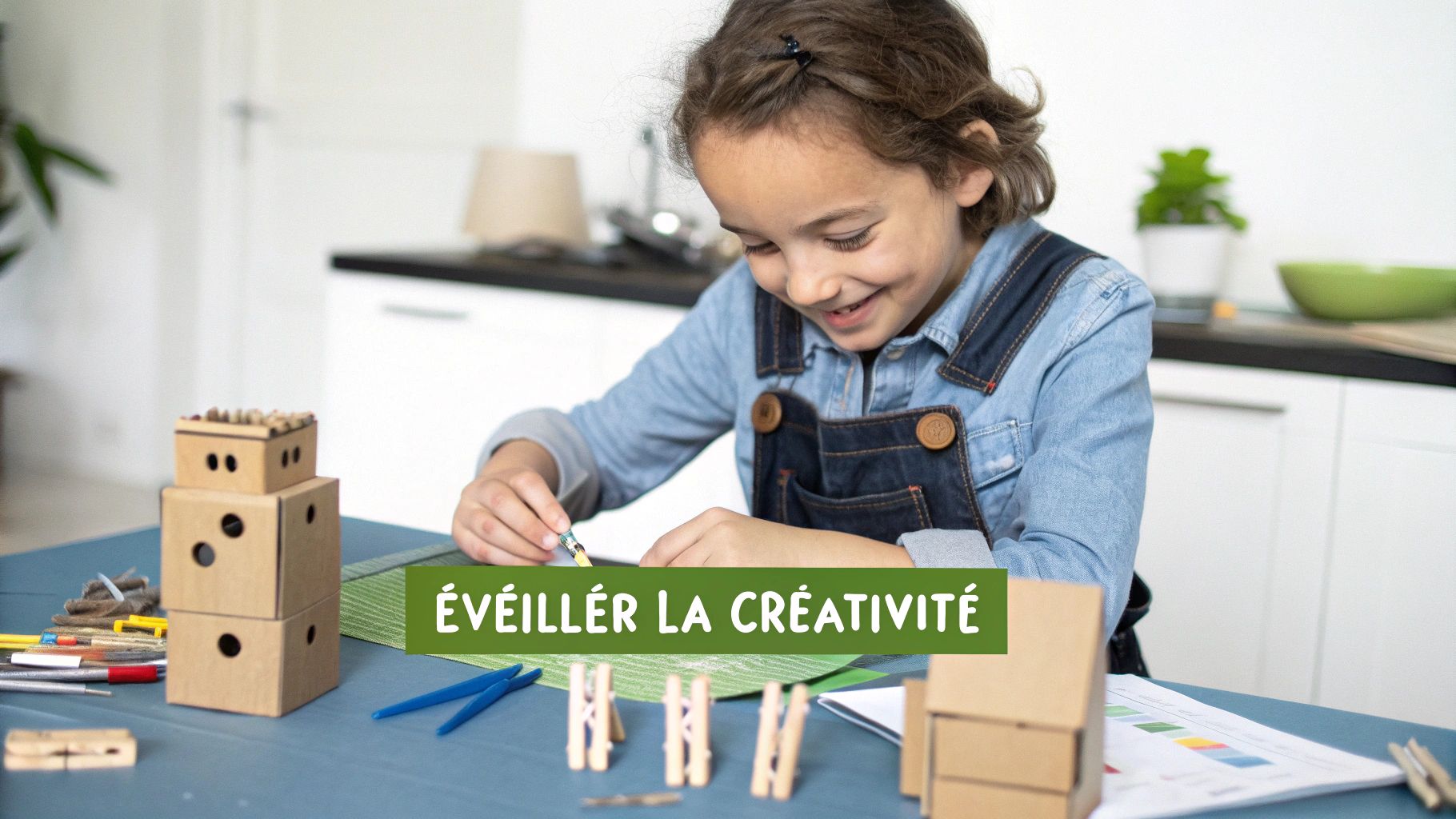
The story factory
Here's a deceptively simple game for creativity: the "story factory." The idea? Gather a few everyday objects in a bag or box. A wooden spoon, an old key, a colorful scarf, a leaf picked up outside…
Your child picks three objects at random and must invent a story that connects them. It's a wonderful exercise that stimulates their imagination, enriches their vocabulary, and helps them make connections between ideas that, at first glance, have nothing in common.
This game shows him that inspiration can be found everywhere , even in the most ordinary objects. To make things a little more challenging, suggest that he tell his story using different emotions: joy, fear, surprise... It's an excellent exercise for developing his emotional intelligence.
Building challenges for budding young architects
All children love to build. Put aside the instruction manuals and simply let them explore with whatever they have on hand. To spice things up a bit, give them age-appropriate challenges.
Here are some easy ideas to implement:
- The sturdiest shelter : With cushions, blankets and chairs, who will build the most resistant shelter? It's a great opportunity to collaborate as a family and test ideas.
- The tallest tower : Using only books or empty toilet paper rolls, this challenge encourages patience and fine motor skills.
- The cardboard village : Keep your cereal or shoe boxes safe. Suggest building an entire city! Each box can become a house, a school, or even a castle for their toys.
These activities are much more than just a cure for boredom. They develop essential skills such as problem-solving, planning, and perseverance. Your child learns to manage frustration (when the tower collapses!) and to find solutions independently.
Launching artistic challenges as a family
Drawing is a classic activity. But it can easily be reinvented to make it a moment of sharing and laughter. The goal isn't to create a work of art, but to have fun together and explore new ways of expressing ourselves.
A challenge that always works is blindfolded drawing . One family member describes an object without naming it ("It's round, it's a little prickly, and we find it in the garden..."), and the others have to draw it. Laughter is guaranteed when comparing the results!
You can also try collaborative drawing . Each person starts a drawing on a sheet of paper, then passes it to their neighbor who must continue the artwork. The final result is always a collective surprise that strengthens family bonds.
These simple games are true stepping stones to independence. They give your child the tools so that, next time, they can transform their boredom into a wonderful creative adventure.
Adding small wellness breaks to daily life
Sometimes, when a child says "I'm bored," it might be their way of saying they need to reconnect with themselves, to take a break from the whirlwind of the day. Small, self-care rituals are a gentle response to this need.
Far from being mere tricks to "fill a void," these short breaks provide him with tools for life. He learns to understand what's happening within him and to manage his emotions. A moment of boredom can then become an opportunity to rediscover his inner peace.
The inner weather: putting words to emotions
To begin, help him name what he's feeling. The image of the "inner weather" is a fantastic tool for this, as it's simple and visual. The next time he's bored, ask him, "So, what's the weather like inside you right now?"
- Bright sunshine? He feels full of joy and energy.
- Grey clouds? He might be feeling a bit gloomy or tired.
- Rain? Something is bothering him.
- A big storm? Anger or frustration is brewing!
This simple exercise allows you to validate your feelings without judgment. It helps you understand that all emotions are normal and that they always pass, like clouds in the sky. It's an essential first step in building your emotional intelligence.
Funny breathing exercises to relieve tension
Breathing is the simplest tool for regaining calm. But telling a child "Breathe!" is too abstract. The trick is to make this exercise fun and concrete.
By focusing on their breath for a minute, a child learns to return to the present moment. This is a valuable skill for managing stress and improving concentration.
Here are two simple techniques that work every time:
- The balloon in the stomach : He places his hands on his stomach. Inhaling through his nose, he imagines he is inflating a huge balloon inside. Then, by gently exhaling through his mouth, the balloon deflates. Repeat 3 to 5 times in a row.
- The foraging bee : He takes a deep breath. Exhaling with his mouth closed, he makes the sound of a bee: "buzzzzzz". The vibration that spreads through his body has an almost magical, soothing effect.
These little rituals easily fit into daily life, like right after school to unwind, or before bedtime. It's also a great moment of bonding that helps him better manage life's little challenges, including those infamous moments when he wonders what to do when he's bored .
What if her inner world became her most beautiful playground?
When your child sighs with boredom, the reflex is often to look for an outdoor activity. But what if, for once, we invited them to look inward? A creative journal is a brilliant idea for this. It's much more than just a notebook: it's a secret space, a personal garden where they can give free rein to their thoughts, emotions, and even their wildest dreams.
Present it as a companion for adventure, not as homework. Here, there are no right or wrong answers. Just a safe space where he has the right to say anything, draw anything, imagine anything, thus strengthening his creative confidence.
Little sparks to ignite the imagination
To help them get started, nothing beats "creative prompts." These are short questions or simple challenges that inspire them to fill the blank page. It's fun, accessible for 6-12 year olds, and it transforms writing and drawing into a real game.
Here are a few examples to get you started:
- "If you were to invent a new family celebration, what would it be?" Let him imagine the traditions, the meals, the costumes...
- "Draw a map of your own imaginary country." With its mountains of candy, rivers of lemonade, and bizarre creatures!
- "Imagine your toys wake up at night. What would their greatest adventure be?" A great way to develop empathy and build a story.
The goal isn't to get a perfect answer. The idea is to show him that all his ideas are valuable and deserve to exist. It's a powerful exercise to help him gain confidence and learn to see the world creatively.
These moments of calm and inner exploration are often far more impactful than highly structured activities. Of course, the urge to "go out" is sometimes very strong. The success of large amusement parks proves this. According to household tourism data published by INSEE (the French National Institute of Statistics and Economic Studies ), families are increasingly seeking memorable shared experiences. But at home, a journal offers another form of adventure, just as rich and essential to a child's well-being.
Create unique pages that reflect your personality
A journal can quickly become a reflection of their personality. Instead of following rules, suggest they create themed pages that truly resonate with them. This transforms introspection into a kind of treasure hunt for self-discovery, ideal for boosting self-esteem.
Here are some page ideas he might love:
- My Superpowers Catalogue: He can list all his qualities in it. Knowing how to listen, making his little brother laugh, being a champion at climbing trees... everything counts!
- My happiness detector: A page where he can draw or write three little things that made him happy during the day. A hug, a delicious dessert, a ray of sunshine...
- My wildest dream list: Here, anything is possible! Becoming an astronaut, having a dragon, building a cabin on the moon...
Little by little, this journal will become a friend, a silent confidant who grows with him. Each page is a small stone that helps him build a positive self-image. And the next time he's bored, he'll know he has a whole world to explore, right at the tip of his pencil.
Explore the outside world with family adventures
Sometimes, the best answer to the dreaded "I'm bored" is right outside the door. Getting out of the house, even for just an hour, is a fantastic way to break the routine and awaken your child's senses. It's an invitation to wonder and create lasting family memories.
No need to plan an extraordinary expedition. A simple stroll around the neighborhood can transform into an exciting exploration mission with a little imagination. Simply getting a change of scenery awakens curiosity and opens up new perspectives.
Transforming nature into a playground
Nature is the world's greatest playground, and it's waiting for you! It offers endless possibilities for activities that cost nothing but are incredibly enriching for your child's development and well-being.
Here are a few ideas to get you started, tried and tested by parents:
- Nature treasure hunt : Make a list of things to find in the park or forest (a heart-shaped leaf, a smooth stone, a stick that looks like a Y). This is an excellent exercise for developing observation skills and patience.
- Ephemeral art (Land Art) : Use what you find on site (leaves, pebbles, branches) to create a work of art directly on the ground. A beautiful way to express your creativity while learning to respect nature.
- The little engineer by the water : If you have a stream near your home, building small dams or watermills is a fascinating activity that teaches the basics of physics without you even realizing it!
The appeal of nature and outdoor activities is a growing trend. Families are looking to reconnect with what truly matters, away from screens. If this topic interests you, take a look at current trends in the leisure sector in France .
Rituals for observing the world differently
Even your garden or balcony can become the stage for extraordinary adventures. All it takes is learning to look at things differently and establishing small family rituals.
The outdoors is not just a place to expend energy. It is a space of calm, observation and connection that nourishes the emotional balance of the whole family.
Why not organize a stargazing session, all bundled up in blankets? Or a "photo safari" in the garden, where the challenge is to photograph the most beautiful insect or the prettiest flower?
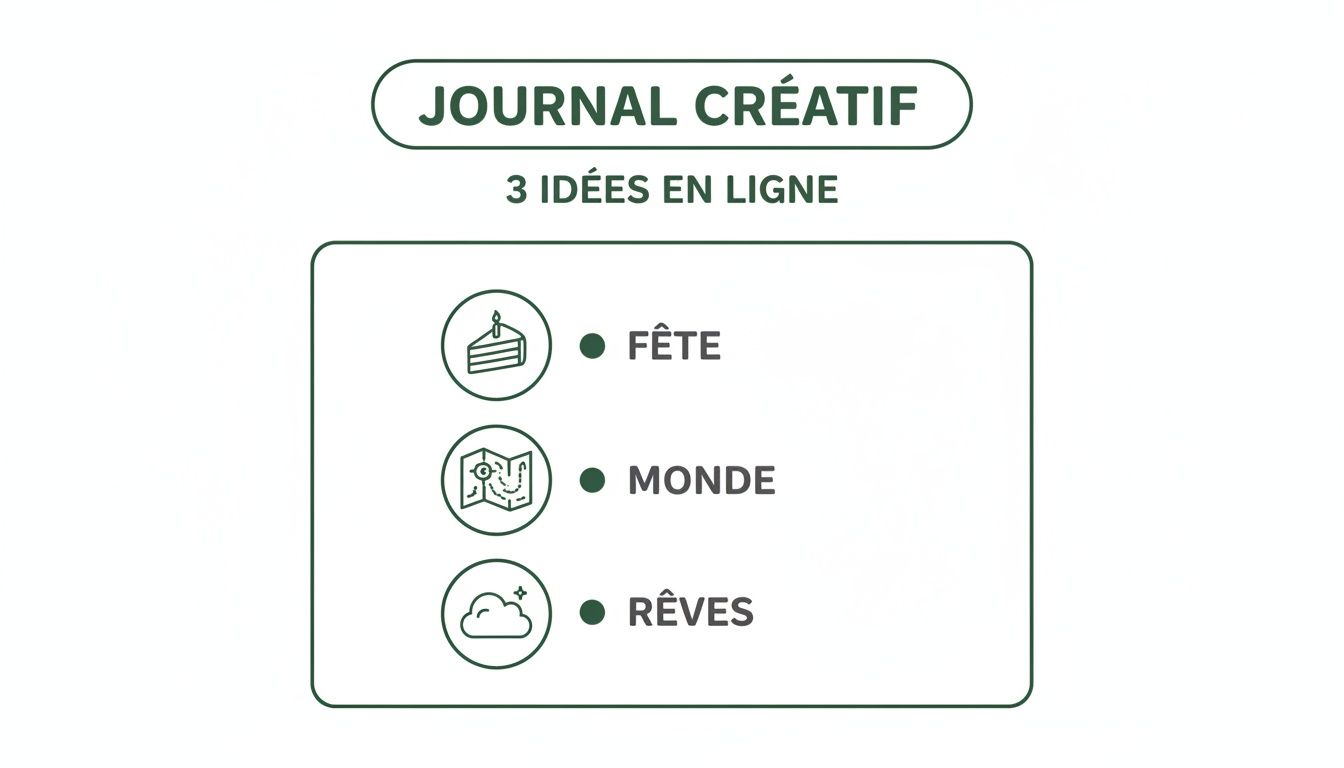
After an outing, the My Book Story journal becomes the perfect place to extend the adventure. Your child can draw a treasure map of your walk, imagine a party for the little creatures of the forest, or write down the dreams inspired by the starry sky.
To help you choose, here is a handy little table that gives ideas depending on where you are.
Family activity ideas based on your environment
| Environment | Creative activity (minimal materials) | Exploration activity | Benefit for well-being |
|---|---|---|---|
| Urban park | Draw trees, flowers or people with a notebook and a pencil. | Follow an ant to see where it goes; identify 5 different types of leaves. | A soothing nature break amidst the hustle and bustle of the city. |
| Forest/Woods | Create characters using pine cones, leaves, and twigs. | Build a small hut out of dead branches. | Deep connection with nature, a feeling of calm and escape. |
| Beach/Seaside | Make sand sculptures or drawings with seashells. | Marine treasure hunt (seashells, driftwood, polished pebbles). | The sound of the waves has a relaxing effect, and there's plenty of space to let loose. |
| Your garden | Create a "perfume" by mixing flower petals and leaves in water. | Observe insects with a magnifying glass, create a mini vegetable garden. | Becoming familiar with one's immediate environment, pride in seeing one's crops grow. |
I hope this painting will inspire you to get outside! An adventure doesn't have to be complicated to be memorable.
Transforming the house into a giant playground
A rainy day, a long afternoon... These moments are invitations to see the house from a new perspective. No need to go out to chase away boredom; the best adventures often begin right at the foot of the sofa.
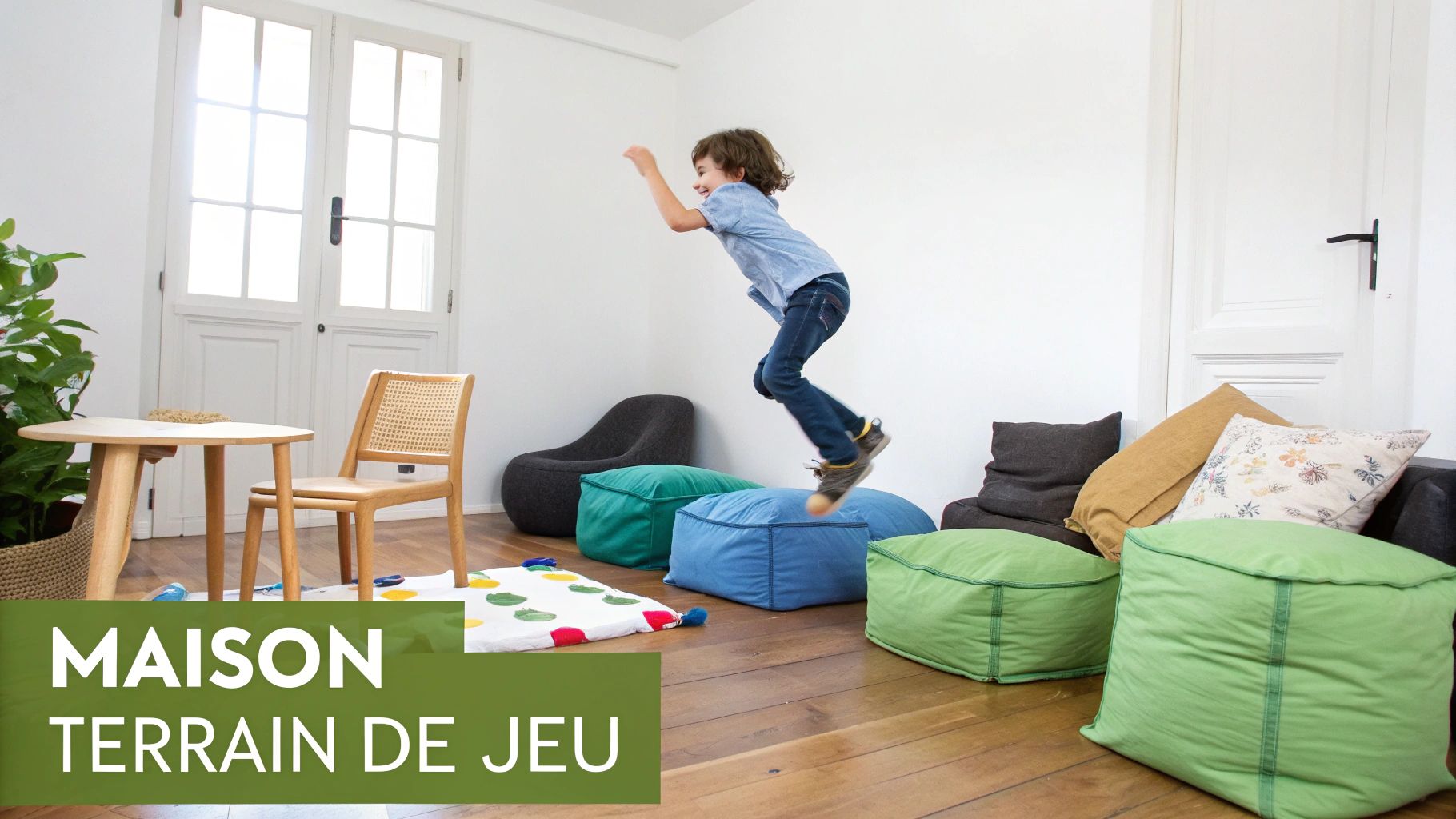
Turning your home into a giant playground is much easier than you might think. A little imagination is all it takes to transform an ordinary day into a memorable adventure. It's also a golden opportunity to strengthen family bonds and watch your child's confidence blossom.
Organize a homemade escape game
Why pay for an escape game when you can create a tailor-made one at home? The principle is simple: hide a "treasure" (a treat, a small book...) and imagine a series of puzzles for your child to find.
Each solved clue leads to the next, which is excellent for stimulating logic and deductive reasoning. It's a fantastic collaborative activity that teaches them to think outside the box and work as a team if you all play together.
The enthusiasm for this type of activity is real. The indoor leisure sector, as shown by the leisure sector outlook , is booming, as families seek original and engaging experiences that are out of the ordinary.
Set up a "Ninja Warrior" obstacle course
The living room can very quickly be transformed into an adventure arena. A few cushions, some chairs, one or two blankets, and you have everything you need to build an obstacle course that is both fun and safe.
Here are a few ideas to get you started:
- The mysterious tunnel : simply go under a table covered with a large sheet.
- The floor is lava! : we jump from cushion to cushion without ever touching the parquet floor.
- The spider web : stretch a woolen thread between two chairs and ask him to weave through it without touching it.
It's not just a simple way to let off steam. This type of game develops your child's coordination, balance, and ability to judge distances and plan their movements. It's an excellent way to develop their gross motor skills.
These spontaneous moments of play are precious. They show your child that with a little creativity, fun is always within reach. Every corner of the house can become the stage for a new story, proving that adventure is first and foremost a state of mind.
The My Book Story journal is the perfect tool for your child to dream up plans for their next escape game or record their obstacle course records. It's their own space to transform boredom into creative projects. Discover how it can become the partner in their greatest inner adventures .