


"Mom, Dad, I'm bored!" We all know that little phrase. And it often stresses us out a bit. Yet, if we think about it, it's an incredible opportunity. Rather than seeing it as a problem to solve immediately, imagine it as a door opening onto your child's world. An invitation to develop their creativity , self-confidence , and independence.
Your child's boredom is a hidden superpower
Our first instinct? To whip out a solution. We pull out a game, suggest an outing, or, let's face it, offer a screen. It's understandable; we want to do the right thing. But by immediately filling this void, we unintentionally deprive our children of an essential step in their development. Boredom isn't a failure on our part. It's a blank canvas where imagination can finally take root.
When a child between the ages of 6 and 12 complains of being bored, they are actually learning about themselves, without anything to distract them. It is precisely in these moments of stillness that the most brilliant ideas emerge.
A gateway to creativity
Think of boredom as a blank sheet of paper. At first, it might seem a little empty, a little intimidating. But give it time, and you'll see your child's mind begin to draw their own worlds on it. That's when a simple cardboard box transforms into a spaceship and the hideout under the table becomes a secret fortress.
Child development specialists are adamant: these "breaks" are crucial. They help develop key skills, such as problem-solving abilities. Children have to dig deep to find ways to occupy themselves—a real asset for their adult lives.
Boredom is the fuel of the imagination. When the brain is no longer bombarded with information, it can finally wander, make surprising connections, and invent. Your role is not to be the chief animator, but rather the guardian of this precious space.
How can we react to help him activate this superpower?
Your reaction is key. Instead of handing your child a solution on a silver platter, guide them in finding their own. This small shift in approach makes all the difference: they will feel more competent and more confident in their ability to handle everyday challenges.
Here are some concrete suggestions for changing your perspective on boredom:
- Acknowledge his emotion. A simple "Ah, you're bored. Yes, I see what that's like" is enough to validate what he's feeling.
- Resist the urge to respond immediately. Allow a brief silence after their complaint. Often, an idea will emerge on its own after a few minutes.
- Guide him towards his own ideas. Ask open-ended questions that stimulate his imagination, such as "What could you invent with everything in your room?" or "If you had a magic wand, what would you make appear for fun?"
By adopting this approach, you are not just answering the famous question " what do i do when bored ", you are giving them a gift for life: the ability to find their own answers.
Deciphering the hidden message behind "I'm bored"
When your child, aged 6 to 12, says the famous "I'm bored," chances are it's not just an observation about their schedule. It's rarely a simple lack of activities, but rather a signal, a window into their inner world.
Your mission, should you choose to accept it, is not to transform yourself into a leisure center entertainer, but rather into an empathetic detective.
This short phrase is often a shortcut. It's your child's way of expressing a deeper need, one they can't yet articulate themselves. By learning to decode this message, you can transform what seems like a crisis into a valuable opportunity to connect and support their growth.
Let's see what's happening beneath the surface
Before you pull out a list of activities, take a deep breath. Pause. Your child might be trying to fill a void much bigger than what's on their schedule. At this age, boredom can mask all sorts of things.
Here are some avenues to explore together:
- Need to connect? Sometimes, "I'm bored" simply means "I want to spend some time with you." It's a subtle request. Suggest a simple activity for the two of you, like preparing a snack or reading a story.
- Feeling tired? After a long day at school or a busy week, your brain needs a break. Boredom is often the first sign of this mental or emotional overload. Quiet time, without expectations, can be the best solution.
- A thirst for a challenge? He may need a new challenge, something that stimulates him intellectually or creatively, but he doesn't know how to ask for it.
- Too many choices? A room full of toys can be overwhelming. Faced with a multitude of possibilities, a child sometimes feels swamped and simply doesn't know where to begin.
The key is to ask the right questions. The ones that will help him put words to what he's really feeling. This approach validates his emotions and, in the process, teaches him to know himself better. An essential life skill!
Instead of asking "What do you want to do?", which puts pressure on them to find THE solution, try a more open-ended question. For example: "What does your body feel like right now?" or "What exactly are you thinking about when you say you're bored?" This shifts the focus from action to feeling.
This small visual diagram clearly shows how you can support him, either by guiding him or by letting him find his own way.
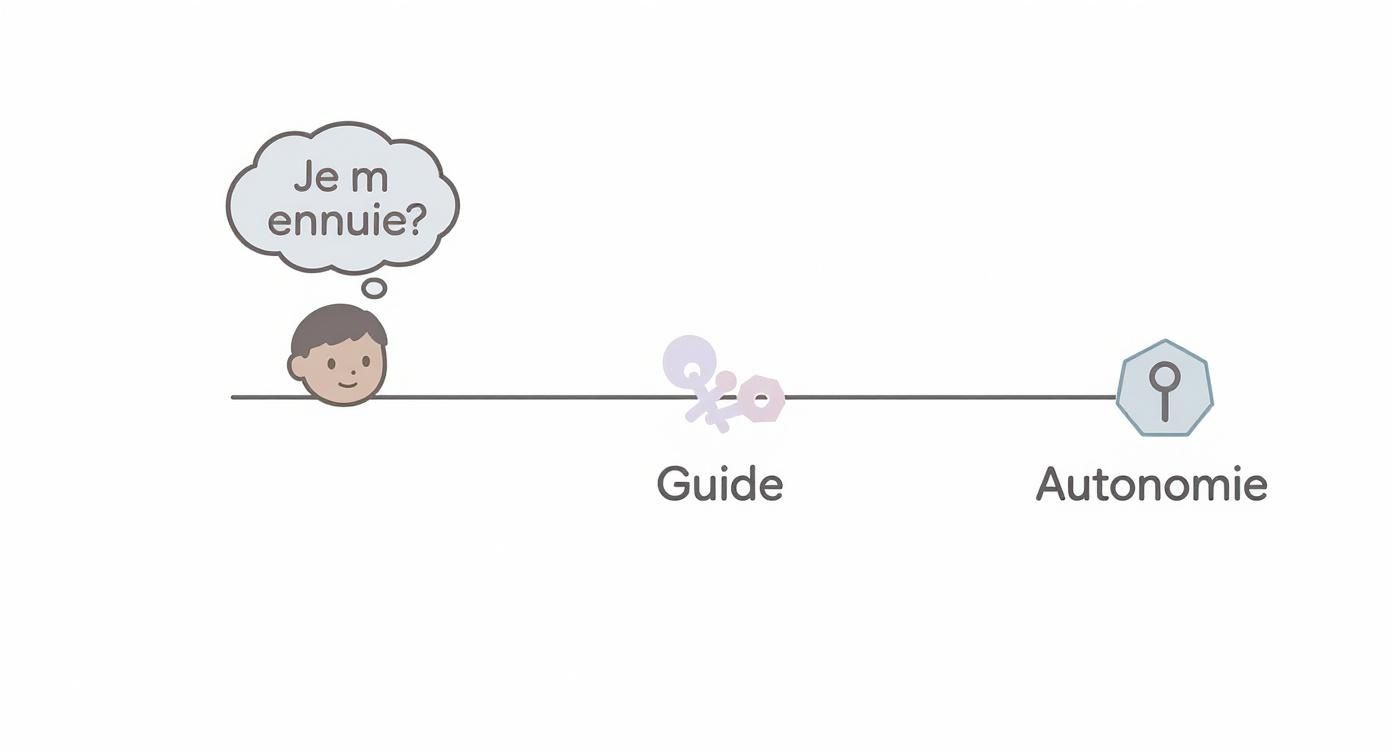
The idea is that there isn't one single right answer. Sometimes he'll need your help, and other times you'll just need to encourage him to manage on his own. That's how he'll learn to handle his emotions and build his self-confidence.
Turning boredom into a creative adventure, without screens
Now that we understand that boredom is not an enemy to be defeated, a new question arises: how can we concretely help our children transform it into something positive? The idea is certainly not to fill every minute of their schedule, but rather to sow a few seeds so that their imagination can germinate and take over.
The goal is to give them just enough inspiration so that they can then build their own worlds.

The magic of the boredom box
The idea is very simple, but I assure you, it works wonders. Prepare a special box, always within reach, filled with basic supplies. Mind you, this isn't just another box of fancy toys, but rather a treasure chest full of possibilities.
The content may change over time, but here are some essentials to get started:
- The basics of DIY: string, empty toilet paper rolls, cardboard boxes of all sizes, a glue stick and round-tipped scissors.
- Treasures of nature: pine cones, some beautiful dried leaves, smooth pebbles, twigs.
- A little bit of art supplies: some colored pencils, sheets of paper (white and colored), a block of modeling clay.
The secret is to give no instructions. The box is there, that's all. When boredom sets in, simply extend an invitation: "How about you go see what's hidden in the boredom box today?"
Launch small creative challenges
Sometimes, the spark is slow to ignite. In those moments, a small challenge can make all the difference. It's not about providing the solution, but about asking an open-ended question that will stimulate their ingenuity.
The three-object challenge: "Choose three objects at random from the living room. How would you build the strongest fort in the world with them?" This kind of small constraint pushes the child to see everyday objects from a new angle and to think differently.
The important thing is to show them that games don't need complicated rules or expensive equipment to be exciting. In fact, more and more families are looking for simple and engaging ways to fill their free time. Learning through play is an excellent way to turn a lull into a developmental opportunity, as these suggestions for games to learn French demonstrate.
Ideas for all tastes and moods
Every child is unique. Some need to move and expend energy, while others prefer peace and quiet to recharge. Having a small selection of ideas on hand is handy for gently guiding them according to their mood.
Here's a small table to give you some ideas. It's an excellent starting point for creating your own list of "anti-boredom" activities with your child.
| Screen-free activity ideas to beat boredom | | :--- | :--- | :--- | | Category | Activity Idea | Benefits for the Child | | Creative | Create a comic strip with a completely invented hero. | Stimulates imagination, storytelling skills, and self-confidence. | | Construction | Build a giant marble run using cardboard tubes. | Develops logic, patience, and fine motor skills. | | Calm | Learn to make simple origami (a boat, a plane, a crane). | Promotes concentration, precision, and frustration management. | | Expression | Staging a short play with sock puppets. | Encourages self-confidence, oral expression, and empathy. |
By creating an environment that encourages creativity and autonomy, you give your child the tools to find the answer to their question themselves, transforming a moment of uncertainty into a wonderful adventure.
Creative journaling: a superpower against boredom
The famous "I'm bored" often masks a disconnect. Your child simply doesn't know what to do with their feelings. We often think of activities to keep them occupied, but the most beautiful adventures are sometimes internal. That's where a creative journal comes in and can work wonders.

More than just a notebook, a journal like My Book Story becomes a kind of personal compass. It gives him a space of his own, a secret garden where he can explore his thoughts and emotions, without judgment or performance pressure.
Transforming boredom into an indoor playground
The goal is certainly not to give him another chore. Think of it instead as an invitation to explore his own inner world. The notebook becomes a friend, a confidant that helps him understand what's going on inside him. Suddenly, boredom is no longer a heavy emptiness, but simply a blank page waiting to be colored.
The next time boredom sets in, instead of pulling out a list of activities, try a different approach. Suggest opening their journal with a simple, open-ended question. This gentle gesture can transform a moment of inactivity into a genuine opportunity for self-discovery.
Here are some concrete suggestions to support him/her:
- The weather drawing of emotions: "If your boredom were a color, what would it be today? And if we drew a big cloud of that color on the "My emotions" page of your notebook?" Putting an image to a feeling immediately makes it less daunting.
- The imaginary treasure map: "Close your eyes. Imagine an amazing place where you would like to be right now. What does it look like? Go ahead, open your notebook to the page 'My Imaginary World' and draw the map to get there."
- The list of little joys: "Sometimes, when we're bored, we forget the good times. Let's try to find three little things that made you smile today. We could write them in your journal so you don't forget them."
By introducing him to journaling, you're not giving him a ready-made solution. You're giving him a superpower for life: the ability to draw on his own inner resources to cope with his emotions.
Making journaling a ritual of connection
To make this notebook a true companion, simply integrate it naturally into your routine. Why not establish a little "creative journal" ritual after school or just before bedtime stories? Five minutes is all it takes.
There are no rules. The most important thing is that your child makes it their own. One day it might be a drawing, the next a few words, or even just a collage. Each page becomes a testament to their creative journey, a celebration of their boundless imagination.
By showing him how to transform boredom into creative exploration, you help him build a peaceful relationship with himself. He discovers that he is the hero of his own story, capable of creating adventure even when, on the surface, "nothing" is happening.
Turning boredom into a positive family ritual
What if the infamous "I'm bored" were no longer a cry for help, but an invitation to reconnect as a family? Rather than seeing boredom as a void to be filled at all costs, we can view it as a welcome respite from the whirlwind of daily life. It's a golden opportunity to show our children how to cultivate a healthy and peaceful relationship with free time.

Making boredom a shared experience can surprisingly strengthen family bonds. By showing our children that calm is not frightening but rather comforting, we give them an essential skill for their future well-being.
Introduce moments of creative boredom
The idea is quite simple: intentionally schedule "moments of creative boredom" during the week. Choose a time slot, say Sunday afternoon, when all screens are turned off for the whole family. That's the rule, and it applies to parents too!
Meanwhile, everyone is free to do a quiet activity on their own, but all together in the same room.
- One can read on the sofa.
- The other person can draw at the living room table.
- A third person can become absorbed in a building game on the floor.
The goal is not to be productive, but simply to enjoy the pleasure of being together, without the pressure of having to constantly interact. It is sharing this tranquility that creates the bond.
This ritual shows your child that it's perfectly normal not to do something exciting all the time. They learn by example that comfort can be found in simple, solitary activities, while still feeling connected to their family.
The power of shared calm
These moments of digital detox are also perfect for getting back into more physical activities. In fact, sport is an excellent way to reconnect with your body. To learn more about the benefits of physical activity as a family, you can take a look at sports trends in France .
It's easy to draw inspiration from this. This ritual of creative boredom can very well take place in the garden: one person takes care of the plants, the other observes the insects, while you read quietly nearby.
Claire, a mother, perfectly illustrates this effect: "At first, my children complained. Now, they ask for our 'quiet time'. My son has rediscovered his LEGO and my daughter spends her time writing stories. The most incredible thing is that they come to talk to me spontaneously more often during these times."
Ultimately, turning boredom into a ritual transforms a stressful parental question (" what do I do when bored ?" applied to my child) into a soothing answer for the whole family. It's a concrete way to cultivate creativity, autonomy, and, above all, strong family bonds.
Frequently Asked Questions about Boredom
As parents, we all ask ourselves a lot of questions about our children's boredom. We sometimes feel helpless, even a little guilty. Here are a few suggestions, based on experience, to transform these lulls into real opportunities.
What should I do when my child refuses all my suggestions?
Ah, the classic scenario! You suggest an outing, a game, a drawing... and the answer is always "no, I don't feel like it." It's frustrating, isn't it?
Often, when a child rejects everything outright, it's not an activity they're looking for. It's something else. They may simply need to feel that you're there, that you understand their state without trying to "fix" them right away.
So, instead of exhausting yourself trying to come up with yet another idea, try something else. Sit next to him, without saying anything special, just being present. You can simply validate what he's feeling: "I get the feeling nothing really resonates with you right now, and that's okay." This simple moment of connection can defuse the whole situation. Sometimes, a silent presence is the best response.
My child seems addicted to screens to escape boredom, how can I help him/her?
This is a challenge of our time. Screens are so effective at filling every void with their instant gratification. "Normal" life can seem quite bland in comparison. The key here is patience.
Rather than banning them abruptly, start by creating "screen-free zones" throughout the day and in the house. For example, no phones at the table, or no screens in the bedroom after a certain time. The beginning will likely be difficult; expect some resistance. That's perfectly normal.
Support him by putting words to this difficulty: “I know it’s not easy at first. It’s a bit like a muscle you haven’t used in a long time; you have to train it gently again.” The goal is to retrain his brain to find interest in activities that require a little more effort. And above all, lead by example! Put down your own phone to pick up a book or simply look out the window. Your behavior is the most powerful message.
Your role is not to be a summer camp counselor for your child. It's to guide them. Teaching them to cope with boredom is giving them an immense gift for their future life: autonomy, creativity, and the ability to be comfortable with themselves.
Is boredom really useful for older children, between 10 and 12 years old?
More than ever! At this pivotal age, boredom takes on a whole new dimension. It becomes an essential space for the construction of their identity. It is in these moments of "nothing" that pre-teens begin to ask themselves deeper questions about who they are, what they truly like, and what they want to do.
While younger children transform boredom into imaginative play, 10- to 12-year-olds use it to build their inner world. They need these breaks to process the flood of information they receive, to manage increasingly complex emotions, and to forge their own opinions. It's interesting to note that the need to break from daily life is a general trend, as shown by data on summer tourism in France .
Letting a preteen get bored isn't neglect; it's trusting them and helping them become a thoughtful and introspective adult. If this topic interests you, you'll find other articles and reflections on boredom that might shed some light on the subject.
It's precisely in these moments of inactivity that the My Book Story notebook becomes a valuable ally. It offers a nurturing space where your child can jot down their thoughts, scribble down their ideas, and transform that dreaded "boredom" into a true creative adventure. Take a look and discover how it can help them cultivate their imagination at https://mybookstory.co/products/le-carnet-my-book-story .