




As parents, we all want the best for our children. We want to see them grow, thrive, and, above all, develop strong self-confidence. What if a simple phrase, "You're amazing," could become a true pillar for building that confidence? When used correctly, it works wonders for children aged 6 to 12.
The hidden impact of this positive affirmation on child development
Telling your child "you're amazing" isn't just a casual word of encouragement. When these words are sincere and linked to concrete action, they help them develop a positive self-image. It's an incredibly powerful tool for teaching them to recognize their own worth.
Far from being a magic formula, this phrase fosters his well-being and inner security. It's the difference between a somewhat automatic "well done" and recognition that truly and lastingly impacts him, thus contributing to his emotional development.
What positive words bring to your child
The power of positive words isn't just a parent's intuition. In France, sincere compliments are a real mood booster. Studies show the beneficial impact of recognition on overall well-being. If you're curious, you can read more about the impact of compliments . For a child, it's even more powerful.
A specific compliment is like giving your child an internal compass. It tells them not just that they succeeded, but how they succeeded. This helps them better understand their strengths to face future challenges.
This guide will show you, with concrete examples, how to use this little phrase so that your child integrates this strength within themselves and keeps it for life.
When and how to use this powerful affirmation with your child
The secret to making the phrase "you're amazing" truly impactful isn't repeating it constantly, but choosing it carefully. The trick is to transform this somewhat general compliment into a specific acknowledgment that highlights the child's effort and approach, far more than just the final result.
By doing this, we shift the focus of appreciation. We're no longer just praising a supposedly innate talent, but rather perseverance and creativity. And these are real skills that your child can cultivate throughout their life. The key is to always connect your words to a concrete action they've just completed.
Linking praise to effort and perseverance
Rather than simply saying "well done" once the puzzle is finished, try to be more descriptive. For example: "The way you concentrated to find the right place for each piece, without giving up even when it was difficult, that's what's incredible!"
This small difference makes all the difference. Your child doesn't just hear that they succeeded, they understand why what they did was remarkable. This reinforces their sense of competence.
Adapt the compliment to the everyday situation
Context is key. A casual "you're amazing" will never have the same impact as a targeted and thoughtful remark. For your words to truly help your child build confidence, they must be authentic and specific.
Here are some concrete examples to help you adapt this statement to family life situations.
| Child's situation | Example of an ineffective (general) statement | Example of an effective (specific) statement |
|---|---|---|
| Finished a drawing | "Your drawing is magnificent, you're incredible!" | "I love how you used all those vibrant colors. The attention to detail is incredible!" |
| Help a brother/sister or a friend | "It's good to be kind, you're amazing." | "I saw that you shared your snack with your friend. This spontaneous kindness, without being asked, is truly incredible." |
| Persevere on a task | "You've finished your homework, that's incredible!" | "You've spent a lot of time on this problem. I've seen that you've tried several solutions. Your perseverance is what's incredible." |
| Facing disappointment | "It's not a big deal to lose." | "Even though you didn't win the game, you stayed calm and encouraged your teammates. Having that kind of team spirit is incredible." |
Ultimately, the goal is to show your child that you see their efforts, qualities, and intentions, not just their successes.
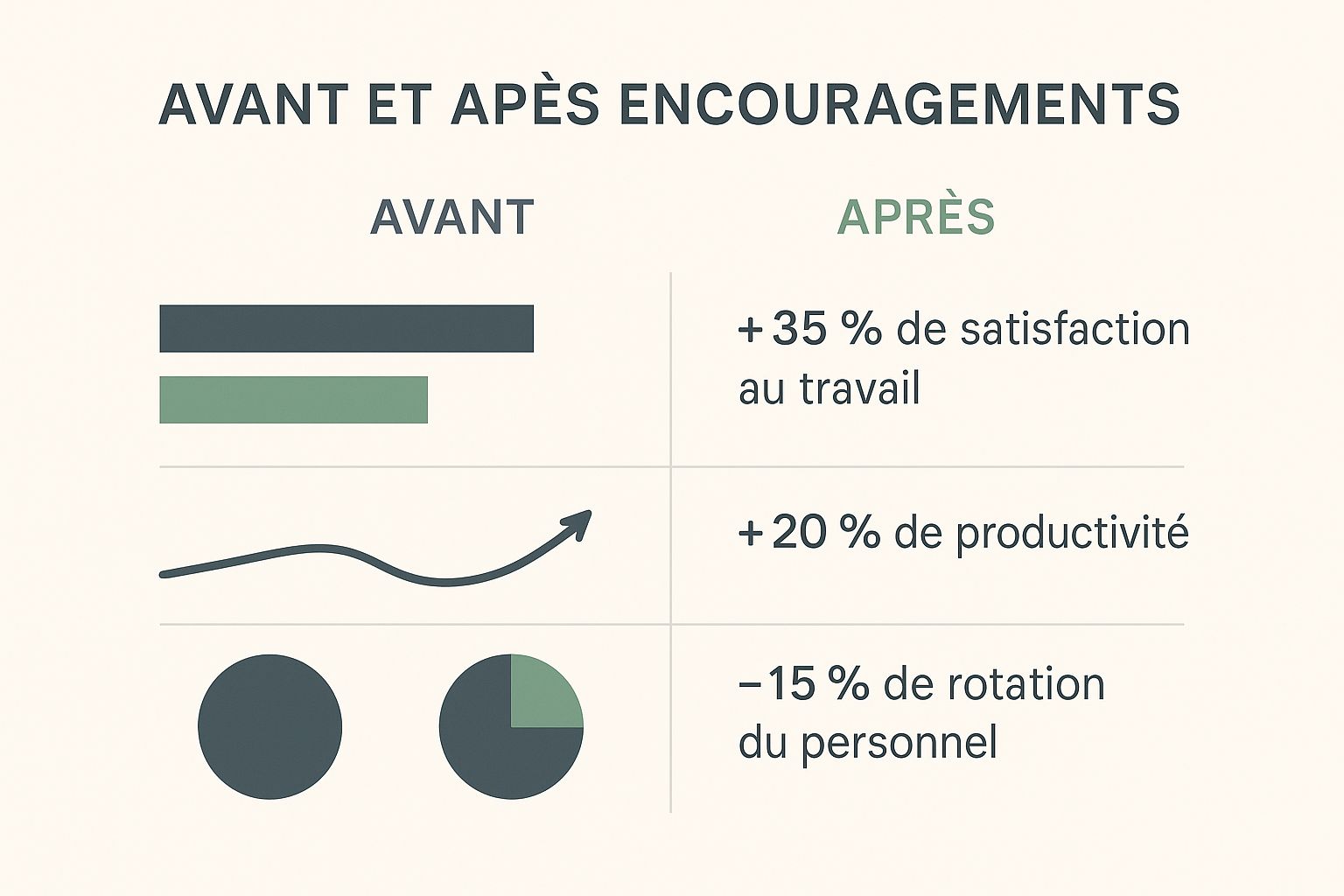
The idea is not just to please, but to provide guidance. Genuine recognition fosters a positive and encouraging mindset.
By making your compliments specific, you give your child concrete examples of what you truly value: their tenacity, creativity, or empathy.
Developing this habit helps him build strong self-confidence, based on his actions and inherent qualities, not just his successes. It's a gift that will stay with him long after childhood.
Turn words of encouragement into family rituals to strengthen bonds

Words have immense power, especially when they become part of our routines. Family rituals, even the most seemingly insignificant, are pillars for a child; they provide a sense of security and connection. This creates the ideal setting for making encouragement a natural and expected practice.
The idea is to weave these moments of recognition into the fabric of your daily life. No need for grand speeches. Just small, regular gestures that show your child that their efforts are noticed and that their actions matter.
Create moments of genuine sharing around the table
Dinner is often the perfect time to get together. Why not turn it into a little recognition ritual? A simple round of sharing is all it takes. Everyone shares a time when they thought another family member was wonderful.
For example, your child might say, "I thought Dad was amazing when he fixed my toy." And you could reply, "I thought you were amazing when you set the table without me even asking." It's simple, but this exchange strengthens bonds and teaches everyone to see and appreciate the positive actions of others.
By making mealtimes a moment of listening and mutual appreciation, you solidify the habit of encouraging each other for good. It's a concrete way to show that every effort, big or small, matters.
Simple actions, a lasting impact on self-esteem
There's no need to look for complexity. The most effective rituals are often the simplest, those that integrate effortlessly into your routine.
Here are some ideas to get you started:
- The word surprise. Slip a sticky note into their lunchbox or school bag. A sentence like "I'm so proud of you, you packed your things all by yourself this morning. You're amazing!" can literally brighten their day.
- The Pride Jar. Place an empty jar prominently in the living room. Whenever someone is proud of an achievement (their own or someone else's), they write it down on a small piece of paper and put it in the jar. Once a week, open the jar and read a few notes aloud. It's a truly joyful moment shared together.
- The compliment tree. Find a pretty tree branch or draw one on a large sheet of paper. Hang it on the wall. Prepare small paper tags with string to hang words of encouragement. It's a visual and positive reminder of the kindness that reigns in the home.
Through these small rituals, you create a true family culture where recognition is central to communication. Your child grows up knowing that their efforts are seen and appreciated, and that's the best fuel for self-confidence.
Transforming words into concrete memories through writing
Words of encouragement have an immediate effect, that's for sure. But when written down, they become far more powerful memories, true emotional anchors for the child. A simple notebook can then be transformed into a treasure trove, preserving these moments of pride.
Putting their thoughts into words, whether through writing or drawing, helps children to process what they felt. The compliment from you then becomes part of their story, a tangible proof of their worth.
Create a journal of successes and proud moments.
Why not offer your child a notebook of their own? The My Book Story journal, for example, was designed specifically for 6- to 12-year-olds . The idea is simple: invite them to write down moments when they felt proud, competent, or simply good. This notebook becomes their own personal success story.
Please note, this is not a school assignment. It's his space for freedom. He can draw the scene, write a few words, paste a photo... The important thing is to encourage him to capture the emotion of the moment.
To help him get started, you can whisper a few short phrases to him:
- Today, I was proud of myself when…
- I felt incredible because I managed to…
- What really pleased me was…
This little ritual helps her become aware of her own successes, without always waiting for someone to point them out to her. It's a huge step towards self-confidence that comes from within.
The echo of positive words in creativity and reading
This approach of nurturing confidence through words is gaining increasing popularity, including in children's literature. The success of phrases like " You're amazing " is evident in numerous books that support the personal development of young children. Since 2020, projects like Magami Junior: You're AMAZING have been a perfect example. This reflects a genuine trend in parenting. If this topic interests you, you can explore this inspiring project .
This pride journal becomes a valuable resource. On days of doubt, after a setback, your child can look through it to remember their strengths and what they are capable of.
Ultimately, this ritual transforms a simple positive phrase into a lasting memory. It's a concrete way to give her the tools to build her own confidence, day after day.
What to do when your child refuses a compliment?

You exclaim enthusiastically, "Your drawing is magnificent, you're amazing !" and the immediate response is, "No, it's ugly." It's a frustrating and disconcerting situation for us parents.
Why this reaction? Often, a child who doubts themselves has trouble believing compliments. Their inner voice, the one that whispers their insecurities, speaks much louder than ours. By rejecting your words, they protect themselves from possible disappointment or simply remain true to their self-image, even if it's negative.
Do not contradict, but welcome the emotion
The first instinct is often to insist. "But yes, it's true!" Yet, this is the best way to put him off. He's likely to shut down and cling even more tightly to his conviction.
The best approach? Simply acknowledge their reaction. Show them that you understand their emotion.
Try validating his feelings with an open question, such as: "Oh, okay, you don't like your drawing? What don't you like about it?". You show him that his opinion matters and you open the door to a sincere discussion, which is much more constructive than a debate.
Make the compliment concrete and factual
Sometimes, a broad compliment like "you're amazing" is difficult for a child to grasp. It's abstract. They can easily dismiss it out of hand.
The secret is to move from value judgment to concrete observation. Ground your compliment in facts, things he can't deny.
Here are some examples to transform your lyrics:
-
Instead of saying, "You're a champion at drawing!"
-
A better option would be: "I love the colors you chose for the sky. The mix of yellow and orange makes it so bright."
-
Instead of saying, "You were incredible at football today."
-
Try this instead: "I saw you run super fast to help your teammate. That was great teamwork."
By describing a specific action, you leave no room for doubt. He can't deny the facts. Your compliment then becomes much more genuine and, above all, easier for him to accept.
With a little patience, this approach will help him see his successes through your eyes. He will gradually learn to recognize the value of his own efforts and understand that your encouragement is sincere and deserved.
Your questions, our answers about your child's self-confidence
As parents, we have countless questions about how to best support our children. That's perfectly normal! To help you find some answers, here are a few frequently asked questions to help you build strong self-confidence in your child, day after day.
How often should you say "you're amazing"?
Here, sincerity is paramount. The quality of your compliment will always have more impact than the quantity. The secret is to reserve this powerful phrase for moments when you truly mean it, linking it to a concrete action by your child.
The idea is to prevent this powerful statement from losing its value. By using it at the right time, each compliment retains its full weight, impact, and credibility in your child's eyes.
And does it work with pre-teens too?
Yes, absolutely, but we need to adjust our approach a bit. Pre-teens and teenagers have an infallible radar for detecting what sounds fake or like flattery. Authenticity is therefore more essential than ever.
With a pre-teen, try very specific compliments that focus on their choices, perseverance, or approach. For example: "I noticed you organized your revision differently this time. Your method is really effective; it's amazing how well you adapted."
The essential point remains the same, regardless of age: to focus on the process and the effort, rather than on a result or a talent that might seem fixed. This is what fosters their autonomy and gives them a positive vision of what they are capable of.
Is it a good idea to compliment intelligence or talent?
In reality, it's far more powerful to value effort, strategy, and perseverance. Studies in developmental psychology have shown that praising a trait perceived as innate (for example, "you're so smart") can unintentionally create a fear of failure. The child may then avoid challenges for fear of no longer appearing "smart."
Conversely, by valuing the process ("I saw all the effort you put into it, well done!"), you encourage what is called a growth mindset . Your child understands that their skills are not fixed and that they can develop them through work. This is an incredible motivator to encourage them to persevere in the face of difficulties.
To transform these encouraging words into tangible memories and help your child write their own story, discover the My Book Story journal. It's the perfect companion for cultivating their confidence every day.