


What if a simple five-minute ritual could change your child's day, and even their outlook on life? That's exactly what The Five Minute Journal offers. Far from being just a notebook, it's a playful companion designed for children aged 6 to 12 , helping them cultivate optimism, self-confidence, and emotional well-being day after day. As a parent, it's a wonderful tool for creating unique moments of connection and supporting your child's personal development.
What exactly is the Five Minute Journal for children?
The idea behind this journal is disarmingly simple, and that's what makes it so charming. Forget the traditional diary where you have to recount your entire day in detail. This one is a short, guided format that invites the child to answer a few carefully chosen questions, morning and evening, to help them focus on the positive.
This practice is designed to fit effortlessly into any family routine, even the busiest. In the morning, it helps start the day off right, with positive energy. In the evening, it allows you to recall happy moments and calm your mind before falling asleep.
A small family ritual in two parts
The journal is divided into two key moments, each lasting only a few minutes:
- In the morning: As soon as they wake up, the child takes a moment to write down what they are grateful for and what could make their day really great. It's a simple way to train their brain to see the positive from the start.
- In the evening: Before falling asleep, he reflects on the good moments of his day and thinks about one small thing he could have done differently. This simple step promotes peaceful sleep and gently introduces him to self-reflection.
This isn't a writing assignment, but rather a little conversation with oneself. For a child, it's like planting a seed of happiness each morning and watering it in the evening to watch it grow.
The goal is to develop key emotional skills while having fun. By focusing on gratitude and small daily victories, the child learns to build a positive image of themselves and the world around them.
Much more than just a notebook
Very quickly, this little journal can become a wonderful bridge between you and your child. Their answers, even the simplest ones, open the door to deeper conversations about their joys, hopes, or minor frustrations. It's a golden opportunity to connect with their inner world.
For example, when your child tells you what would "make their day great," you discover what's important to them at that precise moment: perhaps passing their math test, or simply playing ball with a friend at recess. It's a valuable window into their world, giving you clues to better support and encourage them.
The newspaper's three superpowers explained to children
To make the five-minute journal an exciting adventure for your child, the secret is to present its pillars as superpowers to be developed day after day. Forget the big psychology terms; instead, talk about fun missions that give real meaning to this little family ritual.
With this playful approach, keeping a journal is no longer a chore, but a game where your child is the hero of their own story. The trick is to find simple images and words that speak to their imagination.
Here's a small illustration to make things clearer.
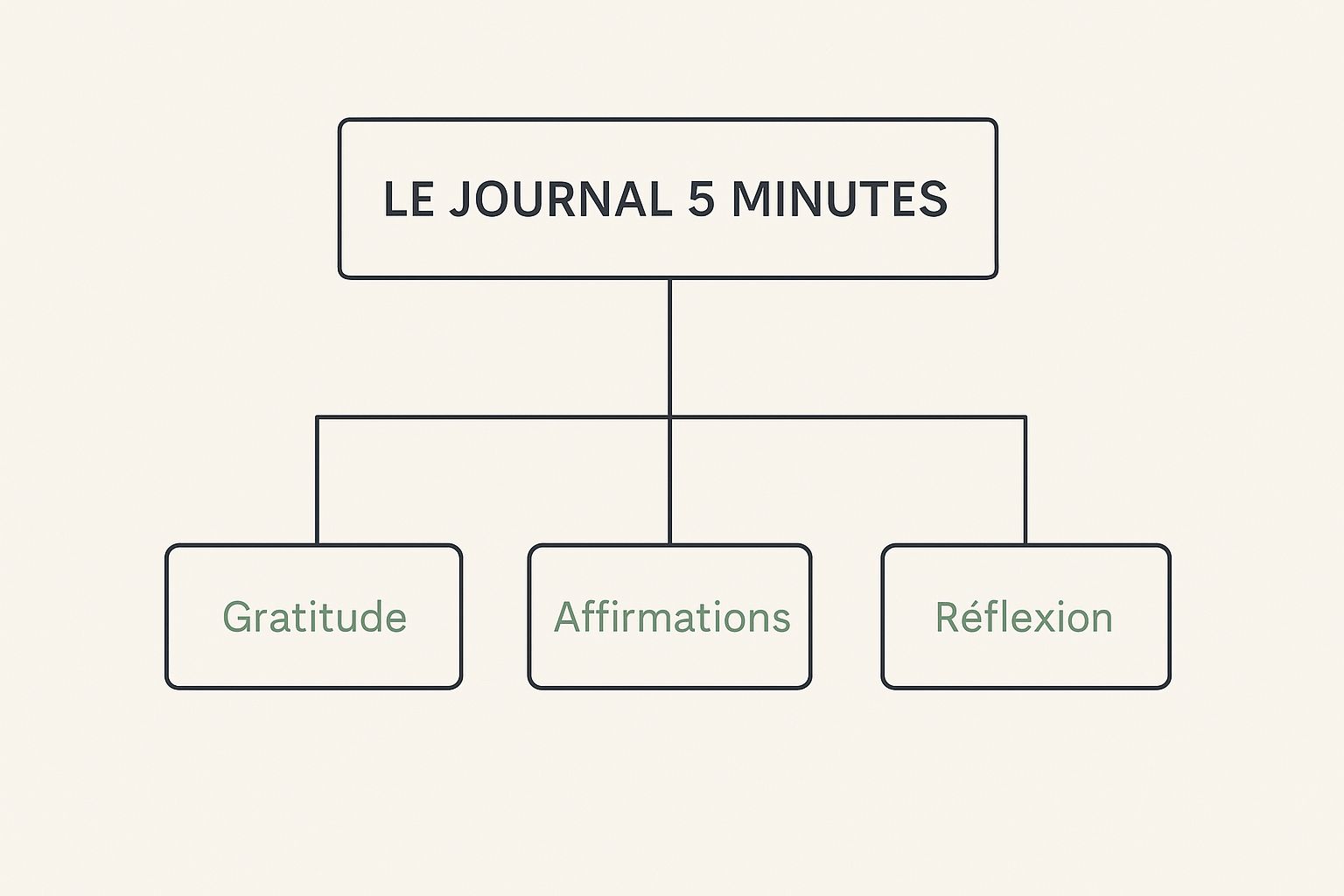
This diagram shows you the winning trio: gratitude, affirmations, and reflection. These three branches originate from the same trunk to help your child cultivate a positive and confident mindset.
The superpower of gratitude
Gratitude is simply the power to spot the magic hidden in the little things. It's a bit like having a happiness detector that's always on! This superpower helps your child see all the good things, instead of only thinking about the little worries.
Advice for parents: To help activate it, you can give them some suggestions:
- "What made you smile the most today?"
- "If you could thank someone with a magic wand, who would you choose and why?"
- "What little treasure did you discover today? (A pretty pebble, a kind word, a successful drawing...)"
The superpower of positive affirmation
Defining an affirmation, or an intention, is a bit like choosing your secret mission for the day . It's deciding which hero you want to be today: the superhero of kindness? The champion of courage? Or perhaps the explorer of curiosity?
This power helps the child understand that they are not just a spectator in their day, but an active participant. This is a huge first step in building their confidence in their ability to create positive things.
By saying to themselves, "Today I'm going to be brave," a child is not just making a wish. They are giving their brain a clear instruction to help it react courageously to a challenge.
Advice for parents: To encourage him, nothing could be simpler:
- "What superpower would you like to use at school today?"
- "What would be your special mission to make this day amazing?"
The superpower of thinking
As evening falls, it's time to activate the final power: that of reflection, which involves celebrating the day's achievements . The goal isn't to strive for perfection, but simply to acknowledge one's efforts and small successes, even the most discreet ones.
This positive review is a real boost to self-esteem. It shows your child that they accomplish wonderful things every day. It's the best way to recharge their positive energy before falling asleep.
Advice for parents: To support him, you can ask him/her:
- "Tell me about a time today when you were really proud of yourself."
- "What small victory have you achieved? (Even if it's just daring to ask a question in class!)"
Adapt the newspaper questions to each age group
To ensure that journaling remains enjoyable, the questions must, of course, evolve with your child. The idea is to maintain the spirit of the three pillars while phrasing them in a way that truly resonates with them.
Here are some example questions to turn journal posts into a fun and age-appropriate conversation for your child.
| Pillar of the newspaper | Idea for 6-8 year olds | Idea for 9-12 year olds |
|---|---|---|
| Gratitude | Who was super nice to you today? | What is the most interesting thing you learned today? |
| Affirmation | What special mission will you give yourself to be a good friend? | What small challenge could you set for yourself today to push yourself a little? |
| Reflection | Tell me about something you've accomplished, even if it was a little difficult. | What are you most proud of from your day and why? |
These questions are just starting points. The most important thing is to listen to your child and build on their answers to create a genuine moment of sharing, free from judgment and full of kindness.
How a journal fosters your child's confidence and optimism
Every small victory or happy thought your child writes in their journal is like a brick. Day after day, without even realizing it, they are building a solid wall: their self-confidence. This little evening ritual has a much greater impact than you might imagine, because it subtly changes the way they see the world and themselves.
By focusing on what's going well, even when the day has been a bit gloomy, he trains his brain to see the glass as half full. This is a fundamental skill for growing up with a realistic and solid optimism, a key to his future well-being.

Transforming small successes into great confidence
Self-confidence doesn't appear by magic. It's built on evidence, proof that you're capable. The journal then becomes a personal record of all your successes, from the biggest to the smallest.
Imagine for a moment: your child is afraid to read aloud in class. That evening, they write: "I managed to read two sentences without stumbling." It might not seem like a huge accomplishment to the world, but for them, it's concrete proof. The next day, thinking about it, they'll feel a little bit more confident.
Each positive statement is a message he sends to himself: "I am capable, I have value, I can succeed." It is this kind inner dialogue that forges a healthy and solid self-image.
Simply putting words to an achievement makes it real and much easier to remember. It's a powerful mechanism that helps children integrate their successes into their sense of self.
Gratitude, a shield against gloom
Practicing gratitude is one of the pillars of journaling, and its benefits are remarkable. It teaches your child to focus on the positive aspects of their life, making them more resilient to both minor and major setbacks.
This mental habit isn't just a pipe dream; it's backed by science. One study showed that just five minutes of gratitude a day is enough to improve well-being. After eight weeks, participants saw their personal fulfillment scores increase by 15% and their emotional resilience by 12% . To learn more, you can read this analysis on journaldemontreal.com .
Practical advice for parents:
- Validate their emotions: If the day was difficult, start there. "I can see it wasn't easy today. Despite everything, was there even a small pleasant moment?"
- Turn failure into a lesson: If he writes something he thinks he messed up, help him see things differently. Instead of "I messed up my drawing," encourage a thought like "Tomorrow, I'll try using a different color to see."
- Celebrate the effort, not just the result: The important thing is that you tried. "What's great is that you tried, even if it wasn't easy!"
Through these small interactions, the journal becomes a true training ground. Your child develops what is called a growth mindset . They learn that challenges are not insurmountable walls, but rather steps to grow and navigate life's ups and downs with greater serenity.
Make journaling a fun and creative family ritual
For a new habit to take root, especially in a child, it needs to be enjoyable, not a chore. The idea isn't to add another task to the list, but rather to create a special moment, a time everyone looks forward to. By transforming journaling into a creative family ritual, your child will embrace it for good.
Imagine this moment as a small daily celebration. Forget the austere notebook and the homework-like exercise. Bring out the colors, the stickers, and let your imagination run wild so that this journal becomes a true playground for emotions.

A journal that reflects your child's personality
Every child is a world unto themselves, and their journal should reflect that. This is key to helping them make it their own and see it as a confidant. Rather than imposing a strict framework, the trick is to adapt the tool and the timing to their personality and mood of the day.
Here are a few simple ideas to make the experience truly unique:
- A notebook that speaks to them: Let your child choose their notebook. Their favorite color, a character they adore... it doesn't matter, as long as they like it! Also, get some stickers, glitter markers, or fun stamps so they can decorate their thoughts.
- The audio diary for chatty kids: Your child loves to talk about their day, but writing isn't their thing? No problem. Your phone's voice recorder can become a great audio diary. It's spontaneous, easy, and perfect for capturing their gratitude and pride as they happen.
- A picture is worth a thousand words: For little ones or budding artists, a thought can absolutely take the form of a drawing. A bright sun for a great day, a little cloud for feeling down, a heart for a hug... The important thing is to express yourself, not necessarily with words.
A moment to share with the family
The best way to establish a habit is to share it. By making journaling a family ritual, you're not just motivating your child; you're creating precious memories and strengthening the bonds between you. Your own example is the greatest encouragement.
By sharing your own thoughts, you show your child that gratitude and introspection are normal and beneficial practices for everyone. Even adults! It's a priceless gift you're giving them for life.
To find a place for this ritual in your busy days, choose the time that suits you best. It could be in the morning at breakfast, each with their own notebook, or in the evening, for a quiet moment before bedtime stories. Regularity is more important than duration.
Consider variations, such as "the jar of good times." Each person writes down a nice thing that happened to them during the week and puts it in a jar. On Sunday, for example, you read all the notes together. It's a fun, group way to celebrate the little joys that make family life so special.
Using the journal to talk about emotions as a family
Your child's journal is much more than just a notebook. It's a secret door to their inner world. The few words they jot down or the drawings they make are precious little clues to what they're going through. They can become the starting point for rich and profound conversations about their joys, fears, or frustrations.
Seizing this opportunity is essential to helping her develop what is known as her emotional intelligence. By creating a space for compassionate dialogue, you offer her an invaluable gift: the security of feeling listened to and understood, without any judgment.

Creating a safe space for dialogue
The secret to getting your child to open up? Turn this moment into a friendly conversation, not an interrogation. Your role isn't to jump in and solve their problems, but simply to listen with genuine curiosity.
When he shares an emotion, whether happy or difficult, your first reaction is crucial. Acknowledge what he expresses with empathy. A simple phrase like, "I can see that made you very happy" or "That must have been difficult," validates what he's feeling. It shows him that his emotions are legitimate.
This approach is at the heart of the five-minute journal concept, which aims to improve emotional management through a simple practice. In fact, a survey conducted in France highlighted that 22% of gratitude journal users reported a significant decrease in their stress after just one month. To learn more, you can listen to this podcast on the impact of these practices at qub.ca.
Putting words to feelings
One of the biggest challenges for a child is learning to name what's happening inside them. A journal is a fantastic training ground for acquiring this all-important emotional vocabulary.
When your child draws a big black cloud or writes that they felt "weird," it's a real invitation to explore. You can help them by gently asking open-ended questions.
- "That cloud looks a little sad. Is that how you felt?"
- “'Strange' is an interesting word. Was it like having butterflies in your stomach, or more like a heavy stone?”
- "What happened right before you started feeling like this?"
By helping him make the connection between a situation, a sensation in his body and a word, you give him the keys to better understand himself.
Each time your child is able to name an emotion, they gain a little more control over it. Fear or anger becomes less overwhelming when you can say, "I feel afraid," instead of simply letting yourself be overwhelmed by it.
Advice for parents: here are some suggestions for reacting constructively to a difficult emotion:
- If he expresses frustration: "I understand that you're frustrated that you didn't succeed right away. That's normal. Do you remember a time when you succeeded at something difficult by persevering?"
- If he shares a fear: "Thank you for talking to me about this fear. It's brave of you. Just talking about it makes it a little less intense."
- If he recounts an argument: "That must have made you angry. What hurt you the most in this whole affair?"
Through these exchanges, the journal becomes a truly living tool. It serves not only to archive memories, but to actively build your child's emotional well-being, one conversation at a time.
How to maintain motivation when enthusiasm wanes?
Even with the most fun ritual in the world, it's perfectly normal for the initial enthusiasm to wane a bit. Don't be surprised if one evening your child utters the famous "I have no idea!" or drags their feet a little. It's an almost inevitable stage, and the best way to manage it is with a touch of creativity and a good dose of patience.
The key is to never lose sight of the goal. The 5-minute journal is neither a homework nor a competition. It's primarily a tool for feeling good. If it becomes a source of stress, it completely misses its purpose. Flexibility will be your best ally in overcoming those little dips in energy.
Restart the idea machine
Writer's block isn't just for writers! When inspiration is lacking, forcing your child to "find something" is often the worst strategy. The trick is to offer them alternative paths to help them reconnect with their emotions, without the pressure of having to find the right words.
Practical advice for parents:
- Engage the five senses: Ask them a very specific question. For example: "What's the best smell you've smelled today?" or "Tell me about the funniest sound you heard at recess."
- Drawing rather than writing: If the words don't come, the pencils are always ready. "What if you drew your mood for the day instead of writing it down? What color would it be?"
- Make the photos speak: Look at the photos from the day on your phone together. A single image is often enough to awaken a happy memory or a feeling of pride that he had forgotten.
The goal isn't to fill the journal at all costs, but rather to maintain this dialogue with yourself. Remind yourself that every little thought, even the simplest, has its place.
Rekindle the flame of the ritual
If a routine has become a little too... routine, it might be time to spice things up. A small change can be enough to revitalize this habit and make it exciting again for your child.
Practical advice for parents:
- Introduce themes: Why not launch themed weeks? One week on nature, the next on friends, or even one on superpowers. It provides a fun framework that can guide their thinking.
- Change of scenery: What if you swapped the notebook for colorful sticky notes to stick on a large board? Or even for chalk to write on a slate?
- Switch roles: For once, he's the one asking you the newspaper questions. You'll see, children love playing journalist!
Ultimately, a journal filled out three times a week with pleasure is a thousand times better than one completed every day reluctantly . Listen to your body, don't hesitate to adjust your approach, and celebrate consistency, not perfection.
Your questions, our answers
You think the idea is brilliant, but some practical questions come to mind? That's perfectly normal. Here's some clarification to help you embark on this adventure with your child, with complete peace of mind.
At what age can my child start?
From age 5 or 6 ! At this age, even if they can't yet write well, the practice can be oral. You become their scribe, or they can simply express their thoughts through drawing. The key is to establish this little ritual of positive reflection.
Then, around the age of 8 , he will enjoy writing a few words himself, which is excellent for strengthening his independence and pride. The tool simply grows with him.
What if he finds it boring in the long run?
That's a legitimate concern; routine can sometimes be a burden. The key is to keep the fun at the heart of the practice !
- Introduce fun weekly themes: "My friends' superpowers week" or "Treasures I've seen in nature."
- Vary the media: why not sticky notes of all colors on a large board, or even short audio messages recorded on your phone?
- Make it a moment of sharing with the family where everyone, in turn, tells a little story that made them happy.
The goal is for it to remain a pleasure, never a chore.
Trust is the foundation of this ritual. As your child grows, they will need their own private space. Respecting their privacy shows them that you trust them, which is fundamental to their personal development.
Can I read what he writes?
When he's young ( 6-8 years old ), filling out the journal together is a wonderful moment of bonding. But as he grows older, around 9-12 years old , his need for privacy will naturally emerge. It's crucial to respect this.
Offer to share whatever he wants, but never insist. It's an excellent way to show him that you respect his personal space.
And if we forget to do it one day, is that a big deal?
Not at all! The goal is to cultivate well-being, not perfection . It's better to do it a few times a week with joy and enthusiasm, rather than every day as an obligation. This moment should remain a little bubble of lightness, without any pressure for him or for you.
The My Book Story journal has been specially designed to accompany your child on this wonderful journey of self-discovery. With its inspiring themes and creative activities, it transforms writing into a truly captivating game.
You can discover it right here: The My Book Story notebook