


Can you imagine a tool that can enrich your child's day in just five minutes? That's the promise of the Five Minute Journal . Far from being a simple notebook, it's a true family ritual designed to help children aged 6 to 12 cultivate gratitude, boost their self-confidence, and develop their emotional intelligence.
What exactly is the Five Minute Journal?
The Five Minute Journal is a very simple journaling method that only takes a few minutes in the morning and evening. Say goodbye to writer's block! Children are guided by clear questions that encourage them to focus on the good things in their lives and better understand their emotions.
This isn't a diary where you have to recount your entire day from A to Z. Think of it more as a little daily well-being ritual. In the morning, set positive intentions for the day. In the evening, take a moment to remember the good times.

This habit easily finds its place in daily family life, whether during breakfast or just before bedtime stories. It's also a wonderful opportunity to create a moment of sharing with your child, focused on their feelings and inner world.
Simple, but terribly effective
The magic of this method lies in its simplicity. It doesn't require superhuman effort, just a little consistency. The idea is to make gratitude and reflection as natural a habit as brushing your teeth. By learning to notice the little joys of everyday life, your child develops an optimistic outlook for the future.
It's no coincidence that this concept is becoming increasingly popular with families. In France, interest in children's well-being tools climbed by an average of 18% per year between 2018 and 2022. This clearly demonstrates that many parents are looking for positive rituals. If you're interested in the habits of young people, analyses like those from 20minutes-media.com clearly illustrate this underlying trend.
The goal isn't to pretend that difficulties don't exist. It's more about training your brain to also see all the beauty and goodness that surrounds us. It's a real superpower for life!
The benefits for the child are tangible and affect many aspects of their development. Here's a small table to help clarify things.
The benefits of journaling for your child
This table summarizes the main benefits of the Five Minute Journal in the routine of a child aged 6 to 12 years.
| Benefit for the child | Simple explanation for parents | Long-term impact |
|---|---|---|
| Increased self-confidence | By noting his small victories each day, he becomes aware of his abilities and feels stronger. | He will more easily dare to embark on new projects and face challenges with greater serenity. |
| Greater resilience | He learns to find the positive even when the day has been difficult, which helps him to bounce back better after a failure. | He will develop a growth mindset, seeing obstacles as opportunities to learn. |
| Emotional Intelligence | Putting words to one's emotions (joy, pride, gratitude) helps one to better understand oneself and manage one's feelings. | Better communication of one's needs and greater empathy towards others. |
| Stronger family ties | This ritual becomes a special moment of sharing between you, where he feels listened to without judgment. | Family relationships based on trust and open, sincere communication. |
In short, this little notebook is much more than just an object. It's a companion that helps your child grow by discovering their own strengths and the beauty of the world around them.
Establish a positive morning ritual
The morning is the start of the day. These first few minutes often set the tone for everything that follows. Why not use this precious time to create a positive family ritual? That's exactly what the Five Minute Journal offers, with a simple approach to get started smoothly.
Far from being just another chore in an already busy routine, it's about creating a brief moment of connection with your child. Five short minutes is all it takes to build a solid foundation before the big day of school. Let's look at how to address the three morning questions.

First question: sowing the seeds of gratitude
The journal begins with a simple question: "What am I grateful for today?" For a child, gratitude can quickly seem like a dirty word, a somewhat vague concept. Your role is to help them make it concrete and personal.
The idea is not to look for extraordinary things. On the contrary, the whole point of the exercise is to learn to see the magic in the little things of everyday life.
Here are some examples to guide him:
- The sensations: "I'm happy about Dad's big hug this morning." or "I love feeling the sun warming my face."
- Tastes: "I'm grateful for the good pancakes at breakfast!"
- The people: "I'm happy that Grandma is coming to pick me up from school later."
- The objects: "I love my new adventure book."
By doing this, you train their brain to notice the positive things around them. It's a valuable reflex that will stay with them throughout their life.
Second question: to imagine a beautiful day
Next comes the question: "What would make this day amazing?" The goal isn't to create a to-do list, but rather to imagine moments that would bring a smile to their face. It's a fun way to program their brain for happiness.
Help your child find small things that depend only on them and that are primarily a source of pleasure.
We move from a passive expectation ("I hope the day will be good") to an active intention ("This is how I'm going to make it great"). It's a huge change in perspective that gives her the feeling of being in control of her own happiness.
Here are some ideas to inspire her:
- How to make a friend laugh during recess.
- Learning something amazing in class.
- Inventing a great game with my brother tonight.
- Make a beautiful drawing to give to the teacher.
These small missions transform his day into an adventure in which he is the hero.
Final step: nurturing self-confidence
The last question of the morning is a positive affirmation: "I am..." . It's the moment to remember your superpowers, your qualities, and boost your self-esteem.
At first, he'll probably need a little help finding the right words. You can give him some ideas based on what you see in him each day.
- I am brave .
- I am a good friend .
- I am creative .
- I am capable of learning many new things.
By repeating these words each morning, they eventually take root within him. This simple and nurturing ritual gives him all the tools he needs to start his day off right: confident, optimistic, and ready to welcome all the wonderful things that await him.
Create a soothing evening ritual
While the morning is meant to give the day a great boost, the evening is a time to slow down and unwind. The Five Minute Journal bedtime ritual is designed precisely for this: to help your child process the day's events and fall asleep peacefully.
This little ritual revolves around two simple yet incredibly effective questions. They invite reflection and gratitude, transforming bedtime into a true moment of calm. It's the best way to ensure that your last thoughts before falling asleep are positive and gentle.

Spot the day's gems
The first question of the evening is: "3 great things that happened today." It's an invitation to become a true happiness detective, capable of finding the positive even when the day has been a little gray or quite ordinary.
The idea is to teach him to notice the little hidden treasures of everyday life. These "wonderful things" don't need to be extraordinary events, quite the opposite! Magic is often found in the details.
- A fit of laughter shared with a friend in the canteen.
- The pride of finally understanding a math problem.
- The delicious taste of chocolate cake for afternoon tea.
- The surprise of seeing a rainbow through the window.
By recalling these little moments, your child revisits their day with a positive perspective. This reinforces the idea that every day, even the simplest, has its share of lovely memories. A perfect practice to soothe the mind and fall asleep more easily.
By guiding your child to find the good in their day, you give them a superpower: the ability to build resilience. They learn that even a day perceived as "bad" has its little sparks.
Turning challenges into lessons
The second and final question is: "How could I have made this day even better?" Be careful, this question might seem a bit tricky, but it's meant to be supportive. The goal is never to dwell on regrets or focus on what went wrong.
No, the goal is to cultivate a mindset focused on improvement. It's a gentle way to reflect on one's actions and learn from them. Your role, as a parent, is to help them formulate their thoughts so they look toward the future.
-
Instead of saying, "I messed up my drawing."
-
You can guide them towards: "Next time, I could take a little more time to color without going over the lines."
-
Instead of thinking, "I got angry with my brother."
-
Encourage a thought process like: "Tomorrow, if I feel myself getting angry, I'm going to try to take a deep breath before I speak."
This approach completely demystifies mistakes. They become simple learning opportunities. Your child realizes they have the power to do things differently next time. This little ritual gently concludes the day, prepares for a peaceful night, and opens the door to a tomorrow full of new possibilities.
Adapt the journal to each age
A 6-year- old and a 12-year -old obviously don't see the world in the same way. For the Five Minute Journal ritual to truly work, the key is to adapt it to their age, personality, and current interests. The goal isn't to impose a strict framework, but rather to give them a tool that will evolve with them.
For younger children, between 6 and 8 years old , writing can be a little intimidating. At this age, imagination reigns supreme! So, instead of long texts, we'll focus on more creative and fun forms of expression. The journal becomes a real playground.
For creative little ones aged 6 to 8
The idea is to make gratitude and positive emotions concrete and fun. Writing is just one of many ways to express oneself.
Here are a few ideas to turn this moment into child's play:
- The illustrated journal: Suggest that they draw what made them happy or what they are grateful for. A big sun for a beautiful day, a heart for a hug, or a portrait of their best friend. It's simple and speaks volumes!
- The magic of stickers: Prepare a small box with all sorts of stickers (smileys, stars, animals). Each evening, he can choose one to illustrate a good moment or a positive thought.
- Talking aloud: The journal can very well be 100% oral. In the evening, take five minutes to ask him questions. It's a golden opportunity for a moment of sharing and connection, just before bedtime.
For budding thinkers aged 9 to 12
As children approach pre-adolescence, they begin to develop more complex thinking skills and a real thirst for autonomy. This is the perfect time for a journal to become a genuine tool for self-discovery.
You can encourage him to elaborate a little more in his answers, beyond simply listing things. If he's grateful for a friend, why? What does this friend bring to his life that's so special? This is also the perfect age for him to personalize his notebook from A to Z. A simple notebook can become his own secret garden, decorated according to his tastes.
Your role changes slightly. You go from being a guide who shows each step to a discreet and supportive presence. The important thing is that your child takes ownership of their journal, without ever feeling pressure to give the "right answer" or to have perfect spelling.
To get a clearer picture, here is a small summary table of the different possible approaches.
Ideas for adapting the activity according to the child's age
| Age range | Recommended approach | Support ideas | Advice for the parent |
|---|---|---|---|
| 6-8 years old | Playful, visual and oral. | Drawings, stickers, discussions out loud. | Actively guide, ask simple and open-ended questions. |
| 9-12 years old | Independent, introspective, and creative. | Simple writing notebook, journal to personalize. | Encourage and value effort, and respect one's private life. |
This table clearly shows how the method is evolving from a highly guided practice to a more personal approach.
This infographic perfectly illustrates how the newspaper can evolve with the child.
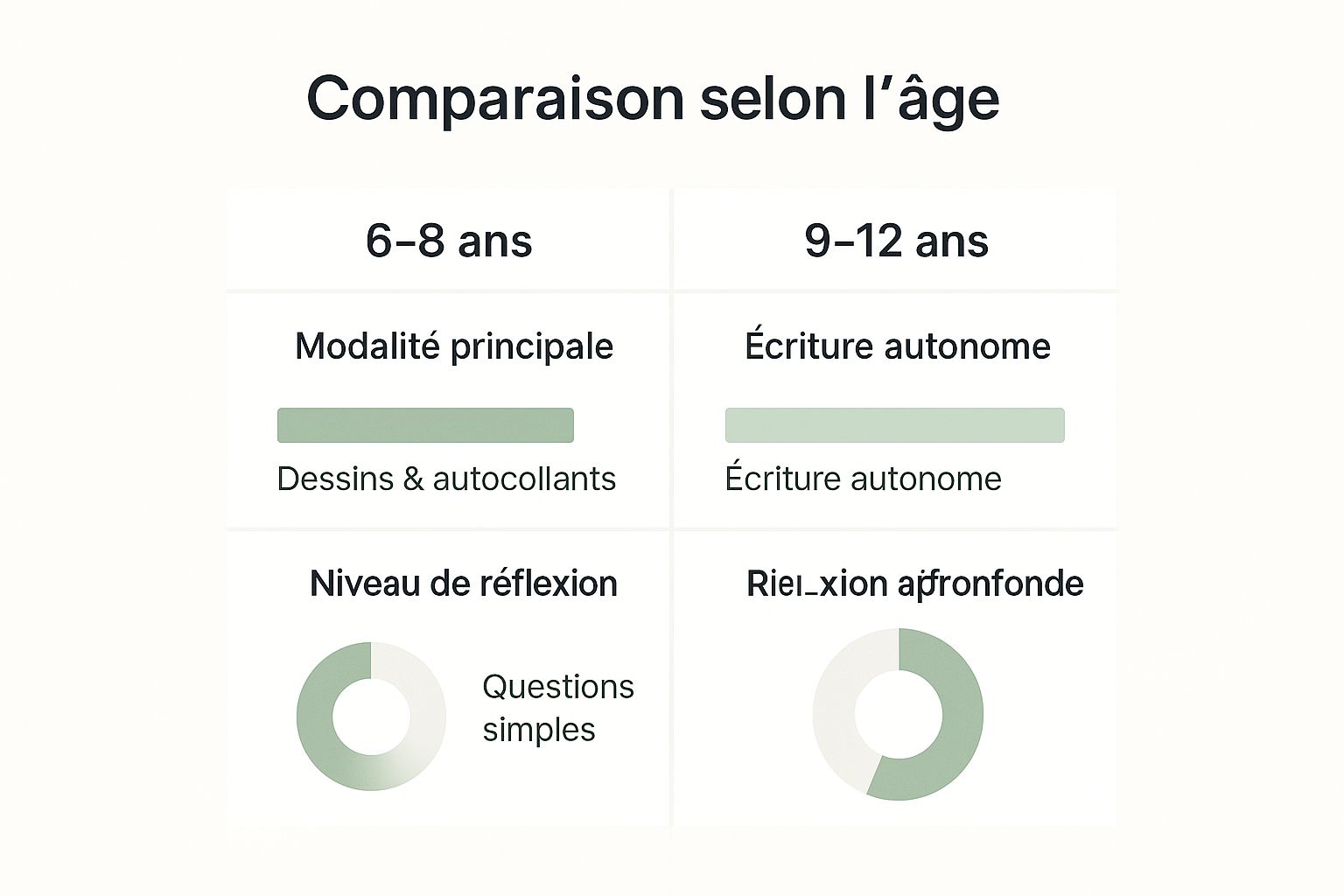
It's immediately clear how we move from a sensory and fun approach to deeper, more independent reflection. Whether drawn, narrated, or written, the essential thing is that the Five Minute Journal remains a space of freedom, positivity, and kindness.
Maintaining motivation and overcoming periods of creative block
Starting a new habit, even one as simple as the Five Minute Journal , is a bit like embarking on a small adventure. There will be days when enthusiasm is high, and others when motivation seems to have packed its bags. That's perfectly normal! The important thing isn't to aim for perfection, but to move forward with patience and gentleness.
The dreaded "I don't know what to write" is a classic. When your child gets stuck staring at a blank page, it's not a lack of gratitude, but often simply a lack of inspiration. The best way to handle this is to anticipate it.
What to do when ideas just won't come?
Writer's block happens to everyone, even children. Instead of putting pressure on yourself, why not turn this small obstacle into a game to reignite your creativity?
Here are some simple parenting tips to ensure you're never short of ideas:
- The gratitude box: Take a pretty box and slip in little slips of paper with ideas for things to be grateful for (a good meal, a fun game, a hug, sunshine). If you're ever stuck for something, just pick one!
- The power of photos: Look together at a photo of a recent happy memory (a vacation, a birthday, a trip to the park). It helps to instantly reconnect with the emotion and immediately gives you something to talk about.
- Engage the senses: Guide him with simple questions. "What is the best thing you have tasted today?" or "What is the funniest sound you have heard?"
How to keep the flame alive in the long term?
Once the initial excitement fades, routine sets in. It's often at this point that motivation can begin to wane. To keep journaling a pleasure and not a chore, the ritual needs to be maintained. The trick is to see it as a moment of sharing, not as a homework assignment.
The goal isn't to fill pages, but to cultivate a positive mindset. If your child skips a day, or even a week, it's not the end of the world. The important thing is to gently encourage them to return to school, without ever judging them.
To ensure the magic lasts, here are a few suggestions:
- The journal, a family affair: Lead by example! If your child sees you enjoying filling out your own journal, they'll be much more likely to do the same. You could even create a special time when everyone fills out their journal together.
- Celebrate progress: A full week of journaling completed? That's great! Highlight this small victory with a simple reward: choosing the evening's movie, getting 10 extra minutes of reading time, or simply enthusiastic praise.
- Stay flexible: If your child is too tired to write one evening, suggest they do it verbally. If they prefer to draw about their day, that's perfect too. The medium matters less than the intention behind it.
By approaching this ritual with flexibility and creativity, minor setbacks become opportunities to enhance this beautiful moment. The Five Minute Journal then transforms into a true ally for your child's well-being.
Questions that all parents ask themselves
Incorporating the Five Minute Journal into your child's routine is a wonderful idea, but it's normal to have some questions before taking the plunge. It's a bit like starting a new activity: you want to make sure you have a good foundation.
Here are the answers to the most frequently asked questions, to help you start this wonderful adventure with complete peace of mind.
At what age can my child start?
There's no strict rule, but you can start gently from age 6. At that age, of course, you don't expect long paragraphs! The journal can take the form of a drawing, a few words you write for them, or even a simple conversation.
The idea is to open up a dialogue about what he felt during his day. Around 8 or 9 years old , when writing becomes easier, he'll really be able to take flight and fill his journal on his own. The key is that this moment remains a game, a little ritual shared with him, and certainly not just another homework assignment.
What if he no longer wants to?
As with everything, the initial enthusiasm can fade. That's perfectly normal! The first thing to do is simple: don't force anything. Forcing him could make him resistant for good.
Try digging a little deeper. Does he get bored with the questions? Does he find it difficult? Suggest a short break of a few days, then bring the idea back up by doing it together. To spice things up, get out the colored markers, stickers, or let him choose a new notebook. And often, the best motivation is seeing you fill yours in next to him.
The goal is not perfection, but enjoyment. A joyful and irregular ritual is better than a daily chore. Consistency will come with habit, not with constraint.
Do I need to buy a special notebook or is a simple notebook sufficient?
A simple notebook is perfect to start with! It's even a great option, because your child can decorate it however they like, turning it into their own little secret garden. This reinforces their engagement. You can even prepare the pages with them each week, writing down questions.
Some commercially available notebooks are well-designed, with a clear structure that can motivate children who like having a "real" book. But ultimately, the tool matters less than the ritual itself. The notebook has the advantage of its low price and the endless creativity it allows.
How should I react if he tells me his day was "rubbish"?
Take this response as an opening. It's a golden opportunity to talk. The first step is to validate his feelings, without trying to contradict him: "Oh really? Tell me, what went wrong today?" Let him get it all off his chest.
Once he feels listened to, you can gently guide him. The goal is not to deny his bad day, but to help him find a tiny spark, however small: the taste of his favorite dessert in the cafeteria, a friend who smiled at him, a cloud shaped like a dragon.
This is where the evening question, "What could have made this day better?", takes on its full meaning. It doesn't trap him in his disappointment, but helps him think about solutions. He once again becomes the architect of his own happiness, even on rainy days.
The My Book Story was designed to be much more than just a notebook. It's a true creative companion that guides your child, step by step, to develop their confidence, imagination, and well-being. Discover the My Book Story notebook at mybookstory.co