


What if a simple habit, quicker than choosing clothes in the morning, could boost your child's confidence and cultivate their optimism? That's exactly the promise of the 5-Minute Journal . Much more than just a notebook, it's a daily ritual that can become a real superpower for children aged 6 to 12 .
Why 5 minutes a day can change everything for your child
In the whirlwind of our lives as parents, we all know that finding time for genuine connection with our children is a challenge. Yet, it's these little rituals that build the strongest memories and foster their inner peace. The 5-minute journal concept perfectly addresses this need: it's not just another chore, but a truly beneficial break.
It's an invitation to talk to yourself and share, a reassuring little cocoon where your child learns to listen to their thoughts and emotions, without judgment.
A superpower for her emotional well-being
Think of these five minutes as a mini workout for your child's mind. Each day, they strengthen their ability to see the bright side of things, understand their feelings, and set small goals. It's a simple practice that can truly change how they view their day and the challenges they face.
It's a powerful tool for developing qualities that will serve him throughout his life. Here are some of the concrete benefits for him:
- Cultivating gratitude: By taking the time each day to write down what they are grateful for (a hug, a shared game, a compliment), your child learns to savor small joys. Their worldview immediately becomes more positive.
- Boosting emotional intelligence: Putting words to what he feels helps him better identify and manage his emotions. This is an essential skill for building good relationships and self-confidence.
- Developing optimism: Simply asking oneself "what would make my day great?" encourages one to focus on possibilities rather than problems.
More than a newspaper, a bridge between you
The 5-minute journal isn't something to do alone. It can quickly become a golden opportunity to talk and strengthen family bonds. When you show interest in what your child writes or draws, you open a window into their inner world.
"The greatest gift you can give your child is your attention. These five minutes shared around the newspaper become a ritual of listening and appreciation that strengthens the parent-child bond in a lasting way."
By setting an example or sharing your own thoughts, you turn this routine into a little family adventure. It's a very concrete way to show him that his thoughts matter, that his emotions are valid, and that you're there to support him. This little notebook then becomes a symbol of your support and love.
What exactly is the 5 Minutes children's newspaper?
The concept of a 5-minute journal might seem a little vague at first. But for a child, it's quite simple: it's like a secret garden all their own, where they can let their thoughts wander. It's a nurturing little haven, far removed from the pressure of grades or activity schedules. The secret of this tool lies in its simplicity and reassuring structure.
The idea is to structure the day around two short moments of self-reflection, like a gentle ritual. In the morning, your child takes a few moments to sow the seeds for a good day. In the evening, they return to gather the pleasant moments and lessons learned.
It's a practice that's gaining popularity, and for good reason: its benefits for morale are very real. Moreover, this habit is part of a broader trend in France, where more and more people are turning to writing to take care of themselves. A study showed that approximately 23% of French people keep some form of personal journal, and 67% of those who practice gratitude say they feel much better. If this topic interests you, this article on the impact of media on well-being explores this underlying trend.
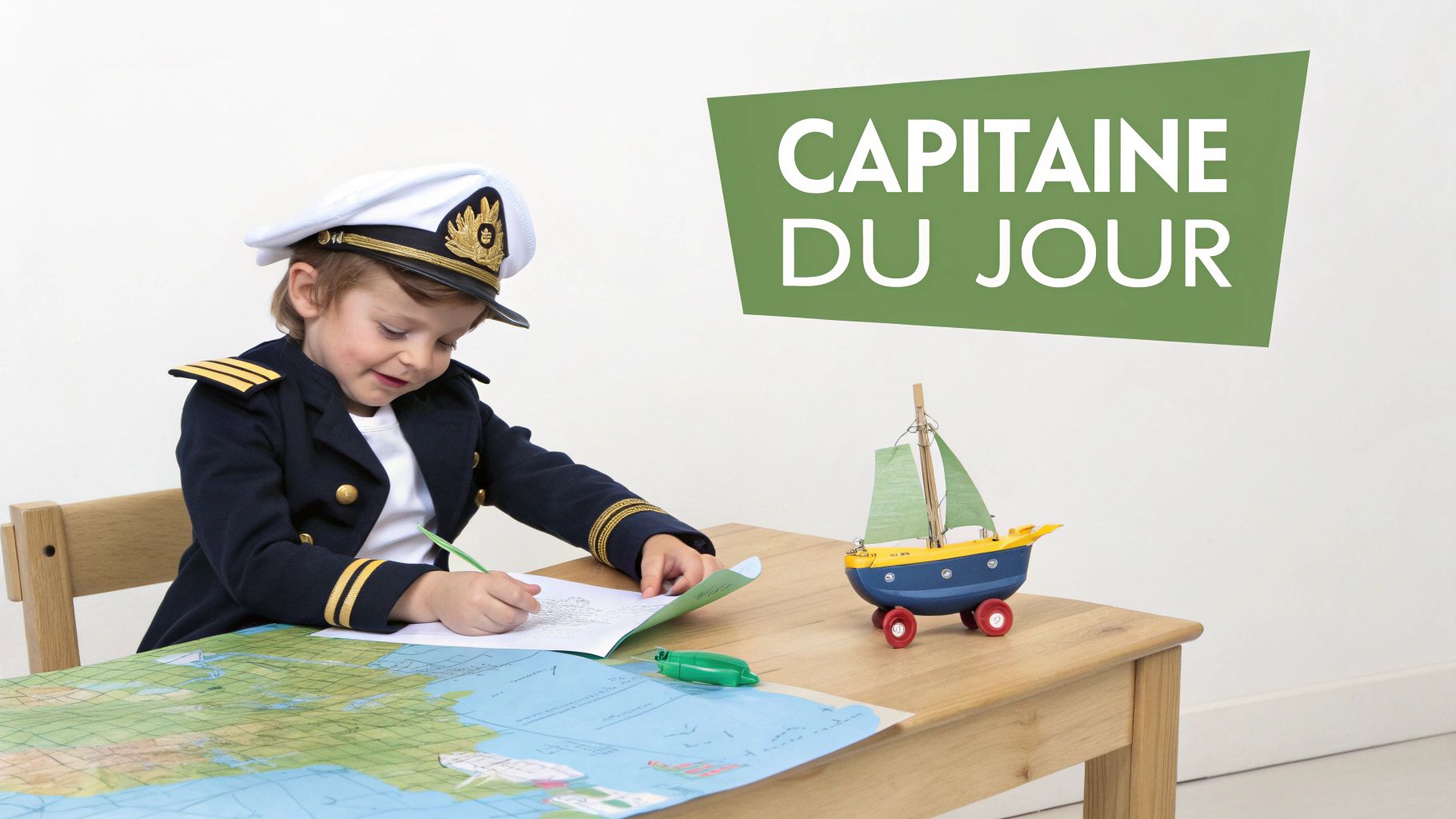
Become the captain of your day
To help your child understand the idea, why not use a little metaphor? Tell them they are the captain of their own ship: their day.
In the morning, before setting off for school, he takes out his telescope and looks at what awaits him on the horizon. It's time to prepare for the journey with some simple questions:
- What good things could happen to me today? (A game of football with a friend, a compliment from the teacher...).
- What small action could make my day great? (Helping a classmate, drawing my favorite hero...).
In the evening, back in port, the captain notes his discoveries in his logbook. It's time to take stock of the day's treasures:
- What were my three best moments? (Dad's smile, a good grade, the taste of chocolate cake...).
- What did I learn today? (Even a small argument can teach us something!).
Simplicity above all
One of the biggest strengths of the 5 Minutes newspaper is that it's truly accessible to all children. You don't need to be a great writer or a budding artist to get started.
The true value of journaling lies not in the perfection of the sentences, but in the regularity of the ritual. It is this small habit of connecting with oneself that nurtures confidence and serenity.
If your child is still young or not very comfortable with words, no worries. Encourage them to express themselves in other ways! A drawing, a smiley face, or a few words are perfectly sufficient. The goal isn't to create a work of art, but rather to offer them a safe space where they can be themselves. This flexibility is often what reassures parents the most and allows them to adopt this routine in a natural and fun way.
The tangible benefits for child development
Adopting the 5-minute journal ritual isn't just about giving your child a notebook to fill out. It's so much more. It's a true tool for growth that will plant essential seeds for their development. The effects, sometimes subtle at first, take root day after day, building a solid foundation for their future.
Think of this journal as a little gym for their mind. Every morning and evening, without even realizing it, your child is strengthening their ability to see the positive, to have confidence in themselves, and to understand their feelings. These benefits aren't just a feeling of well-being; they're tangible in their daily life.
Boosting self-esteem, one small victory at a time
Self-confidence is built step by step, through small successes. The 5 Minutes newspaper encourages your child to identify and celebrate their personal victories of the day, each evening before bedtime.
For you, as a parent, it's a window into what truly matters to your child. It could be a good grade, of course, but also finally managing to tie their shoelaces independently or daring to ask a question in class. By putting these successes on paper, they become aware of their own capabilities.
A child who writes "Today I helped a friend who was sad" isn't just recording a memory. They're internalizing the idea that they are a kind person, capable of helping others. That's powerful for their self-image.
This habit will gradually make him more courageous in the face of challenges, because he will have in mind a whole list of his own successes to give him strength.
Developing emotional intelligence and resilience
Between the ages of 6 and 12, emotions are often a whirlwind. A journal offers a safe space to put words, or even drawings, on everything that's happening inside.
By asking themselves how they are doing each day, children learn to identify their feelings: joy, anger, sadness... Putting a name to an emotion is the very first step in learning to manage it. A child who can say, "I'm frustrated because..." is already taking control.
This improved self-understanding makes him more resilient. When faced with an obstacle, he learns not to let himself be overwhelmed. Specifically, the journal helps him to:
- Practicing gratitude to see the glass half full: By looking for the positive, he realizes that even in a "terrible" day, there were good moments.
- Taking a step back in the evening: The question "What could have made this day even better?" is not there to reproach him, but to invite him to imagine solutions.
The 5-minute journal thus becomes a daily exercise to forge a calmer, more creative mind, ready to face life's small and big adventures.
How to start this new habit as a family?
Introducing a new routine isn't always easy, especially with children. The idea of a new "task" can quickly put them off. But with the 5-Minute Journal , the trick is not to present it as homework, but rather as a little adventure just for the two of you. Make it a game, a special moment together, and you'll see, it will quickly become an eagerly anticipated ritual.
The goal isn't to add another constraint to an already busy schedule. On the contrary, it's to offer a break, a little space to breathe, talk, and create together. By approaching it with lightness and your own enthusiasm, you show your child that dealing with their emotions is as natural and fun as playing with LEGO. It's this positive approach that will help them establish this habit for good.
Create a small bubble of trust
The atmosphere is essential for your child to feel safe enough to open up. No need to completely overhaul your home! A few small touches are all it takes to create a space that encourages confidences.
- Choosing the right time: Try to fit the newspaper into a quiet moment of the day. In the morning, while your hot chocolate is still warm, or in the evening, just before reading a story, are perfect times. The idea is to associate it with relaxation, not with the daily grind.
- Creating a cozy corner: A simple rug with a few cushions, a soft blanket, and a box of pretty crayons can transform a corner of the room. This "journal corner" will become his little refuge, a place where he knows he can say and draw anything without judgment.
- Lead by example: The best way to motivate your child is to do it yourself. Take your own notebook and sit down next to them. There's no need to share what you write; simply seeing you do the same thing adds value to the moment and shows them that it's important to you too.
Expression is more important than perfection
The biggest trap would be wanting your child's journal to be "perfectly filled." For a child, the important thing is to let out what's inside, no matter how.
True success isn't a page written without a single correction. It's a child who feels free enough to draw their anger in big scribbles, express their joy with a bright sun, or simply stick on a sticker to tell the story of their day. It's the gesture that counts.
Be flexible. One day he wants to draw? Great! The next day he only wants to write one word? That's perfect too. There's no right or wrong way to do it. This freedom is essential for him to take ownership of his journal and make it a real tool for feeling good.
To help you get started, here are some simple questions to ask. Feel free to adapt them to suit the age and mood of the moment.
Examples of questions for your child's 5-minute newspaper
This small chart is a simple toolbox to help you guide your child, whether upon waking or before going to sleep.
| Time of day | Questions for 6-8 year olds | Questions for 9-12 year olds |
|---|---|---|
| The morning | Which emoji represents your mood? What would make you super happy today? | What can I say thank you for this morning? What small thing could I do to have a great day? |
| The evening | Draw the best moment of your day. What new things did you learn today? | What were the 3 best moments of my day? How could I have made today even better? |
Ultimately, approaching the 5-minute journal as a creative game and a time for sharing is a wonderful way to care for your child's well-being, while strengthening that precious bond you share.
Create a one-of-a-kind journal with My Book Story
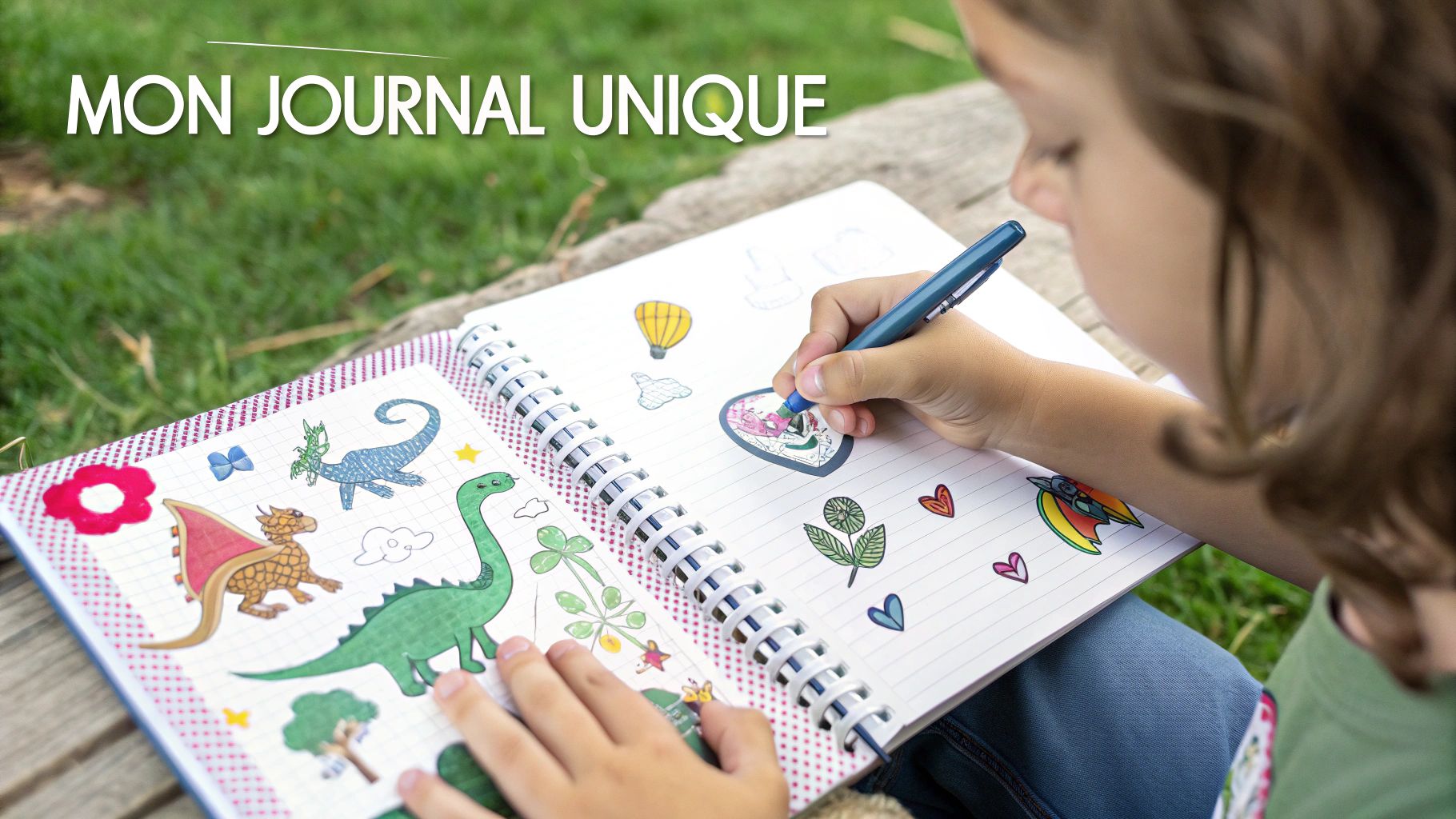
For a child to truly embark on the adventure of the 5-Minute Journal , the notebook must be their own . A simple notebook bought in a store is fine, but it remains somewhat anonymous. Now imagine if your child became the hero and creator of their own book. That's where personalization changes everything, transforming a simple tool into a true personal treasure.
This personal involvement is key to establishing a lasting habit. When a child actively participates in creating their journal, it's no longer a routine imposed by their parents, but their own personal project . This sense of pride motivates them to return to it every day, not out of obligation, but out of pure desire.
A newspaper that truly reflects him
That's exactly what a platform like My Book Story offers. You don't just pick a notebook off a shelf; you personalize it to reflect the child's passions. Imagine a dinosaur-themed journal for your budding paleontologist, or a notebook filled with fairies and glitter for a dreamer.
By choosing the themes, colors, and even the characters that will accompany them throughout the pages, the child sees their tastes validated. It's a powerful message that's being sent to them: their inner world matters and deserves to be explored.
But personalization doesn't stop at the cover. The content can also be customized:
- Choosing characters: He can select an avatar that resembles him or that embodies his favorite heroes. The emotional connection is immediate.
- The selection of themes: Passionate about space, animals or sport? The journal becomes the visual reflection of what excites him.
- Adapting the questions: The short questions of the day can be adjusted to his age and maturity, making the exercise much more meaningful for him.
By giving a child the reins in creating their own journal, we offer them much more than a book. We give them concrete proof that their imagination and identity have value. The journal becomes a true reflection of who they are.
A routine that becomes a creative family project
The creative process itself becomes a wonderful activity. Designing the perfect 5-minute journal together is a real family creative project. It's a special time to discuss tastes, dreams, and what makes them happy, all while strengthening family bonds.
This shared time anchors the practice in a positive atmosphere from the outset. The journal is no longer an object given to them, but the fruit of a joyful collaboration.
With this approach, your child discovers that taking care of their emotions can be fun and creative. They're not just filling pages; they're building, day after day, a book that tells their story, their feelings, and their small victories. Their journal becomes a unique work of art, a companion that grows with them and that they'll be proud to continue.
Your questions, our answers from parents
You think the idea of a 5-minute journal is brilliant, but you have a few questions? That's perfectly normal. Starting a new routine with your children always requires a little adjustment period.
To help you embark on this exciting adventure with complete peace of mind, we've compiled the most frequently asked questions. Our goal? To transform your doubts into simple and creative solutions.
At what age can my child start?
There's really no magic age! The period between 6 and 12 years old is often ideal, as children begin to reflect more deeply on themselves. But ultimately, every child is different. A 5-year-old with a vivid imagination might love the exercise, while a more reserved 8-year-old might need a little help.
The secret is to adapt. For younger people who aren't yet writing pros, drawing is a wonderful language.
- Bring out the creative artillery: colored pencils, markers, stickers… anything goes!
- Ask questions using images: "Draw the thing that made you smile the most today" or "Which emoji would you choose to describe your mood this morning?"
- Become their personal scribe: Offer to let them dictate their thoughts to you. By writing them down for them, you show them that what they feel is important and you strengthen your bond.
Keep in mind that it is the tool that must adapt to the child, and never the other way around.
What should I do if my child doesn't want to write?
Forcing him would be the best way to turn this enjoyable moment into a chore. If your child resists, the first thing to do is try to understand why. Is he simply tired? Does he feel like it's just another homework assignment?
The journal should never become a source of conflict. It's a gift, a space for freedom. If he doesn't feel like it one evening, it's perfectly fine. Flexibility is the best friend of good habits.
Here are some ideas to take the pressure off and keep the game lively:
- Make the exercise fun: Instead of "homework," propose a "creative challenge." For example: "Tonight, we'll tell the story of the day, but only with collages!"
- Give him the reins: Let him choose the time, the place, and even the question of the day.
- Share your own experience: Tell him a funny little thing you wrote down in your own notebook. This will show him that it's a moment of sharing, not an interrogation.
How can I support him as a parent?
Your role is that of a supportive guide, not an examiner. Your presence is valuable, but it must always respect her own privacy.
Get involved by making this ritual a real moment of family sharing. You could, for example, start a "gratitude minute" during dinner, where everyone shares one positive thing from their day.
Participating also means setting an example. By keeping a journal yourself, you show them that taking care of their inner world is important for everyone, young and old. It's undoubtedly the best way to make the 5-minute journal a cornerstone of your family bond.
At My Book Story , we believe that every child is the hero of their own adventure. Give them a journal that reflects their personality, a companion to explore their emotions and build their self-confidence. Discover how to create their unique journal right here: https://mybookstory.co/products/le-carnet-my-book-story .