


When we talk about personal development books, we often think of adults. However, there is a wealth of resources specifically designed for children, particularly for the 6 to 12 age group.
Far from being complicated essays, these books take the form of captivating stories or playful activities. Their goal? To give children the tools to better understand themselves, manage their emotions, boost their confidence, and unleash their creativity. They are wonderful resources for sparking family discussions and strengthening bonds.
Why self-help books are also for children
Let's dive together into the fascinating world of personal development books designed specifically for 6-12 year olds. Forget those slightly tedious manuals! We're talking about adventures, characters you'll grow attached to, and little challenges that resonate with their everyday lives.

For us parents, these books quickly become true allies. They give us a foundation, a concrete support for addressing topics that are not always easy, such as managing emotions or self-confidence.
Tools for navigating their inner world
A well-chosen book can completely transform a slightly tense conversation into a genuine moment of sharing. It becomes a starting point for exploring crucial themes at this age:
- Managing emotions: Helping your child put words to what they are feeling, whether it's anger rising after an argument at school or sadness in the face of disappointment.
- Boosting self-confidence: Encouraging them to see their qualities and to understand that a mistake is not a tragedy, but an opportunity to learn.
- Resolving conflicts: Show him that you can manage a disagreement with a friend or a small squabble with his brother without yelling or sulking.
Tip for parents: Use the characters in the book as intermediaries. "Do you remember the little dragon who was scared? What helped him to be brave?" This is a gentle way to address your child's own fears.
Reading is becoming an exploration undertaken together. It's no coincidence that interest in these topics is exploding. In France, sales of personal development books jumped by 17.5% in 2022. This clearly demonstrates the growing need to take care of one's well-being, even from a very young age. To learn more about this trend, you can consult the e-book sales figures on Accio.com .
A good personal development book for children is not one that gives lessons, but one that asks questions and invites inner adventure.
The secret is to find resources that pique their curiosity. By doing this, we're not just giving them a bedtime story, but a real toolbox for life. We're subtly laying the foundations of their future emotional well-being.
Developing your child's superpowers
Children's self-help books are much more than just nice bedtime stories. Think of them more as a toolbox filled with treasures to help them grow. They plant little seeds of skills that will serve them throughout their lives, long after they've turned the last page. Let's take a closer look at what these books can offer children aged 6 to 12.
And it's not a niche topic! For adults, self-help books represent 16% of sales in France. That's huge. This enthusiasm clearly demonstrates one thing: we're all looking for ways to live better lives. So why not give our children those same tools, adapted to their world? If you're interested in the figures, you can consult the information on Le Livre Vert (The Green Book ).
Better understand and manage the whirlwind of emotions
Emotional intelligence is arguably the most useful superpower there is. It's about being able to name what's happening inside you—anger, joy, fear—and understanding why it's happening. These books are fantastic allies in developing this skill.
Imagine: your child comes home from school, looking glum. Instead of asking, "Are you okay?" which is likely to fall on deaf ears, you can talk to them about that little character from the book they read yesterday, the one who turned into a volcano when he was upset. "Do you feel a bit like the little volcano today?" Suddenly, the conversation is flowing. The book has provided the words and images to talk about feelings that are sometimes too intense or too complicated.
A child who can say "I'm sad because..." instead of stamping their feet or sulking in a corner has already taken a giant step. These books give them the language to build bridges between their inner world and others.
Building unshakeable self-confidence
Between the ages of 6 and 12, self-confidence is like a house of cards. Comparisons at school, the fear of making mistakes, the gaze of friends... everything can make it waver.
Self-help books are like a mirror that reflects a positive image. They feature heroes who aren't perfect. Heroes who doubt themselves, who make mistakes, but who get back up and try again. That changes everything in a child's mind! Failure is no longer a catastrophe, but simply a normal step on the path of learning.
Tip for parents: After reading about courage, create a "pride box" as a family. Everyone can put a little note or drawing in it, representing a moment they were proud of themselves during the week. A simple ritual to recognize everyone's efforts.
Stimulating creativity and the art of finding solutions
These stories don't just tell stories, they ask questions. They invite children to think differently, to look for clever solutions to the problems their favorite characters encounter.
They foster what's called divergent thinking : the ability to find multiple answers to the same question. It's a real brain workout! After reading a story about ingenuity, why not launch a family challenge? "What incredible thing could we invent with this cardboard box?" Reading then transforms into a game that prepares your child to approach life's challenges, big and small, with greater flexibility and imagination.
How to find the perfect book for your child
Faced with a mountain of children's books, finding that perfect personal development gem can seem as complicated as looking for a needle in a haystack. Yet, with a few good habits, this quest can transform into a wonderful adventure to share. The key? Think less in terms of "lessons to learn" and more in terms of "connections to create."
The goal isn't to find a book to "fix" something in your child, but rather to offer them a companion that resonates with their personality. By involving them in the selection process, you maximize the chances that the book will be more than just an object read and put away. It can become a true personal treasure. This is the beginning of a conversation, not the end of a search.
To get started, imagine this search as a quest for superpowers. This simple decision tree can help you identify which skill you would like to explore first with him: managing emotions, boosting self-confidence, or sparking creativity.
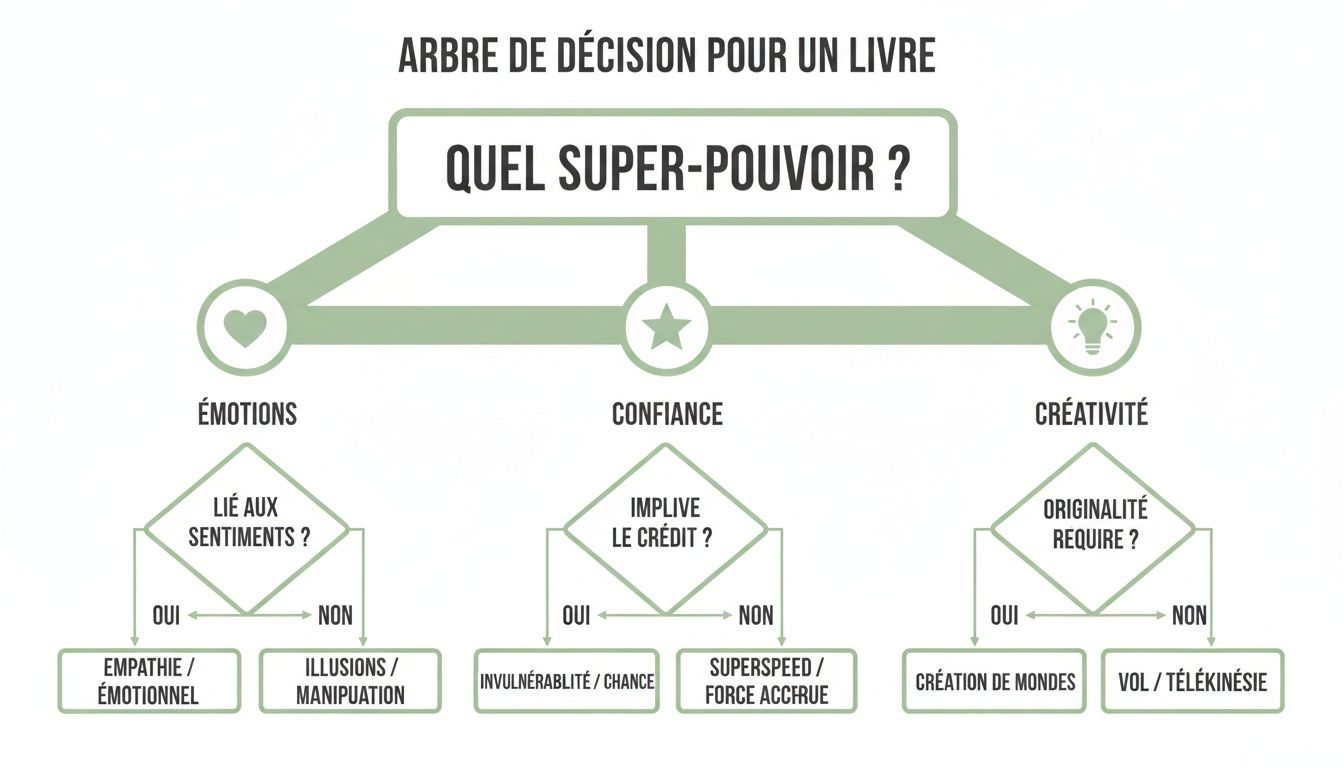
As you can see, the starting point is always the child. Their desires, their interests, their little challenges of the moment.
Adapting the choice to age: a crucial step
A 7-year- old and an 11-year -old pre-teen are not on the same planet. Their attention spans and concerns are radically different. Therefore, it's essential to choose the right book for you.
The table below gives you some guidelines to help you see more clearly and make the right choice depending on your child's age.
Criteria for choosing a personal development book for your child
| Selection criteria | For ages 6-8 | For ages 9-12 | Tip for parents |
|---|---|---|---|
| Themes | Stories about friendship, fear of the dark, anger management, and sharing. Topics rooted in their everyday lives. | Stories about self-esteem, harassment, organization, anxiety. More abstract concepts. | Start with a recent experience to choose a theme that will really resonate with her. |
| Format | Highly illustrated picture books, short stories, game books, activity books with stickers. The image is king! | Novels, comic books with more complex plots, practical guides, journals to complete. | Flip through the book: is the layout spacious? Is the text too dense? The visual aspect matters enormously. |
| Interactivity | Prioritize formats where the child is an active participant: they draw, they paste, they answer simple questions. Play is paramount. | Look for tools they can make their own: quizzes, checklists, challenges to overcome, writing spaces. | The goal is to give him concrete tools. The book should be a springboard to action. |
This short guide will help you make the right choice. Choosing the right book is a bit like finding the right key for the right lock. An age-appropriate format opens the door wide to interest and discussion.
Making choice a shared moment
The secret to getting a book read and loved? Choosing it with your child. This simple step shows them that their opinion matters and strengthens their independence.
Turn it into a game! A trip to the library or bookstore can become a real treasure hunt. Give them a mission: "Today, we're looking for a book about courage" or "Let's find a story with a super creative hero!" Let them browse, look at the covers, read a few pages. It's their adventure.
This approach is a win-win situation. On the one hand, you ensure that the subject and style appeal to your child. On the other, you transform this moment into a precious family ritual. It's the very first step towards making reading a true bridge between you.
Transforming reading into a precious family ritual
A book, however wonderful, only truly comes alive when it is shared. Personal development books for children offer a golden opportunity to transform a simple reading moment into a genuine ritual, a special time for family connection.
The idea is not to overload an already busy schedule, but to create little bubbles of complicity that nurture the parent-child bond.
This approach is part of a broader trend. Did you know that 35% of French people read at least one self-help book a year? Many do so to improve their relationships. By sharing these books with your children, you show them in a concrete way the importance of taking care of themselves and others. To learn more, this article from ELLE.fr explains why self-help is so popular .
Ultimately, these shared moments become the foundation of trust and dialogue within your family.
How to create simple and effective reading rituals
No need to turn everything upside down. The secret is to incorporate small habits that, seemingly insignificant, will make a big difference. Consistency matters much more than duration.
Here are a few easy ideas to steal:
- Parent-child book club: Choose a book together and meet weekly, even for just 15 minutes , to discuss it. Add a hot chocolate and some cookies, and you've got everything you need to make the moment even more special.
- The five minutes after the chapter: Right after the bedtime story, take five short minutes to ask a very simple question: "What did you like best about this passage?" or "If you had been the hero, what would you have done in his place?"
- Word of the day: After reading a book about emotions, choose an "emotion of the day" together. In the evening, each person shares when during the day they felt it.
These little rituals create reassuring points of reference for your child. They are moments when he knows he has your full attention, and that alone is precious.
A family ritual doesn't need to be complicated. Its strength comes from regularity and the intention behind it: simply to connect.
Using books to illuminate everyday life
The ideas presented in these books become truly useful when applied to navigating everyday challenges. That's when the reading transitions from the abstract to the concrete.
Imagine this situation: You've just read a story about empathy. The next day, your child is arguing with a friend at school. This is the perfect opportunity to bridge the gap: "Do you remember Leo from our book? How do you think your friend is feeling right now?"
This simple exercise helps your child develop their ability to see things from the perspective of others, an essential social skill for life.
The art of asking the right questions
To make reading a true dialogue, the secret lies in the questions. Forget those that elicit a simple "yes" or "no." Favor open-ended questions, those that invite reflection and sharing.
Here are a few examples to get you started:
- Instead of asking "Did you like the story?", ask "What surprised you most about this story?".
- Instead of "The hero is brave, isn't he?", try "When did you feel the hero was really showing his courage?"
- Replace "That's a great lesson, don't you think?" with "If you had to keep only one idea from this book, what would it be?"
By asking these kinds of questions, you show your child that their opinion matters and encourage them to develop their own thoughts. Each book then becomes a gateway to their inner world and a wonderful opportunity to forge even stronger bonds.
Create a personal journal to nurture ideas
Self-help books are perfect for planting little seeds in children's minds. But for these seeds to germinate and flourish, they need fertile ground. That's where a personal journal comes in: it's a fantastic tool for transforming somewhat abstract lessons into real-life experiences.
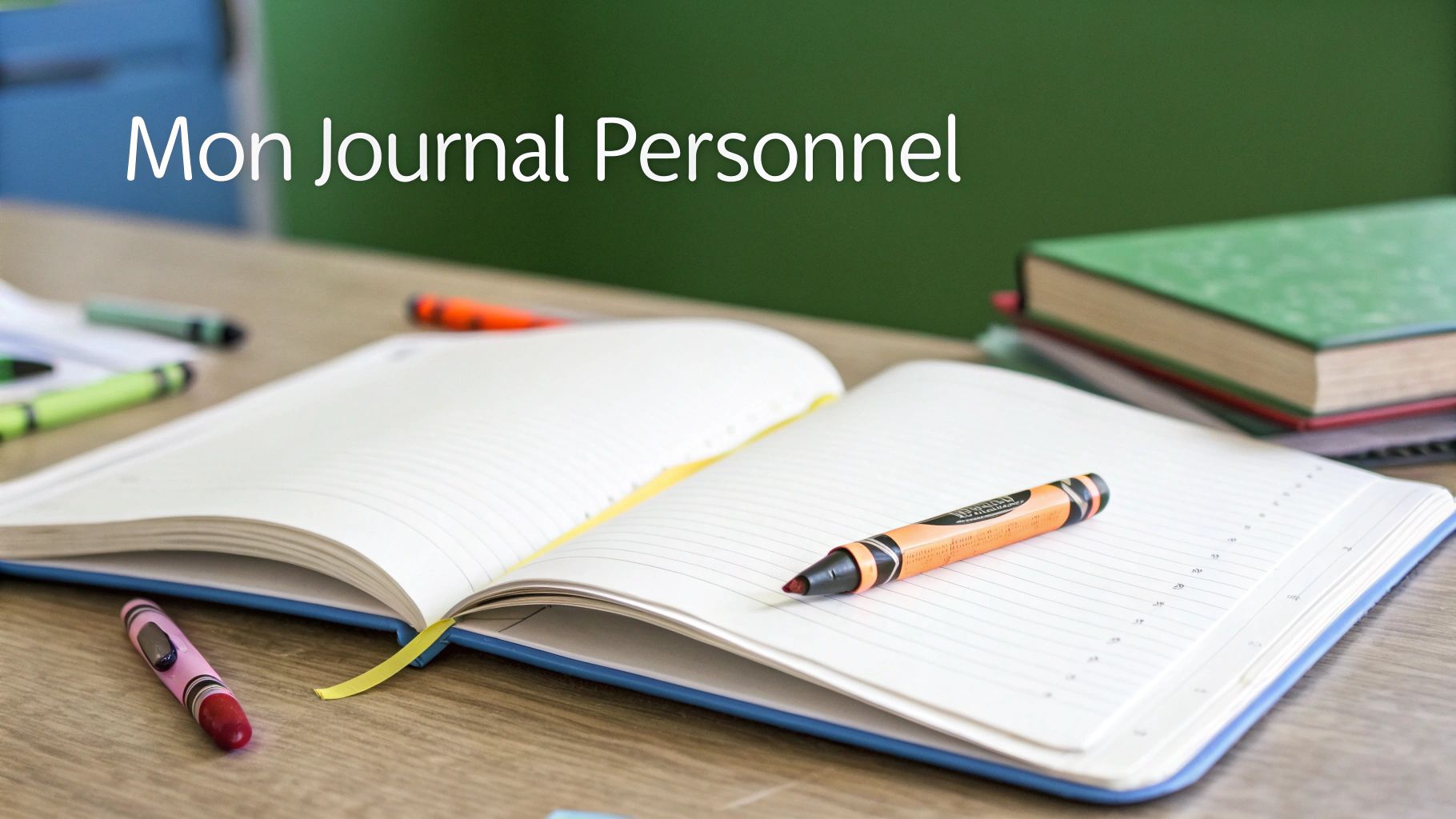
Think of this journal as their secret little laboratory. It's where your child can draw their angry face after reading a story about emotions, recount their own brave deed, or simply jot down three things that made them proud today. The idea is no longer just to read, but to experience the concepts .
Through this practice, the child moves from the role of a simple reader to that of an active participant in their own development. They take ownership of the ideas, test them, and integrate them at their own pace, without any pressure.
From book to newspaper: a creative bridge
Combining a journal with reading creates a direct link between inspiration and action. It's a simple and fun way to help your child permanently retain what they've learned.
Here are some concrete ideas for making the connection:
- After reading a book about gratitude: Suggest that he draw a big sun in his notebook. Each evening, he can write or draw a small thing that made him happy during the day.
- After a story about self-confidence: Invite him to create a "collection of his successes". He can stick photos, drawings or words in it to remember times when he felt strong and capable.
- After reading about problem-solving: If he has a small problem, his journal can become his "solution notebook" where he imagines all possible outcomes, even the most far-fetched!
A journal is not a duty, it is a space of freedom. It becomes a secret garden where the lessons from books can take root, grow and blossom in your child's life.
My Book Story: the perfect companion for your reading
To get started, a journal like My Book Story is an ideal partner. Specially designed for 6-12 year olds , it offers a framework that is both simple and stimulating. It doesn't just provide blank pages; it guides children with creative activities to develop their self-confidence and imagination.
With themes like resilience and ingenuity, it naturally extends the topics explored in the best children's books. Each page is an invitation to explore one's inner world, transforming the journal into an essential companion. Reading then becomes a true personal adventure.
Your questions (and our answers) about these books unlike any other
Embarking on a personal development journey with your child can raise a lot of questions. That's perfectly normal! Let's untangle the most frequently asked questions together so you can get started with confidence.
But... isn't my child too young for all this?
Absolutely not! Forget the image of personal development for adults, with its performance goals and complex theories. For a 6 , 8 , or 10- year-old, it's first and foremost a game, a kind of self-discovery.
These books use stories, engaging characters, and activities to help children put words to their feelings. They help them learn to identify a burning anger, understand why a friend is upset, or simply appreciate a small sense of pride. It's a gentle and fun way to plant the seeds of future well-being.
And if he doesn't like to read, what do I do?
Ah, the dreaded "he doesn't like to read"! It's a challenge many parents know all too well. The good news is that the solution isn't to force it, but to be a little more clever.
The idea isn't for him to devour a novel, but for him to absorb the book's ideas. To achieve this, opt for slightly different formats:
- Comic strips: The images speak for themselves and make the message much easier to grasp on the fly.
- Gamebooks: When you have to solve a puzzle or make a choice, you are no longer just a reader, you become the hero of the story!
- Activity books: Drawing, sticking stickers, answering short quizzes... The child is active, and that changes everything.
Consider reading just a page together in the evening, listening to an audiobook in the car, or even simply looking at the pictures and imagining the story. What really matters is the conversation and the shared moment the book creates between you.
I'm afraid it might put pressure on him... Is that possible?
That's a very valid and important concern. Rest assured: the key to avoiding any kind of pressure lies with you. It all depends on how you present things to her.
Think of these books as a toolbox for exploration, an adventure for two. Definitely not as a how-to guide for "improving" yourself or correcting some supposed flaw. The goal is to awaken your curiosity, not to demand a specific result.
Start the discussion with open-ended questions, without any judgment. For example: "What that little fox is doing is funny, what do you think?" or "And you, if you had a magic wand like in the book, what would you do with it?"
By doing this, the book becomes a pretext for sharing, laughing, and confiding in each other. You show them that it's a friend helping them understand themselves better, not a teacher grading them. The book should remain, above all, a moment of pleasure and connection.
To go further and help your child transform all these wonderful discoveries into small, everyday actions, the My Book Story journal is a fantastic companion. It helps them move from inspiration to practice with creative activities designed specifically for 6-12 year olds. Discover how to build lasting confidence and creativity with My Book Story .