


In an ever-accelerating world, we're all looking for ways to help our children grow up with peace of mind. Perhaps you've already heard of self-help books ? For children aged 6 to 12 , they are invaluable resources. Much more than just stories, they are designed to support and help children cultivate their confidence, creativity, and inner balance.
Why read self-help books with your child?

Let's be clear: these books aren't magic wands. Think of them more as companions on the journey, for you and your child. They have the knack of transforming somewhat abstract ideas, like self-confidence or managing emotions, into captivating and easy-to-understand stories.
Unlike a traditional fairy tale, their mission is to plant small seeds that will grow into valuable life skills. It's a bit like a kind mirror: your child identifies with characters who experience the same doubts and joys as they do. This makes learning about emotions much more real and concrete.
It's no coincidence that this type of reading is so popular. In France, the self-help section represents a significant portion of the book market. This reflects a genuine search for everyday well-being, for both adults and children. If this topic interests you, you can take a look at this detailed analysis of the success of self-help .
A great excuse for a family chat
The real secret of these books is the moment of sharing they create. Settling in comfortably to read together a story about managing anger or the fear of making mistakes is the perfect opportunity to start a discussion.
Reading a book together is much more than just a story. It's a shared memory, a moment of connection that opens a space of trust where your child will feel comfortable sharing what's on their mind.
This quiet time allows you to ask questions, to really listen, without judgment. Imagine: after reading a passage about a shy character, you could simply ask: "And you, do you sometimes feel like the little hedgehog in the story?"
Building the foundations for your future well-being
The lessons learned from these readings are true gifts for the future. By helping your child put words to their feelings, you give them valuable tools to better understand themselves and, later, to interact better with others.
These moments of shared reading help him concretely to:
- Strengthening his resilience: He discovers that failure is not an end, but just a step towards learning.
- Developing empathy: By putting himself in the characters' shoes, he learns to understand the emotions of others.
- Boosting creativity: The stories encourage him to find his own solutions to small and large challenges.
- Building self-confidence: Feeling understood and seeing that he is capable of overcoming obstacles is priceless!
Ultimately, these books are wonderful tools to guide our children on the path to a more fulfilling and serene life.
Dive into your child's inner world through stories

What's the difference between a children's self-help book and a classic fairy tale? That's an excellent question. After all, both feature heroes who experience grand adventures. The distinction is subtle, but it makes all the difference.
A traditional fairy tale is a bit like an expedition to a distant castle. The journey is thrilling, but it takes place outside. A self-help book , on the other hand, offers an equally exciting adventure, but one that takes place inside the child. It's a kind of treasure map for exploring one's own emotions, thoughts, and reactions.
These books are not just meant to entertain. Their aim is to provide children with tools to better understand themselves and move forward more serenely in life.
A compass for navigating emotions
The magic of these stories is that they simplify concepts that can seem complicated. Topics like anger, sadness after an argument, or stress before a presentation are embodied by characters your child can immediately identify with.
Instead of saying "you need to learn to manage your anger," the book presents a little hero who feels a huge storm brewing inside and discovers a trick to calm it. It's much gentler and, above all, much more relatable for the child. They don't feel singled out; they feel understood.
These stories act like a mirror. By seeing their own challenges reflected in the story, your child realizes they're not alone in feeling this way. This is the very first, essential step in building their self-confidence.
This identification opens the door to discussion, without any pressure. It is often easier to talk about what the character in the book is experiencing than to directly address one's own difficulties.
Concrete solutions hidden within the adventure
Children's self-help books are not psychology manuals in disguise. They integrate well-being strategies in a completely natural and playful way. The child learns without even feeling like they are "working."
Here are some examples of practical applications for you, parents:
- Facing the fear of failure : A character attempts to build the world's tallest tower of cubes, but it collapses. He learns about perseverance. Action for you: After reading, launch a family building challenge and celebrate each attempt, even a failed one, as a learning experience.
- To manage frustration : A little fox wants a toy, but his parents refuse. The story shows him how to breathe deeply to calm down. Action for you: Create a "calm corner" together with cushions and suggest going there to breathe like the little fox the next time your child experiences a tantrum.
- To develop empathy : The story recounts an argument from each character's point of view. Action for you: During a sibling conflict, ask each child to describe how the other might have felt, as in the book.
By following the adventures of these heroes, your child gradually fills their own inner "toolbox." They discover healthy ways to respond to everyday challenges—valuable skills that will serve them throughout their life.
The tangible benefits for his/her personal development

Far more than just a bedtime story, a personal development book is a real boost to your child's well-being. Its effects don't end on the last page; they gently permeate their daily life, shaping their perspective on the world and helping them find their place in it.
Think of these books as a gym for your heart and mind. Each story is a little exercise that builds confidence, improves emotional regulation, and awakens creativity. The benefits are real; you can see and feel them every day.
Strengthening a solid self-esteem
A child's self-esteem is a bit like a fragile plant. It needs sun, water, and good soil to grow. These books are perfect for that. They feature heroes who make mistakes, who fall, but who always learn something and ultimately get back up.
This approach changes everything for a child. Mistakes are no longer a catastrophe, but simply a normal step in the learning process. This is an incredibly powerful message for children between 6 and 12 years old , an age when peer pressure can sometimes weigh heavily.
A child who understands that making mistakes isn't a big deal, but rather a way to learn, develops much stronger self-confidence. They dare to try, ask questions, and take the plunge, because they are no longer paralyzed by the fear of not being perfect.
A little tip for parents:
After reading a story where the hero fails before succeeding, start a discussion. "What do you think the little squirrel learned when his house collapsed? And have you ever failed at something and learned something amazing because of it?"
To open a calm dialogue about emotions
Putting words to anger, sadness, or jealousy isn't easy, especially when emotions are running high. Stories offer a gentle entry point. The book becomes a kind of mediator, a neutral space where emotions can be explored without your child feeling singled out.
By identifying with a character experiencing intense anger, your child can finally name what's been simmering inside them. They discover that it's normal to feel this way and that there are strategies for weathering the storm.
Stimulate his creativity and his ability to find solutions
These books don't just point out problems; they offer ideas for solutions. When a character faces a dilemma, your child is naturally invited to think along with them. How could the hero reconcile with their friend? What other idea could they try to build their rocket?
This little mental exercise is excellent for his creativity. He learns to think differently and to imagine several possible paths to the same challenge.
Some suggestions for further exploration:
- Inventing an alternative ending: "What if the story ended differently? What could the character have done differently?"
- Draw the solution: Suggest that they scribble down the invention or idea that helped the hero get out of trouble.
- Applying the idea at home: If the book offers a nice tip (like a "wheel of choices" to manage frustration), why not make it together and use it?
Create a bubble of trust between you
Each shared reading session is a precious moment of connection. A brief respite from screens and the frenetic pace of daily life, where you give them your undivided attention. This availability creates a safe haven that strengthens your bond like nothing else.
No wonder this type of book has become essential! Moreover, the self-help book sector, which includes well-being and personal development, is a very dynamic segment of the market. This is a clear sign that these books meet a genuine need for families. You can find out more about the book market in this summary from the French Publishers Association (SNE) .
These little reading rituals turn into unforgettable memories and build a solid relationship, based on listening and sharing.
How to choose the right book for your child
Faced with a mountain of children's books, finding that rare gem, the one that will truly resonate with your little one, can quickly become a daunting task. Yet, the secret is quite simple: connect with their current experience, here and now. Forget the latest bestseller! The perfect book is the one that meets their individual needs.
Rather than relying solely on his age, take a moment to observe his daily life. Does he throw a tantrum when his tower of blocks collapses? Is he the shy type, blushing whenever he has to speak? Or perhaps he's bursting with brilliant ideas but never dares to put them into action?
By pinpointing their current little challenge, your search takes on its full meaning. You're no longer looking for just a book, but a true ally. A story that will whisper in their ear: "Hey, I understand you. What if we tried this?"
Identify the right theme for your child
Children develop at lightning speed. A book that fascinated them six months ago may leave them completely unmoved today. Your best guide is listening.
Choosing a book is, above all, about taking a kind look at one's inner world. It's about acknowledging one's emotions, validating one's difficulties, and showing oneself that there are paths to feeling better.
To help you see things more clearly, here are some pointers to guide you based on what you observe in him:
- If he lacks self-confidence: Look for stories where the heroes dare to make mistakes, learn from them, and ultimately discover their hidden talents. The idea is to show him that worth isn't measured by perfection, but by the courage to try.
- To manage strong emotions (anger, sadness): Turn to books that give these feelings a visual representation, like an inner storm or a big gray cloud. This helps him visualize what he's feeling. Often, these books offer simple tips, like blowing very hard or drawing his anger, to regain his composure.
- To cultivate empathy and friendship: Stories about friendship, sharing, or minor disagreements are perfect. They help children put themselves in others' shoes and build gentler relationships.
- If he's afraid (of the dark, of failure): Choose stories that demystify fear, without dismissing it outright. Characters who learn to overcome their fears are excellent role models to give him courage.
This little visual can give you ideas for integrating these moments of reading and discussion into your routine, even when time flies.
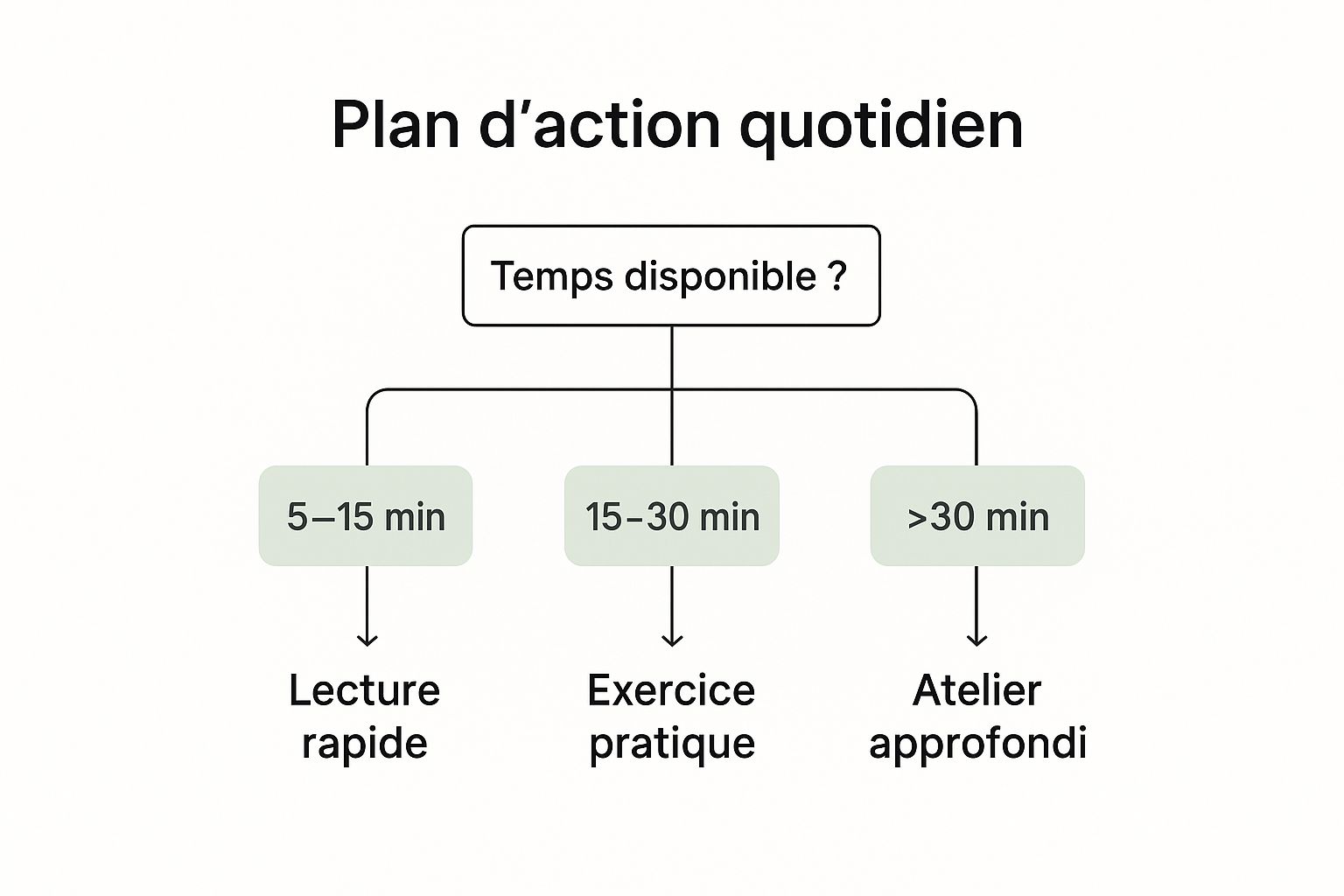
As you can see, even a few minutes a day can be enough to create a valuable ritual and open up dialogue.
What type of book for what need?
To make things even easier for you, this chart links your child's challenges to the most suitable type of book. Think of it as a compass to help you navigate the bookstore aisles more easily.
What type of book for what need?
| Child's needs | Recommended book type | Example of a theme |
|---|---|---|
| Managing your frustration | A story with calming exercises | A character who learns to breathe when he feels anger rising. |
| Boosting his confidence | An illustrated biography of an inspiring person | The life of an inventor who experienced many failures before succeeding. |
| Developing empathy | A story told from multiple points of view | Two friends have a fight and the book explores the feelings of each of them. |
| To soothe a fear | A metaphorical and reassuring tale | A small animal that befriends its shadow so that it is no longer afraid of the dark. |
| Stimulating one's creativity | An interactive book with challenges to complete | An adventure where the reader must draw solutions to help the hero. |
With this little guide, you have all the tools you need to find the book that will resonate with your child's experiences and help them grow up peacefully.
Make reading a family ritual, a moment just for you.
A book a child reads alone is a gateway to a story. But a book you read together is a memory you create as a couple and a golden opportunity to connect. For the messages of a personal development book to truly resonate, the secret is to integrate it into a gentle and warm routine. A real little ritual that strengthens family bonds.
Far be it from me to add yet another chore to your already busy days! On the contrary, the aim is to create a pause, a little bubble of connection where your child will feel heard and completely safe. This moment will quickly become an essential emotional anchor, a playground where dialogue flows effortlessly.
We all know that in our fast-paced lives, finding time to read is a real challenge. In fact, lack of time is one of the main obstacles to reading for adults. On average, the French read several books a year. By establishing a reading ritual, you protect this precious time. If this topic interests you, you can find more details about reading habits in this report from the National Book Centre .
Establish a reading-and-cuddle time
The evening, just before bedtime, is often the perfect time. The day is behind you, the hustle and bustle subsides, and children are much more receptive to quiet time. Rather than reading a story quickly, why not transform this moment into a "fifteen-minute reading and cuddle session"?
Settle in comfortably, snuggled up together. The goal is twofold: of course, to read the story, but above all to use the characters and their adventures as a mirror to talk about your child's day.
For example, in the middle of a page, you can pause briefly and slip in:
- "Look, the little bear is sad because he messed up his drawing. And you, was there anything at school today that made you a little sad?"
- "The hero is super proud of his cabin! What was your best moment of the day?"
With this simple approach, reading becomes a pretext for kind and respectful conversation. Your child finds the words to express what they feel through the characters' emotions, without feeling like they are being interrogated.
A shared reading ritual is much more than just an activity. It's a message you send to your child that says: "This time with you is important. What you think and feel matters to me."
This little daily ritual becomes a powerful engine of trust. Your child understands that they can tell you everything, that their small victories as well as their big sorrows will always be received with a listening ear and without judgment.
Extend the magic far beyond the book
To truly let the book's lessons sink in, take them beyond the pages! Continue the discussion and exploration in a fun way, especially on weekends when you have a little more time. These books on self-confidence then become a goldmine for creative family activities.
Here are some simple ideas for transforming the themes of a book into small creative workshops:
- Drawing an emotion: The book talked about anger? Suggest that your child draw it. What does it look like? Does it have colors, a particular shape? It's an excellent way to help them express their feelings so they can better understand them.
- Inventing a different ending: The hero made a choice, fine, but what would have happened if they had done things differently? Imagine together an alternative ending to the story. This boosts their creativity and their ability to see that there are always multiple solutions to a problem.
- Act out a short scene: Choose a key passage from the book and act it out! Embodying the characters helps you put yourself in their shoes and better understand their emotions and motivations.
These activities require almost nothing, just a little imagination. They create joyful memories and ground the book's lessons in reality. Your child is no longer just reading a story: they are experiencing it, transforming it, making it their own. And along the way, they are building their self-confidence and emotional intelligence.
Raising our children, one page at a time
As a parent, you're not looking for a miracle book that will solve everything with a wave of a magic wand. The idea is rather to see each story as a little seed that you plant. These books, sometimes called self-growth books , are simply allies, gentle tools to help us guide our children on their journey.
Each shared reading experience is an opportunity to offer them a kind of inner compass. A compass that, we hope, will guide them through the challenges and joys of life, long after they have left home.
The parent, that benevolent gardener
Imagine yourself as a gardener. Your role is to choose the right seeds—the books that speak to your child, here and now—and prepare the soil so they can germinate. Soil rich in listening, watered with patience, and bathed in plenty of love.
Reading a book together is never just a story. It's an open door to discussion, another brick in building self-confidence, and above all, a moment of love that will nourish the adult they will become.
By cultivating these moments, you are doing much more than reading. You are building a strong bond between you and your child, showing them that they are understood, supported, and simply loved.
Building foundations for life
Incorporating these readings into your daily life is a bit like investing in your child's long-term well-being. It's a simple yet incredibly powerful way to help them develop essential life skills.
- Emotional intelligence: That famous ability to recognize and manage one's own emotions, but also to understand those of others.
- Resilience: The strength to get back up after a setback, telling yourself that every failure is a chance to learn.
- Self-confidence: That little inner voice that whispers to him that he has everything he needs to face life.
Each page turned is a small victory, a step closer to a peaceful childhood. It's an invitation to grow up together, nourished by stories and shared experiences. One page at a time.
We answer your questions about these children's books
Exploring the world of personal development with your child is an exciting adventure! But it's perfectly normal to have some questions before getting started. To help you see things more clearly, here are the answers to the most frequently asked questions.
Specifically, at what age do we start?
The ideal period is between 6 and 12 years old . It's truly a pivotal age. Before 6, a child is in the midst of discovering their primary emotions. After this stage, their thinking becomes more nuanced, and they begin to question themselves, the world, and their place among others.
That said, there are no hard and fast rules. The best guide is your child. If they ask you questions about friendship, wonder about what's right and wrong, or struggle to express their anger, a well-chosen book can be invaluable, even a little before they turn six. The key is to select a story that's appropriate for their current sensitivities.
My child hates reading, what can I do?
Ah, the dreaded resistance to reading! It's a fear many parents share. But rest assured, the idea isn't to force him at all. The secret is to make it such a fun experience that he won't even feel like he's "reading."
Some suggestions for defusing the situation:
- Let him take the wheel: Take him to a bookstore or library. A book he has chosen himself, touched, and leafed through will have a very special flavor.
- Opt for short formats: To begin with, choose stories with large illustrations and minimal text. The important thing is to establish a pleasant little ritual, even if it only lasts five minutes at first.
- Don't read, play: Instead of following the text literally, explore the pictures together. "What do you think the little rabbit is thinking?" Turn reading into a detective game.
- Make a connection to his life: "Hey, look, this character is afraid of the dark, a bit like you sometimes! Do you think his trick could work for us?"
The goal is simple: to make reading a moment of complicity and sharing, not a chore.
Won't that put pressure on him?
That's an excellent question, and it shows how attentive a parent you are. Rest assured: the goal of these books is never to present a perfect model to strive for. On the contrary, they are there to normalize the doubts, fears, and emotions that we all experience.
The underlying message remains the same: "It's okay to feel this way. You're not alone. And there are solutions to feel better." These books are allies, not performance manuals.
Your role as a parent is key, of course. By approaching these readings with curiosity, without expecting any "results," you create a space where your child feels safe to explore. It's not about "fixing" them, but about giving them a toolbox to learn about themselves and how to take care of themselves. It's a wonderful gift for building their self-confidence.
And to transform those reading moments into a true creative exploration, the My Book Story journal is the perfect companion. It helps your child take the wonderful ideas discovered in books and apply them to their own life in a fun and personal way. Discover how it can boost their confidence and creativity .