


A personal development planner for a child isn't just another diary on their desk. Think of it more as a companion on their journey, a secret garden where they can explore what's happening inside, celebrate their achievements, and gradually build their self-confidence. It's their own creative and safe space to grow up with peace of mind.
Why introduce your child to a personal development planner?
Imagine being able to transform self-exploration into a fun adventure for your child. A self-development planner is absolutely not a homework book in disguise. It's a playful tool that helps them cultivate their confidence, creativity, and emotional intelligence.
For a child between 6 and 12 years old , putting words to their feelings is a real challenge. This notebook offers them a concrete tool to help them achieve this.
Instead of focusing solely on grades and academic results, this planner highlights her inner journey. It provides a supportive framework for:
- Putting words to one's emotions : Learning to differentiate between joy, sadness, anger, and understanding what triggers them.
- Celebrating small everyday victories : Noting that he managed to tie his shoelaces all by himself or that he helped a friend at recess, this boosts self-esteem incredibly.
- Bringing his dreams to life : Giving him a place to draw or write about what he would like to do later makes his goals much more real and attainable.
A bridge to strengthen your bond
Very quickly, this notebook becomes a wonderful pretext for starting conversations you might not have had otherwise. By sitting down with him to fill it out, you open a small door to his inner world, a universe sometimes difficult to penetrate.
A shared planner isn't just a tool for the child. It's a true ritual that weaves and strengthens the parent-child bond. You create memories while establishing communication based on listening and kindness at home.
Finally, use a A personal development planner offers your child their first keys to autonomy and resilience. They learn to see challenges not as insurmountable mountains, but as opportunities for growth. It's a precious gift to help them flourish, teaching them to better understand and love themselves as they are.
Create a fun and stress-free ritual around the planner
So that the A personal development planner can become a true companion for your child; it needs to be gently integrated into your daily routine. See it as a game, a moment to share, and definitely not as extra homework. The idea is to create a little bubble of connection, a special time just for the two of you.
The secret is consistency and enjoyment. The goal isn't perfection, but rather to make this a positive habit. Ideally, choose a time when you're both relaxed, without being rushed. For many parents, this happens right after snack time or before bedtime stories. The day is winding down, and it's the perfect moment to unwind a little.
Turn the planner into a playground
The best approach? Present the planner as a creative activity! Get out the markers in all colors, the glitter pens, and, the secret weapon, a super sticker sheet. Let your child make their planner their own by customizing it. They can draw on the cover, invent a color code for their moods, or create little symbols for their personal victories.
By personalizing it, the tool immediately becomes less intimidating and much more fun. It's his notebook, his secret garden.
This diagram gives you a simple three-step idea to establish this habit in your routine.
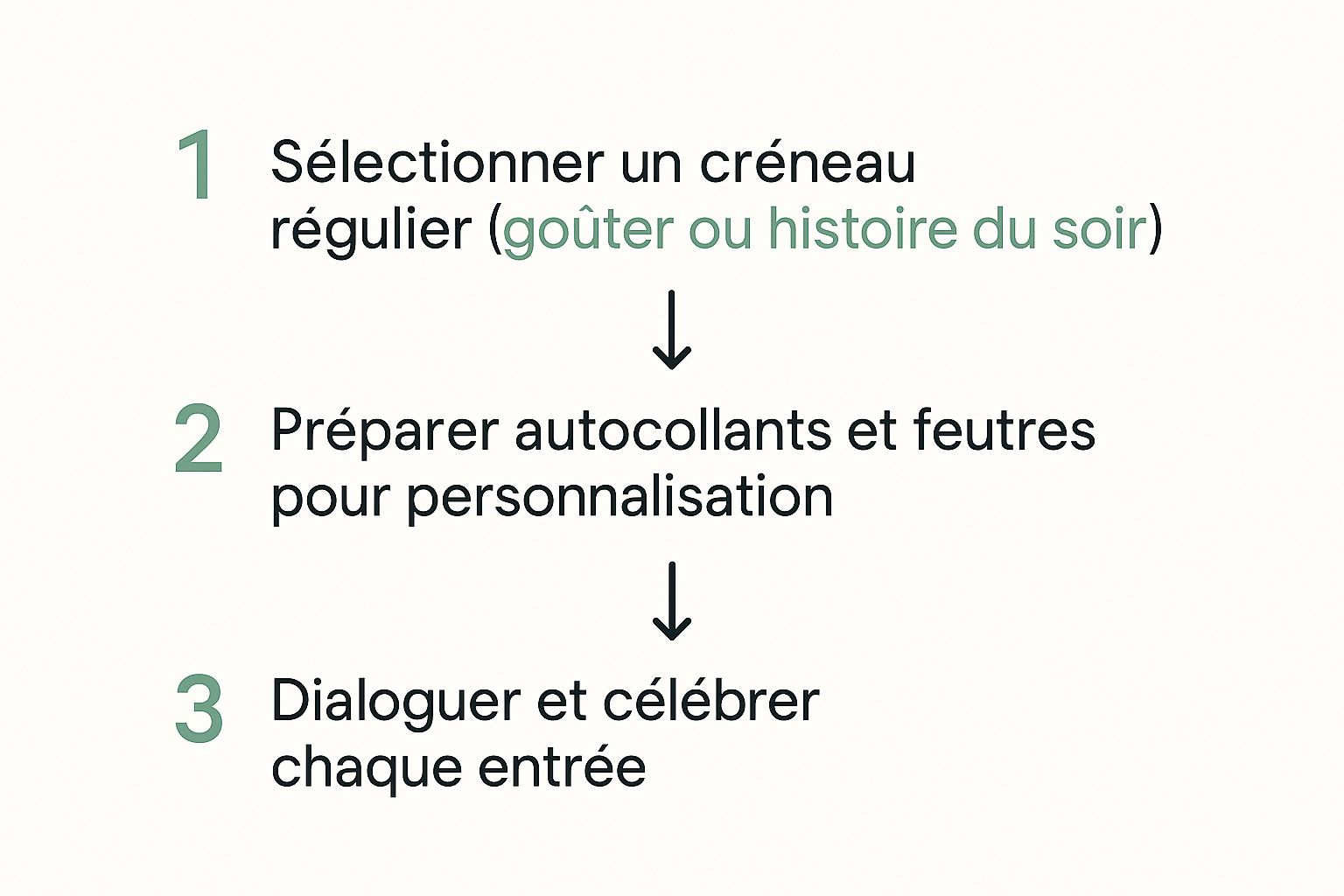
As you can see, it all comes down to good timing, appealing tools and, of course, an open and warm dialogue.
Start the discussion with ease
This time spent together discussing the planner is a golden opportunity to chat about the little things and big emotions of the day. Don't just supervise, really participate! Ask open-ended questions that encourage them to share their experiences.
Some ideas to get started:
- "If you had to choose a sticker to represent your favorite moment of today, which one would it be?"
- "Ah, you chose that emotion! Tell me why."
- "What little drawing could you make so you never forget this amazing day?"
The most important thing isn't what your child writes or draws, but simply the fact that they want to express themselves. Celebrate every little effort, every sharing, without ever judging. You'll see, this ritual will quickly become a reassuring anchor that strengthens your bond and their self-confidence.
Exploring emotions and creativity, page after page
Imagine the This personal development planner is like a playground. On one side, your child learns to manage their emotions; on the other, they unleash their creativity. Each double page is designed for this purpose, transforming somewhat abstract ideas into simple and fun activities. Your role? To gently guide them and use this notebook as a springboard for conversation.
One of the biggest challenges for a child is putting words to their feelings. This is where emotion pages, often designed as an "inner weather" chart or a color wheel, come in. They give children a simple visual vocabulary to express feelings that can sometimes be confusing.
By accompanying him, you give him the tools to connect with himself. This is the very first step in building his emotional intelligence, a skill that will be invaluable to him throughout his life.
Decoding your inner weather
Instead of directly asking "Why are you angry?", a question that can sometimes put him off, use the planner to start the conversation. The conversation immediately becomes lighter and less intimidating.
Here are some suggestions to encourage him to open up:
- Observe without judging: "Hey, I saw that you circled the cloud today. Is something weighing on you? If you like, you can draw it for me."
- Validating his feelings: "It's perfectly normal to feel sad sometimes. Thank you for showing me that. Shall we look for something small that could bring back a ray of sunshine?"
- Linking the emotion to the need: "You chose anger. Often, anger masks a need. What do you need right now?"
Your attitude is key. By asking open-ended questions and accepting their answers without judgment, you create a safe space for the planner. They then understand that all their emotions are valid and that they can share them without fear.
A space to create and dream without limits
Right next to the inner weather report, there's often a blank page or some free space. This is the realm of creativity! Drawings, lists of small joys, challenges to imagine, or stories to invent... anything goes. This section is essential because it allows her to express her thoughts in a playful way.
Encourage him to make this space his own without any constraints. There is no "beautiful" or "ugly," only the expression of what he feels inside at that moment. It's an excellent exercise for boosting his self-esteem.
To give you some ideas, here is a table with concrete activities to liven up these pages according to their age.
Activity ideas to liven up the planner
This table gives you concrete examples for animating the different parts of the planner with your child, adapted to their age.
| Planner section | Activity for 6-8 year olds | Activity for 9-12 year olds |
|---|---|---|
| Gratitude | Draw 3 things that made him happy during the day. | Write a short thank you letter to someone. |
| Free creativity | Invent and draw an imaginary animal that represents your strength. | Create a mini comic strip about one of your dreams. |
| Personal challenges | Set yourself a small, fun challenge, like complimenting a friend. | List 3 steps to achieve a goal that is important to him/her. |
With these small activities, the self-development planner becomes much more than just a notebook. It transforms into a true daily adventure, a powerful tool to help him get to know himself better, gain confidence, and, above all, strengthen the unique bond you share.
Explore the themes to grow step by step
The true magic of a This personal development planner for children is organized into thematic chapters. Self-confidence, friendship, emotional management, curiosity… Suddenly, these big, somewhat abstract ideas become concrete and fun missions. Your role, as a parent, is to use this structure to support your child in a targeted way. The goal? To make it feel like a game, never a lesson.
This approach has a huge advantage: it allows you to focus on a single skill at a time. Rather than tackling everything at once and risking overwhelming the learner, you take your time. Focusing on one theme per month, for example, creates a simple and progressive framework. Learning happens almost on its own.
Turning a chapter into a family adventure
For a theme to truly come to life, it needs to be taken off the pages of the notebook. The idea is to integrate it into your daily life through discussions and small rituals that are uniquely yours. That's how concepts become truly ingrained.
Let's imagine that the theme of the month is self-confidence . Here are some very simple ideas to implement:
- The Pride Box: Take a pretty empty box. Every evening, everyone (yes, parents too!) puts a small anonymous note in it describing something that made them proud during the day. It can be as simple as "I dared to ask a question in class" or "I succeeded in making my chocolate cake."
- The secret password: Invent a short phrase of encouragement together, a secret code just for you. For example, "I am a brave lion!" Whisper it before a test, a competition, or any slightly stressful situation.
- Celebrate the effort, not just the result: Highlight the courage to have tried, regardless of the final score. Attempting to ride a bike without training wheels and falling is already a huge victory that deserves to be applauded.
By connecting the journal to shared moments, you show your child that growing up and learning about themselves is not a solitary task. It's an adventure that nourishes the whole family.
This early support for emotional skills is increasingly recognized as a cornerstone of well-being. The personal development market as a whole continues to grow, clearly demonstrating how central these topics have become. To learn more, you can read thiscomprehensive analysis of personal development trends .
Adapt the notebook as your child grows up
Your child's enthusiasm for their personal development journal will come and go, and that's perfectly normal. The important thing is to see this tool as a companion that evolves with them, and not as a chore to be crossed off their list.
If you feel their motivation is waning, don't put any pressure on them. Instead, suggest new ways to use it to reignite the spark. Sometimes, all it takes is a new set of glitter markers or some fun stickers to get things going again! Another idea: create a special page together on a theme they're currently passionate about, whether it's dinosaurs or space exploration.
Adapting the tool with age
Over the years, the use of the notebook will naturally change. A 7-year-old will primarily express themselves through drawing. At 11, they might begin to record more personal thoughts, a bit like in a diary. Guide this transition gently, without ever forcing it.
The goal isn't perfection, but expression. Celebrate every effort, whether it's a simple doodle or a well-crafted sentence. What matters is valuing the fact that he dares to share what he feels.
This early habit of putting words or images to one's emotions is a real asset for the future. Studies highlight the growing importance of emotional well-being, including in the future professional world. Knowing how to identify and manage one's inner state is a valuable life skill. To learn more, you can consult key statistics on well-being at work .
Sometimes a break is necessary. If the notebook sits on the shelf for a few days, or even a few weeks, it's not a failure. Let it rest for a little while. The desire to return to it will emerge naturally.
The questions you may be asking yourself
Embarking on the adventure of using a personal development planner with your child is fantastic! But it's normal to have a few questions before diving in. Let's address the most common doubts together so you can begin this wonderful experience with complete peace of mind.
What age group is it for, exactly?
A child can absolutely start writing from the age of 6. At this age, the goal isn't perfect handwriting, far from it. The idea is to give them a first space to put words, drawings, or stickers to their experiences. A very visual notebook will be their best friend!
And if he doesn't want to fill it out, what do I do?
Above all, don't force it. The planner should remain a pleasant experience, a nice meeting, never a chore. If he doesn't feel like it one day, that's okay. We respect that. You can simply suggest an alternative, like chatting a bit about his day.
Flexibility is truly the key. It's what will allow this little ritual to become a lasting and positive experience.
The goal isn't to tick all the boxes, but to keep the door open for dialogue. If the experience is associated with a moment of connection and joy, regularity will come naturally.
One last tip for choosing the right notebook: opt for a model specifically designed for children, with illustrations they'll love and simple questions. Even better, choose it with them. If they're involved in the selection process, they'll immediately feel a connection to it!
The My Book Story journal was designed precisely for this purpose: to accompany your child on this creative and emotional adventure. It could very well become their best ally in growing confidence. Take a look at the My Book Story journal and give them a unique companion.