


An hourglass is more than just a decorative object. It's an incredible visual tool to help children grasp and manage time in a very concrete way. When they see the sand flowing, abstract ideas like "five minutes" suddenly become real. This can truly transform everyday routines into fun and calming learning moments for children aged 6 to 12 , fostering their self-confidence and emotional well-being.
The hourglass, a surprising ally for concentration and calmness

For a child, time is a rather vague concept, often a source of anxiety. Who hasn't said, "Come on, just five more minutes before we leave!" or "Ten minutes of reading and that's it!"? For them, these instructions can seem a bit arbitrary. That's where the hourglass comes in and becomes a great ally, for both you and your child.
This ancient instrument has the power to materialize the passage of time in a gentle, almost magical way. Forget the stressful digital countdown on a screen. Here, the constant flow of sand offers a soothing visual representation of duration, inviting calm and concentration.
Making time visible and reassuring
The greatest advantage of the hourglass is that it makes time visible. For a child between 6 and 12 years old , watching the sand flow down gives them a sense of control over the task at hand. They know exactly where they are and how much time they have left, which significantly reduces endless arguments and minor frustrations.
This visualization helps him build a healthier relationship with time. It is no longer an enemy that pressures him, but a partner that helps him organize his day and feel in control.
The hourglass transforms an abstract constraint into a sensory experience. The slow, steady movement of the sand has a calming effect, perfect for helping a child focus on their homework or gently prepare for a transition, such as bedtime.
By incorporating this simple tool into your routines, you're giving your child much more than just a timer. You're giving them a key to developing their independence, patience, and self-confidence. In this guide for parents, we'll see how an hourglass can:
- To ease anxiety related to changes in activity and routines.
- Strengthen concentration during homework or quiet playtime.
- Encourage autonomy by transforming tasks into small personal challenges.
- Stimulate creativity with fun, timed activities.
Let's discover together how this timeless object can enrich your daily family life and support your child's development.
The hourglass, much more than just a simple gadget for the family
The elegance of an hourglass goes far beyond its slightly retro charm. For a child between 6 and 12 years old , this simple object becomes a true everyday ally. It helps them grow gently, by influencing three essential areas: their perception of time, their ability to manage their emotions, and their path towards independence.
Unlike a digital timer, with its sometimes stressful beeping, the hourglass offers a visual and calming approach. It doesn't impose time, it makes it visible. This small difference makes all the difference and can transform a tedious routine into a moment of connection and personal growth.
To finally make time tangible
For a child, "five minutes" is a vague idea, almost a magic formula used by adults. It's often a source of frustration. An hourglass, however, makes this concept completely concrete. By watching the sand flow grain by grain, your child literally observes the passage of time. They can then better anticipate what's going to happen and accept it more easily.
Tip for parents: Instead of shouting, "Just 10 more minutes before we stop playing!", try turning over a 10-minute hourglass and saying, "When the sand runs out, it's time to tidy up." The child can see the end of the game approaching. This gives them a sense of control and significantly reduces protests. The transition is smoother because it's visualized, not just something they experience.
A valuable ally in regaining one's composure
The slow, steady movement of the grains of sand has something hypnotic about it. It's an excellent tool to help a child process strong emotions, such as anger or deep sadness. The hourglass then becomes a reassuring point of reference.
Watching the sand flow by helps to distract from swirling thoughts. Naturally, the child is encouraged to slow their breathing and focus on the present moment. It's a simple introduction to mindfulness, perfectly suited to their age.
Tip for parents: Create a small calming corner with an hourglass.
- Prepare a cozy space : a large cushion, a blanket, some books he likes.
- Add a 3 or 5 minute hourglass : When emotions run high, invite him to sit in it and watch the sand flow.
- Accompany him with simple words : "Come on, let's take a moment to look at the sand, just until things get a little better."
With this little ritual, your child learns a key life skill: he discovers that he has the resources within himself to calm himself down, with a little visual boost.
Fostering autonomy and confidence
Using an hourglass for small daily tasks is a great way to strengthen a child's sense of responsibility and self-confidence. Little chores suddenly become fun challenges that they can handle all by themselves, like a grown-up.
Brushing teeth is the perfect example. A 2- or 3-minute hourglass transforms this sometimes unpleasant task into a game. The goal is simple and visual: brush your teeth until the last grain of sand falls. This small victory, repeated every day, discreetly but surely builds self-confidence.
A 15-minute hourglass can work wonders for homework too. It helps children focus on a task, knowing that a well-deserved break is just around the corner. They learn to manage their effort and take control of their study time, a crucial step towards independence.
How to choose the right hourglass for your child?
Choosing an hourglass for your child isn't just about color or shape. It's about finding the right companion to help them grow safely and confidently towards greater independence and peace of mind. To make the right choice, three criteria are essential: its lifespan, the materials used, and, of course, its design!
A well-chosen hourglass quickly becomes a reassuring reference point in a child's daily life. It helps them move from one activity to another without stress, with a sense of control and self-confidence.
Safety and materials first
Safety is every parent's top priority. For children aged 6 to 12, it's best to choose a sturdy, virtually unbreakable plastic hourglass . Many are protected by rubber or soft plastic end caps that cushion impacts. They are designed to withstand the sometimes clumsy hands of small children and guarantee safe use.
If you're looking for a more natural approach, wooden hourglasses are a lovely option. The feel of the wood is warm and authentic, adding a sensory dimension to the experience. Just make sure the wood is smooth and the glass inside is securely protected.
Adjust the duration according to the activity and age
The duration of the hourglass is the most important factor. If the time is poorly chosen, the hourglass can become a source of frustration instead of a help. The trick is to start with short durations so the child can get used to it, and to choose the time according to the objective and their age.
- 1 to 3 minutes: Perfect for those little daily routines that require perseverance. Brushing your teeth, putting on your shoes... These short durations transform small, necessary tasks into fun and quick challenges.
- 5 to 10 minutes: Ideal for well-defined breaks, for tidying your room in "express mission" mode, or for a short, quiet reading session. It's short enough to avoid getting bored, but sufficient to make good progress.
- 15 to 30 minutes: This is where we move on to activities that require more concentration. This is the recommended duration for homework, a creative project, or well-structured screen time. The child learns to manage their effort over a longer period, strengthening their mental stamina.
Which hourglass should I choose for which activity?
To help you see things more clearly, this small table summarizes the most common durations and the benefits for your child's development.
| Hourglass Duration | Recommended activity for ages 6-12 | Benefit for the Child |
|---|---|---|
| 1 minute | Wash your hands properly, put away 3 toys | Establishes quick and positive micro-routines, develops discipline. |
| 3 minutes | Brushing teeth, dressing oneself | It transforms a task into a game, encouraging autonomy and responsibility. |
| 5 minutes | Time to "return to calm" after a strong emotion | Provides a calming visual aid for learning to manage one's emotions. |
| 10 minutes | Quickly tidying his room, 10 minutes of reading | It breaks down a large task, making it more manageable and less intimidating. |
| 15 minutes | Homework session, board game time | Helps to focus on a task without feeling overwhelmed, develops perseverance. |
| 30 minutes | Allowed screen time, creative activity (drawing, modeling clay) | It creates a clear and predictable boundary, promoting prolonged concentration. |
Each hourglass therefore has its own superpower to accompany your child in their growth!
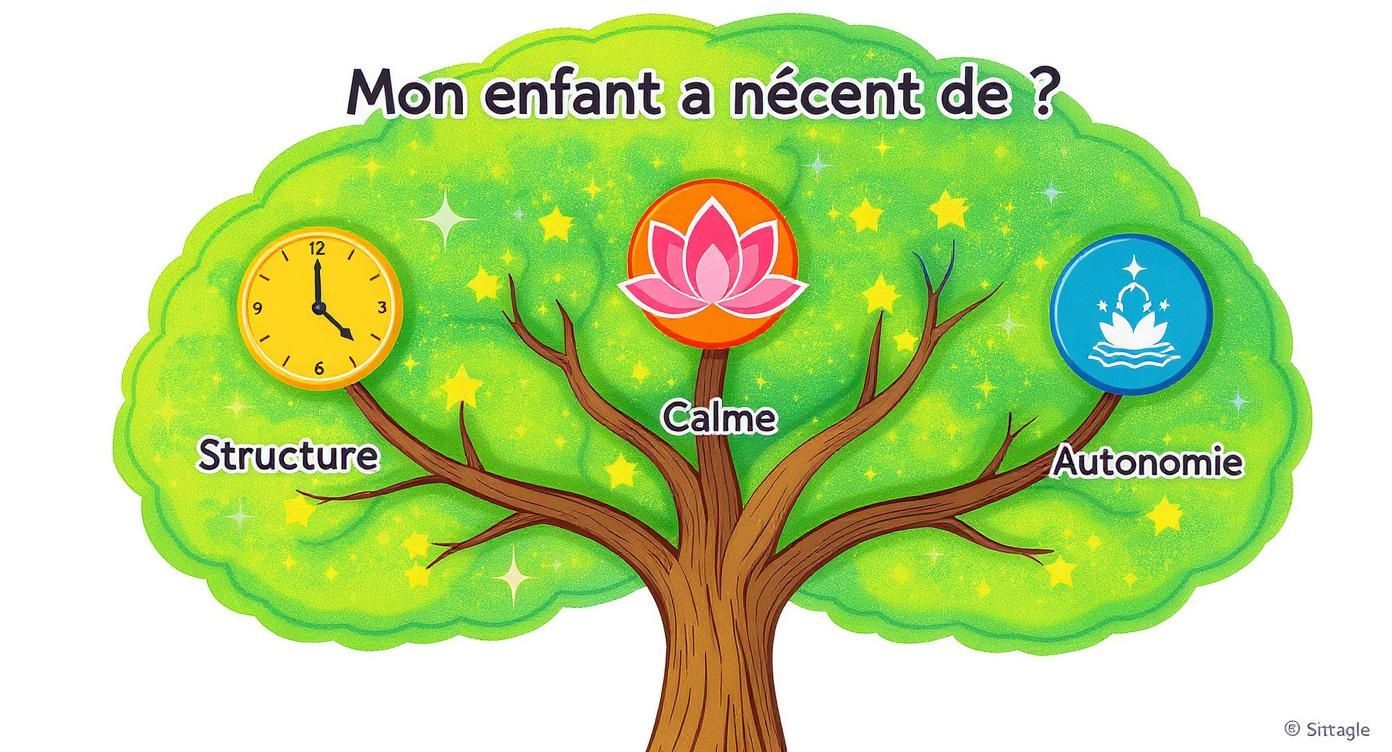
As this image shows, the hourglass is a simple yet powerful tool. It provides structure, helps to find calm, and encourages independence—three essential pillars for your child's well-being and development.
The importance of design and colors
An hourglass isn't just a timer; it's also an object your child will make their own. A playful design with bright colors or colored sand makes it instantly more appealing. The object is then perceived as a toy, not a tool for control.
Tip for parents: Let your child choose their own hourglass. If they choose the color of the sand themselves, they'll feel much more connected to it. They'll be proud to use it and much more motivated to respect the time limit, because it will be "their" tool.
By involving them in the decision-making process, you give them a small responsibility and reinforce their sense of competence. The hourglass then becomes a true ally, helping them to get organized and feel grown-up.
5 creative and soothing ritual ideas to do with an hourglass
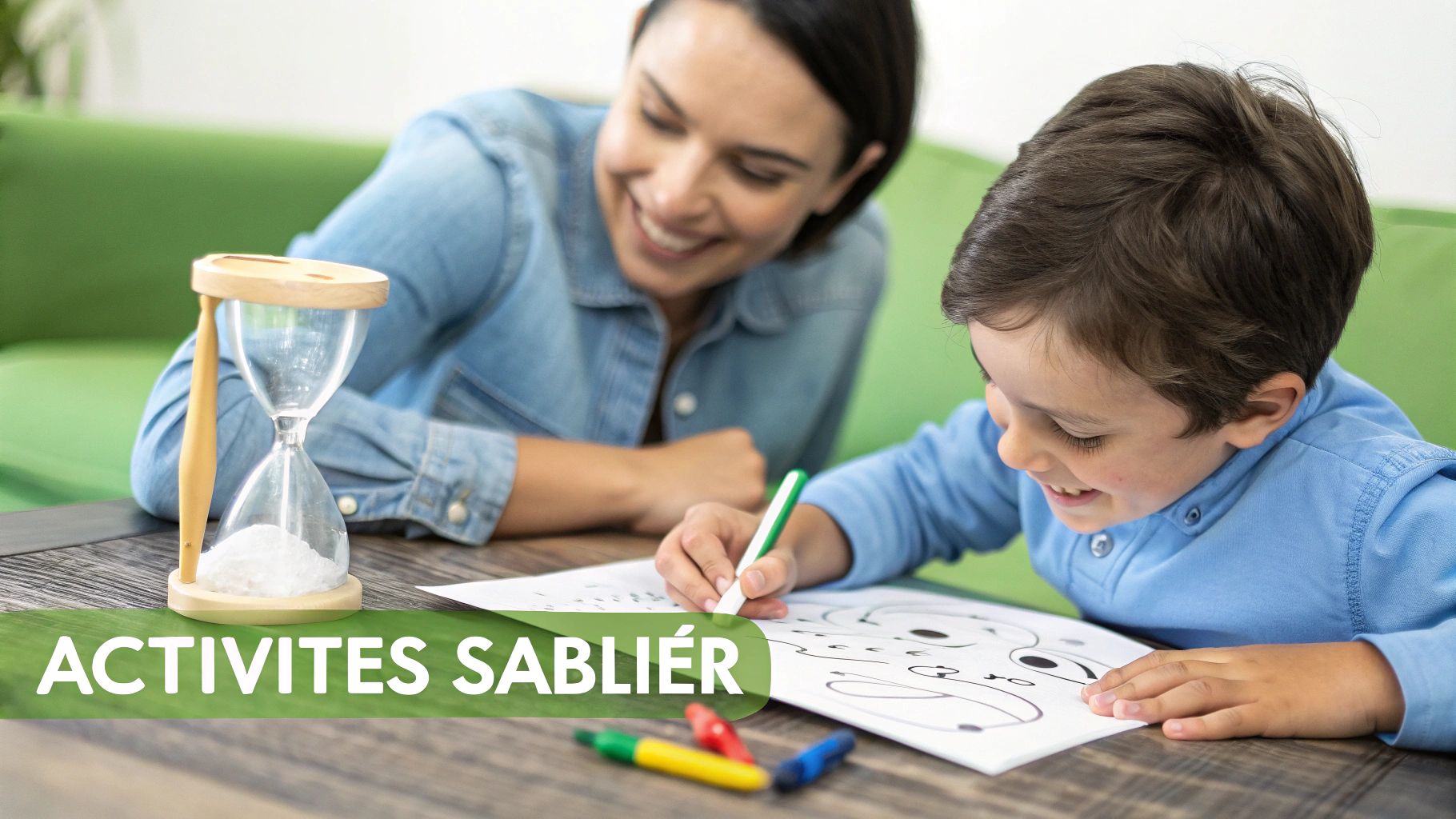
The hourglass is much more than just a timer. It's an invitation to play, creativity, and family time. It's a simple object that transforms everyday moments into precious memories, while helping your child develop key skills. Away from screens, these simple activities promote calm, attentive listening, and family bonding.
Here are five easy ideas to try for incorporating the hourglass into your routine in a fun and nurturing way. Each one has been designed to foster your child's well-being and strengthen your bond.
1. Taking turns speaking in the family
The evening meal is often the only time when everyone is finally together. Establishing a "turn to speak" system is a simple ritual to ensure everyone feels truly heard and valued.
Take a 3-minute hourglass. Each family member—parents and children alike—takes a turn, flipping the hourglass and having that much time to recount their day: a joy, a minor worry, a discovery. The golden rule? While the sand is running, no one interrupts the speaker. This exercise teaches an essential life skill: active listening .
2. The timed creative challenge
We don't always realize it, but creativity loves small, friendly constraints! Setting a time limit removes the pressure of the "perfect result" and makes you want to get started, quite simply.
Suggest a small challenge using a 5-minute hourglass:
- Draw your spirit animal as fast as you can.
- Build the tallest LEGO tower possible.
- Write a mini-poem using the words "moon", "smile" and "chocolate".
This type of game shows your child that they can accomplish amazing things in a very short time. A real boost to their self-confidence!
The important thing is not the result, but the pleasure of creating in the moment. The hourglass transforms the challenge into a fun race against time, freeing the imagination without the fear of being judged.
3. A break to breathe
In our fast-paced lives, taking just a minute to breathe can seem like a luxury. Yet it's essential for easing both minor and major tensions.
Get a one-minute hourglass. Sit in a circle with your child and turn it over. The game is to remain silent, watch the sand fall, and focus on your own breathing until it runs out. It's an incredibly effective exercise for calming restless minds after school or just before starting homework.
4. The tidying sprint
"Go tidy your room"... probably one of the least popular phrases among children. What if we turned it into a game?
Start a "tidying sprint" with a 10-minute hourglass. Put on some music and challenge your child to tidy up as much as possible before the sand runs out. You can even play together, each taking charge of a corner of the room. This playful approach makes the chore much less daunting and far more motivating.
5. Spontaneous writing in her diary
For a child, the blank page of a notebook can be daunting. An hourglass is a great tool to help them get started without overthinking it. Suggest they open their journal, like the My Book Story notebook , and fill it in for 5 or 10 minutes , the time it takes for the sand to run out.
The idea is to never stop drawing. He can invent a story, describe what he's feeling, or simply scribble whatever comes to mind. This exercise liberates expression and helps him connect with his inner world, without the pressure of having to "do it right."
How to incorporate the hourglass into family rituals?
For an hourglass to become a true ally, it needs to blend seamlessly into your family's daily life. The idea isn't to make it a tool for control, but rather a playmate and a means of communication. It should be associated with positive moments that structure the day while strengthening bonds and your child's sense of security.
By gently integrating it into your routine, the hourglass ceases to be a simple timer. It transforms into a guardian of precious moments, a visual marker that helps organize time without adding any pressure.
Make the hourglass your partner in routines.
Every family has its little rituals, those habits that structure the day and make it more predictable, and therefore more reassuring for a child. The hourglass can naturally find its place within these rituals, transforming sometimes tricky transitions into smooth and fun moments.
Practical advice for parents:
- In the morning, the dressing challenge: Start a 5-minute hourglass. The goal isn't to stress your child, but to provide a fun framework for them to get dressed independently before the sand runs out. A little game against the clock!
- After school, a well-deserved break: A 15-minute hourglass can symbolize a real rest period before tackling homework. This helps them unwind, while knowing exactly when they'll need to get back to it.
- In the evening, story time: A 10-minute hourglass for reading before bed sets a clear and soothing boundary. The child sees bedtime approaching without it being a harsh announcement.
To make it magical, tell him his story
To help your child truly connect with this object, make it something special. An hourglass isn't just a gadget. It's a treasure that has stood the test of time, an object filled with adventures and secrets.
Explain to him that this object has a fascinating history. In France, for example, the hourglass (or sand clock) was a very important tool from the Middle Ages onward. It is even said that one of the first to make one was a certain Luitprand, a monk from Chartres Cathedral in the 8th century! This instrument helped organize life in monasteries and even guided great explorers on the oceans. If this topic interests you, you will find more details on the history of this measuring instrument on the website of the Academy of Lyon .
Telling this story gives the object a soul. It's no longer just a simple plastic timer, but a time machine that helped monks, sailors, and scholars. Every time your child turns it over, they'll connect a little bit to this grand adventure.
This small touch of storytelling changes everything. The hourglass becomes a companion on adventures, an almost magical object that helps him master his time, a bit like the heroes of his favorite books.
We answer your questions as parents about the hourglass
Introducing a new tool into daily family life, even something as simple as an hourglass , always raises a few questions. That's perfectly normal! As parents, we want to be sure the idea will truly benefit our child. So, let's review the most frequently asked questions, with simple and helpful answers.
The idea is to make the hourglass a companion on the journey, not a source of pressure. With a few tips, you'll see that it can become a wonderful support to help your child grow.
From what age can it be used?
Six years old is often the ideal time to start. It's at this age that children begin to grasp the concept of time passing, even if it remains a very vague notion for them. The hourglass, however, makes this concept visible, almost tangible.
For younger children, between 6 and 8 years old, opt for very short timers, from 1 to 5 minutes . This is perfect for fun little tasks: brushing their teeth, tidying up some toys. For older children, from 9 to 12 years old, you can use longer timers, from 15 to 30 minutes , for homework or reading time. This helps them develop their ability to concentrate for longer periods.
What if my child sees it as a punishment?
That's a perfectly legitimate fear. The key is really how you present it. An hourglass should never be associated with punishment. If it's used for time-outs or to time a punishment, it will very quickly become an object of fear.
To prevent this from happening, always present him as an ally, a partner in the game. Here are a few ideas:
- Choose it together: Let your child decide the color of the sand. It immediately becomes their own object.
- Start with fun activities: A drawing challenge, a board game, or even a timed "cuddle time".
- Use positive words: Say "He's our partner in the tidying challenge!" rather than "You have 10 minutes to tidy up, not a second more."
By linking it to moments of sharing and enjoyment, it will be seen as a positive tool.
A child's perception depends entirely on the framework you set. If the hourglass is a tool for having fun, calming down, and organizing together, it will never be seen as an instrument of constraint.
How can we prevent time from becoming a source of stress?
The purpose of the hourglass is to calm, not to put pressure on you. If you feel it's becoming stressful, it's probably because the duration isn't right, or the goal is too ambitious.
If you see your child rushing to "beat" the hourglass, it's time to adjust. Explain that the hourglass isn't an opponent, but a guide. You can say, "The sand just shows us how much time we've decided to spend on this activity; it's not a race." Choose realistic time limits and praise the effort, not just the fact that they finished "on time."
And are hourglass apps on phones just as good?
Excellent question! Apps may seem convenient, that's true. But they miss the main advantage of a physical hourglass: its sensory and calming aspect . A real object that a child can hold, turn over, and observe has a much stronger impact than a simple animation on a screen.
Not to mention that a phone is a gateway to distractions: a notification, another app that catches the eye… The hourglass, on the other hand, has only one function. It encourages concentration and calmness, away from the constant stimulation of screens. For a child's well-being and to promote their focus, this physical object is truly incomparable.
The hourglass is a wonderful tool to help your child discover themselves and the world. To further this process of self-expression and self-confidence, discover the My Book Story journal. It offers a creative and nurturing space where your child can explore their emotions, dreams, and ideas, perfectly aligned with the calm and structured approach of the hourglass. Explore the My Book Story journal and give them a unique companion for growth .