


As parents, we've all experienced that gap between what we imagine and reality, especially when it comes to our children's activities. We give them a journal hoping it will become their little secret garden, but we often find ourselves facing the reality of a blank page that can be daunting, even for the most creative.
Parents' expectations: Is a newspaper a miracle solution for a child's well-being?
When we give our child a journal, a whole movie plays out in our minds. We imagine our little one, between 6 and 12 years old , settling down quietly at their desk to write about their day, their joys, and even their little frustrations. It's a beautiful image, full of good intentions, focused on their development.
We often hope for several things for him:
- His creativity will explode as if by magic : We see him drawing, inventing stories, giving free rein to his imagination without us needing to push him.
- That he will be able to put words to his emotions : We believe that the journal will be the perfect tool to help him express what he feels, even complicated things.
- That it will boost his self-confidence : Seeing the pages fill up with his own creations, we think that he will be proud of himself and that his self-esteem will skyrocket.
- He will make it a ritual, all by himself : Ideally, he would get into the habit of using it every day, without us having to remind him.
But reality is often quite different. A child's motivation comes and goes. The fear of doing it wrong, of not knowing what to write, can completely paralyze them. And the lovely journal often ends up forgotten at the bottom of a drawer.
This gap between our expectations and reality is not a failure. It's simply a clue to better understand what our child truly needs to get started.
Seeing that journal gathering dust doesn't mean the idea was bad. Perhaps it simply meant the tool wasn't suited to their developmental needs. So, how do we bridge the gap between our parental hopes and our children's need for guidance and encouragement? This is where comparing expectations with reality becomes truly valuable for their well-being.

The reality of the traditional newspaper: the anxiety of the blank page
We all have this beautiful image in mind, but the reality is often quite different. For a child between 6 and 12 years old , a blank notebook isn't always an invitation to creativity. It's much more often a source of anxiety, the infamous writer 's block that transforms a good idea into a real headache.
The initial excitement quickly fades. The child is faced with paralyzing questions: "But what am I going to write?" or "What if my drawing is ugly?" Without any guidance, the blank sheet of paper can become a true reflection of their doubts. The pressure is there, even if it's unintentional, and it stifles any desire to begin.
The real obstacles for the child
A traditional newspaper, by its completely open nature, poses several problems for a young mind that is developing.
- Lack of ideas at the moment : A child lives in the present. Unlike an adult, they don't necessarily think about analyzing and recounting their day. They need a little help to know where to start.
- The fear of being judged : The child wonders if what they are going to write is "good enough" or "interesting." This little inner voice is often enough to stifle their natural enthusiasm and self-confidence.
- Competition with screens : Let's be honest, between a blank sheet of paper that requires effort and a tablet that offers an immediate reward, the choice is quickly made for many children.
This gap between our expectations (a creative and fulfilling activity) and reality (a tool that can be intimidating) is quite common. Moreover, it reflects a broader trend where our perception is often out of sync with the facts. In France, for example, 83% of people say they are happy, but when others are asked to rate their happiness, this figure drops to just 41%! This 42-point difference clearly illustrates how our preconceived notions can distance us from reality, much like imagining our child thriving with just a notebook. To learn more, you can take a look at this data on Statista.com .
Without a minimum of structure, the journal becomes just another chore, not a refuge. It often ends up at the bottom of a drawer, sometimes with that persistent little idea in the child that "creativity is not for me".
Fortunately, this is not inevitable. It simply indicates one essential thing: for the habit to become firmly established, the tool must be designed for the child, for their real developmental needs.
A guided approach, like that of My Book Story , can change everything. It was designed precisely to bridge the gap between our expectations as parents and what a child truly needs to express themselves and develop their confidence.
Instead of leaving him facing a blank page that can seem immense and a little daunting, this journal offers him a framework. But be warned, it's a supportive framework, one that guides without ever imposing. Each page is a new adventure: a question to help him put words to his emotions, a small creative challenge, an invitation to imagine. Writing becomes a game, not a chore.
Transforming pressure into creative pleasure
Thanks to this structure, the anxiety of not knowing what to write disappears. The child has concrete prompts to get started, which naturally sparks their curiosity. They feel supported and guided, and this is what gives them the confidence to unleash their creativity.
This approach of listening and adapting is key. Moreover, it aligns with the principles of quality customer service : understanding the need to best meet it. A guided journal is a bit like that: it "listens" to the child's difficulties in order to offer simple solutions that promote their well-being.
The infographic just below summarizes well the steps that often lead to the abandonment of a traditional newspaper.
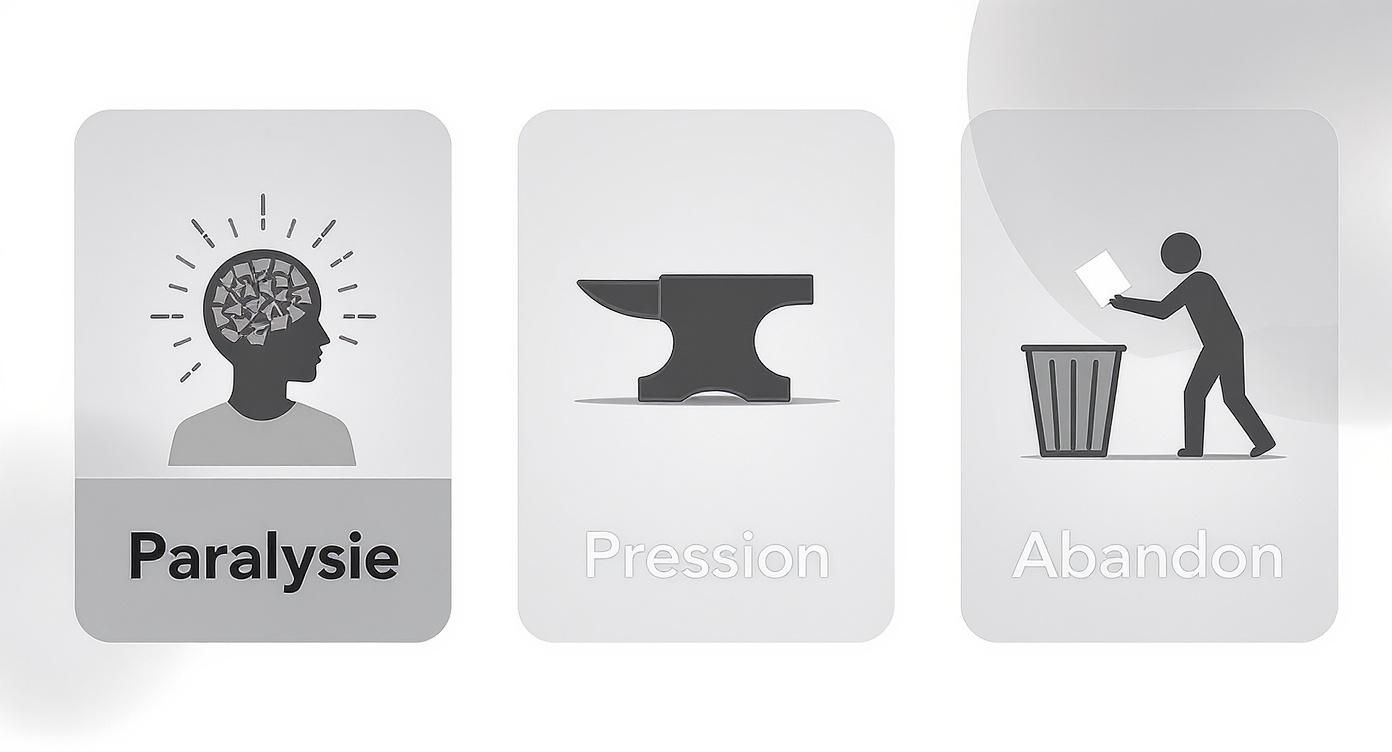
As we can see, without a little help, the blank page can quickly become an obstacle that paralyzes, then completely discourages the child.
A comparison to help you choose the right tool
To make it even clearer, let's put the two approaches side by side. This table compares the experience of a traditional journal with that offered by My Book Story, for a child aged 6 to 12 .
Comparison between the classical approach and the guided approach
| Evaluation criteria | Classic Journal (Reality) | My Book Story (The wait was over) |
|---|---|---|
| Starting point | A blank page, often intimidating. | Questions and activities to spark inspiration. |
| Child's motivation | It must be completely self-sufficient, which is difficult. | Intrinsically motivated by play and discovery. |
| Emotional Management | The child is alone in identifying and naming what he or she is feeling. | Guided with simple tools like the "wheel of emotions". |
| Long-term benefit | Risk of rapid abandonment, creating frustration. | Helps build a positive and lasting habit for her confidence. |
This table clearly shows how a guided approach concretely addresses the difficulties a child may encounter, transforming a potential disappointment into a successful and enriching experience for their personal development.
The tangible benefits for your child's development
This isn't simply about aligning parental expectations with reality. A guided journal like this offers much deeper benefits, things you can observe daily in your child's development. The goal isn't to turn them into a future writer, but to give them a tool to better understand themselves and grow in confidence.
These benefits are not abstract. They manifest themselves in very concrete situations, allowing you to see a direct and positive impact on your child.
Better understand and manage your emotions
Concrete example: Take Leo, 8 years old. Like many children, he is rather reserved and has difficulty explaining what he feels after a difficult day at school. When asked "how are you?", he often gets a simple "fine", even when he isn't.
Tip for parents: His journal offers a different approach, like an "emotions wheel." By pointing to the emoji that represents his mood, he begins to put a word to what he's feeling. It's very simple, but this small gesture opens the door to a real discussion. Silent frustration transforms into a dialogue, and the journal becomes a bridge between you and him.
Boost your confidence and dare to be creative
Concrete example: Now let's imagine Chloé, 10 years old, who is convinced that she is "hopeless at drawing". A blank page, for her, is a source of anxiety.
Tip for parents: If her journal presents her with a fun little challenge, everything changes. "Draw the weather of your thoughts" or "Imagine an amazing machine and describe what it does." These little prompts take all the pressure off. The goal is no longer to "make a beautiful drawing." By taking on these mini-challenges, Chloé no longer compares herself to an unattainable ideal. She simply has fun and discovers that her creativity can take many forms. Each completed page becomes a small source of pride that boosts her self-esteem .
A guided journal doesn't judge talent; it encourages expression. It helps the child understand that their voice and ideas matter, regardless of how they express them.
As we can see, the benefits go far beyond simple writing. It's about developing essential life skills: resilience, self-awareness, and the ability to communicate. The journal then becomes a true companion for your child, helping them navigate their inner world with greater peace of mind and much more confidence.
Transforming the journal into a loving family ritual
We often have this idea in mind: we give a journal, and presto, the child magically takes to it. In reality, even the best tool sometimes needs a little help to become part of daily life. The key is to make this journal a true family ritual, a pleasant moment that reinforces this habit in a positive way.
The idea isn't to glance over his shoulder to see what he's writing, but rather to create a shared experience around this activity. This transforms a task that might seem solitary into an opportunity to connect and strengthen family bonds.
Create a dedicated space-time
For it to work, it needs to be a gentle moment, without any pressure. Here are a few simple tips to integrate it into your family routine:
- The creative quarter-hour: After dinner, instead of rushing to the screens, why not each take a notebook (yes, parents too!) for a little quiet time? We can draw, write, it doesn't matter.
- Evening question: Pick a question from the newspaper to start the evening discussion. For example: "What was the best surprise of your day?"
- The weekend travel journal: If you go on an outing or do a special activity, suggest that your child write about it in their journal. It's a great way to transform a memory into a unique creation.
This need for meaningful experiences is evident everywhere. In the business world, for example, 46% of French consumers admit to having higher expectations than a year ago. The same is true for our children! They need stimulating activities that are more than just objects. This analysis is very insightful for learning more about the evolution of consumer expectations .
Supporting your child doesn't mean interfering. It's simply creating a reassuring environment where they feel their inner world is welcomed with curiosity and kindness, without any judgment.
By making journaling a ritual, you show your child the importance of taking time for themselves and their emotions. It changes everything. Journaling is no longer seen as a chore, but as a shared pleasure. It becomes an opportunity to talk and nurture family bonds, transforming the gap between expectations and reality into a wonderful achievement.
When reality exceeds parents' expectations
We all have expectations when we suggest a new activity to our children. But sometimes, reality holds wonderful surprises. This is often the case with a guided journal, which can reveal unsuspected facets of their personality and creativity.
The following parent stories are no exception. They perfectly illustrate how a simple expectation—like keeping your child away from screens—can transform into a rich and touching experience for the whole family. You quickly realize that the goal isn't to fill pages, but to discover what they can unlock in our children.
The discovery of a secret passion
Let's take the example of Marc, father of a 9-year-old boy who is very keen on sports. His goal was modest: he just wanted his son to put down his console for a while and do something more creative.
"Frankly, I expected him to scribble two or three drawings and that would be it. But one evening, he came to show me a page where he had written a mini action movie script. I was blown away; I had no idea he had this kind of imagination. It was much more than a hobby; it was a window into his world."
Marc's story clearly demonstrates how a playful, pressure-free environment can bring out hidden talents. His expectations were shattered by a far more creative and personal reality.
An unexpected ally against anxiety
Sophie, mother of 11-year-old Léa, had a different goal. She was looking for a way to help her daughter better manage her stress before her gymnastics competitions. She hoped the journal could serve as a small outlet for her emotions.
Here too, reality proved far more powerful. Léa appropriated the "wheel of emotions" from her notebook to put words to her anxieties. Before each competition, she began drawing her "mountain of stress" and imagining how she would climb it, step by step.
Her journal became her personal coach, a practical tool that allowed her to regain control. What began as a simple hope for emotional support transformed into learning a true life skill: resilience.
We answer your questions about the children's newspaper
It's normal to have some questions before getting started. We've gathered the most frequently asked questions here to help you make this journal a great experience for the whole family.
At what age can one start?
The My Book Story guided journal is truly ideal for children between 6 and 12 years old . This is a pivotal age range: they are beginning to understand their emotions well, but a little playful and structured help is often welcome to help them put words to them and develop their confidence.
My child doesn't seem motivated, what should I do?
Motivation comes and goes. That's perfectly normal! The trick is not to force it. Instead, try turning this moment into a little shared ritual. Suggest they choose a page at random, or fill out a page together for fun. The important thing is to keep it playful.
The goal isn't to "do it right," but to create a fun habit that strengthens your bond. If you see it as a game and not a chore, it changes everything.
The idea is not to monitor what your child writes, but simply to encourage them. Your role is to build a safe space where they feel free to explore their inner world without any pressure.
Do I need to get very involved?
Your support is essential, but that doesn't mean constantly hovering over him. The goal is to help him get started, to show interest in his creations (if he wants to share them, of course!), and to value his efforts.
Often, a listening ear and a few words of encouragement are enough to boost their independence and self-confidence. This journal is their private sanctuary; your role is simply to keep the door open, with kindness.
Discover how My Book Story can support your child's learning journey. It's much more than a notebook: it's a true companion for growing with confidence and creativity. Order your copy here .