


Photos aren't just pretty pictures. They're true emotional anchors that help our children weave the threads of their own stories and feel comfortable in their own skin. Revisiting these precious moments strengthens their sense of belonging and their self-confidence.
The importance of photographs in self-construction
For a child, a photograph is much more than a memory. It's tangible proof that they are loved, that they have their place in the family. When they see themselves in a picture, surrounded by loved ones or exploring something new, they don't just see a scene, but a moment when they felt important and safe.
These little visual treasures are invaluable allies for his emotional development. They help him revisit his experiences, understand his emotions, and build a positive self-image.
Strengthening one's identity and self-confidence
Each photo is a piece of the puzzle of your child's identity. Looking through snapshots of holidays, birthday parties, or simple afternoons in the park together allows them to connect the dots and build their personal story. It simply grounds them.
Take a photo of their very first day of school. It can be a wonderful reminder of their courage in the face of the unknown. Looking at it together before the next school year starts can help calm their anxieties and show them that they've already overcome this big challenge.
The photos act as emotional mirrors. They show not only what the child did, but also what they felt. It's a subtle way to validate their emotions and celebrate their achievements.
This table summarizes the concrete positive impacts of sharing photos on the emotional and creative development of children aged 6 to 12.
| The benefits of photos for your child's well-being | ||
|---|---|---|
| Benefit for the child | Example of an activity for parents | Impact on development |
| Sense of security | Looking at photos of cuddly or reassuring moments before going to sleep. | Strengthens the attachment bond and reduces anxiety. |
| Self-esteem | Create a "pride page" in the newspaper with photos of his achievements (bike without training wheels, swimming certificate). | It values his achievements and fosters confidence in his abilities. |
| Emotion regulation | Use photos to talk about a difficult moment (an argument, a fall) and how it was overcome. | It helps to put words to emotions and develop resilience. |
| Creativity | Invent a story based on a mystery photo picked at random from a box. | Stimulates imagination, language, and the ability to construct a narrative. |
By using photos in this way, we are not just remembering; we are actively creating tools for the well-being of our children.
A pillar for family memory
The photo album, whether a beautiful book displayed on the living room table or a neatly organized folder on the computer, is a cornerstone of family memory. It transmits the family's history and values, showing children where they come from and who their relatives are. To explore this topic further, some interesting research explains how photo albums connect our past to our present.
And when you incorporate these photos into a creative journal, you go even further. You transform a simple viewing into an interactive activity that boosts both their memory and their desire to express themselves.
Create a family memory journal
Let's go, let's turn these photos into a real family treasure! The idea is much more fun than a simple photo album. We're going to create a journal together that tells your story. It's a great opportunity to get together, chat, and create something tangible, away from screens.
By doing this, you truly bring memories to life. Your child isn't just looking at pictures; they become the author of their own story. It's an incredible boost to their self-confidence!
Where to begin? The equipment and the atmosphere!
The first step is to choose your tools. Nothing complicated, the goal is for it to be fun and make you want to get started.
- A large notebook or sturdy journal: Consider an A4 size, or even larger, with fairly thick pages. This is important to prevent glue and markers from bleeding through to the other side. A notebook like the one from My Book Story is a good option if you're looking for a pre-structured base.
- Printed photos: Make a small selection together. Simply being able to touch the photos, to handle them, changes everything and makes the moment much more personal.
- Decorations include: markers of all colors, crayons, stickers, masking tape... Let your child choose what catches their eye. It's their journal after all!
The atmosphere is just as important as the equipment. Make yourself comfortable on a rug or a large table, with some soft music and perhaps a hot chocolate. The goal is to transform this activity into a little ritual that everyone looks forward to.
How to find inspiration? Let's start with themes!
To avoid getting stuck in front of a blank page, a good tip is to start with themes. This helps to organize ideas and give your journal a direction without stressing yourself out.
Remember: we're not aiming for a museum-worthy, perfect page. The important thing is to let emotions flow. A slightly crooked drawing or a funny sentence will be far more valuable than a flawless page, because they will be an authentic reflection of what your child felt at that moment.
Here are some ideas to get you started:
- "Our weekend adventures": Gather photos from your last trip to the park, a walk in the forest, or that slightly crazy visit to the museum.
- "The week's big wins": Celebrate everything! The first swimming certificate, that 100- piece puzzle finally completed, or the day he managed to ride a bike without training wheels.
- "Our Laughs Notebook": Paste photos of really funny moments and write next to them the little joke or situation that made you burst out laughing.
For each photo, start a discussion. Ask your child what they think. They can write down a single word that comes to mind, draw around it to add details, or even invent a completely wacky story based on the image. It's this kind of little game that nurtures their creativity and strengthens that special bond between you.
Use photos to open a dialogue
A simple photograph is so much more than a frozen memory. It's a true gateway to rich and sincere conversations with your child. Each snapshot is a little spark that can rekindle emotions and stories just waiting to be shared.
Looking at a picture together creates a moment of connection, a safe space where he feels free to explore and express his feelings. It's a simple yet incredibly effective approach to helping him develop his emotional intelligence , an essential skill that will serve him throughout his life.
Asking the right questions to bring out the stories
The key is to ask questions that invite dialogue, not just a simple "yes" or "no." The goal is to make them feel that their thoughts and emotions are important and deserve to be heard.
Here are some suggestions to start the conversation:
- "What were you thinking at that moment, do you remember?"
- "If this photo could talk, what story would it tell us?"
- "How does it make you feel to see that image again today?"
- "Do you remember the noise or the smell that was around you?"
This kind of open-ended question encourages him to immerse himself in the moment and find the words to describe what he experienced, even the most fleeting sensations.
To make each photo a small life lesson
Every image, even the most seemingly ordinary, can become an opportunity to discuss topics important for its development. By linking the memory of the photo (the famous " pictures are memories ") to constructive discussions, you help it to grow.
Let's take a concrete example: a photo of him falling off his bike. It's not just a memory of a scraped knee. It's a great opportunity to talk about courage, perseverance, and the fact that it's okay to make mistakes to learn. You could say to him, "I remember how brave you were to get back on your bike right afterward."
Each image is an opportunity to validate one's emotions. A birthday photo allows one to talk about joy, a picture of him playing alone can open a discussion about the need for calm, and a group photo, about the importance of friendship.
This approach transforms your photo album into a wonderful communication tool. It's an authentic and caring way to strengthen your bond and nurture it as it grows in confidence.
Incorporate photos into your family rituals
For photos to become true treasures, creating and sharing them must be a pleasure, not a chore. The secret? Integrate these moments into your daily life to make them genuine rituals that strengthen bonds.
These small family traditions quickly become points of reference for a child. They nurture their sense of security by showing them that a special time is set aside to remember the good times they have shared.
Create simple habits for your memories
No need to embark on complicated projects. Often, the simplest rituals are the most effective in transforming the idea that photos are memories into a concrete and shared reality.
Here are some easy ideas to adopt:
- Favorites Friday: Every Friday evening, invite everyone to choose their favorite photo of the week (even a candid shot with a phone!) and share why that moment was special. It's a great way to end the week on a positive note.
- The monthly memory box: Print a handful of photos each month and put them in a pretty box. Once or twice a year, open it together for a guaranteed nostalgic evening full of laughter and stories.
The idea of preserving family history through images is not new. As early as the 19th century , photography established itself as a powerful tool for building collective memory, allowing for the creation of a shared narrative of the past. To delve deeper into this topic, you can consult analyses of photography as a heritage tool .
By creating these little rituals, you instill a culture of gratitude and celebration in your family. You teach your child to be attentive to small joys and to cherish the memories they create.
These simple habits transform somewhat forgotten digital files into very real memories, which nourish the happiness of being together.
Preserve and pass on your family treasures
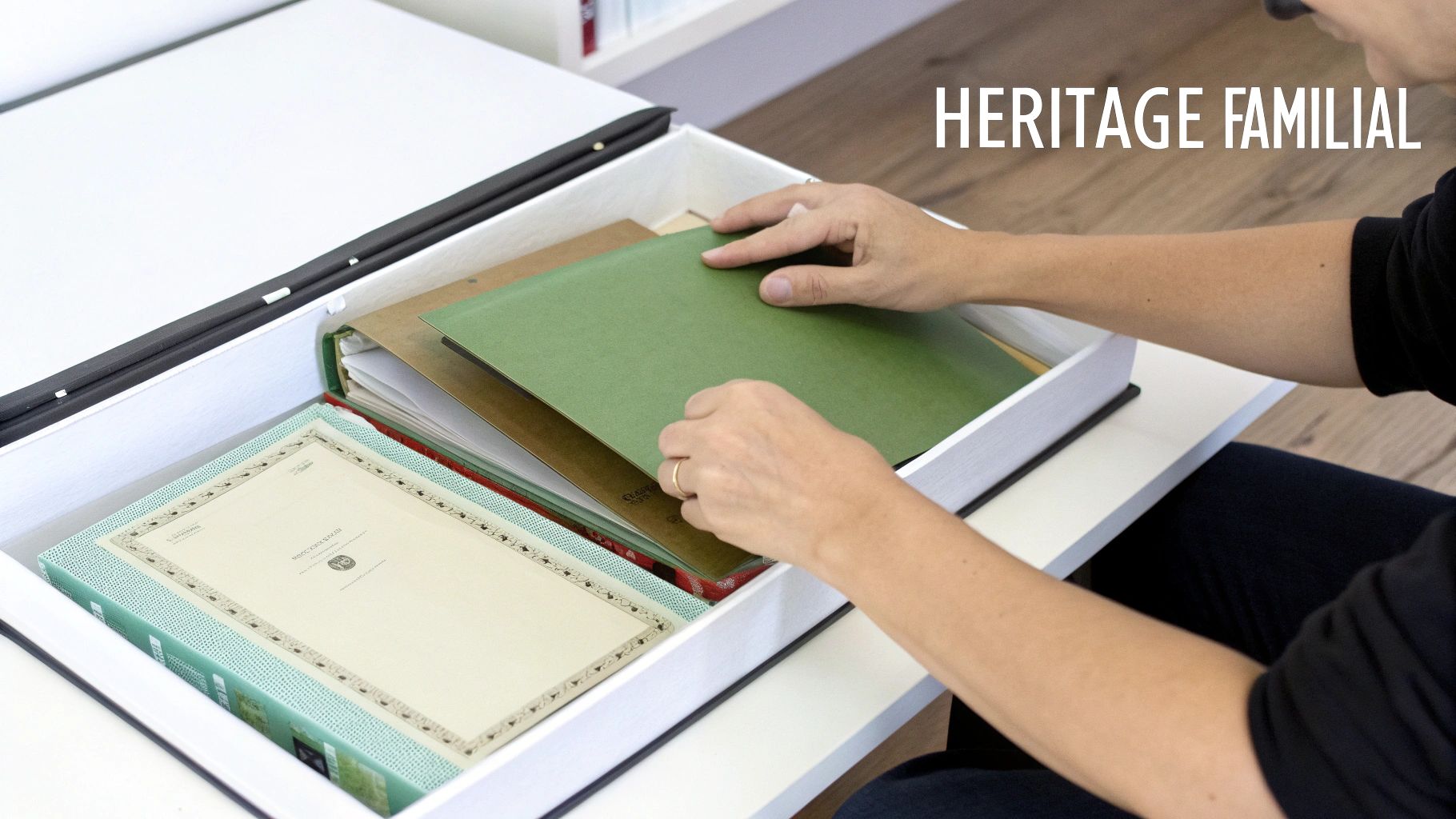
This creative journal you hold in your hands is much more than just a collection of decorated pages. It's a true treasure trove of family history, a collection of love that deserves to travel through time. After all, if images are memories , the care we give them transforms them into true treasures.
To begin, let's talk about physical storage. The first thing to do is protect your photos and your child's notebook from the ravages of time. The simplest solution is often the most effective: store them away from direct sunlight and humidity. A pretty cardboard box, placed on a high shelf, will do the trick perfectly.
Beyond the object, the art of conveying a story
But the real magic isn't just preserving an object; it's passing on the story it tells. This is somewhat what France is doing on a large scale with the "Mémoire" database of the Ministry of Culture, which safeguards our collective heritage. If this topic interests you, I invite you to discover the importance of photography in our collective memory .
On your own scale, a very simple gesture can have a huge impact.
Consider slipping a short note inside the journal. Explain why you started this project, what these moments mean to you. Speak directly to future generations of your family.
This little note is the finishing touch that transforms a notebook into an emotional legacy, a vibrant testament to the love that unites you.
Your questions, our answers for hassle-free photo memories
Creating photo memories with your children is wonderful, but it often raises a number of questions. Don't panic! Let's see these questions as opportunities to find creative and gentle solutions, so that the idea that photos are memories remains, above all, a shared pleasure.
My child doesn't like having their picture taken, what should I do?
It's a classic! Instead of struggling for a forced smile, why not turn the tables? Make him chief photographer for the day. An old camera, a forgotten smartphone... and off he goes to capture his world.
Also consider photos that tell a story without necessarily showing their face. Their hands building a sandcastle, their feet in their favorite boots, or the shadows of the whole family stretching across the ground. These images are often very poetic and completely respect their need not to be the center of attention.
How to choose photos without spending hours on it?
We've all been there: the mountain of digital photos that overwhelms us. To avoid drowning in them, establish a simple routine. For example, every Sunday evening, set aside five minutes to choose your three favorite photos of the week.
Create a "Creative Journal" folder on your phone and drag them into it. Another tip: prioritize emotion over technical perfection. A slightly blurry photo where everyone is laughing will have far more appeal in a few years than a flawless but soulless portrait.
The idea isn't to document everything, but to capture the spirit of your family life. The quality of an emotion is worth far more than the quantity of photos.
And does it work with pre-teens too?
Of course, but you have to adapt your approach! Your pre-teen probably won't be too keen on an afternoon of collage and glitter. Suggest something that fits their interests. A digital journal on an app they like, a slideshow of the year with their favorite music, or even a short video montage of their best moments.
The key is to let him take the reins and respect his style. The way memories are created changes, but the need to remember and build his identity is incredibly important at this age.
The My Book Story journal was designed precisely for this purpose: to offer a space where your child can bring their photos to life and put words to their feelings. It's the ideal tool for transforming simple images into precious memories that nurture self-esteem. Take a look at the My Book Story journal and start creating lifelong treasures together.