


Personal growth books are much more than just stories. They're veritable toolboxes, designed to help children aged 6 to 12 develop their self-confidence, better understand the whirlwind of their emotions, and unleash their creativity. Forget performance manuals; these are inspiring stories that serve as a springboard for gentle, family-oriented growth.
Why explore personal growth with your child
You might be wondering if personal development is really a topic for children. The answer is a resounding yes! But not at all in the way we adults see it. For a child, it's not about ticking off goals or being more productive. It's more about building, brick by brick, solid emotional foundations with your loving guidance.
The period between the ages of 6 and 12 is a pivotal stage. It's during this time that children begin to forge their identity, navigate more complex friendships, and become aware of their own strengths. Personal growth books are like supportive companions to help them through this crucial phase, and a wonderful resource for you, the parents.
Imagine yourself as the gardener of his inner world
To truly understand their role, let's look at things from another perspective. Your child is like a secret garden, brimming with potential. And you, as a parent, are the caring gardener. Every book you share together is a seed you sow.
- The Seed of Confidence : It sprouts thanks to the story of a shy character who finally dares to speak up. Parent tip: After reading, ask your child to share a moment they were proud of themselves today, even when they were very young.
- The seed of resilience : It grows with the story of a hero who falls, gets back up, and decides to try again. Parenting tip: Share one of your own mistakes and what you learned from it. This shows them that everyone makes mistakes, even parents!
- The seed of creativity : It blossoms through an adventure that encourages finding original solutions to a problem. Parent tip: Suggest that they invent a different ending to the story.
These stories never tell your child what they should be. They simply show them examples and give them tools so they can develop their own qualities, at their own pace.
The idea is not to add more pressure to his little shoulders. The goal is to share reading moments that help him understand himself, put words to his emotions, and see that he already has everything he needs to grow up happy.
By nurturing this inner garden from a young age, you give your child strong roots for their future well-being. It's not about pushing them to be perfect, but about guiding them in discovering the wonderful person they already are. These books then become marvelous springboards for valuable family discussions.
How these books nurture your child's emotional growth
Personal growth books are much more than just stories. Think of them as real seeds planted to cultivate the inner garden of our children. They don't just entertain; they are a mirror in which a child can finally see and understand their own emotions, often a confusing whirlwind that's difficult to put into words.
When a book character experiences immense anger in the face of injustice, or profound sadness after a disappointment, the child reading realizes something fundamental: they are not alone. These stories give them the right words to name what's turmoiling inside. A vague "I don't feel well" can then transform into a much clearer "I'm frustrated" or "I feel disappointed." This is the first essential step in helping them manage their emotions.
Developing resilience and self-esteem
One of the superpowers of these stories is their ability to teach resilience without ever feeling preachy. Throughout the pages, the characters stumble, face setbacks, and, most importantly, learn to get back up. What a powerful message for a child! It shows them that failure isn't the end of the world , but simply a step on the path of learning.
Imagine a little hero who misses the winning goal during a soccer match, but decides to keep practicing. By following his journey, your child naturally grasps the importance of perseverance. It's a gentle and effective way to build a growth mindset, that crucial idea that you can always improve, so vital for facing life's challenges, both big and small.
These books also encourage children to celebrate their unique qualities and accept their imperfections. They whisper to them that being themselves, with their strengths and weaknesses, is the greatest achievement.
A bridge for family discussions
These books are also wonderful invitations to dialogue. They open doors to authentic and compassionate conversations. By using the story as a starting point, you can approach sometimes sensitive topics in a simpler and safer way. A simple question like, "And you, what would you have done in the character's place?" can spark an incredibly rich discussion.
These readings help to build three fundamental pillars for solid emotional intelligence.
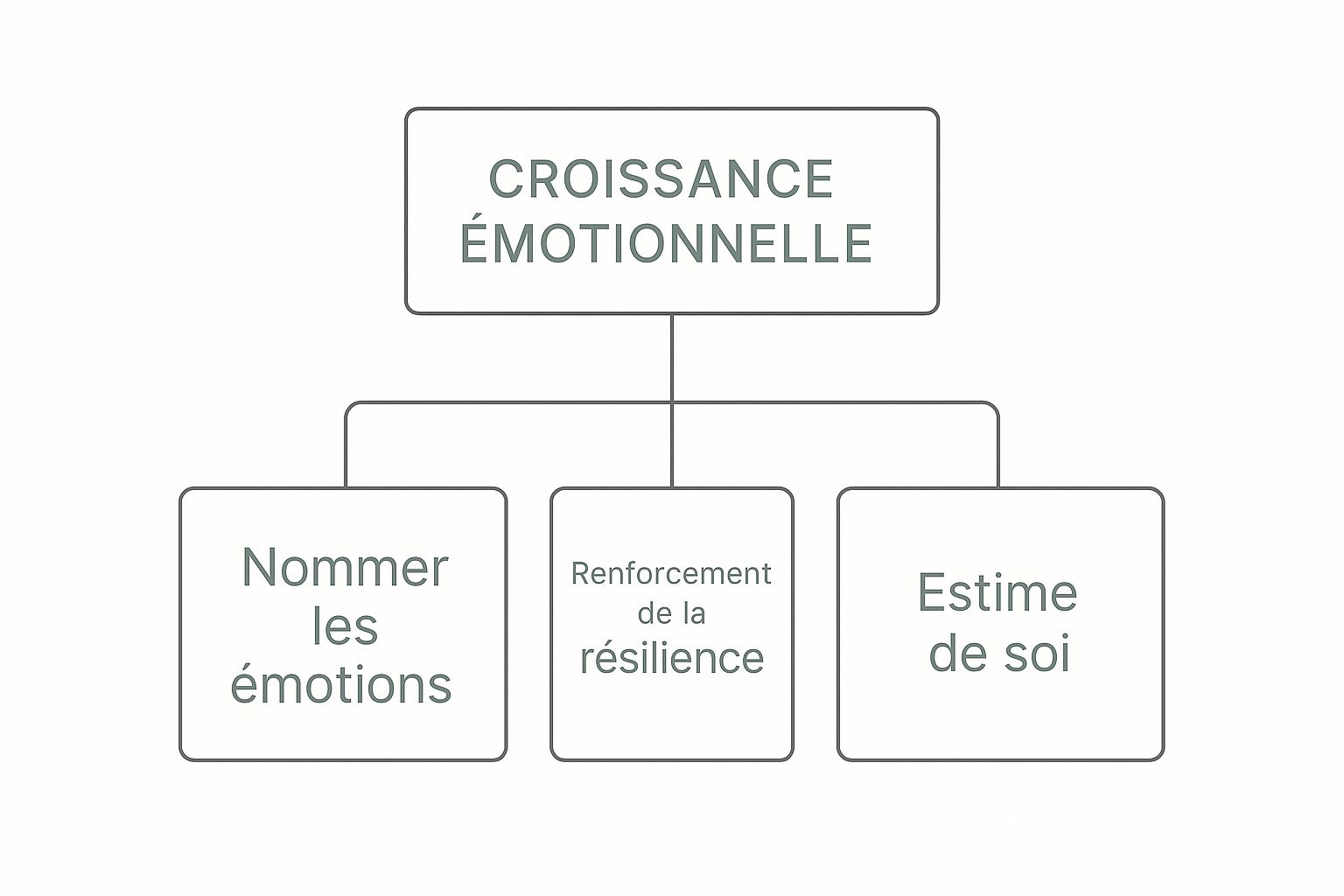
We can clearly see it here: naming your emotions, strengthening your resilience and developing your self-esteem are skills that feed off each other, and that you can cultivate through these moments of sharing.
This growing interest in emotional well-being is reflected in the figures. In France, the personal development market represents approximately 32% of the total book market . This strong demand proves that families are actively seeking tools to thrive and to help their children do the same. You can learn more about the success of this personal development trend by consulting this analysis. Ultimately, these books are a true investment in your child's emotional future.
Choosing the right book for your child without making a mistake

As parents, we've all felt a little lost in front of the overflowing shelves of bookstores. How do you choose THE right personal development book for your child when the selection is so vast? It's a real challenge.
However, with a few simple guidelines, you can find a hidden gem. The secret is not to choose for him, but with him. When you involve him, what was just a simple purchase transforms into a moment of connection and discovery. It's the best way to truly make him want to dive in!
Start with what excites him.
For a book to truly resonate with your child, it must speak to them, speak to their inner world. The first question to ask yourself is: what are they currently passionate about? Dinosaurs, space, magical adventures? A book that incorporates their favorite themes will always be a hit.
Next, think about what he's going through. Perhaps he struggles to manage his temper? A story about a little dragon learning to control its inner fire could be a wonderful way to start a conversation. Is he a little shy and anxious about making new friends? A story about friendship will show him he's not alone in feeling this way.
A good personal growth book is like a kind mirror. The child recognizes themselves in it, sees that their emotions are normal and, through the story, finds keys to move forward.
To help you once you're in the bookstore, here's a short list to keep in mind:
- Is the age appropriate? The vocabulary and complexity of the story should be suitable for a child aged 6 to 12 .
- Does he like the illustrations? Beautiful pictures make all the difference! They capture his attention and help him better understand emotions.
- Is the message positive? The book should encourage and provide tools, without ever being moralistic or guilt-inducing.
- Does it open up the discussion? A good story naturally invites questions and sharing of feelings within the family.
Each child has their own book format
Not all personal growth books are the same. Understanding the different formats allows you to make an even better choice for your child.
What type of personal growth book should I choose?
This short guide will help you see more clearly to find the format that best suits your child's age and needs.
| Book type | Ideal for... | Main objective | Example of a parent-child activity |
|---|---|---|---|
| Illustrated Album | Children aged 6-8 years . | To address an emotion or concept (fear, sadness) in a simple and very visual way. | To mimic the characters' emotions together. |
| short novel | Readers aged 8-12 . | Exploring more complex themes (resilience, friendship) through a compelling plot and engaging characters. | Discuss the hero's choices when faced with a difficulty and imagine alternative solutions. |
| Interactive newspaper | All ages, as soon as they start writing. | Encourage the child to express themselves and reflect on themselves through writing, drawing, and games. | Fill out a page together about "our family qualities". |
The children's book market is incredibly rich. Although the self-help segment experienced a slight downturn after the Covid years, it remains a pillar of publishing. Furthermore, if you're interested in the figures, you can consult the summary of French publishing to see the trends.
This abundance is a blessing. Each format has its own magic, and the best choice will always be the one that creates a unique moment of reading and sharing between you and your child.
Transforming reading into a precious family ritual

A book isn't just paper and ink. It's first and foremost a pretext for reconnecting, a bridge between your adult world and your child's vibrant universe. Making reading a ritual is simply creating a little bubble outside of time, where screens are switched off and you take the time to truly connect.
No need to plan long sessions. Ten minutes snuggled up on the sofa before bed, a quiet moment on the weekend to escape the hustle and bustle... The key is regularity. This little habit quickly becomes a special time that everyone looks forward to.
Beyond words: the discussion
The true power of a book, especially a personal growth book , lies not only in the story itself. It lies in the conversations it sparks. It's a wonderful gateway to discussing emotions, fears, or joys in a natural and reassuring way.
Instead of devouring the book in one sitting, take breaks. Ask simple, open-ended questions that can't be answered with a simple "yes" or "no." That's where the magic happens: the story becomes a mirror in which your child can see themselves.
The goal is not to do a text analysis! It is rather to open a space for discussion where your child feels confident to share what they think, what they feel, without any fear of being judged.
Questions that create connection
To start the discussion, there's no need to overcomplicate things. A few well-chosen questions can help your child identify with the characters and make connections to their own life.
Here are some ideas to get you started:
- To cultivate empathy : "What do you think the character felt at that moment? Have you ever felt like that?"
- To encourage creativity : "If you had written this story, what would you have changed?"
- To reflect on the choices : "In their place, what would you have done to solve this problem?"
- To boost confidence : "What do you think is this hero's greatest strength? Do you think you have that strength too?"
These moments of sharing are gifts you give each other. Moreover, reading is a very much alive practice. A 2023 study showed that the French read an average of 17 physical books per year. You can consult this study on French reading habits if the topic interests you. Each book shared together is another stone in building this very special bond that unites you.
Go beyond the last page
A good personal growth book doesn't end with the word "The End." Its true magic begins when its lessons become part of your child's everyday life. For younger children, concepts like gratitude or resilience can seem a little vague. That's where our role as parents becomes crucial: helping them transform these beautiful ideas into concrete and fun actions.
The idea is to prolong the pleasure of reading so that the important messages truly sink in. By creating fun activities inspired by the stories, you give your child the tools to grasp these concepts and naturally integrate them into their worldview. It's this transition from theory to practice that makes all the difference.
Creative activities to bring lessons to life
Once you've finished reading, don't let the story gather dust on the shelf! Use it as a starting point for sharing creative moments as a family. There's no need to embark on complicated projects; the most important thing is to have fun together and connect with what you've just discovered.
For example, if the book is about kindness, why not organize a "week of super-acts"? Each day, everyone can write down an act of kindness they did or received. It's a simple way to make this concept tangible and celebrate it as a family.
Here are some easy-to-implement ideas to bring the themes of personal growth books to life:
- Create a happiness box: After reading a book on gratitude, decorate a simple shoebox together. Each evening, each person slips in a little note describing a good moment from their day. This small family ritual helps cultivate a positive outlook on life.
- Drawing the inner weather: If the story deals with emotions, suggest that your child draw their "emotional weather." Do they feel like bright sunshine, a slightly gray sky, or a big storm? This offers them a simple and visual way to express what they are feeling.
- Imagine what happens next: What happens to the characters once the book is closed? Let your child imagine what happens next, whether by drawing, telling a story, or even acting out a short scene. It's perfect for stimulating their creativity and encouraging them to think about the choices the heroes make.
The important thing isn't the perfection of the drawing or the story. It's the shared moment. Every scribble, every whimsical idea is a way for your child to digest the lessons from the book and make them their own.
From reading to action
All these activities, whether manual or creative, have incredible power. They anchor learning in lived experience, in the body. A child who makes a "solutions wheel" after a story about conflict management will retain the idea much better than with a simple discussion.
Taking action makes personal growth concepts concrete and useful. You show your child that the ideas in books aren't just nice stories, but that they can truly help them in their everyday life. This is how reading becomes much more than just a pastime: it transforms into a real toolbox for growing and flourishing.
In conclusion: cultivating your child's inner garden together
As parents, we can see ourselves a bit like gardeners. Our role? To nurture our children's well-being, to ensure their inner world flourishes. In this image, personal growth books are precious seeds. Seeds we sow to cultivate confidence, creativity, and resilience in the face of life's challenges, both big and small.
Every story you share, every page you turn together, is a unique opportunity to nurture this inner world. It's a human adventure, far more than a race for achievement. The important thing isn't to accumulate reading material, but to savor the quality of the discussions that arise from these moments. Reading then becomes a wonderful pretext for strengthening your bonds and understanding each other better.
Every question asked after closing the book, every conversation that follows, is an act of love. It's a bit like watering a young plant to help it develop strong roots and grow straight.
So, the invitation is quite simple. Choose a book that speaks to you, a theme that resonates with your current life. Dive headfirst into this exploration with your child. You already have everything you need to transform these reading moments into precious and enriching memories for the whole family.
The questions you're probably asking yourself
As parents, we always want the best for our children. So, when we talk about books that touch on their emotions or their confidence, it's normal to have some questions. You want to be sure it's a good idea and that it will go well.
Let's demystify the most common questions together. It's simpler than you think!
At what age should we start, specifically?
Although this guide focuses on the 6-12 age group, there's really no set age to start talking about emotions. The very first seeds are planted much earlier.
From the age of three or four, a small picture book about anger or happiness can be a great conversation starter. The key is to choose a book that matches your child's maturity level. For older children, between six and twelve, their ability to follow a story and make connections to their own experiences is much more developed. This is the perfect time to explore topics like resilience or friendship in a bit more depth.
Isn't that a bit too "complicated" for a child?
Talking about our fears or what makes us sad isn't something only grown-ups do. On the contrary! Giving a child the words to express what they feel is like giving them a real toolbox for life.
These books aren't meant to complicate their lives. They give them simple words and concrete situations so they can better understand their inner world. They realize they're not alone in experiencing strong emotions and that it's all perfectly normal.
And if he doesn't like to read, what do I do?
That's the big question! Forcing a child to read is often the best way to turn them off. If yours isn't a big fan of reading, you simply need to find a different, more fun and interactive approach.
Here are some ideas:
- Interactive notebooks: They're the perfect format! They combine a little writing, drawing, and lots of little activities. The child doesn't just read, they create their own book.
- Audio versions: Listening to a story together in the car or before going to sleep can be a great alternative, gentle and immersive.
- Let him choose: Take him to a bookstore. Let him touch, browse, and look at the pictures. The book that attracts him will be the one he wants to open.
The goal is not to read tons of pages, but to find the medium that will ignite that little spark of curiosity.
To move from theory to practice in a creative way, the My Book Story workbook is an excellent companion. For 12 weeks , it guides your child with simple and fun activities to boost their confidence, creativity, and emotional well-being. Discover the My Book Story workbook and make this journey a true adventure to share as a family.