


As parents, we all look for simple and kind ways to help our children thrive. The "5-minute journal" idea is one of those gems: taking just five minutes a day to jot down things we're grateful for and things that would make us happy. For a child, it's a wonderful tool. In just a few moments, they learn to develop confidence, better navigate their emotions, and see the bright side of things, creating a precious family ritual.
Why this little 5-minute ritual can change everything

Imagine a moment just for you, away from the noise of screens, to truly connect with your child. That's exactly what the 5-minute journal practice offers. Forget about adding another chore to your schedule! Think of it instead as a creative break that does wonders for the morale of 6- to 12-year-olds and strengthens your bond.
As parents, we're always looking for ways to help our children understand the complex puzzle of their emotions. This little daily ritual gives them their own space, a safe haven where they can explore their thoughts without fear of judgment.
A true springboard for growing up with peace of mind
The concept is simple, but its benefits for your child's development are immense. The idea is to help them develop a new habit: focusing on the positive. This seemingly insignificant practice strengthens essential skills for their well-being.
- Appreciating the little things: He learns to see and name the little joys that punctuate his day, like a hug, a good dessert or a game with a friend.
- Boosting your confidence: It's a way to validate your own emotions and celebrate your successes, even the smallest ones, like successfully completing a difficult exercise at school.
- Letting his creativity speak: Whether through words or drawing, he has complete freedom to express himself and develop his imagination.
- Better managing one's emotions: Putting words to what one feels is the first step to understanding and taming one's feelings, whether it be joy, sadness or anger.
It's no coincidence that "My 5-Minute Journal" has become a popular tool in France, inspired by the principles of positive psychology. Studies confirm that taking five minutes a day to practice gratitude truly improves well-being in the long term. To delve deeper into the subject, feel free to consult detailed analyses of the benefits of this method .
The journal itself is not the goal. It's the starting point. The real aim is to initiate a dialogue, first with oneself, and then with you, their parent.
Ultimately, this little ritual becomes much more than a simple writing exercise. It transforms into a precious moment of sharing, an opportunity to strengthen your bonds, one page at a time. It's an invitation to build, together, a more optimistic vision of life.
Setting up the perfect framework for journaling
To make journaling a real pleasure for your child, and not just another chore, it's all about preparation. The idea is to create a little bubble of creativity, a moment just for them, where they feel comfortable and safe to express themselves.
The best way to get him involved in the adventure? Involve him from the very beginning. Let him choose his notebook, the one that catches his eye. Whether it's a simple one, a colorful one, or even our My Book Story notebook specially designed to guide them, the important thing is that he makes it his own. This notebook will be his confidant.
Finding the right time and the right place
The "when" and the "where" are just as important as everything else. Observe your child; every family has its own rhythm. Some prefer to write in the morning to start the day with energy, others in the evening to clear their heads and fall asleep more peacefully.
To help you see things more clearly, here are some tips for choosing the time slot that suits you best.
| Choosing the best time for your child's journal | ||
|---|---|---|
| Time of day | Benefits for the child | Advice for parents |
| The morning | He starts the day with a positive intention and a calm state of mind. It's perfect for setting a small goal or thinking about what makes him happy. | Incorporate it into your breakfast routine. Place the notebook on the table with the bowls so that it becomes a natural reflex. |
| The evening | This is an opportunity to let go of the day's emotions (both good and bad), to practice gratitude, and to prepare for a peaceful sleep. | Make it a soothing ritual just before bedtime stories. Soft lighting, a calm atmosphere, away from screens. |
Of course, there's no golden rule. The important thing is to find the moment that fits most naturally into your daily life, without stress.
Once you've chosen the right moment, create a cozy little corner together. No need to change everything! A few cushions on the floor, a small lamp, or even a fort made of sheets under the table can be enough to create a refuge just for them. This little haven will become their sanctuary, the symbol of this quiet time.
The goal is not perfection, but connection. A simple and inviting space is all it takes to transform five minutes into a powerful ritual for emotional well-being.
And the time you dedicate to it truly pays off. The benefits are tangible, not just theoretical.
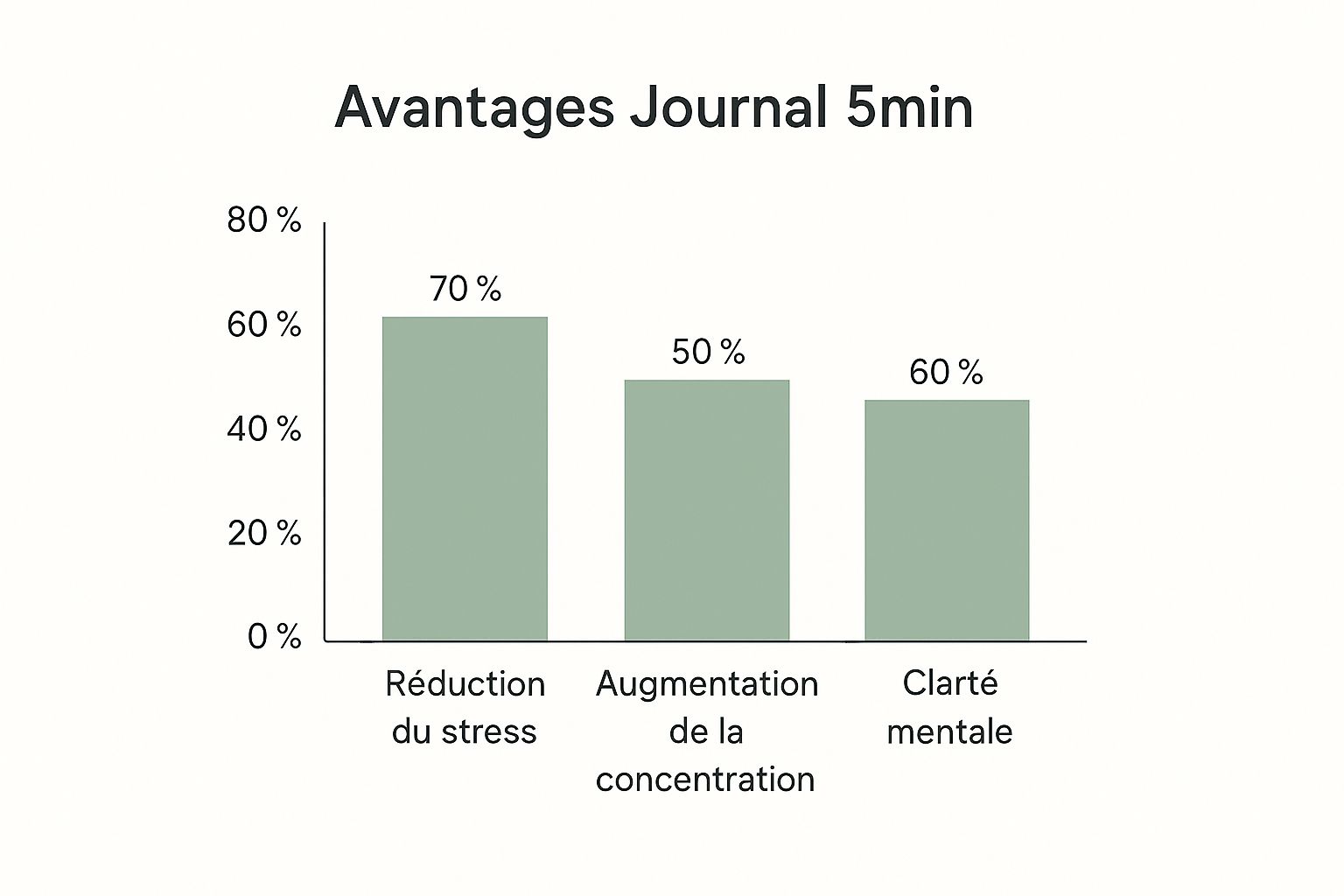
As we can see, stress reduction is one of the clearest benefits. It's a fantastic tool to help our children navigate the complexities of emotions.
The growing success of the " 5-Minute Journal" concept in France demonstrates how simple and effective it is to implement. Notebooks of this type are readily available to accompany this ritual. If you're curious, there are even digital versions for adults, such as the Five Minute Journal app .
To support his initial reflections

The dreaded blank page… it can be intimidating, even for us adults! So for a child, the challenge is to transform this moment into a kind of exploratory game, not just another homework assignment. Your role is to be a guide, a partner, not a teacher waiting for the right answer.
The idea is to help him start a little conversation with himself. The key? The quality of your questions. You have to succeed in opening the door to his thoughts. So forget the classic "Was school good?", which almost always ends with a simple "yes" or "no".
Start the conversation with creative questions
To help them get started, the secret is to mix things up with open-ended questions that pique their curiosity. The goal is to encourage them to reflect on their day and uncover hidden gems. Here are a few ideas for your first 5-minute journal sessions:
- To cultivate gratitude: "If you could say a huge thank you to someone today, who would it be and why?" or "What was the best thing you ate today?"
- For introspection: "What is the bravest thing you did this week?" or "If your emotions were colors, what color would your day be?"
- For creativity: "If you had a superpower for just one hour, what would you do with it?" or "Draw the funniest thing you saw today."
Of course, these are just starting points. Feel free to adapt them to his personality, his interests, and the events in his life. The most important thing is that this moment is engaging and truly resonates with him.
The greatest gift you can give her is to lead by example. Take your own notebook and write alongside her. This shows her that this moment of reflection is precious time you share. It's no longer a "chore to do," but a ritual you're building together.
To value every effort, from the smallest to the greatest
In this endeavor, the final result is not what matters. Whether he writes a sentence, a few words, or makes a simple drawing, each attempt is a success. It is the effort and the intention that are precious.
Highlight what he has created, without ever judging. A simple "I love the colors you chose to draw your day" or "It's a great idea to thank the lunch lady!" is enough to give him confidence. It shows him that his inner world is important and worthwhile.
This support is the foundation of everything. It transforms the journal, like the My Book Story , into a true haven where he can be himself, unfiltered. And that's how a simple five-minute ritual becomes a powerful tool for his self-esteem and a cornerstone of your bond.
Observe its development over the days
Far more than a simple writing exercise, this little daily ritual will have real effects on your child's behavior. The five minutes spent with their journal aren't confined to the pages; they gently seep into their life and color their worldview.
You'll likely see your child better manage minor frustrations. By learning to put words to what they're grateful for, they develop an essential emotional skill: the ability to step back and reflect. A broken toy or an argument with a friend, while still annoying, loses its power.
This ritual shows her that even on a "terrible" day, there are always little sparks of joy. This is the very foundation of resilience and healthy optimism.
This gratitude exercise also strengthens his empathy. By reflecting on the people to thank, he becomes more aware of others' actions and their importance. He begins to better understand the emotions of those around him, which is key to building healthier relationships.
Concrete changes in everyday life
The benefits aren't just emotional; they also extend to creativity. The habit of filling a page each day, even with just a simple drawing, stimulates their imagination. They learn to observe their surroundings more keenly to find inspiration.
The positive effects of the "5-minute journal" on mental health are well known. Based on the principles of positive psychology, it has been proven that regularly expressing gratitude amplifies positive emotions.
Studies have even shown that regular users report a decrease in symptoms of anxiety and depression. If you'd like to delve deeper into the subject, you can learn more about the foundations of this effective approach .
Finally, this ritual is a wonderful opportunity to strengthen family bonds. These moments of sharing open the door to sincere and profound conversations, giving you the chance to discover facets of your child that you might never have suspected otherwise.
Keeping the flame of the journaling ritual alive

Even the best rituals can lose their momentum. One day, enthusiasm is high, and the next, your child drops the dreaded line: "I don't know what to write." Don't panic, it's perfectly normal and doesn't mean the good habit is lost.
Your role at that moment is to nurture that little flame. It's about introducing a touch of novelty without it ever becoming a chore. The goal is to preserve the joy and spontaneity of the moment.
When faced with a blank page, be creative!
When inspiration is lacking, it's time to shake things up a bit. The idea is to bypass writer's block with fun and different approaches.
Here are some ideas to rekindle your child's interest:
- Launch themed weeks. Suggest a theme for the week, such as "friends week," "nature week," or even "wildest dreams week." It provides direction and helps to focus ideas.
- Create an idea jar. Write lots of fun questions on slips of paper and put them in a jar. Each day, he'll pick one for inspiration.
- Turn writing into conversation. Sometimes, fatigue takes over. On those evenings, simply suggest talking about three things you're grateful for or your favorite moment, without writing anything down. The important thing is to keep the dialogue open.
Remember that flexibility is your best friend. The goal of this 5-minute journal isn't to fill pages, but to cultivate a positive mindset. If one approach stops working, that's okay, we'll try another.
By remaining attentive and adapting the ritual to her moods and needs at the moment, you show her that her feelings are important. This is the best way to ensure that this habit stays with her for good, becoming a refuge and not a burden.
We answer your parenting questions
Are you tempted to start a 5-minute journal ritual with your child, but still have some doubts? That's perfectly normal. Here are some answers to help you get started and confidently embark on this wonderful family adventure.
Is my child old enough to start?
From the age of 6 , a child can begin to take ownership of their journal. Don't worry if they haven't yet mastered handwriting. They can absolutely express their ideas through drawings, collages, or even by simply dictating what's on their mind.
The important thing is to help him put words or images to what he feels and to the little joys of everyday life.
What if he really doesn't like to write?
Be flexible! If writing is a hurdle, the idea isn't to force it. Offer them other ways to express themselves so that this moment remains, above all, a pleasure.
- Drawing of the day: He can draw his mood or the best moment of his day.
- Emotion stickers: It's a simple and very visual way to say how he feels.
- Just talking about it: Sometimes, simply telling you three positive things about your day is more than enough. The goal is to encourage reflection, not to write an essay.
The most important thing is to maintain the connection that this moment creates between you. The tool, whether it's a pencil, a marker, or words, can change. What matters is the intention behind it: taking a little time for yourself and to share.
Is it absolutely necessary to do it every day?
Regularity is certainly a good thing for establishing a habit. But it should never become a chore or a source of stress.
If you miss a day, it's perfectly fine. The most important thing is to maintain a positive and lighthearted approach. It's better to aim for consistency in the long term than daily perfection.
The My Book Story journal was specifically designed to guide your child in this journey of self-discovery. Discover how they can transform these five minutes into a truly magical, creative, and fulfilling experience on the My Book Story website .