


Homework time, that moment that sometimes turns into a real struggle... Do the phrases "it's too hard" or "I'll never manage it" sound familiar? That's where a positive mantra for schoolwork comes in. It's simply a short, encouraging phrase that your child repeats to themselves to change their perception of a difficult task and boost their confidence.
How a simple sentence can change everything during homework time
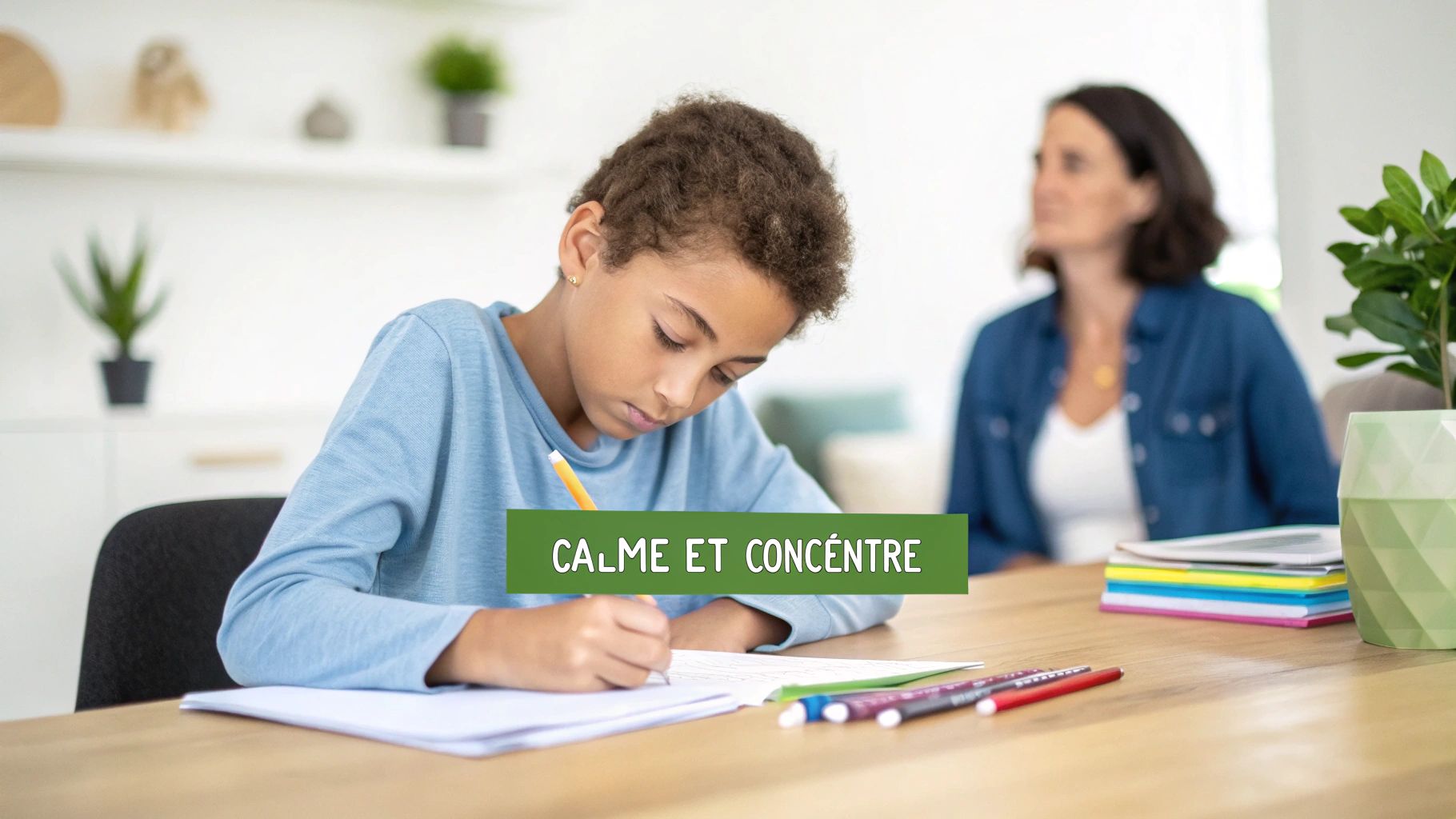
Negative thoughts like "I'm worthless" aren't harmless. They're real barriers your child erects themselves, turning learning into a mountain of anxiety. The idea behind the mantra is to demolish these walls, brick by brick, and replace them with thoughts that help them grow.
Note that the goal isn't to make him believe everything is easy. The objective is to help him change his perspective. Instead of letting frustration overwhelm him, he learns to channel it with more constructive thinking.
The magic of words on a child's brain
Think of a mantra as a mini workout for the brain. By repeating a positive affirmation, your child activates the areas of their brain associated with self-esteem and perseverance. It's a very concrete way to teach them to create new thought patterns that are more helpful for their emotional development.
A mantra is much more than a parenting tip. It's a real tool you give them for life. They learn that effort isn't an obstacle, but simply a step on the path to success and pride.
This practice, even just a few minutes a day, helps him cultivate essential qualities:
- Resilience: a mistake is no longer a tragedy, but an opportunity to learn.
- Concentration: by banishing anxious thoughts, he frees up mental space to focus on his task.
- Self-confidence: he remembers that he has the abilities and resources to succeed.
Preparing the ground for the adult of tomorrow
This positive approach to schoolwork has repercussions far beyond the kitchen table. By helping them see schoolwork in a constructive light, you lay the foundation for a healthy relationship with effort and perseverance that will be valuable to them throughout their lives, long after they leave school.
In the adult world, the relationship with work is crucial for well-being. Moreover, according to a survey by the Institut Montaigne, 77% of working French people say they are satisfied with their jobs, a key factor in their personal fulfillment. If this topic interests you, you can consult the full results in the Institut Montaigne report .
Create the perfect mantra with your child

For a mantra to truly resonate, it must speak directly to your child, come from within them. A ready-made phrase, even with the best intentions, will never have the same impact. The secret is to make it a moment of connection, a little creative game between you to find the right words.
Start the conversation in a simple and natural way. Your goal is to uncover that little voice inside that tells him he can't do it. Try open-ended questions like: "Tell me, what do you find most challenging about your homework right now?" or "When you think 'it's too hard,' what goes through your mind at that moment?"
The idea is to pinpoint what's really holding him back. Is it the fear of making mistakes in math? The anxiety of a blank page before an essay? By understanding and validating his emotion, you've already covered half the ground.
Transforming doubts into power statements
Once you've identified the thought that's causing the problem, it's time to turn it inside out! This is a fun and creative exercise to do together. If your child says something like, "I'm terrible at spelling," guide them to transform that sentence into something positive that motivates them to move forward.
We are not trying to deny the difficulty, but to change the point of view.
The goal is to make him understand that he is in control of his thoughts. Instead of being a victim of his frustration, he learns to use it as a springboard for his self-confidence.
Here are a few examples to see how it works:
-
The doubt that creeps in: "I'll never manage it, it's too complicated."
-
The mantra that gives you energy: "I move forward step by step, and each step is a victory."
-
The doubt that creeps in: "Everyone else is better than me."
-
The mantra that gives you energy: "I'm doing my best, and that's what matters most."
The recipe for a mantra that works
To make a positive schoolwork mantra easy to remember and use on a daily basis, there are a few key ingredients.
Make sure it starts with "I," so your child can fully embrace it. It should also be in the present tense , as if it were already a reality. And of course, it should be short, simple, and easy to say , a bit like a personal slogan.
Here is a short list of magic words to slip into your creations:
- Able
- Calm
- Concentrate
- Brave
- Creative
- Strong
By assembling these pieces, a phrase like " I am calm and capable of finding the solution " becomes a truly powerful, personal tool. It is by building it together that the mantra truly gains its strength.
How can you integrate these mantras into your family routine?
A positive schoolwork mantra , however powerful, remains just a nice phrase if it isn't used regularly. The key is to make it a part of your child's daily routine. Not as just another chore, but as a little ritual, a fun moment just for them. The idea is to create habits lasting a few minutes that will become positive reflexes when facing challenges.
These little routines help transform a somewhat abstract idea into a concrete and easy-to-use tool. When homework pressure mounts, your child will instinctively know where to find the strength to refocus.
Make the mantra visible and fun
For your child to remember their mantra, they need to see it! The practice should be joyful and part of their work time. The secret is to never present it as an obligation, but rather as a game or a secret superpower.
Here are a few simple ideas to try tonight:
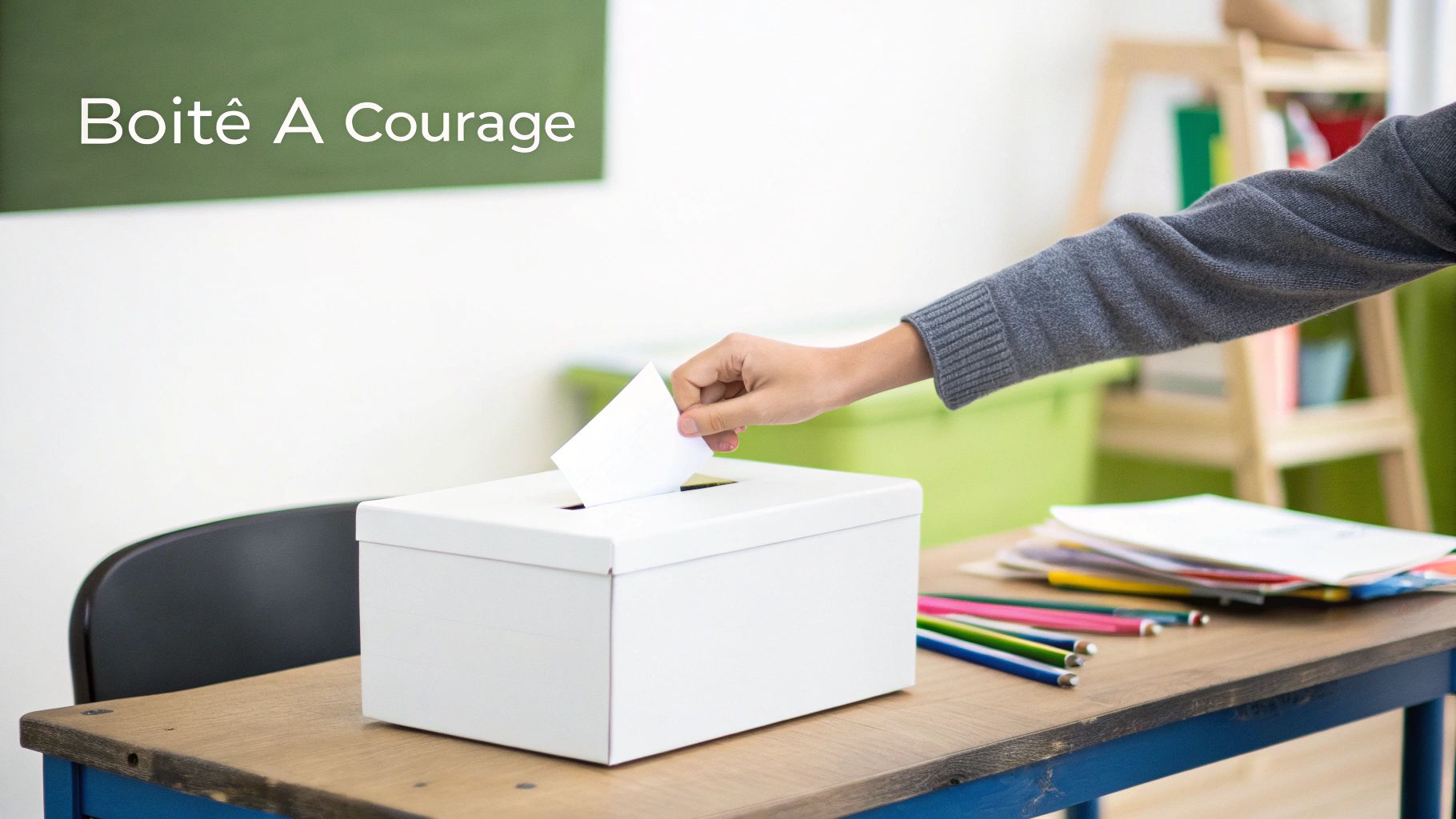
- The Courage Box: Take a simple shoebox and decorate it together. Each week, write new mantras on small colored slips of paper and slip them inside. Before starting homework, your child can pick out their "magic phrase" for the day.
- The Superhero Post-it Note: A simple colored sticky note stuck to a desk, screen, or planner can work wonders. Let your child doodle around it, use their favorite markers... Seeing it constantly reinforces its message without even thinking about it.
- The Pencil Keeper: Write the mantra at the very top of the worksheet. It's a bit like a secret message between him and the paper, a silent encouragement that accompanies him on every line.
The goal is definitely not to add pressure. It's to create a positive anchor, a visual reminder that your child already has all the resources within them to overcome the current difficulty.
Use a journal as a space for expression.
A personal journal, like the My Book Story notebook, is a fantastic tool for going further. You no longer just repeat a sentence, you make it your own with your emotions and creativity.
In their notebook, your child can dedicate a page to their weekly mantra. They can write it in large letters, draw it, or even create a short comic strip where the hero (themselves!) uses this phrase to accomplish a mission. This creative exercise amplifies the mantra's impact, as it associates it with a pleasant emotion and a feeling of accomplishment.
This approach also boosts autonomy. Did you know that in France, only 21% of employees consider themselves truly engaged in their work? This figure is partly explained by the need for autonomy and meaning. By encouraging your child to manage their own motivation with a tool like a mantra, you give them valuable keys to investing themselves in their schoolwork. It's a solid foundation for a proactive mindset that will serve them throughout their life. To delve deeper into the subject, you can read analyses on engagement at work on Echodumardi.com .
The right parenting approach: be a coach, not a project manager

Introducing a positive mantra for schoolwork into your child's daily routine requires a delicate touch. Your role isn't to direct, but rather to support, like a caring coach. The idea is to guide, inspire, but above all, never impose. The ultimate goal? To give them the tools to build their own self-confidence.
The support you provide is crucial, but it must be carefully measured. Encouraging without putting pressure on is an art! If you sense a hint of skepticism in your child, or if they find the idea a little "strange," the best approach by far is to lead by example.
The power of example: become their first ally
Children learn a great deal by imitating us. Don't hesitate to share your own "grown-up mantras" aloud when facing challenges. It can be as simple as whispering before a complicated chore: "Okay, one thing at a time and it'll be fine."
Seeing you use this tool on yourself will help him understand that everyone, even adults, sometimes needs a little mental boost. This makes the practice much less intimidating and completely normalizes it. It's a very concrete way to show him that knowing how to manage his thoughts and emotions is an essential life skill.
Your own vulnerability can become an incredible strength. By sharing your doubts and the strategies you use to overcome them, you create a space of trust. A space where he will feel safe to do the same. You are no longer the one who knows everything, but the one who learns alongside him.
The little phrases that accompany without directing
Your coaching approach also depends on the words you choose. It's not about repeating his mantra, but about reminding him that he has this tool at his fingertips.
Here are some phrases to gently encourage him:
- "Don't forget your magic phrase; it's there to help you find your strength."
- "I can see it's difficult... Could your secret word help you feel stronger?"
- "Take a deep breath. Do you remember the little phrase we created together?"
These subtle invitations remind him that he's in control. You're simply showing him where the key is; it's up to him to decide if he wants to use it.
Common mistakes to avoid
For the experience to be truly positive, it is important to avoid certain pitfalls that could unintentionally produce the opposite effect.
- Minimize his fears. Phrases like "No, it's not that difficult!" or "You're worrying for nothing" only invalidate his feelings. The first step is always to acknowledge his fear before offering him a tool to overcome it.
- Forcing the use of the mantra. If your child doesn't want to use it at the moment, don't insist. The mantra should remain a resource they choose, never an obligation. Otherwise, it becomes just another chore.
- Choose for him. A mantra that doesn't resonate with him will be completely ineffective. Even if a phrase seems perfect to you, if he doesn't like it, respect his choice. Find another one together—that's part of the fun!
Your role is that of a patient ally, who offers tools and celebrates every small victory towards greater autonomy and confidence.
Recognize progress and evolve the practice
Establishing a positive mantra for schoolwork with your child is a bit like planting a seed. You don't see results right away, but with a little patience, something solid begins to grow. The first changes are often subtle, almost invisible. Your role as a parent is to become a kind detective, on the lookout for those small victories that, added together, truly make a difference.
Let's be clear: patience will be your best friend. Don't expect a dramatic transformation overnight. But little by little, you might notice that your child sighs less before getting out their notebooks. Or that they no longer give up so easily on that math problem that seemed like a mountain to them last week.
Identify the telltale signs
Progress can take many forms. Keep an eye out for these encouraging signs, even the smallest ones, and most importantly, tell your child when you see them!
- His vocabulary is changing: Phrases like "it's rubbish" or "I'll never manage it" are becoming less common. Instead, you're starting to hear things like "I'll try" or "It's difficult, but I can do it."
- He manages his frustration better: He gives up less quickly (or drops his pencil!). He learns to take a break, take a deep breath, and then get back to it.
- He is prouder of himself: He comes to show you his work more spontaneously, even if it is not perfect, just because he is happy to have tried.
- He tells about his day differently: He shares more positive anecdotes from school, focusing on what he learned rather than the difficulties.
This last point is crucial. By encouraging them to use mantras, you help them build their own source of motivation and pride. In fact, a study reveals that 78% of adults derive pride from their work , a feeling directly linked to the recognition of an effort accomplished. By planting this seed in childhood, you give them a solid foundation for their future development. To learn more, you can explore other statistics on well-being at work .
Knowing when it's time to change your mantra
A mantra isn't set in stone; it's a tool that must evolve with your child. The little phrase that worked perfectly at age 7 for early reading might not have the same impact at age 10 when faced with two-digit division.
The idea is not to cling to a single magic formula, but rather to learn to create new ones as challenges arise. It's a dynamic support system that adapts to its growth and needs.
So, how do you know when to adjust your approach? It's simple: if you feel the current mantra has lost its power or your child is facing a new obstacle, that's the signal. It's time to sit down with them and discuss this new challenge, just as you did the first time.
By making this a regular appointment, you strengthen his ability to reflect on himself and show him one essential thing: strategies for feeling good can, and should, evolve with him.
Questions about mantras? We'll answer them.
The idea of introducing a positive mantra for schoolwork appeals to you, but you still have some questions? That's perfectly normal. When starting a new routine with your children, you want to be sure you're doing things right.
This short FAQ is here for just that: to reassure you, give you concrete suggestions, and show you that you already have everything you need. You don't need to be an expert, just a parent who listens.
Is my child old enough to understand a mantra?
Absolutely. From the age of 6 , a child can grasp a simple sentence and experience its benefits. The trick is to keep things very simple at the beginning.
For younger children, between 6 and 8 years old, we get straight to the point with short statements, focused on a single idea. Think of sentences like:
- "I am capable."
- "I am calm and focused."
- "I'm trying, that's the most important thing."
These few words are easy to remember, even when emotions take over. They act a bit like a "pause" button for the mind, helping to refocus before moving on.
What if he finds it completely ridiculous?
Ah, the famous "your thing is rubbish" reaction! If your child refuses or makes fun of it, the worst thing you can do is force them. The magic of the mantra can't work under duress. Even minimal initial buy-in is essential.
Your best tool is example. Show him how YOU use your own "magic phrases" every day. Let him hear you whisper "Okay, I'm breathing and staying calm" before a stressful meeting or while frantically searching for your keys. He'll see that it's not just a "thing for kids," but a real trick for adults too.
Another idea is to change the name. The word "mantra" can seem a bit abstract. Why not suggest creating a "secret anti-panic formula" or a "password for courage" ? By turning the exercise into a game, you'll pique their curiosity and they'll be much more inclined to try it.
How long will it take before I see a difference?
There's no one-size-fits-all rule; every child is different. Forget the idea of a dramatic transformation in 48 hours. We're not looking for a miracle solution, but rather to establish a new mental habit, and that takes time.
The secret is to celebrate the small victories. Did he manage to concentrate on his math for five more minutes? Did he remember to say his little phrase to himself when faced with a difficult problem? These small signs are proof that something is changing. Consistency is much more effective than intensity. A little each day is better than a lot once a week.
Do we need a different mantra for math, French, etc.?
Not necessarily, especially to begin with. It's even simpler to start with a "one-size-fits-all" mantra that focuses on the attitude towards effort rather than on a particular subject.
A mantra like "I'm doing my best, and that's already great" is perfect. It works for everything and, above all, it helps to take the drama out of making mistakes, which are an integral part of learning.
Later, if you notice a real blockage in a particular subject (the dreaded multiplication tables, for example), you can create a more targeted mantra. A phrase like "Every problem is a puzzle, and I love solving them" can really help them see math in a new light.
To give your child a space where they can write down their thoughts, successes, and personal mantras, the My Book Story journal is a wonderful tool. It's the perfect companion to help them develop their self-confidence, day after day.
Discover the My Book Story notebook and give them a space to grow up in complete serenity .