


A positive mantra of the day is simply a short, optimistic phrase that you repeat to your child in the morning. The idea is to help boost their self-confidence and start the day off right, with a positive mindset. It's a simple ritual to bring serenity and intention into everyday family life.
The hidden superpower of everyday words
Imagine a simple ritual, just a few words exchanged each morning, yet one that has the power to transform your child's day. That's the power of a daily positive mantra. For children aged 6 to 12 , who are in the process of building their inner world, this practice is much more than a pretty phrase. It's a true emotional shield.
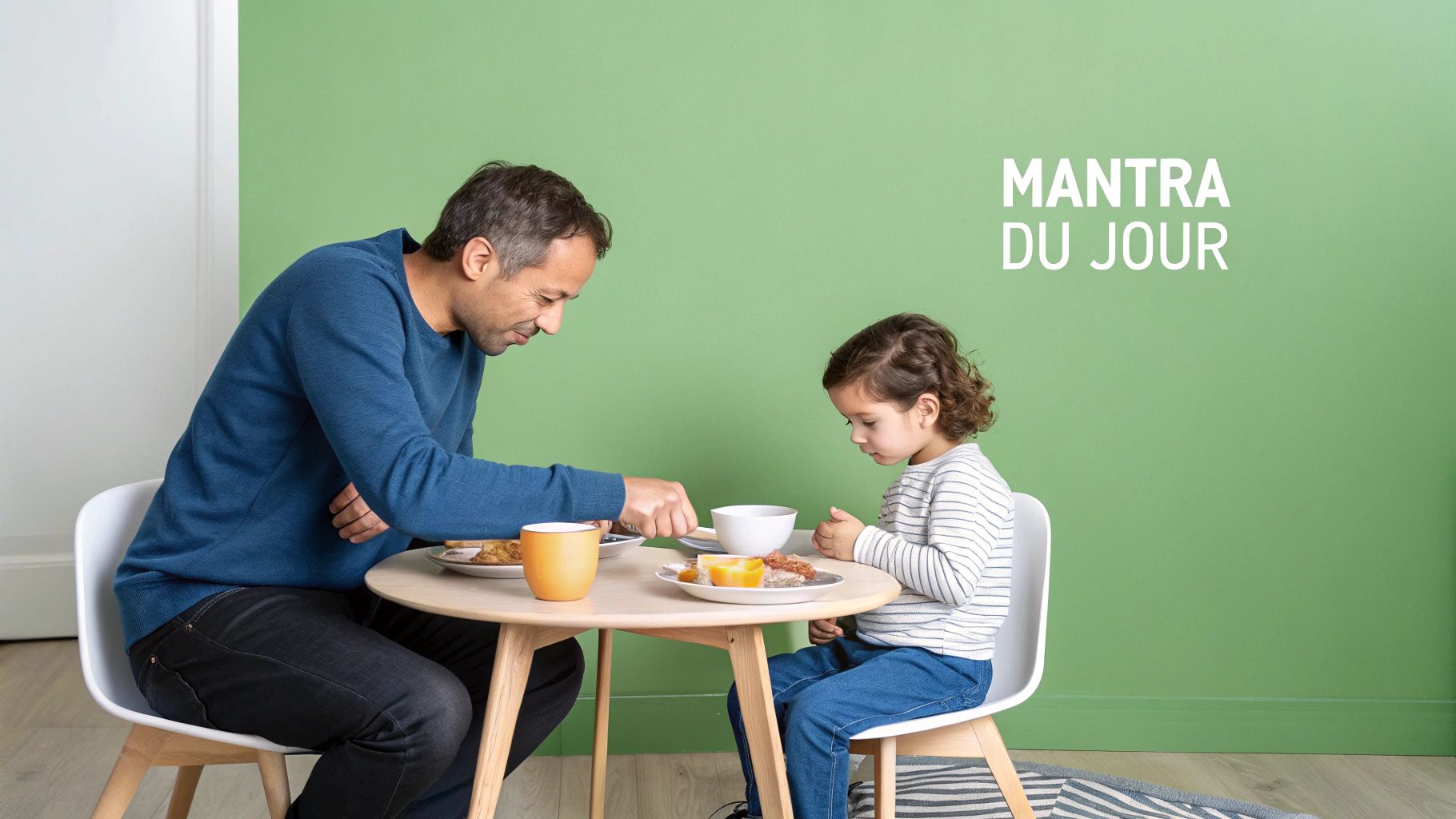
Let's be clear, this isn't a magic formula. It's more of a practical tool to help your child communicate with themselves more constructively. The goal isn't to deny their difficulties, but to offer them comforting words to cope with them. It's a bit like giving them an internal compass to help them navigate the waves, big and small, of life at school and with friends.
Why is this ritual so precious?
Incorporating a mantra into your family routine is, above all, about creating unique moments of connection. It's a wonderful opportunity to talk about emotions simply, without making things complicated. When you choose a phrase together that resonates with what he's experiencing right now, you show him that his feelings matter and that he already has everything he needs within himself to manage them.
This guide is here to help you, step by step. We'll see together how to:
- Boosting his self-confidence: Giving him the right words to make him believe in himself, whether it's before a math test or a new sporting activity.
- Soothe minor anxieties: Offer them a calming reflex to better manage morning stress or calm a major frustration.
- Open a sincere dialogue: Use the mantra as a starting point to discuss your joys, fears, and dreams.
The goal isn't perfection. It's to sow little seeds of positive thinking. Every word repeated with heart is a small investment in one's well-being and resilience.
Together, we'll explore how to make this practice a joyful habit, and definitely not a chore. You'll discover how to transform the daily mantra into a shared little secret, a treasure that will help it grow with greater strength and serenity.
How a simple mantra can change everything for your child
Between the ages of 6 and 12, your child's mind is developing rapidly. It's during this pivotal age that their inner voice takes shape, this ongoing dialogue they have with themselves. The positive mantra of the day isn't a gimmick; it's a genuine tool to help them shape this voice, so that it becomes their greatest ally.
Think of your brain as a small garden. Every thought is a seed. If negative thoughts like "I'm worthless" or "I'll never succeed" take over, the garden quickly fills with weeds. A mantra, gently repeated each day, is like planting seeds of confidence and courage. In time, these seeds will grow into strong trees.
The goal isn't to pretend everything is easy. Rather, it's to give her an inner compass to navigate through difficult times. Instead of feeling crushed by the frustration of a bad grade, the mantra "Every mistake is a learning opportunity" opens a new door for her. Failure then becomes simply a step on her path.
From idea to reality: the daily impact
The power of mantras is not just theoretical; it is concretely visible in everyday life. That's where the magic happens.
- Before a school presentation: A slightly stressed child can quietly repeat to themselves, "I am calm and well-prepared." This phrase alone can help them slow their breathing, lower their blood pressure, and feel more confident in front of their classmates.
- After an argument with a friend: Anger and sadness can be overwhelming. A mantra like "I breathe and I regain my calm" acts like a "pause" button. It teaches him to regain control of his emotions, instead of letting himself be swept away by the storm.
- Getting ready in the morning: Looking in the mirror and saying "I'm proud of who I am" changes everything. It helps her focus on her strengths and start the day with a healthy dose of self-esteem, no matter what lies ahead.
The goal isn't to force optimism at all costs. It's to build, day after day, a solid foundation of inner security. The mantra becomes a personal reminder of one's strength and resilience.
This approach is becoming increasingly popular, and not just for children. In France, the idea of cultivating positive thoughts to manage stress is gaining ground. In fact, a study showed that nearly 60% of people find that these practices have a real impact on their mood. This figure even rises to 71% among women! To delve deeper into the subject, you can take a look at this information on mental health in France on generation.fr .
By incorporating a positive mantra into their routine, you're not just giving them pretty phrases. You're offering them real mental training, strengthening their ability to think constructively, for today and for their entire life.
Choose and create the right mantra with your child
Okay, so how do we do this in practice? The idea is definitely not to impose a ready-made phrase on him. The secret is to find it together . Turn it into a little game, a friendly chat, not just another homework assignment.
For a child between 6 and 12 years old to truly embrace their daily positive mantra , they need to feel that it comes from them, that it truly speaks to them. Start the conversation simply: "Tell me, is there anything at school that you find a little difficult right now?" or "What superpower would you like to have this week?" These simple questions open the door to their real concerns.
Turn the idea into a creative game
To avoid it feeling like an obligation, the best approach is to make it a fun, hands-on activity. This is an excellent way to ground the mantra in reality and make it much more personal.
Here are some fun ideas to get you started:
- The Power Box: Take a small box and decorate it together. Each week, write mantras on slips of paper that correspond to his current challenges. He will then simply have to pick his "magic phrase" each morning.
- The Wheel of Magic Phrases: Make a cardboard circle with a spinning arrow in the center. Divide it into several sections, like a pie, and write a mantra in each section. Spinning the wheel becomes a fun little ritual to start the day.
- Drawing the mantra: A picture is sometimes worth a thousand words. If he chooses "I am as brave as a lion," ask him to draw a lion. It anchors the message very powerfully in his mind.
These short phrases have a real impact. In fact, they are based on three pillars that you reinforce on a daily basis.
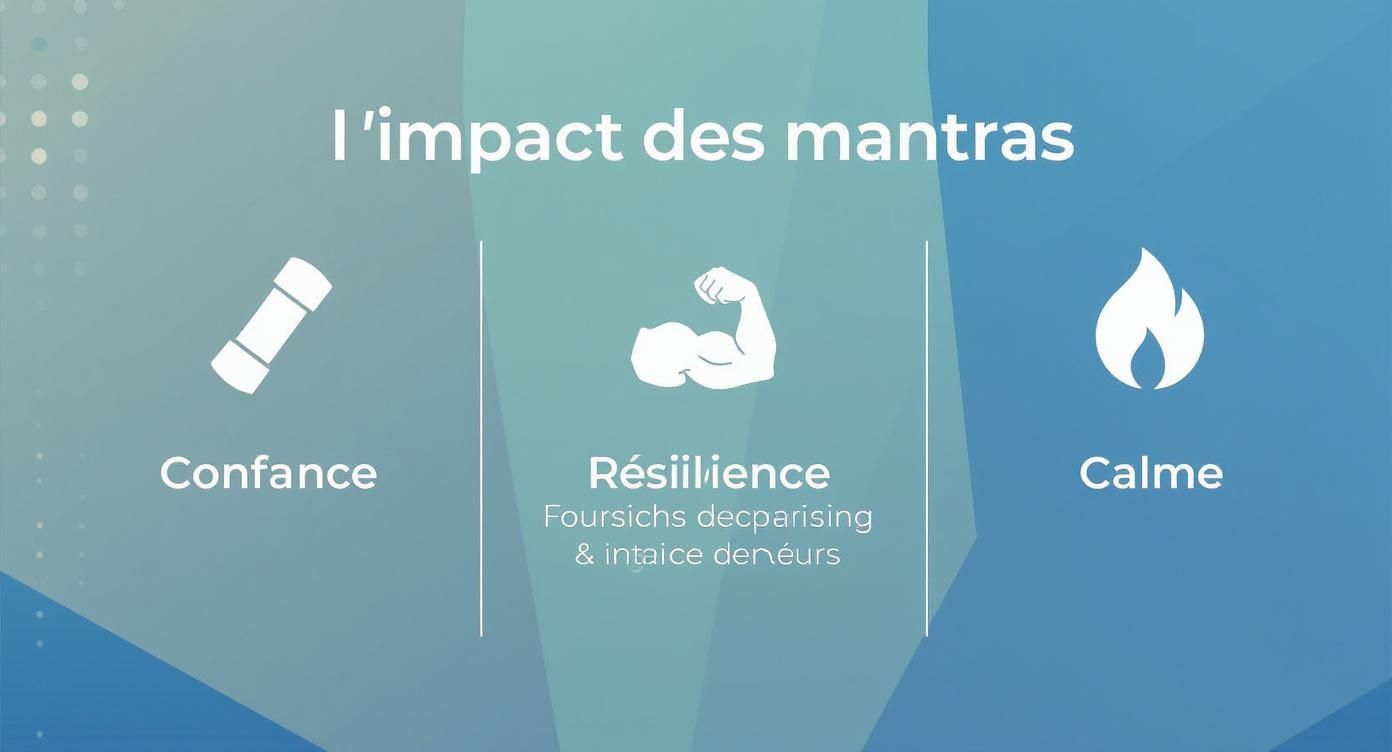
By cultivating confidence, resilience and calm, the mantra becomes a real toolbox for your child's well-being.
Find inspiration with concrete examples
Sometimes, all it takes is a little spark for ideas to ignite. Don't hesitate to offer him examples, not so he takes them as they are, but to help him come up with his own.
To help you get started, here are some mantra ideas suitable for different ages and common themes. This is a great starting point for a discussion.
Ideas for positive mantras by age and need
| Need / Theme | Example for 6-8 year olds | Example for 9-12 year olds |
|---|---|---|
| Self-confidence | "I am capable and I am doing my best." | "I believe in my ideas and my abilities." |
| Courage | "I have the strength of a superhero within me." | "I can face challenges with courage." |
| Friendship | "I'm a good friend." | "I am open to others and I share joy." |
| Creativity | "My imagination is a great adventure." | "My ideas are unique and important." |
| Perseverance | "Every mistake is an opportunity to learn." | "I don't give up and I achieve my goals." |
Keep in mind that the perfect mantra is one that speaks to your child, here and now. A phrase as simple as "I breathe and I stay calm" can work wonders before a test, much more so than a complicated one.
The best mantra is the one that resonates with what your child is experiencing at a given moment. Authenticity above all!
This practice is gaining ground. A study shows that French people who use mantras generally feel happier. It's also worth noting that 54% of 18-24 year olds say they are optimistic about their future, a sign of the younger generation's genuine receptiveness to these positive messages. If this topic interests you, you can consult data on the well-being of the French at cepremap.fr .
By involving them in choosing and creating their mantra, you're not just giving them a phrase. You're offering them a tool they can use for life, an essential first step towards emotional autonomy.
Incorporate the mantra into your family rituals
You and your child have now created a mantra. It's a little treasure, but to unlock its full magic, it needs to be repeated. The secret? Integrate it naturally into your existing routines, without it becoming just another chore.
The idea is not to add a task to your already full list, but to transform an ordinary moment into a small parenthesis of trust and connection.
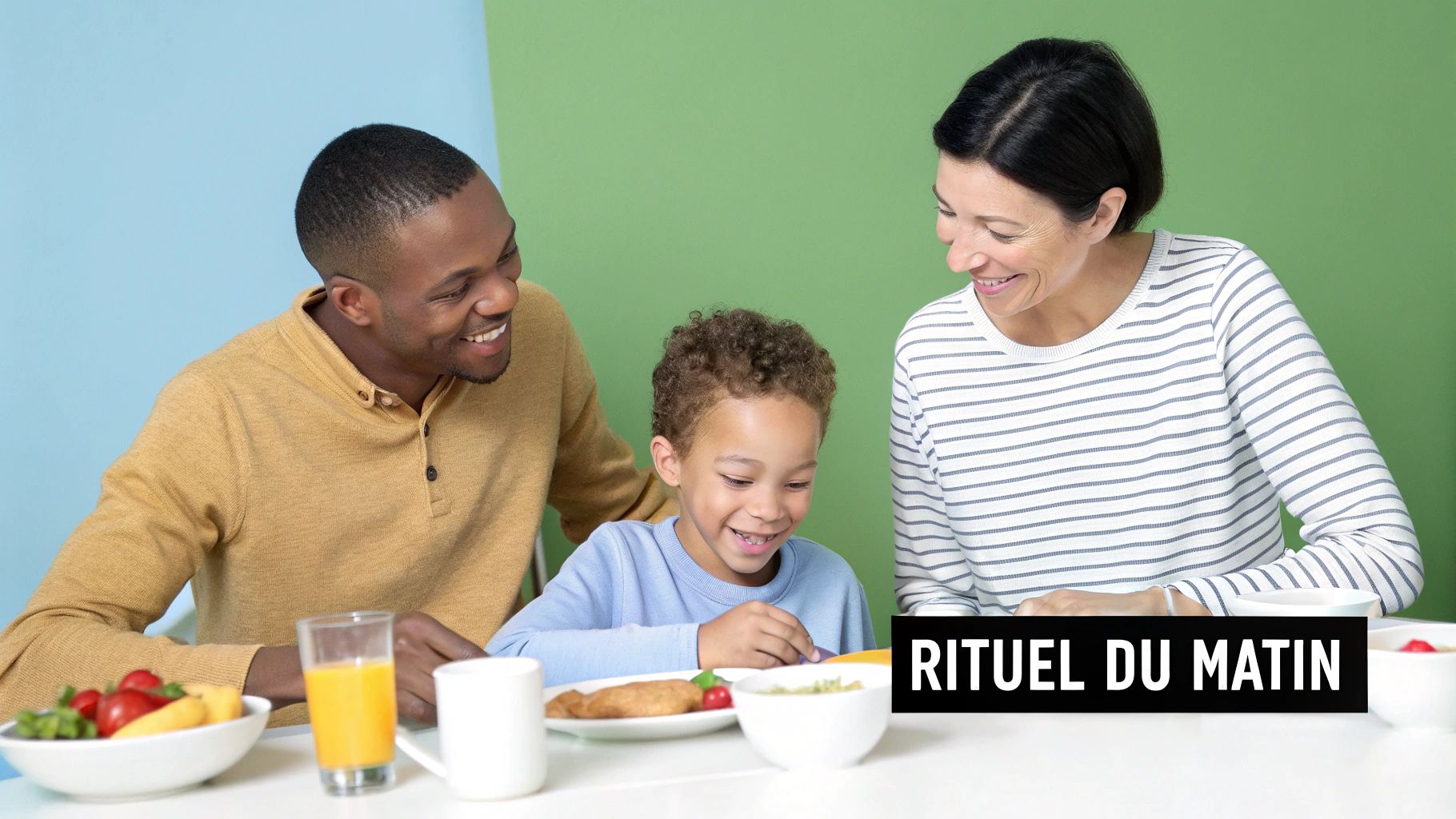
The key moments of the day are perfect for this. Think about your morning routine; it's a goldmine for anchoring a positive thought before the whirlwind begins.
Find the perfect time for your family
Each family has its own rhythm. The goal is to find one or two key moments when saying the mantra is effortless, joyful, and spontaneous.
Here are some ideas to get you started:
- During breakfast: Just before the day begins, take 30 seconds to say the mantra together to set the tone. It's a gentle way to mentally prepare for the challenges ahead.
- On the way to school: The car or the walk, it's your bubble. Just before saying goodbye, the mantra becomes a little boost of courage, a final encouragement that will accompany them throughout the day.
- At bedtime: The evening is ideal for calming the mind. A gentle phrase like "I am at peace and I am resting well" helps to chase away the day's little worries and drift off to a peaceful sleep.
Remember, consistency is what counts, not length. A mantra whispered from the heart for a minute will always have more impact than a long, forced speech. Choose what feels most natural to you.
Make the mantra visible and concrete
For a child between 6 and 12 years old , things need to be concrete. A sentence, even a very powerful one, can remain somewhat abstract. To bring it to life, it needs to be physically anchored in their environment.
When the child sees the mantra written down, it brings it back to their awareness without you needing to remind them. That's how they truly make it their own and use it as their personal tool.
- Write it on the bathroom mirror with a dry-erase marker. Every morning, while brushing his teeth, he'll see his message of confidence.
- Slip a sticky note into his lunchbox. It's a small surprise that warms the heart and reminds him of his inner strength in the middle of his day.
- Make it a creative activity. Suggest that they draw their mantra and decorate it. Then display their artwork on the fridge or in their room.
- Create a mantra bracelet. String letter beads together to form a keyword (for example, COURAGE ) that he can wear on him, as a little secret reminder.
By making the mantra a joyful and visible marker, you transform it. It's no longer just a phrase, it's a true family ritual. A pretext for a hug, a knowing smile, a moment of connection that strengthens both their inner world and your bond.
The journal: the ultimate ally for anchoring positive thoughts
Repeating a positive affirmation each day is a bit like planting a seed. It's a great start. But for that seed to take root and truly grow in your child's mind, it needs fertile ground. That's where a creative journal comes in. Much more than just a notebook, it becomes that special space where thoughts come to life and emotions find their place.
When a child writes or draws their mantra, they are not simply copying it. They are making it their own, internalizing it. The simple act of holding a pencil and tracing the letters anchors the message in their muscle memory. This physical connection makes the phrase much more powerful and easier to recall in moments of doubt.
A tool like the My Book Story journal was designed precisely for this purpose. It guides the child to connect their thoughts with their feelings. The mantra then transforms from a somewhat abstract phrase into a genuine tool for self-discovery.
How does the newspaper amplify the power of the mantra tenfold?
By linking the phrase of the day to a creative activity, you really take it to the next level. The journal becomes a kind of secret garden, a safe space where your child can explore what that little phrase means to them , without fear of judgment.
This routine helps to gradually build a veritable inner library of positive resources. On days when he feels a little overwhelmed, he can not only recall his mantra, but also think back to the drawing of the brave lion he made last week, or reread that list of things that made him so proud.
Here are some very concrete ideas to suggest to him to bring his mantra to life in his notebook:
- Draw your mantra: If the phrase is "I am calm like a mountain," ask them to draw their mountain. Is it tall and pointed? Covered in snow or forest? This visualization exercise makes the idea much more concrete and personal.
- The success page: For the mantra "Every mistake is a learning opportunity," he can recount a time when he failed at something and what he ultimately learned from it. The journal then becomes a testament to his ability to bounce back.
- The evidence hunt: With a phrase like "I'm a good friend," he can try to find and list three times during his day when he was kind to someone. This is a great exercise to help him notice his own good qualities on a daily basis.
Once written down, a mantra is no longer a fleeting thought. It becomes a tangible trace, proof of your child's inner strength. It's a guiding light they can always return to.
Transform writing into a little ritual that's all your own
The idea is definitely not to make it homework. Simply suggest that he dedicate 5 to 10 minutes to it, perhaps in the evening before bed, as a moment to process the day's emotions. It's a special time you can share with him, not to correct what he does, but simply to listen and encourage him.
You could, for example:
- Dedicate an entire page to the mantra of the week. He can write it in large print, color it in, decorate it with stickers or images that resonate with him.
- Create a "pride bank." Invite him each day to write down or draw one thing, however small, that made him proud of himself. This is excellent for nurturing his self-esteem.
- Describe a "mantra moment." Ask them if there was a time during the day when their little phrase helped them. For example: "I remembered I was brave just before raising my hand in class."
By linking the positive affirmation of the day to a creative activity like writing or drawing, you give your child an incredibly valuable skill. They learn that their thoughts have real power and that they already possess within themselves all the tools to cultivate their own well-being.
Your questions about today's positive mantra
Adopting a new habit, like the positive mantra of the day, always brings its share of questions. That's perfectly normal! To help you get started with confidence, we've compiled the most common questions parents ask, along with simple and practical answers.
What if my child finds this ridiculous?
This is the number one fear of many parents, and it's legitimate! If your child rolls their eyes, above all, don't take it personally. At this age, between 6 and 12, anything that lacks authenticity or seems a little too serious can quickly be labeled "old-fashioned".
The key? Make it a game . Ditch the solemn tone. Suggest that they whisper their mantra like a superhero secret, sing it to the tune of their favorite song, or even say it in a robot voice. The goal is to have fun and create a moment of connection.
If he really doesn't take to it, there's no pressure. Give up for today and try again another day, perhaps by suggesting he draw it or pick a "magic phrase" from a box.
How long will it take to see results?
Let's be honest: there's no magic formula. The effect of a mantra isn't seen overnight. It's more of an accumulation of small victories.
The first signs are often very subtle. You might notice him reusing the words of the mantra to calm himself after an argument, or that he catches himself when a negative thought slips out. The most important thing is to be patient. The idea isn't to change him, but to give him a tool to build a gentler inner dialogue. Consistency, even just one minute a day , makes all the difference.
The goal is not performance, but connection. Every word shared with kindness is a seed planted for her future self-esteem, whether it germinates tomorrow or in a few months.
Should you change your mantra every day?
Not necessarily. For younger children (6-8 years old), keeping the same mantra for a whole week is often more effective. Repetition really helps to anchor the message in their minds.
For older children (9-12 years old), who often crave novelty, you can vary their routines more frequently. A good idea is to have a small collection of "tool" mantras: one for courage before a test, one for calmness before bed, and so on. The best approach is to listen to them. If a presentation is causing them anxiety this week, choose a phrase together that will give them strength.
Should I have my own mantra, as a parent?
Yes, absolutely! It's actually one of our best pieces of advice. Remember that children learn best by imitating.
If, before dealing with the stress of going to school, you say out loud, "I am calm and patient," you demonstrate concretely that this skill is useful for everyone, even adults. It makes the practice much more natural and creates a positive family dynamic. You're no longer just giving advice; you're practicing it. It's the best way to inspire them.
The My Book Story journal is a fantastic tool for bringing these rituals to life. It helps your child explore their emotions and personalize their mantras by drawing or writing them down. A simple phrase then becomes a truly personal tool to boost their confidence.
Discover how the My Book Story notebook can enrich your daily life at mybookstory.co .