


A children's emotions book isn't just a bedtime story. Think of it as an interactive toolbox, designed for 6-12 year olds , that teaches them to put words to their feelings, understand their own inner weather, and navigate it . It's a personal compass to guide them through the ups and downs of their development, a true ally for their growth.
Supporting your child's emotions: an essential life skill

In our ever-accelerating world, giving our children breaks to reconnect with themselves is a true gift. As a parent, you are their first guide in developing their emotional intelligence, an absolutely fundamental skill for their future well-being and self-confidence.
The goal isn't to erase "negative" emotions, but rather to teach your child to acknowledge and listen to them. When experiencing intense frustration, a wave of sadness, or a surge of anxiety, their primary need is to feel that what they're feeling is normal and legitimate. This is the starting point for building self-confidence and learning to create genuine connections with others.
A valuable tool for opening dialogue
A children's emotions book serves as a bridge between their inner world and yours. It makes somewhat vague concepts like "anger" or "joy" much more concrete. You can draw on them, write about them, talk about them. This tool then becomes a wonderful invitation to discuss as a family topics that are sometimes difficult to broach spontaneously.
And current events remind us that these conversations are urgent. In France, children's mental well-being has become a real concern. The High Council for the Family, Childhood and Adolescence (HCFEA) has highlighted a striking statistic: nearly 20% of children aged 6 to 12 experience distress. If you would like to learn more, please consult the full report on children's mental health .
Tip for parents: Using a creative activity helps validate what the child is feeling. Telling them, "I see you're angry, and it's normal to feel that way," is so much more constructive than dismissing their emotion with, "Oh, it's not a big deal." It shows them that their feelings matter.
By choosing to incorporate a book like this into your family rituals, you are making a powerful choice. You are not simply offering a journal, but a safe space where your child can explore who they truly are, without judgment. It is a direct investment in their ability to bounce back from difficulties and thrive.
How an emotions journal can change your child's daily life
Incorporating a children's emotions book into your family routine isn't just offering another creative activity. It's providing a powerful tool that will help your child develop essential life skills.
Imagine for a moment: instead of slamming the door or sulking in a corner, your child comes to you and simply says, "I'm frustrated with this homework." That's exactly what this journal allows. Page after page, they learn about themselves and how to put words to what's going on inside.
This stage, that of verbalization, is a real turning point. By naming his emotions, whether anger, disappointment, or joy, he gains perspective. The raw emotion then loses its hold, and he can react in a calmer way.
Gaining confidence and better managing inner turmoil
When a child is able to identify what they are feeling, they instantly feel understood and validated. Simply being able to say "I'm scared" or "I'm sad" sends them an incredibly positive message: what you're feeling is normal and you have the right to feel it . It is on this validation that strong self-confidence is built.
The journal teaches him to stop running away from unpleasant emotions, but rather to welcome them. He discovers that he has the right to be sad, and above all, that this sadness will eventually pass. This is called emotional regulation, a key skill for becoming a resilient and well-adjusted adult.
As parenting experts Adele Faber and Elaine Mazlish so aptly put it, when a child's feelings are met with respect, they in turn learn to trust their own feelings. A journal becomes the perfect place to practice this.
In practical terms, what does this change at home?
- Fewer crises and conflicts : A child who understands why they are angry is less likely to express it through shouting or sudden gestures.
- More peaceful relationships : By better understanding himself, he develops his empathy and understands others more easily.
- Richer communication within the family : Discussions become deeper and more authentic. Your bond is strengthened as a result.
A boost for creativity and problem-solving
But be careful, the journal isn't just for gloomy days! It's also a wonderful playground for the imagination. By drawing their joy, inventing a little story about their surprise of the day, or looking for a way to calm their fear, your child strengthens their creative thinking.
This creativity then helps them find solutions to life's challenges. A problem at school or an argument with a friend are no longer insurmountable obstacles, but situations to explore. In short, a children's emotions book is a gift for life, an investment to help them find their balance, today and tomorrow.
How to choose the perfect children's emotions book
With so many options available, finding THE children's emotions book that truly resonates with your child can seem like a bit of a challenge. The goal isn't just to find a pretty book, but a genuine companion, perfectly suited to their age, personality, and experiences.
To make the right choice, a few points are really important. First, a nice, colorful design immediately makes you want to open it and make it your own. Second, the words used should be simple, positive, and encouraging, without ever talking down to the child. It's essential that they feel understood and valued in their feelings.
The keys to making an informed choice
But appearance isn't everything. The way the book is structured internally is just as crucial. A good emotions journal should be able to grow with the child and accompany them over time.
Here are some tips to guide you as a parent:
- Interactivity is key : Look for formats that encourage action. Spaces for drawing, writing, pasting, or coloring transform the exploration of feelings into a creative game. The child is no longer passive; they become the active participant in their own inner world.
- A framework that is both reassuring and free : The book should offer guidance, but without ever confining. Questions can help spark reflection, but blank pages are also essential to allow the imagination to express itself without any constraints.
- An overview : A comprehensive tool like the My Book Story journal goes beyond simply identifying emotions. Thanks to its thematic chapters, it offers a genuine path to developing essential skills: self-confidence, curiosity, the ability to bounce back from failure... all away from screens.
This little diagram shows very well how journaling can become a positive reflex when a strong emotion arises.
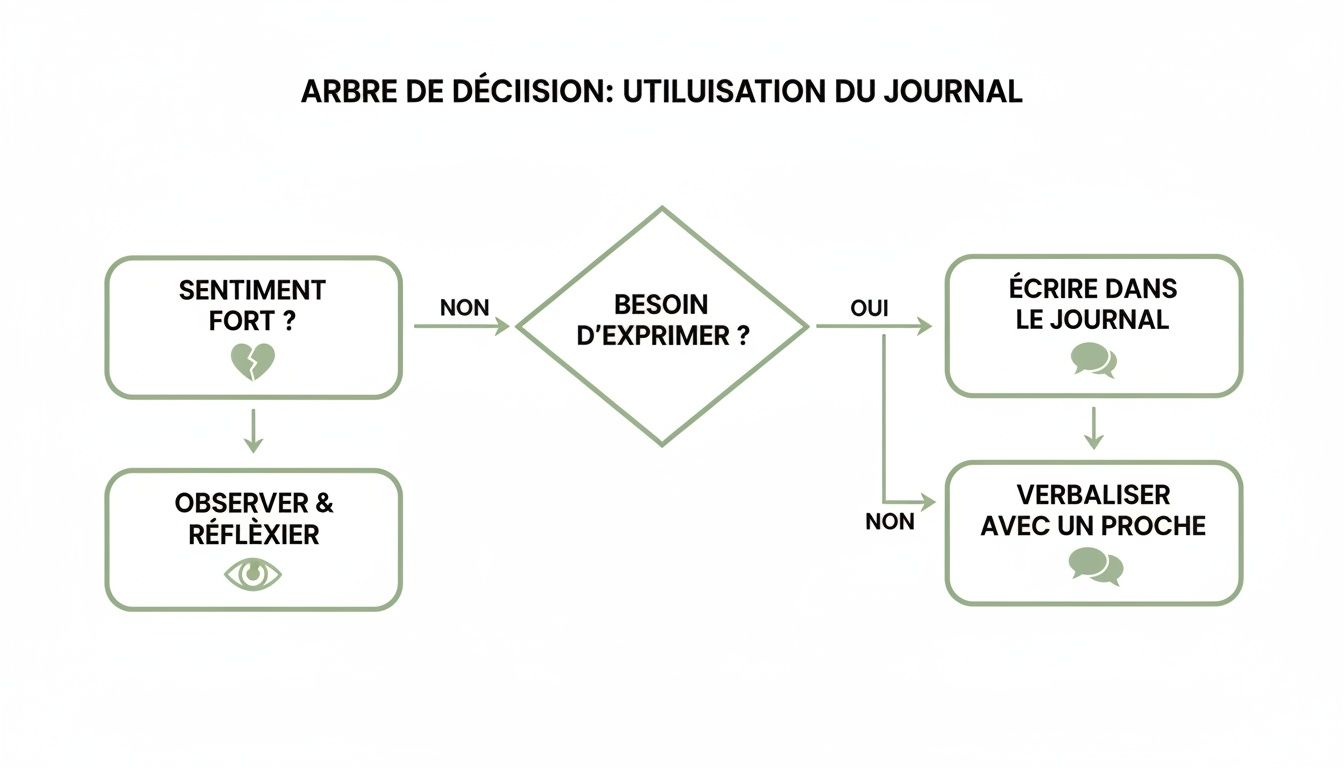
Instead of letting themselves be overwhelmed, the child learns to turn to their notebook to put words or drawings to what they are feeling. This is a huge first step towards regaining control.
Interest in these tools continues to grow. As proof, the 2021 UNICEF Children's Literature Prize brought together more than 12,300 children voting for their favorite books on the theme "Through the Thread of Emotions." This clearly indicates a deep need.
To help you see things more clearly, here is a table summarizing the points to check.
Criteria for choosing a suitable children's emotions book
This chart helps parents quickly compare the essential features of a good emotions journal for their child aged 6 to 12.
| Characteristic | Why this is important | Example with My Book Story |
|---|---|---|
| Suitable age | The tone, activities, and concepts must match the child's developmental level in order to hold their interest. | Designed specifically for 6-12 year olds, with simple language and activities that evolve with the child. |
| Interactive content | Children learn best by doing. Drawing, writing, and coloring actively involve them and make the exercise fun. | Offers over 100 pages of varied activities: quizzes, drawings, lists, free writing spaces to never get bored. |
| Positive approach | The journal should be a safe, non-judgmental place that encourages self-esteem and resilience. | Each activity is designed to empower the child, help them identify their strengths, and cultivate a positive mindset. |
| Autonomy encouraged | A good book provides guidance but leaves the child free to use it as they wish, promoting their independence. | The notebook is structured into chapters, but the child can explore them in any order they want, at their own pace. |
| Disconnect from screens | Providing a tangible alternative to screens for thinking and creating is essential for concentration and well-being. | A 100% paper-based medium, designed as a creative and introspective break, far from any digital stimulation. |
By keeping these criteria in mind, you maximize your chances of finding the support that will become a true ally.
Ultimately, the best book is the one your child will enjoy opening often. It should be their tool, their secret garden where they feel completely free to plant the seeds of their thoughts and emotions.
Choosing the right medium is therefore the first step in making this journal a valuable companion in your child's emotional development adventure.
Create a family ritual around the emotions journal.

So, you've found the perfect children's emotions book . But the real challenge begins now: how do you keep it from gathering dust on a shelf? The idea is to integrate it naturally into your daily routine, without it feeling like a new homework assignment.
Transform this journal into a cherished moment, a little bubble of connection just for the two of you. The goal isn't to bombard your child with questions, but to create an atmosphere of trust where they feel free to talk about their proudest moments as well as their little worries, without ever being judged.
Transforming the journal into a genuine moment of connection
The secret is consistency. By making this journal a true family ritual, you show them something essential: "What you feel matters to me, and we're going to take the time for that." For a child, this is a fantastic boost to self-confidence.
Here are some ideas for simple family rituals to implement:
- The evening ritual : Just before the story, why not take ten minutes for everyone to "get things off their chest" on paper? It's a great way to calm the mind and leave the day's tensions behind before falling asleep.
- A creative break after school : After snack time, offer a quiet moment with the newspaper. It's ideal for a smooth transition between the hustle and bustle of school and the comfort of home.
- The weekend meeting : Sunday morning, for example, could become your time to "review the week." We remember the good times, discuss the challenges, and start the new week off on the right foot.
Tip for parents: The atmosphere makes all the difference. A cozy little corner with cushions, a pretty box of felt-tip pens, soft music... All these little details transform a simple activity into a truly special moment of shared well-being.
Lead by example; that's the best guide.
Children are like sponges: they learn by watching us. If you take out a notebook to jot down your thoughts, there's a good chance your child will want to do the same.
So, don't hesitate to sit next to him with your own journal. You can even share aloud something that made you smile today. It's a very concrete way to show him that it's perfectly normal and healthy to have his own private thoughts, whatever his age. You're not playing the perfect parent, but the authentic one.
To help you get started, tools like the parent guide included with the My Book Story journal can be very helpful. It offers suggestions for starting conversations naturally. For example, instead of asking directly, "What's wrong?", try a gentler approach like, "I feel like you're a little lost in thought today. Is there anything you'd like to draw or write about it?" This small nuance makes all the difference and helps build a relationship based on trust and respect.
Fun activities to explore the six major emotions
A children's emotions book truly comes into its own when it becomes a playground. Beyond the words written within, there are countless creative ways to delve into your child's inner world. The idea is simple: transform every emotion, even the most unpleasant, into an opportunity for better understanding, for creativity, and above all, for strengthening your bond.
Here are some simple activity ideas and open-ended questions to spark discussion about basic emotions. A journal like My Book Story , with its guided and free-form pages, is the perfect companion for these explorations.
Joy: an energy to share
When joy is present, it's the perfect time to savor it and etch it into memories. Don't just let it pass; celebrate it! It's a fantastic way to build positive memories and boost your child's confidence.
- Activity for parents and children : Start the "Joy Playlist." Ask them which songs make them want to dance. You could even draw a picture or make a collage representing this playlist in their notebook.
- A question to start the conversation : "If your joy were a color, an animal, or even the weather, what would it be and why?"
Sadness: a wave to ride
We often instinctively want to push sadness away. Yet, it carries an important message: it signals a need for comfort. Accepting your child's sadness without judgment teaches them to take care of themselves.
- Activity for parents and children : Suggest that they build a "sadness hut" with cushions and blankets. This cozy space becomes their refuge, a place where they have the right to be sad, for as long as they need.
- A question to start a conversation : "What does your sadness need right now? A big hug, a drawing, a story?"
Anger: a volcano to tame
Anger is a powerful energy that needs to be channeled, not suppressed. Helping your child express it constructively gives them a valuable tool for their future relationships.
Acknowledging the emotion doesn't mean accepting the behavior. It's perfectly acceptable to say, "I see you're very angry, and that's your right. However, hitting isn't the solution. Let's find another way to let this out."
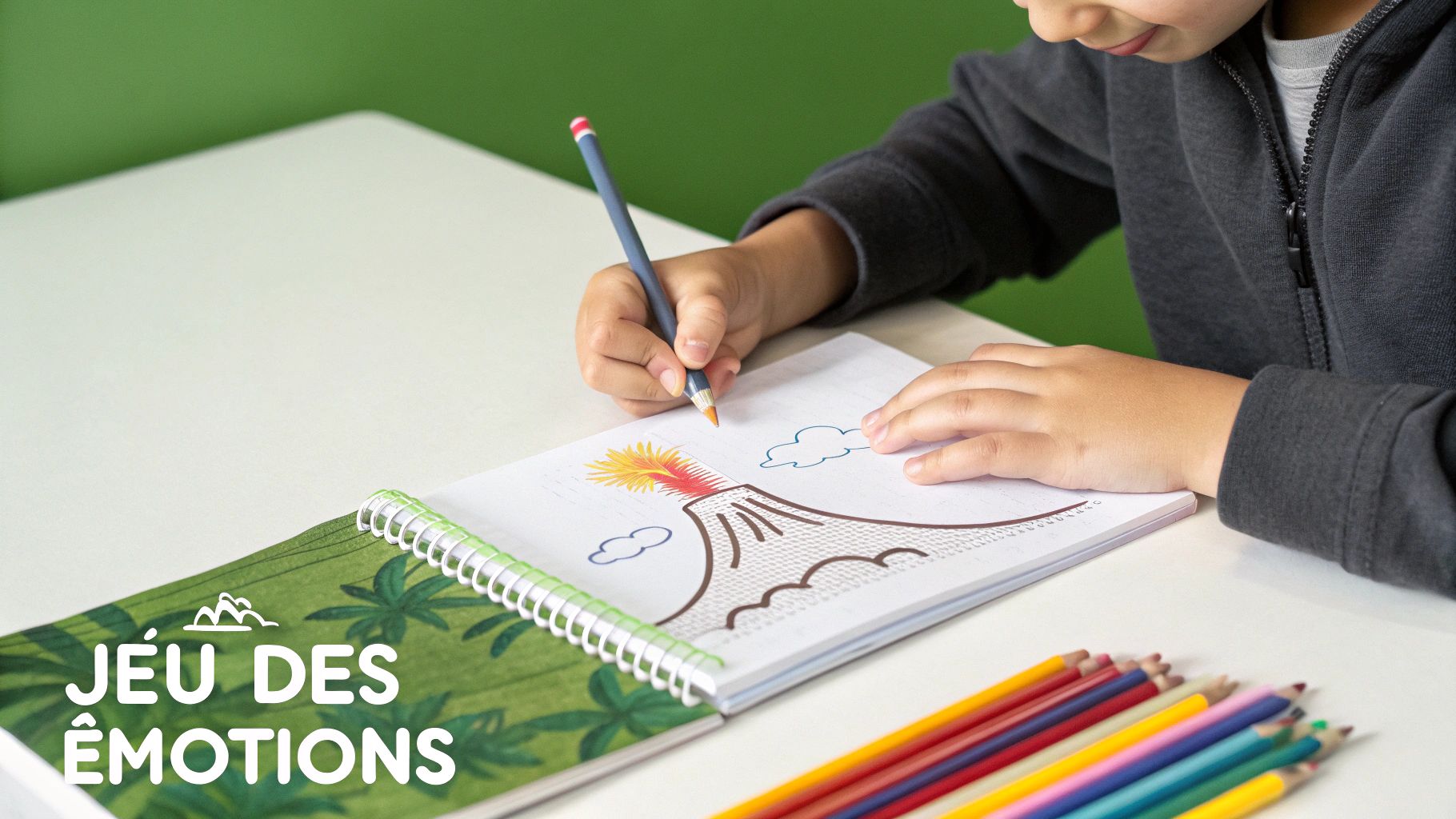
- Activity for parents and children : The "volcano drawing." Suggest that they draw a huge volcano to represent their anger. They can add bright colors, lightning bolts, and even make it erupt on the paper. It's a great way to release tension.
- A question to start the conversation : "What triggered your volcano this time? And what might help it calm down a bit?"
Fear: a messenger to reassure
Fear exists for a good reason: to protect us from danger, whether real or imagined. Listening to it gives us a chance to find strategies to feel safe again.
- Activity for parents and children : Write a "letter to your fear." Your child can write a few words to tell it that they heard it, thank it for wanting to protect them, and reassure it by explaining what they will do to be careful.
- A question to open the dialogue : "If your fear could speak, what would it tell you? And what could you say to calm it down?"
Thanks to these simple activities, the children's emotions book becomes much more than just a simple notebook. It transforms into a true partner in growth, a playful pretext for discussing feelings and making emotional intelligence an exciting adventure to experience as a family.
Why My Book Story is much more than just a book
We've seen how essential it is to support our children's emotions. But for this to truly work, we need a tool that's more than just a notebook for jotting down thoughts. It's precisely with this in mind that we designed My Book Story: a genuine personal development program designed for children aged 6-12 .
This isn't just a children's book about emotions . It's a playful and structured journey that transforms self-discovery into an exciting adventure. The idea is to give your child concrete skills that will serve them throughout their life.
A comprehensive program to cultivate essential qualities
The magic of My Book Story lies in its six-chapter thematic approach. It doesn't just identify emotions; it teaches you to cultivate strengths that help you thrive every day.
- Visionary : to dare to dream big and give yourself the means to achieve it.
- Ingenious : to boost your creativity and learn to find solutions to everything.
- Ambitious : to give him the desire to take action and never give up.
- Leader : to develop his confidence and his ability to bring others along with him.
- Resilient : to learn how to get back up after a disappointment and to see the positive.
- Curious : to keep that thirst for learning and exploring the world.
This unique structure makes this notebook a true ally in building solid foundations for your child's future.
By choosing My Book Story, you're not just giving them a journal. You're investing in their self-confidence, imagination, and peace of mind. You're giving them a toolbox they can use forever.
Designed for modern families
Every detail has been carefully considered to ensure a simple and enjoyable experience. Its A5 format is ideal for small hands, and the language used is simple so that children can use it independently, if they wish.
And for you, parents? The free guide is a goldmine. It gives you practical tips for establishing little rituals, asking the right questions, and making this time a moment of sharing and connection. My Book Story is truly the complete solution for developing the emotional intelligence of the whole family.
Questions? We'll answer them.
Still hesitating? Wondering if a book about emotions is really right for your child? That's perfectly normal. In fact, many parents share your concerns. Let's explore the most frequently asked questions together.
"My child hates writing, will this work for him?"
Absolutely, and it's even designed for that! A good emotions journal isn't a writing notebook. It's first and foremost a space of freedom where you can draw, color, doodle, or even glue things in.
The idea is for your child to find the means of expression that suits them best. Writing is just one option among many.
"At what rate should it be used?"
There are no rules, and that's what's so great about it. The goal is definitely not to add another task to your to-do list. Think of it more as an emotional toolbox, always at your fingertips.
Some children will want to delve into it every night before bed. Others will open it once a week, when a strong emotion arises. The important thing is that the journal is there, accessible, ready to use when the need arises.
Tip for parents: Offer, but never impose. This journal should remain a private sanctuary, a personal refuge. Not a constraint. The goal is to create a positive family ritual, not an obligation.
"Will this replace our discussions?"
Quite the opposite! Consider this journal as a bridge between her inner world and you. It doesn't replace anything, it enriches everything.
Often, a solitary activity in your own space will become the starting point for an incredibly deep conversation, one of those that you don't always manage to initiate spontaneously. It's a true ally in nurturing your connection and strengthening family bonds.
So, ready to offer your child a companion on the journey to tame their emotions and boost their confidence? The My Book Story notebook was designed exactly for that: a fun, creative and caring exploration journey.
Discover the My Book Story journal and its free parenting guide