


The principle of " less is better " is a very simple idea: by simplifying our daily lives, we improve our quality of life. For a family, this means consciously decluttering everything that accumulates—toys, activities, screen time—to refocus on what's essential: well-being, creativity, and family connection.
Why "less is more" can change everything for your family
In our society, which constantly pushes us to accumulate, the idea of owning less may seem somewhat counterintuitive. Yet, more and more parents are realizing that this overabundance is an unexpected source of stress, both for themselves and for their children aged 6 to 12 .
An overflowing bedroom, an overloaded schedule, notifications that never stop... All this constant background noise ends up stifling our children's imagination, self-confidence and peace of mind.
Cultivate the essentials, like a gardener.
Imagine a gardener. If he lets all the plants grow on top of each other, none will truly flourish. He must make choices, thin them out, so that the most beautiful flowers have the space and light they need to grow.
Applying the principle "less is more" to education is a bit like this. By cutting out the unnecessary, you give your children the mental space they need for their creativity, self-confidence, and the bonds that unite you to truly flourish.
The idea is to move from a cluttered mess to a simplicity that liberates the mind.
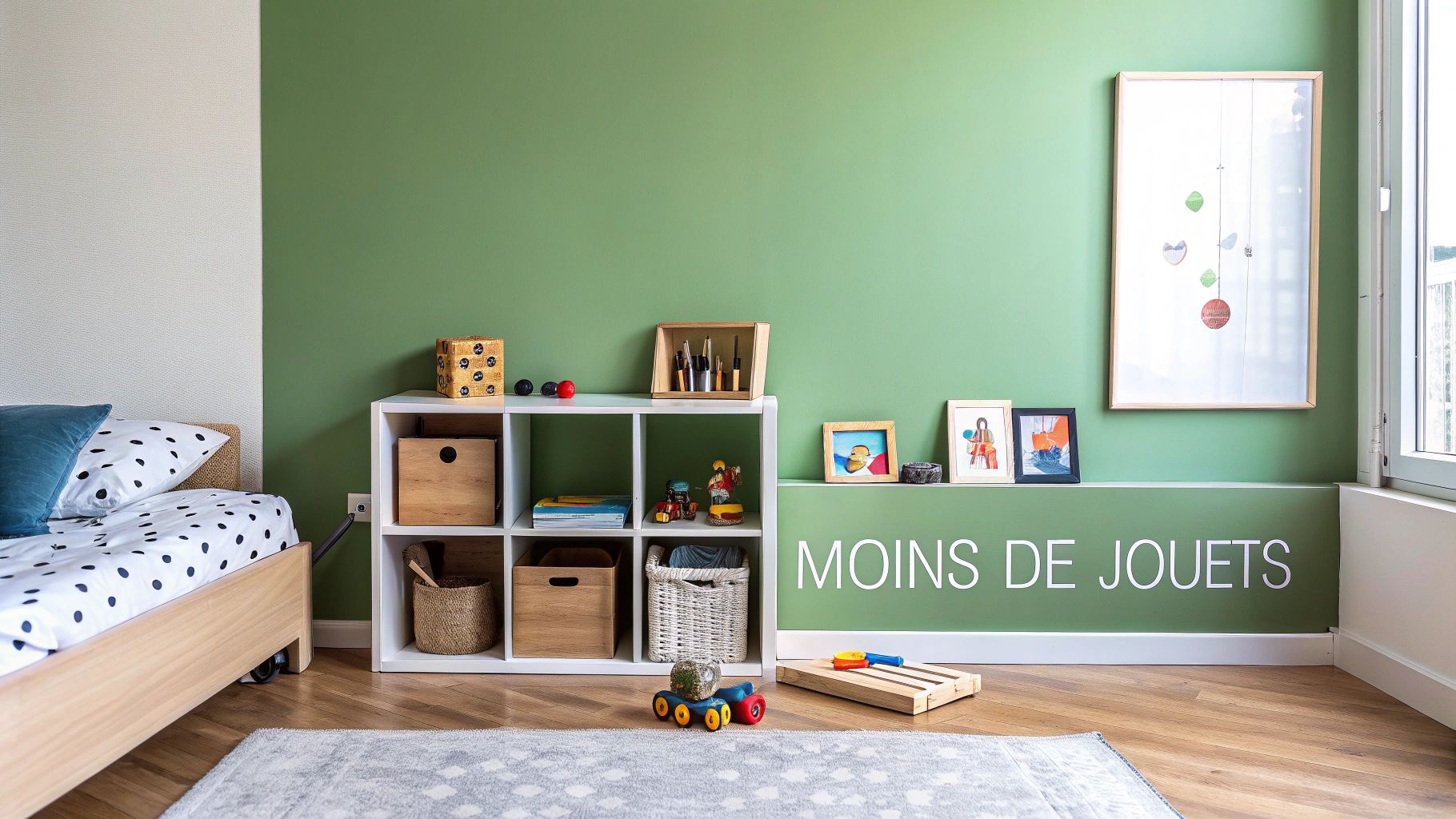
This image sums up the concept well: by reducing clutter, we directly gain in well-being and connection.
The following table perfectly illustrates how simplification in different areas of a child's life translates into concrete benefits for their personal development.
Less excess for more benefits
| Simplified domain | Negative impact of 'too much' | Benefit of 'less' for the child |
|---|---|---|
| Toys | Visual overload, difficulty choosing, superficial games, constant disorder. | Stimulation of creativity, more in-depth games, confidence in one's own ideas, learning to tidy up. |
| Activities | Fatigue, performance-related stress, less free time and family time. | More energy, less pressure, development of autonomy and imagination, time for daydreaming. |
| Screens | Decreased attention span, disturbed sleep, isolation, less active play. | Better concentration, quality sleep, more family interaction and outdoor play. |
Ultimately, the goal is not deprivation, but rather enrichment through quality rather than quantity.
The benefits of a simpler daily life for the child
Easing your child's daily life isn't about taking things away; it's about giving them far more precious gifts: clarity, time, and space to grow up peacefully. The positive effects on their emotional well-being are rapid and very real.
- Less anxiety and mental fatigue : When there are fewer choices to make and fewer stimuli to manage, the brain can finally pause and recharge.
- More creativity : Boredom is no longer an enemy, but an invitation to invent, to create your own stories and your own games.
- Improved self-confidence : By learning to be content and appreciate what he already has, the child gains autonomy, gratitude, and pride in his own creations.
This philosophy is increasingly resonating in France. Did you know that 65% of French people say they are willing to borrow equipment rather than buy it? This reflects a deep desire to consume less in order to live better. If this topic interests you, detailed analyses of minimalism in France explore this underlying trend.
Unleash the imagination by decluttering the playroom
A room overflowing with toys sounds like every child's dream, doesn't it? In reality, it's often the opposite. Faced with a mountain of choices, a child's brain can quickly feel overwhelmed, almost paralyzed. This is what we call decision fatigue.
This overabundance, instead of stimulating play, ends up creating superficial exploration. The child moves from one toy to another, without ever truly immersing themselves in a story, without really investing themselves.
The idea of "less is more" with toys isn't about depriving your child. It's about giving them the mental space to become the true creator of their own adventures. Fewer options encourage them to explore each object more fully. A simple piece of wood can become a magic wand, then a knight's sword, and finally a pirate ship's mast.
Parent tip: The magic of toy rotation
One of the simplest and most effective tricks is toy rotation . The principle is very simple: instead of leaving all the toys within reach at all times, you choose a small portion and put the rest away out of sight.
Every few weeks, or every month, we do a swap. We take one box out of the cupboard and put another away. This very simple method has a double magical effect:
- It rekindles interest : A toy that reappears after an absence is perceived as brand new and beautiful. Enthusiasm returns instantly.
- It simplifies life : Fewer objects lying around means easier and faster tidying, for you and your child.
It's a brilliant way to maintain a sense of novelty without constantly having to buy things. We apply the principle of "less is more" to create a more serene environment, more conducive to imagination.
Turning decluttering into a valuable life lesson
Involving your child in sorting is key. For a child between 6 and 12 years old, it's a golden opportunity to talk about empathy and generosity. Instead of seeing it as a chore, transform sorting into a special mission.
Action for parents: Explain to your child that some of their toys they no longer use could bring joy to other children. Take three boxes, labeled simply: "I'm keeping it," "I'm giving it away," "I don't know yet." Let them make their choices, gently guiding them. This simple gesture teaches them the value of sharing and helps them understand that happiness isn't found in accumulating things.
Choosing to give away a toy is not a loss, but an act of generosity. It shows your child that joy also comes from the pleasure of giving, a human skill far more precious than yet another plastic gadget.
Choose toys that open doors
Ultimately, it's all about quality, not quantity. To make things clearer, toys can be classified into two main categories:
- "Closed" toys : These are often electronic gadgets or figurines from a very specific cartoon. They have instructions, only one way to play. It's fun for five minutes, but it limits the imagination.
- "Open-ended" toys : These have no specific purpose and can become whatever the child decides. Think of building blocks, modeling clay, simple scarves, cardboard boxes, or craft supplies.
By choosing open-ended toys, you give your child the tools to build their own worlds. Boredom is no longer a problem to escape by turning on a screen, but the starting point for creativity. It is often in this void that the most beautiful stories are born.
Reclaim quality time by simplifying the family schedule
Judo on Mondays, music lessons on Tuesdays, tutoring on Thursdays, not to mention weekend birthday parties… Sometimes, our children's schedules rival those of government ministers. We embark on this frantic race, often out of fear that they might "miss out on something," but the effect is often the opposite. We end up exhausting them, and ourselves. A packed schedule leaves no room for spontaneity, daydreaming, or free play. Yet, it is precisely these moments that forge their independence and creativity.
Applying the " less is better " principle to the family schedule is simply choosing to breathe. It's taking the time to sort through what truly nourishes your child and what only adds to an already overloaded schedule.
Learning to say no, without feeling guilty
Saying no to a new activity or yet another outing isn't depriving your child. It's actually saying yes to something far more precious: family time, rest, or simply a moment to do nothing. The key is to learn to assess what's truly good for your child, but also for your family's well-being.
Action for parents:
- Weigh the pros and cons of each activity : Is it a source of joy for your child, or rather of stress? Is it their choice or yours?
- Talk to him about it : Discuss his true desires. Does he still enjoy tennis as much, or does he just go out of habit? Listen to his answers.
- Set clear limits : One or two extracurricular activities per week is often more than enough for their development.
To take a breather and reclaim those precious moments, relying on dependable childcare services can make all the difference. Sometimes, the key is knowing how to delegate so you can focus on what truly matters, without running around in circles. If you're looking for guidance, finding a childcare solution to simplify your routine can be invaluable.
The crucial importance of unstructured time
Free time, time without a schedule or objective, is the best breeding ground for imagination. It is in these moments of "emptiness" that children learn to occupy themselves, to invent games, to devour a book out of pure curiosity, or simply to let their minds wander.
Unstructured time is not wasted time. It is the secret laboratory where problem-solving, creativity, and self-knowledge develop.
This philosophy is gaining ground. The trend towards minimalism in France is accompanied by a genuine desire to slow down and reduce pressure. According to a survey, 65% of 18-34 year olds are ready to adopt a simpler lifestyle to combat overconsumption, and this is also reflected in how family activities are managed.
To rebalance the rhythm at home, here are a few simple ideas:
- Establish a "nothing" afternoon : On Wednesdays or Saturdays, for example, absolutely nothing is planned. It's time for creative boredom!
- Create a free play ritual : Every evening, an hour without screens where everyone does what they like, in peace and quiet.
- Opt for simplicity : A walk in the forest or an impromptu picnic often has much more flavor and creates better memories than an expensive and highly organized outing.
By lightening their schedule, you are not depriving your child of opportunities. On the contrary, you are giving them the greatest gift: time to simply be a child.
Re-establish connection by limiting screen time
Let's be clear: technology is part of our daily lives, and it's not about banning it. The trap is when screens take up too much space and start to nibble away at our children's attention, creating a kind of invisible distance within the family. Applying the "less is more" principle to digital technology simply means choosing to replace some screen time with time spent together.
Finding the right balance is crucial. Clearly, excessive screen time can quickly disrupt concentration, interfere with sleep, and, most importantly, limit those precious human interactions that children aged 6 to 12 need to develop empathy and ease with others.
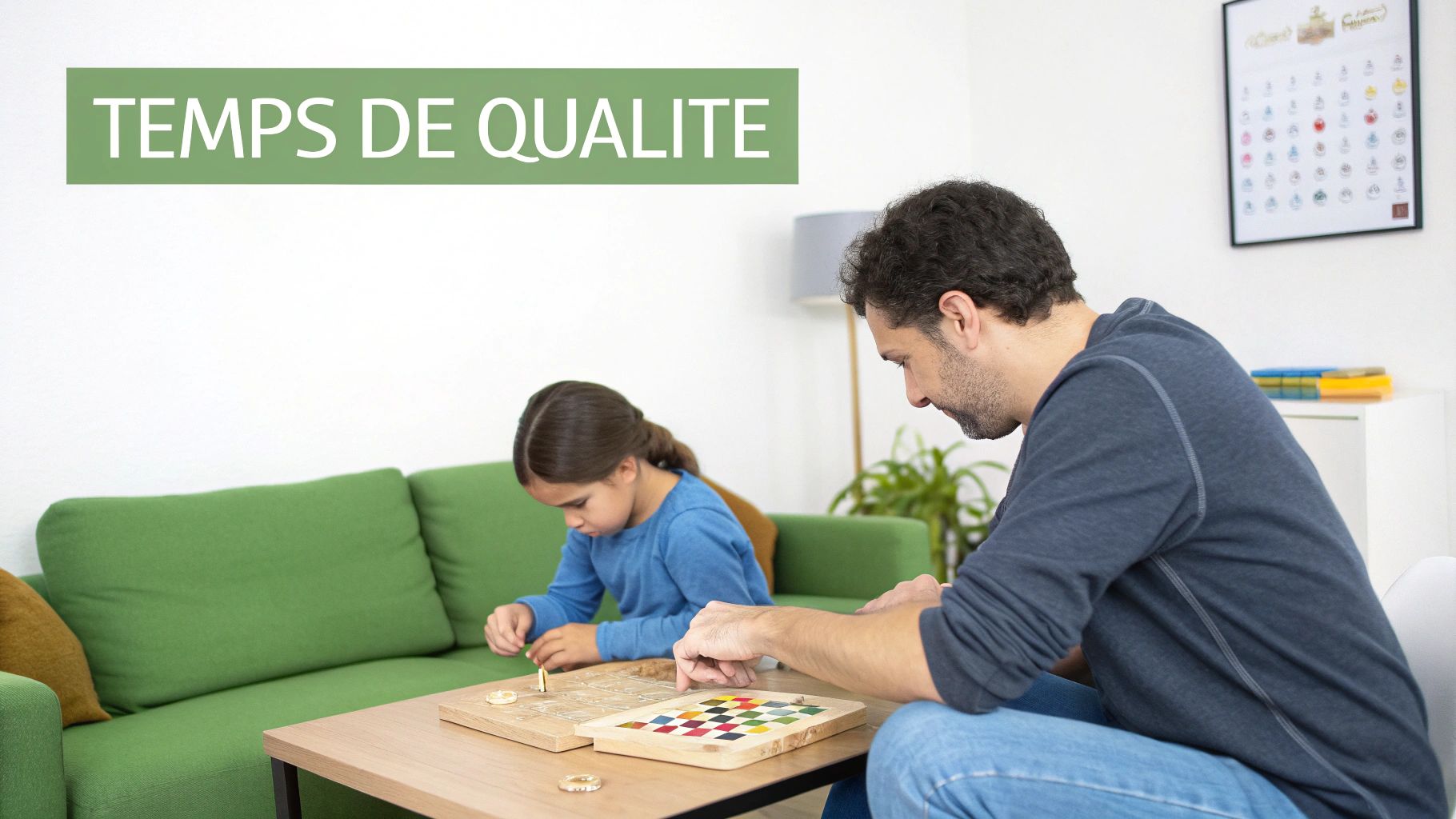
The idea isn't to ban everything, but rather to consciously simplify. The goal? To make quality time the norm again, not the exception. This is a huge step for the emotional well-being of the whole family.
A simple framework, positive rules
To ensure that reducing screen time goes smoothly, a framework is needed. A simple and consistent one. By setting clear rules, we avoid endless negotiations and help children understand what is expected of them.
The key is to present these rules not as punishments, but as a way to protect precious moments that belong to the family.
Here are a few simple ways to implement this:
- "Disconnected" zones : The dining table, bedrooms... let's transform these spaces into family sanctuaries. They become spaces for conversation, reading, or simply resting, away from notifications.
- Schedule screen time : Set specific time slots, such as an hour after homework. When the routine is predictable, there is much less frustration.
- Leading by example matters! Children are our mirrors. If we put our phones down during meals, they'll do the same. It's probably the simplest, and most powerful, rule.
These small adjustments allow us to recover precious time to reinvest in what truly binds a family together.
Reducing screen time isn't about taking something away. It's about making room for something better: connection, play, conversation. It's a true act of love for your family.
Replacing screen time with family rituals
The best strategy to make screens less appealing is to offer desirable alternatives. Simply banning them will quickly lead to boredom. The idea is to fill this newfound free time with shared experiences, the kind that create lasting memories.
There's no need to plan complicated or expensive activities. Their true value lies in the connection they create between you.
Some ideas for transforming screen time into quality time:
- Board game nights : We bring out the classics from the cupboard or discover new ones, why not cooperative ones to strengthen team spirit?
- Creative family projects : Building a fort in the living room, baking a cake or even creating a souvenir photo album.
- Outdoor adventures : A simple walk in the forest, a bike ride or an impromptu picnic in the park.
- Shared reading : Reading a story aloud every night is a magical ritual, even when the child can already read on their own.
By offering these alternatives, we show by example that life without screens is not only possible, it is above all much richer and more fun.
Incorporating journaling as a simple family ritual
In our performance-driven world, the principle of "less is more" brings us back to basics. It encourages us to seek out simple tools that have a huge impact. Journaling, or keeping a personal journal, is a perfect example: a few minutes a day can do wonders for your child's self-confidence and emotional well-being.
Far from being a new school chore, journaling is a true escape. It's a supportive space where your child can share their thoughts, celebrate small victories, and express their emotions without ever being judged. A simple notebook then becomes a powerful tool for reconnecting with themselves, sheltered from the digital noise and external pressures.

A small ritual for big benefits
Making this a habit in your evening routine can become a true anchor, a soothing interlude to end the day. The idea isn't to write novels, but to answer a few simple questions that guide reflection and cultivate a positive mindset.
A journal like My Book Story was designed precisely for this purpose. It offers short, creative activities that help children to:
- Put a name to your emotions by choosing the emoji that sums up your day.
- Practice gratitude by recalling a happy moment, even the smallest one.
- Boost his confidence by celebrating something he is proud of.
This minimalist approach reflects a broader trend. Today, 53% of consumers say they are buying fewer unnecessary things to focus on what truly matters. If you want to delve deeper into this quest for a simpler life, you can read this analysis on minimalism in 2025. The journal fits perfectly within this philosophy: a simple object for profound personal growth.
How to create a moment just for you
For journaling to become a ritual your child looks forward to, the atmosphere is just as important as the journal itself. It's not a homework assignment; it's a gift you give yourself.
Journaling is a silent dialogue with oneself. It gives your child the tools to understand their inner world and teaches them that all their emotions have their place.
Here are some tips to make it a special moment:
- Choose the right time. The evening, just before sleeping, is often perfect for calming the mind and reviewing the day.
- Create a cozy atmosphere. Dim lighting, a quiet corner... Why not fill out your own journal with them to share this moment?
- Leave him his private space. The journal is his personal space. Encourage him, but never read it without his permission. That's the foundation of trust.
In a few weeks, this little ritual will become an essential reference point in her daily life, a valuable tool to strengthen her emotional intelligence and, at the same time, your bond.
Less is more, to be happier and truly connected.
Ultimately, the idea of "less is more" has nothing to do with deprivation. It's more of a deliberate choice, a way of refocusing on what truly matters to your family and your child's well-being.
By decluttering toys, streamlining schedules, or limiting screen time, you're not just creating space. You're giving creativity room to breathe. You're making space for real conversations. You're creating an environment where everyone can finally relax. The "less is better" approach also supports effective methods for mental well-being , simply by reducing the stress of overstimulation.
Adopting the "less is more" philosophy doesn't mean changing everything overnight. It's an invitation to take one small step, then another, to rediscover joy in simplicity and the strength of your relationships.
There's no need to revolutionize everything. Why not start small? Choose a single area that seems easy to manage, like a toy shelf or one evening a week without any screens.
Observe what's happening. Notice the changes, even the smallest ones, and savor this newfound tranquility. It's often in these little adjustments that the greatest happiness lies hidden.
Frequently asked questions about minimalism in the family
Adopting a "less is more" approach with children can seem daunting. A thousand questions arise, and that's perfectly normal! The idea isn't to revolutionize everything overnight, but to move forward step by step towards a simpler, lighter daily life. Here are a few tips to get you started without stress.
See it as a journey, not a race. The important thing is to find a balance that works for your family, without putting pressure on yourself.
My child will get bored if he has fewer toys, won't he?
At first, there might be some frustration. This is a perfectly healthy reaction to change. The key is to welcome this emotion with kindness, while staying the course you've set for everyone's benefit.
Remember that boredom is often creativity's best friend. Once the initial wave of discontent has passed, your child's imagination will take over. It's excellent training for their independence and self-confidence.
Here are a few tips to help you through it smoothly:
- Putting words to their emotion : A simple "I see you're disappointed, I understand" can work wonders. Feeling heard changes everything.
- Give him an active role : Let him choose for himself which toys he wants to keep within reach. This gives him a sense of control.
- Distract him : Suggest an activity together. A great building project with the leftover toys, a walk in the forest, a board game...
And what do we do with the gifts from grandparents?
Ah, the mountain of gifts... It's primarily a token of love, so the goal isn't to reject everything outright and upset the people you love. The key is communication.
The goal is not to say no to gifts, but rather to direct the desire to give pleasure towards things that really matter: shared memories, quality time, or a single beautiful object that will last.
Feel free to suggest ideas beforehand that are more in line with your vision:
- Experiences to be lived : A concert ticket, an afternoon of tree climbing, a museum entrance... Memories last longer than objects.
- A short wish list : Share a short list of books or games that your child really wants to have.
- A shared fund : For a bigger, meaningful project, like their first bike or a musical instrument.
By communicating with kindness, you respect their gesture while remaining true to your "less is better" approach. It's a beautiful way to remind everyone that love isn't measured by the number of presents under the tree.
The My Book Story journal is a wonderful example of a meaningful gift. It's a simple yet incredibly effective tool for helping your child develop self-confidence and express their emotions, away from the hustle and bustle of everyday life. Discover how this journal can become a valuable ally on your journey towards a simpler, more connected family life .