


Choosing a book for your child isn't like choosing a simple toy. Truly impactful books, the kind you remember for a lifetime, are much more than just beautiful stories. They are valuable tools that nurture your child's emotional well-being , awaken their creativity, and help them gradually build strong self-confidence.
A well-chosen book is a door that opens onto unique and profound family discussions, a wonderful pretext for strengthening your bonds.
What makes a book truly amazing for a child?

Between the ages of 6 and 12 , a book becomes "amazing" when it transcends its status as a mere object to become a genuine experience. It's no longer just a series of words on paper. It's a mirror in which your child can see the reflection of their own emotions, fears, and greatest joys.
This kind of book doesn't claim to have all the answers. On the contrary, it's full of thought-provoking questions. It allows your child to connect with characters who are like them, who face similar challenges, and who, in the end, find solutions or simply learn to grow up.
The power of identification to grow up
When a child identifies with a hero or heroine, they are not just following an adventure from afar. It is a way for them to safely explore their own abilities.
- He learns what empathy is: By putting himself in the character's shoes, he begins to understand what others might feel. This is a fundamental lesson for his social relationships.
- It strengthens his resilience: Seeing a character overcome a difficulty proves to him that he, too, can succeed. It's a lesson in silent but powerful perseverance.
- It feeds his confidence: The character's successes inspire him to face his own everyday challenges, whether it's speaking up in class or trying a new sport.
Tip for parents: After reading, ask a simple question like, "What would you have done in Leo's place?" This opens up a pressure-free discussion about problem-solving and emotions.
An amazing book is not one that distracts, but one that connects. It connects your child to themselves, to you, and to the world around them.
Choosing these books is a powerful parental gesture. You're not just offering a story to pass the time. You're giving them a kind of compass to help them navigate the sometimes complex world of their emotions. This is how you lay the foundations for a life of curious, fulfilled, and self-assured reading.
The secret ingredients of a book that leaves a lasting impression
Identifying the books that will truly shape your child's childhood is a bit like becoming a story detective. There's no magic formula, but rather a subtle alchemy between several key elements that, together, create an unforgettable and enriching reading experience.
Characters with whom we can identify
The first ingredient, and undoubtedly the most important, is a character who resembles your child. Between the ages of 6 and 12 , children ask themselves countless questions about who they are. A hero who feels the same emotions, who doubts, who is afraid but finds the strength to move forward, becomes a true friend on paper.
This character doesn't need to be a flawless superhero, quite the opposite! His little weaknesses make him more human, more relatable. By seeing him overcome obstacles, your child understands, without even realizing it, that they too possess this strength. It's an incredible boost for self-confidence and empathy.
Themes that strike at the very heart
An unforgettable book is also a story that sensitively addresses the major themes of childhood. These themes are at the heart of the book's emotional core.
- Friendship: Making friends, managing minor disputes, being there for others... these are crucial issues at this age.
- Everyday courage: Not just the courage to fight dragons, but the courage to dare to say no, to confront one's shyness or to embark on a new activity.
- Difference and self-acceptance: Learning to accept that you are unique and that others are too is an essential skill for feeling good.
When these topics are approached sensitively, they become a springboard for engaging family discussions. They offer your child tools to better understand the world around them and their own feelings. The importance of these themes is reflected in the figures: in France, print book sales reached 351 million copies , generating €4.3 billion in revenue—a success driven by stories that explore human relationships in depth. To learn more, you can consult this article on the French book market at modelesdebusinessplan.com .
Words that open the mind, without discouraging.
The choice of words is just as crucial as the story. Language should be a bridge, not a wall.
An incredible book strikes this perfect balance: it is simple enough to keep reading enjoyable, but rich enough to introduce new words and ideas.
This vocabulary, discovered through a captivating adventure, allows your child to effortlessly enrich their own. They don't learn a list of words; they experience them through the story. It's the best way to gently prepare them for more complex reading later on.
Illustrations that tell their own story
Finally, never underestimate the magic of illustrations. They don't just decorate the page; they play an integral part in the story. A beautiful image can convey an emotion that words struggle to describe, create a mood, or even add a layer of meaning to the story.
For your child, a drawing is a point of reference. It helps them visualize the scene and immerse themselves completely in the world of the book. Illustrations stimulate their imagination and creativity, sometimes even inspiring them to draw the characters themselves.
Keeping these four ingredients in mind, you will have all the tools you need to choose books that will not only be read, but truly experienced.
How to choose the perfect book for your child
https://www.youtube.com/embed/m4adQJVjiBA
Finding the perfect book to captivate your child might seem like a daunting task. But it's actually a golden opportunity to connect with their inner world. Rather than a puzzle, think of it as an exciting treasure hunt to discover what they're currently passionate about.
The key is to transform this search into a shared adventure. By involving them in the choice, you're doing much more than simply selecting a story: you're showing them that their opinion matters. This boosts their confidence and their desire to immerse themselves in reading.
Investigating his current passions
Before you even rush to the bookstore, take a moment to observe. A child's interests between the ages of 6 and 12 change incredibly fast. The dinosaur that was the star yesterday might very well be replaced by the mysteries of ancient Egypt today.
Practical advice for parents:
- Really listen to him: What does he spontaneously talk about at dinner? What themes come up in his games or drawings?
- Observe what he watches: What documentaries or cartoons capture his attention?
- Ask open-ended questions: Instead of "Do you like pirates?", try "If you could travel anywhere, where would you go? And why?". The answer might surprise you and lead you to unexpected worlds.
This small, friendly survey will give you valuable clues to find books that are sure to be a hit.
Learning to look beyond the cover
Once you're in a bookstore, whether physical or online, it's easy to be drawn in by a brightly colored cover. However, the real treasures are often hidden inside. Take the time to browse a few pages, even if it's virtually.
The goal is not to judge the book, but to sense whether it resonates with your child's sensibilities. The tone of the story, the style of the illustrations, and the complexity of the text are crucial indicators.
A book with a lot of text and few pictures might discourage a beginning reader, while an older child could devour it. Trust your parental instincts. After all, you know your child best.
Book selection guide for your child
| Criteria to be evaluated | Questions to ask yourself | What to look for |
|---|---|---|
| Themes and history | Does the story deal with topics that interest him? Is the message positive and constructive? | Themes that resonate with his passions (adventure, animals) and values such as friendship, courage, and curiosity. |
| Language and vocabulary | Is the language level appropriate for his/her age? Are there any new but understandable words? | The text should be neither too simple nor too complex. Ideally, the vocabulary should enrich it without discouraging it. |
| Illustrations | Are the images beautiful? Do they tell part of the story? Do they aid understanding? | Illustrations that stimulate the imagination, complement the text and match the tone of the story (funny, poetic). |
| Emotion and connection | Can the book evoke emotions? Provoke questions? Is it a good starting point for a discussion? | A story that can make him laugh, think, or marvel. A good book is a pretext for conversation. |
This chart isn't an exact science, but rather a compass to guide you. The most important thing is the joy and the sparkle in your child's eyes.
Include your child in the final decision
The most important step is to make this choice a truly shared experience. Be careful, though: involving them doesn't mean leaving them to face thousands of options alone, which can be overwhelming. The best approach is to offer them a selection that you've already approved.
Here's a simple method that works every time:
- Pre-select three or four books based on her tastes and your intuition.
- Introduce each story to him/her quickly, reading the summary on the back.
- Let him browse through the books, look at the pictures, and soak up the atmosphere.
- Let him choose. This simple act gives him a sense of control and allows him to take ownership of the story before it has even begun.
By involving them in the choice, you transform buying a book into a positive ritual. They'll be so much more motivated to read a story they themselves "rescued" from the shelves! This is exactly how incredible personal books are born: the ones that mark a childhood and build lifelong memories.
Create a reading ritual to strengthen bonds
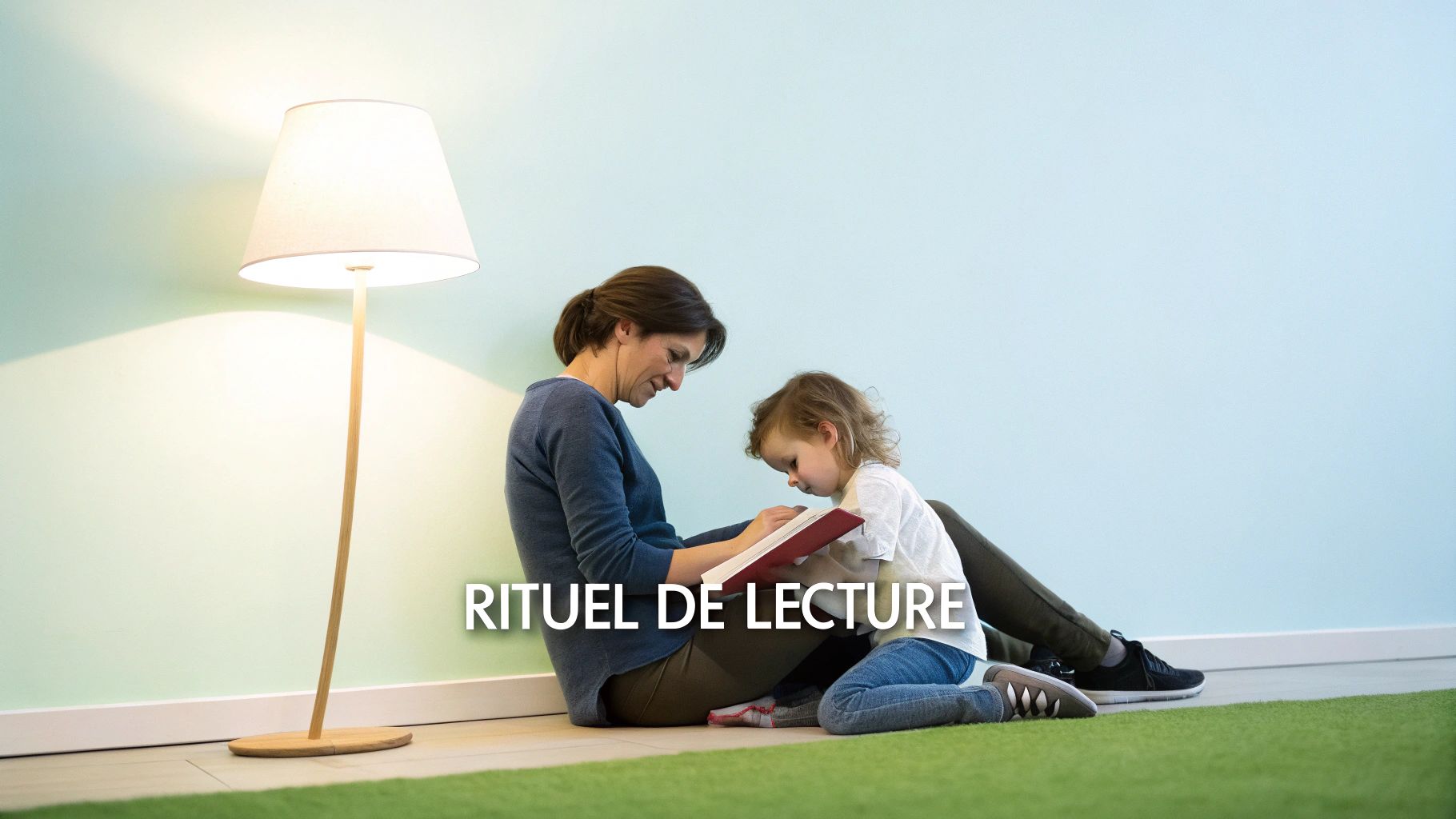
The true magic of a book is revealed when it's shared. It's during these moments of reading together as a family that a simple story transforms into a real bridge between you and your child. By establishing a reading ritual, you create a sacred interlude, a precious time away from the noise of screens and the demands of daily life.
It's not just "reading a bedtime story." It's a regular appointment that tells your child, "Now I'm here, just for you and this story." This consistency provides a sense of security and stability, so important for their emotional well-being.
How can we make this ritual unique and fun?
Every family has its own rhythm. Your reading ritual should reflect your family. The key is to find a formula that everyone enjoys, so that this moment remains a joy, never a chore.
Ideas for family rituals:
- Family book club: Choose a book together. Set aside a time, for example Sunday morning, to read a chapter. Then, everyone shares what they liked or what made them think.
- Reading aloud together: One paragraph for you, one for me. It's a great way to encourage a beginning reader, while also making the story much more engaging.
- The "character dinner": Once a month, why not organize a meal inspired by the current book? If the adventure takes place in Italy, it's the perfect opportunity to cook pasta together!
The idea is to create memories. Moreover, even though the children's book sector may experience adjustments, such as a recent 1.5% drop in publishers' revenue, the passion for shared stories remains strong. The market is still 3.4% above its pre-pandemic level, proof that books continue to bring families together. If these figures interest you, you can consult the data from the French Publishers Association (SNE) at sne.fr.
Ask the right questions to open the discussion
Reading together is a golden opportunity to help your child develop critical thinking and empathy. The art of asking questions is your superpower as a parent. Forget closed questions that only elicit a simple "yes" or "no."
Instead of asking, "Did you like the story?", try asking, "If you were to imagine what would happen next?" This simple question makes all the difference. It opens the door to creativity and a real conversation.
Examples of questions to further the discussion:
- "If you were in the hero's place, how would you have felt in this situation?" (Develops empathy)
- "If you could give him one piece of advice, what would it be?" (Encourages problem-solving)
- "Does this scene remind you of anything we've experienced ourselves?" (Builds connections to real life)
These discussions nurture your bond, acknowledge your child's emotions, and show them that their ideas matter. This is how good books become powerful tools for growing together.
To go further: the reading journal, a tool for self-confidence
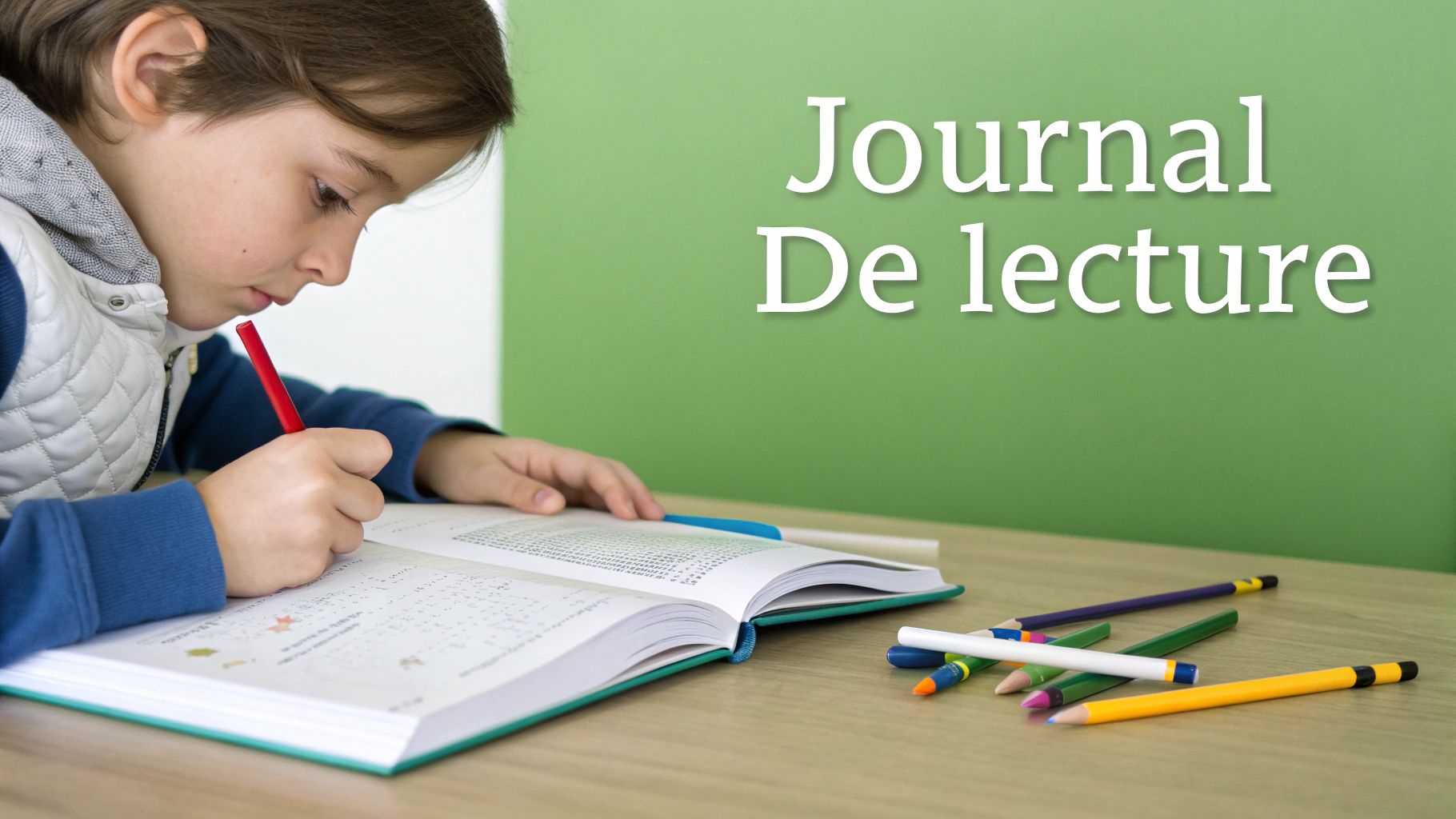
When you close a book, the story doesn't end there. It's the moment when the child can make the story their own. To help them do this, there's a disarmingly simple yet incredibly powerful tool: the reading journal.
Forget the idea of schoolwork. This is a space of total freedom, a secret garden where your child can engage with the story, reinvent it, and, above all, leave their own mark. This is what transforms a young reader into a true creator.
Transforming reading into a personal adventure
A reading journal is like a conversation that continues long after the word "The End." It gives your child the chance to put words, colors, or shapes to what they felt. This helps them sort through their emotions and understand why a scene touched them, made them laugh, or even scared them a little.
By doing this, he unknowingly learns to structure his thoughts and trust his own ideas. He discovers that his perspective on a story is unique and valuable.
A reading journal is not simply a summary. It's a reflection of the inner journey the book has inspired. It's where incredible books become truly personal memories.
This creative exercise is a great and fun way to cultivate emotional intelligence and analytical skills.
Some ideas to get started without pressure
The beauty of journaling is that it requires nothing. A simple notebook and a few colored pencils are all you need. The only rule is to have fun.
Practical tips for starting a reading journal:
- Draw a memorable scene: Suggest that they illustrate their favorite moment from the book. It's an excellent way to express strong emotions without necessarily using words.
- Inventing a different ending: What if the story ended differently? Let him imagine a sequel or even introduce a new character. This stimulates his creativity.
- Write a letter to a character: What would they like to say to the hero? They could ask a question, give advice, or simply thank them. This develops empathy.
These little activities are much more than just pastimes. They are at the heart of what makes a good book a true experience that helps one grow.
A tool to boost confidence and creativity
Keeping a journal is a way of saying to yourself, "What I think and feel is important." Your child learns to give concrete form to their ideas. They practice formulating an opinion and arguing for it, all with their own creativity.
This space is a fantastic laboratory for the imagination. There are no right or wrong answers, just the joy of exploration. This freedom encourages us to be daring and to think differently.
As your child turns the pages, they build an inner library, a map of their literary journeys. They keep track of their heroes and the lessons they've learned. It's a true personal treasure they'll be happy to rediscover years later.
We answer your questions about children's books
As a parent, it's normal to have questions when faced with the vast array of children's books available. Here are some simple answers and practical tips to help you navigate this with confidence.
My child doesn't like to read, what should I do?
Above all, don't panic! A love of reading isn't something you can simply decree; it's something you cultivate. The trick is to step outside the box of "novels." A comic book, a dinosaur magazine, or even a cookbook—that's reading too! They're perfect entry points.
Parental action: Identify one of your child's passions (video games, sports, animals) and find a book or magazine on that topic. The goal is to create enjoyable, pressure-free reading moments. And remember: lead by example by reading for your own pleasure. Curiosity is contagious!
At what age can a child choose their own books?
From the age of 6 or 7 , a child is perfectly capable of participating in the choice of their books. It is even a key step in developing their autonomy and their desire to read.
Parental action: Instead of leaving him alone in front of a huge shelf, make a shortlist of three or four books that seem suitable. Briefly present each story and let him make the final choice. This small gesture gives him a sense of control and pride. He will be much more invested in a book that he feels he has "chosen" himself.
A book chosen is a book already half-loved. It's the beginning of one's own reading adventure, an essential step in developing personal tastes.
How can I ensure that the topics covered are appropriate?
Trust yourself. Your parental intuition is your best guide. Take a few minutes to read the summary on the back of the book and flip through it. The tone of the story and the style of the illustrations will give you a good idea of the atmosphere.
You can also rely on publishers specializing in children's books, who often have well-curated collections categorized by age. And of course, online reviews or advice from your bookseller are invaluable. The world of children's books is incredibly rich. To give you an idea, each fall literary season sees the release of more than 480 new novels . This vitality shows that authors are constantly seeking to speak to today's youth about topics that resonate with them. If this topic interests you, you can explore the fall literary trends on monbestseller.com .
And if you want to go even further, to make each book a true inner adventure, the My Book Story journal is the perfect tool. It helps your child put words to their emotions, unleash their creativity, and build confidence, page after page.
Discover the My Book Story notebook and give them a unique reading companion