


Much more than a simple notebook, a diary for a pre-teen is a wonderful tool for developing self-confidence, learning to embrace their emotions, and giving free rein to their creativity. It's a secret garden where they can explore their thoughts without fear of judgment, transforming a simple habit into a valuable ally for growing up with peace of mind.
Why a Journal Can Become Your Child's Best Friend
In an age where screens monopolize attention, the idea of giving a child a newspaper may seem a little outlandish. Yet, this simple object is a real breath of fresh air, a refuge from the incessant flow of notifications and emerging social pressure. It's a space that belongs only to them, where they have the right to be themselves, without filters.
Think of this journal as a confidant who listens without interrupting. It becomes a silent repository for the joys, doubts, and frustrations that mark this period of great change. As a parent, simply encouraging your child to put their thoughts on paper helps them see more clearly through the whirlwind of emotions and gain some perspective.
An accelerator of personal and emotional development
Giving a journal is a real gesture of support. It's a way of telling your child, "What you think and feel matters." This recognition is crucial in helping them build strong self-esteem.
By writing regularly, your child will, without realizing it, develop essential skills for their balance:
- Emotional intelligence : He's learning to put his feelings into words. Writing, "I was really frustrated during math class," is a first step toward understanding and better managing that frustration. You can help him do this by asking, "How did you feel in your body at that moment?"
- Unbridled creativity : A journal isn't just for writing! It's also a playground where he can draw, stick photos, make lists of his wildest dreams... In short, anything that stimulates his imagination.
- Autonomy and reflection : By rereading what he has written, he learns from his past experiences and gradually finds his own solutions. A great way to strengthen his ability to solve problems on his own.
The journal becomes a mirror to his inner world. It allows him to see how far he's come, celebrate his small victories, and understand that every moment, even the most difficult, is part of his unique story.
In short, a teen journal is a golden resource to help them navigate the ups and downs of this unique time. It encourages them to better understand themselves, which is the foundation for becoming a confident adult.
The benefits of journaling for finding emotional balance

Journaling isn't just a hobby. It's a real tool, a kind of safety valve for your child's mind. It gives them a space of their own to decompress and bring some order to the whirlwind of emotions they experience between the ages of 6 and 12.
Think of their journal as a patient friend, listening to everything without ever judging. For a child going through a period of doubt and major change, it's a breath of fresh air. Simply putting their anxieties or frustrations down on paper gets them out of their head. And immediately, it seems less overwhelming, less overwhelming.
Better manage daily stress and anxiety
Studies confirm it: writing about your feelings really does help reduce stress. By putting their worries into words, your child learns to clearly identify them. No more racing thoughts! This simple exercise calms their nerves and gives them a sense of control.
For example, instead of ruminating after an argument with a friend, he can describe what he felt. This process helps him gain perspective, analyze the situation more coolly, and often even see solutions for himself. This is an essential life skill.
Journaling won't magically make problems disappear. However, it does give you the tools to better cope with them. It's a concrete way to learn how to transform a flood of confusing emotions into much clearer thoughts.
As a parent, your role is to encourage, but never force. A simple suggestion can be enough: "You know, sometimes when something's bothering me, writing it down helps me see things more clearly. Maybe it could help you too?"
Build confidence and self-esteem
A journal is also a kind mirror. It reflects the path your child has taken. By rereading their old pages, they'll see their progress in black and white. They'll remember that challenge they finally overcame, that goal they achieved, or even little moments of joy they'd forgotten about.
This small habit of self-reflection is incredible for confidence. Your child becomes a witness to their own successes, which reinforces their belief in being able to overcome obstacles. It's concrete proof that they are resilient.
Here are some practical tips to offer him:
- Make a "proud list" : Write down one thing each week, even a small one, that he is proud of.
- Keep a “gratitude journal” : Write down a nice moment from your day every day.
- Set mini-challenges : Choose a small goal and write down the steps to achieve it, such as "learning to tie my shoelaces by myself."
With these little tips, your teen journal can be transformed into a collection of your accomplishments. It becomes a powerful ally in building a positive self-image based on your own experiences.
How to find the perfect newspaper for your child?
Finding the right journal for a child is a bit like introducing them to a new friend: you have to get them on the same page. The ideal journal isn't necessarily the most flashy one, but one that resonates with their personality and current desires. If they recognize themselves in it, there's a good chance they'll adopt it for good.
To help you find out, let's explore the different types of teen journals together. You'll see, there's something for everyone, and you'll easily be able to identify the one that will resonate most with your child.
This image illustrates the variety of formats that exist today, from the classic notebook to phone applications.
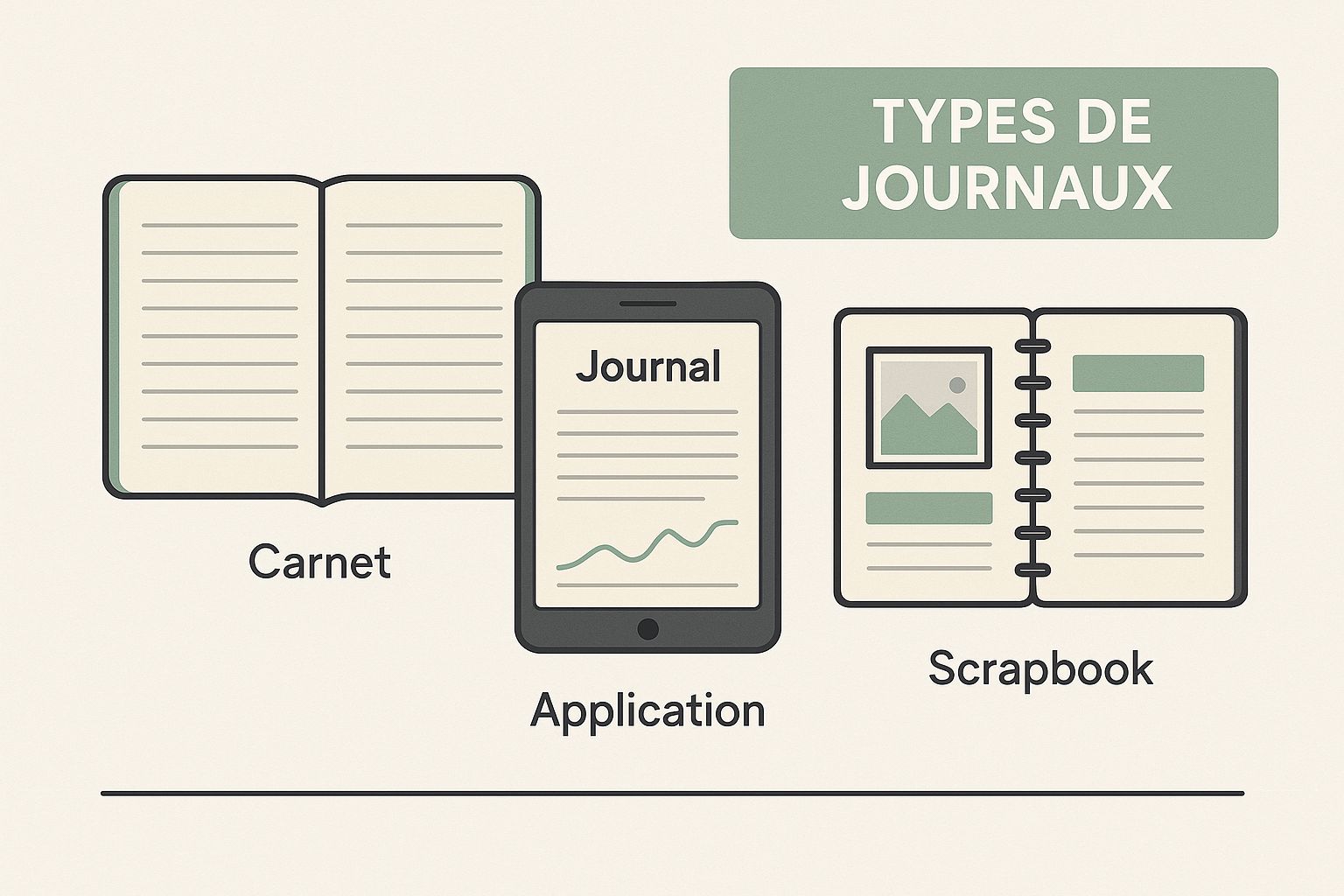
This diversity proves one thing: there's a journal for every temperament. Writing then becomes a practice accessible to everyone, even the most reluctant!
The guided journal: a helping hand to get started
Does your child want to write, but isn't sure where to start? A guided journal is the perfect solution. With its daily questions and prompts (short sentences to get the writing started), it offers a reassuring framework.
This is a great way to start. No more stress about a blank page! Your child is encouraged to think about specific themes, such as "What was the best thing about my day?" or "Draw something that made you happy."
Ideal for the child who:
- Afraid of having nothing to say.
- Needs a little routine to get started.
- Seek to understand yourself better through targeted questions.
The bullet journal: for creative and organized minds
The bullet journal , often called "bujo," is much more than just a notebook. It's a 100% customizable organizational system, halfway between a diary, a planner, and a sketchbook. It's perfect for children who love to draw, track their habits, or simply let their creativity flow.
Your child can draw, create lists, stick photos, invent their own layouts... It's a real space for expression that highlights both organization and imagination.
Bullet journaling turns writing into a creative game. It teaches children to structure their ideas, while giving them complete freedom to do so in their own way. It's a great tool for building independence.
The Gratitude Journal: To See Life Through Rose-Tone Glasses
The concept is simple, yet incredibly effective: each day, take a few minutes to write down the things you're grateful for. This quick exercise has a truly positive impact on your mood and helps you focus on the bright side.
For a child, this is a very concrete way to learn to appreciate the small joys of everyday life. They could write: "I'm happy I passed my math test" or "I had a great time with my friends today."
To help you see things more clearly, here is a small summary table. It will allow you to quickly visualize which type of newspaper would best suit your child.
What type of newspaper for which child?
| Type of newspaper | Ideal for children... | Main objective | Example of activity |
|---|---|---|---|
| Guided Journal | ...who needs a framework and inspiration to get started. | Discover yourself through targeted questions. | Answer the question: "What is the bravest thing you have done this week?" |
| Bullet Journal (Bujo) | ...creative, organized, who loves to draw and personalize. | Organize your life (school, leisure, goals) in a visual and unique way. | Create a page to track your monthly readings, with stars to rate each book. |
| Gratitude Journal | ...who tends to see the negative or needs a boost of positivity. | Cultivate a positive mindset and appreciate the little things. | List three pleasant moments of the day before going to bed. |
| Classic Diary | ...who has a great need to express himself freely, without constraint. | Empty your bag, recount your days, explore your thoughts. | Write a letter to your future self telling them about your current dreams. |
This chart is, of course, a suggestion. Sometimes, a child might appreciate a mix of genres, like adding a "gratitude" section to their bullet journal. The important thing is to find the phrase that speaks to them.
What if you chose together?
The secret to keeping this journal from ending up at the bottom of a drawer? Simply involve your child in the choice. Take a moment to look at different options together, whether in a bookstore or online.
Ask him open-ended questions to get the discussion started:
- Do you prefer to write down what comes to mind or have questions to help you?
- Would you like to be able to draw and organize your ideas however you want?
- A simple notebook or something more colorful, what appeals to you most?
By making this choice together, you transform this moment into a positive experience. You show him that you respect his tastes and support his need to express himself. This is the best way to make this journal a true ally for him.
Turning Journaling into a Family Ritual
Getting a child to start journaling can feel like a mission. The idea is to present it as an opportunity, not just another duty. The key to success? Gently integrate this time into family life, so that it becomes a moment of bonding rather than a chore.
The best way is still to set an example. If your child sees you regularly sit down with your own notebook, they'll understand that it's not just "a grown-up thing," but a real tool for feeling good, at any age. It completely takes the drama out of writing about yourself and makes the idea much more accessible.
Create a bubble of calm to share
What if you set up a little "quiet time" every week? Mind you, we're not talking about a forced group therapy session! Just a moment where everyone, parents and children, sits down with their notebooks. It doesn't have to last for hours: 10 to 15 minutes is perfect.
Ambiance is everything. Soft music, a warm drink, and we settle in comfortably together, each lost in our own thoughts. The goal is truly to associate journaling with a feeling of well-being.
During this time, it's total freedom:
- Write a story, an idea that comes to mind.
- Doodle or draw.
- List your desires, the things you are grateful for.
- Or even do nothing at all, just have your notebook nearby.
This pressure-free approach is essential. It shows that the newspaper is a space of one's own, without any obligations. This ritual should be short and enjoyable. To better understand how the media targets young people, you can take a look at the information on youth press available on Mafamillezen.com .
Encourage dialogue, without ever forcing the door
Your child's journal is their secret garden. Respecting it is non-negotiable; it's the very foundation of your trusting relationship. The goal isn't to read over their shoulder, but to use this shared moment as a springboard for discussion.
A journal is a half-open door to your child's inner world. Your role isn't to open it wide, but to let them know you're there if they choose to share what lies beyond.
Once your writing session is over, you can gently start the conversation. By sharing a little of what you felt, you're subtly inviting them to do the same, but never forcing them to.
Some ideas to break the ice:
- "Hey, today I wrote about something that made me happy. It's amazing how good it feels to remember it."
- "I drew the place where I dream of going on vacation. And you, have you thought of anything cool?"
- “My little challenge this week was to write down one positive thing a day. It’s not always easy, but it really helps change your perspective.”
By opening up a little, you're creating a safe space where they can talk about anything. You're showing them that emotions, even the most complicated ones, are normal and that talking about them feels good. Your child will then feel much more comfortable sharing a little bit of their world with you, if they want to.
Beat writer's block with 15 ideas to get you started
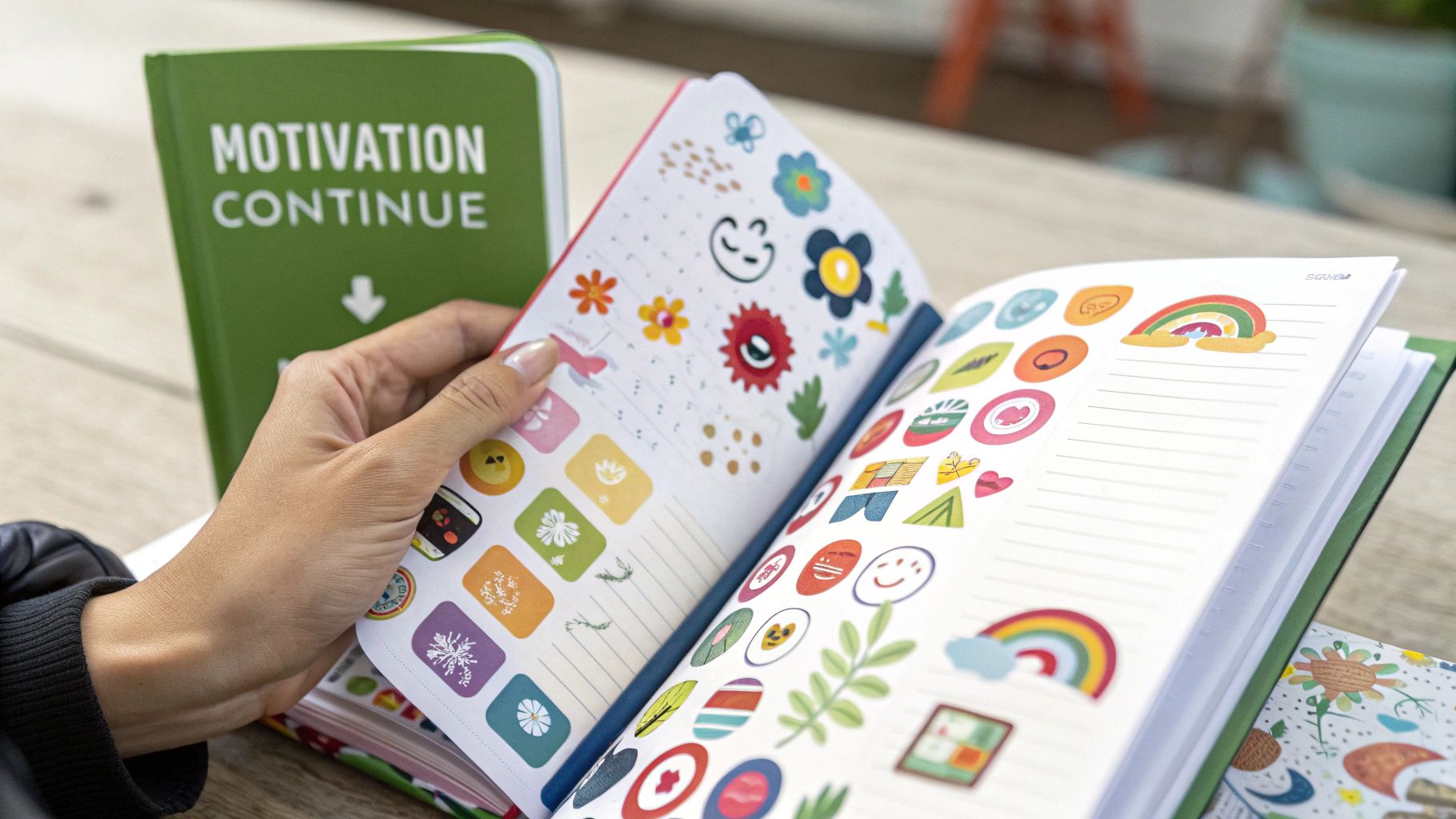
The blank page can be scary, even for adults. So for a child, it's sometimes enough to make them give up before they've even started. The secret is to show them that their teen journal isn't an essay to submit, but a space of total freedom where there are no wrong answers.
The important thing isn't to write a novel, but simply to lay down the first words. It's a bit like learning to ride a bike: the first few pedal strokes are a little awkward, but they're what get the momentum going. Think of these ideas as little training wheels to help you get off to a smooth start while your child finds their own balance.
Simple ideas for an easy start
There's nothing like lists to get started. They're quick, fun, and instantly give you the feeling of accomplishment.
- Three things that made me smile today : Perfect for looking on the bright side and practicing gratitude without realizing it.
- My daily playlist : What songs would work for different times of the day?
- My top 3 at the moment : Books, cartoons, video games... anything goes!
- If I were a superhero, my power would be... : A great way to dream a little and explore what you love about yourself.
- One word to describe my mood : Why not draw it instead of writing it?
Questions to get to know each other
Once the habit is established, your child may want to go a little further. These questions are an invitation to self-reflection, but always in a light-hearted and pressure-free manner.
A journal is a bit like a mirror. It reflects not only who you are now, but also the person you want to become. It's by asking yourself questions that you chart your own path.
- If I could speak to my future self, what would I say?
- What is the kindest thing someone has done for me recently?
- Describe a place (real or imaginary) where you feel really good and at peace.
- What is the most interesting thing I learned this week (and not necessarily at school)?
- What is the best compliment someone could give me?
These little tips are great for staying motivated. At a time when young people under 25 spend an average of 5 hours a day on screens , compared to barely 28 minutes reading books, creative activities like journaling are a real breath of fresh air. If you're interested in the subject, the National Book Center's barometer summary gives a good overview of young people's habits.
To let your creativity speak
And besides, a journal isn't just for words! Drawing, collages, scribbles... all of these things have their place.
- Draw the weather that suits you : Bright sunshine, clouds, a storm?
- Make a plan for your dream cabin.
- Write a letter to someone you admire (no need to send it!).
- Invent a completely crazy cooking recipe.
- Stick a photo, a movie ticket or a leaf on it and write what it inspires in you.
Present this list as a toolbox. Your child can dip into it when inspiration is lacking or, even better, use it as a springboard to create their own ideas. The key is to remind them that their teen journal is their territory, a place where they have all the rights.
Understanding the appeal of digital to better enhance the value of paper
Your child probably grew up with a tablet or smartphone in their hands. For them, the digital world is second nature. Rather than seeing screens as enemies to be defeated, let's try to understand what fascinates them so much to better position the print newspaper.
This universe is instant, visual, and fully customizable. The dazzling success of apps like BeReal and CapCut among adults is no coincidence. In France, 15-24 year-olds represent two-thirds of BeReal's audience! In fact, nearly 40% of them use tools to create their own visuals. These figures, which you can explore in more detail on the Médiamétrie website on young people's media habits , show one thing: young people love quick content that they can shape to their image.
Position the paper newspaper as a unique experience
So, in the face of this culture of immediacy, how can you make a simple notebook attractive? The key is not to present it as an old-fashioned alternative, but rather as a completely different, complementary, and valuable experience.
The teen journal becomes an invitation to intentionally disconnect. It's a rare space where the incessant noise of notifications fades away. It's an opportunity to reconnect with yourself, to let your creativity flow without filtering or editing.
Digital technology is a platform for expression often turned toward others. The paper journal, on the other hand, is an intimate laboratory, entirely focused on oneself.
Some arguments to discuss with your child
To get the conversation started, you don't need a grand speech. Simple analogies can be enough to highlight the superpowers of paper:
- A refuge to concentrate : "On the tablet, your attention is drawn everywhere. Your journal is like a bubble where your thoughts finally have the right to take their time."
- A trace that truly remains : "In a few years, you'll be happy to find your drawings, your writing. It's so much more personal than an old photo on a phone that you might have lost."
- The tool that never needs a charger : “It’s always there for you, even when you run out of battery!”
By approaching things from this angle, the teen newspaper goes from being a somewhat old-fashioned object to a unique experience, a true treasure in our hyperconnected world.
Questions you may have about your child's journal
As a parent, it's perfectly normal to have questions about keeping a teen journal . It's a great tool to help your teen grow, but it can also raise some doubts. Here are some simple, clear answers to help you.
My child doesn't want to write, how can I motivate him?
We know that forcing a child never works. If the words don't come to them, why not try a more creative approach? Offer them other ways to express themselves in their notebook.
- Drawing or doodling : Sometimes a simple sketch says a lot more about your mood than a long paragraph.
- Collages : Cutting out images from magazines or pasting photos together is an excellent way to showcase your dreams or emotions.
- Make lists : Suggest that he list his current songs, his goals, or simply things he loves. It's much less intimidating than a blank page!
The most important thing is to value his approach, not the result. The goal is not to create a work of art, but to give him a space to find himself.
Am I allowed to read his diary?
The answer is simple, and it's categorical: no . Your child's journal is their secret garden. A sacred space that must absolutely remain private. Reading their journal, even if you think you're doing the right thing, is a risk that you'll break the bond of trust between you for good.
Respecting his privacy is a huge demonstration of love and respect for his need for autonomy. Showing him that you respect his boundaries will help him feel safe enough to come and talk to you when he really needs to.
Is a paper journal or an app better?
Both formats have their strengths. An app may seem more modern and practical to a child who grew up with screens. But a print newspaper offers a truly unique experience.
It allows for a real break from the constant notifications and stimulates concentration in a completely different way. The contact of the pen on the paper creates a more intimate, deeper connection with one's thoughts. The best thing to do is to discuss it with him to see what appeals to him most.
The My Book Story notebook has been specially designed to accompany children aged 6 to 12 on this beautiful adventure of self-discovery, well before the big turmoil of adolescence. It's the perfect companion to help them cultivate their confidence, creativity, and emotional balance, day after day. Discover it here: https://mybookstory.co/products/le-carnet-my-book-story .