Free youth newspaper: a tool for cultivating well-being and creativity
Share
Finding a free journal for young people is often the perfect way to introduce your child to personal writing. It's a simple, pressure-free way to see if they like the idea before taking it further. These resources, easily found online, are a fantastic gateway to exploring their creativity and emotions, without you having to spend any money.
Start journaling to support your child's well-being
We often think of a diary as just a simple notebook. But for a child between 6 and 12 years old, it's so much more. It's first and foremost a safe space, their own secret garden. A place where they can share everything: their greatest joys, their minor setbacks from the playground, their wildest dreams... without ever being judged.
This seemingly simple habit is actually a powerful tool for developing emotional intelligence .
By putting words to their feelings, your child gradually learns to name their emotions, understand them, and then accept them. This is a crucial step in building a solid foundation for the future. Journaling allows them to gain some perspective on events, sometimes transforming a difficult day into a valuable life lesson.
The newspaper, a breeding ground for creativity and confidence
In his journal, anything goes! Drawing, pasting photos, inventing stories, doodling monsters... This total freedom is an invitation to let his imagination run wild. He quickly discovers that there's no "right" or "wrong" way to do things, just his own.
Each page filled, each drawing completed, is a small personal victory. These successes, one after another, nourish his self-confidence. He realizes that he is capable of creating something that belongs only to him, of bringing order to his thoughts and telling his own story.
The personal journal acts as a kind mirror. It reflects not only events, but also the child's inner growth, showing them the path traveled and the challenges overcome.
This regular practice helps him cultivate a more positive inner voice and to be proud of what he accomplishes, even the simplest things.
A bridge for communication and family rituals
As a parent, journaling can also become a precious ritual. The idea is obviously not to read your journal in secret, but rather to create a shared moment around this activity. Why not keep your own journal next to your child's, for example?
This can open the door to discussions you wouldn't have had otherwise. Here's how journaling can enrich your conversations:
Facilitating dialogue: After writing about their day, your child often has a clearer understanding of what truly stood out for them. It will then be easier for them to talk to you about it, if they wish.
Create a calming ritual: A few minutes of writing each evening can become a quiet moment, away from screens, to reconnect with yourself. It's a wonderful opportunity to leave the day's tensions behind and truly connect.
Encourage shared introspection: You can launch fun little challenges like "the best thing that happened to you today" or "what made you laugh the most." This transforms writing into a game and offers you lovely insights into their world.
Where to find free printable newspapers for your child
The great advantage of a free youth journal is its immediate accessibility. With just a few clicks, you'll find a multitude of printable templates, without spending a penny. It's perfect for seeing if your child likes the idea before investing in a more comprehensive journal.
The internet is a veritable treasure trove for parents. Between parenting blogs and educational websites, you can find plenty of creative models, often well-designed for each age group.
Where should you begin your research?
To save you time, here are some reliable sources for printable newspapers that will encourage your child to express themselves.
Creative parenting blogs: Many passionate dads and moms share their own creations for free. Simply type "printable children's journal" or "free emotions journal" into your search engine.
Educational websites: These platforms often offer activity sheets, and among them, you can find journal templates to learn to recognize your emotions or to practice gratitude.
Pinterest: It's a visual goldmine. A quick search and you'll have access to hundreds of free templates, from the simplest to the most original, often accompanied by blog articles that explain everything.
A good free journal isn't just a blank page. It should inspire writing or drawing with little questions, spaces dedicated to doodling, or themes that speak to your child, whether it's dinosaurs, space, or animals.
Accessing free content has become second nature, especially for younger generations. In France, social networks boast 50.7 million users , and YouTube is the go-to platform for children to find entertainment and information. This "everything free" habit extends to all areas, including creative hobbies. It's no wonder that printable resources are so popular with families!
Some parenting tips for making the right choice
Faced with so many choices, it's easy to feel overwhelmed. To ensure you choose a product that will truly benefit your child, keep these points in mind.
First, opt for clean and uncluttered designs. A design that's too busy or has overly bright colors can quickly distract a young child. The idea is to provide structure, not overwhelm them with information.
Next, make sure the content is age-appropriate. The questions should be simple, positive, and open-ended to encourage reflection without overwhelming them. For example, "What were you most proud of today?" is much more engaging than "Analyze your mistakes from today."
Finally, beware of websites that hide subscriptions or bombard you with ads. A good free newspaper for young people is often the work of creators passionate about children's well-being.
What if the best free newspaper for young people was one you created together? Far from being just an alternative, it's a golden opportunity to transform this idea into a creative project that brings you closer. It's a shared moment, just for the two of you.
The goal isn't to create a perfect object, but rather a journal that truly reflects them, 100% . By co-creating their journal, your child makes it their own long before writing a single word. It's already a little bit their own secret space.
Where to begin? The practical side
Before bringing out the glitter and stickers, there are a few material details to take care of. Nothing complicated, the idea is to create a base that is both sturdy and pleasant to handle.
The format: A simple A5 notebook often does the trick; it's the ideal size. For a more handcrafted look, you can also fold A4 sheets in half and secure them with a few staples or some pretty string.
Paper: Don't hesitate to vary the textures and colors! Slip in some colored sheets, thicker drawing paper for painting, or even patterned pages. These little surprises will stimulate their creativity.
Assembly: A good stapler will suffice. But if you want a slightly more professional result, try Japanese binding. A few holes punched with a hole punch, a pretty ribbon, and you're done. It's a simple technique and the result is very attractive.
What truly matters is the shared experience, far more than the final result. Creating their own journal is a concrete way to show your child that their ideas are valuable and deserve a space of their own.
This DIY moment is also an excellent excuse to step away from screens and focus on a rewarding manual activity.
Bringing the newspaper to life: personalizing it from A to Z
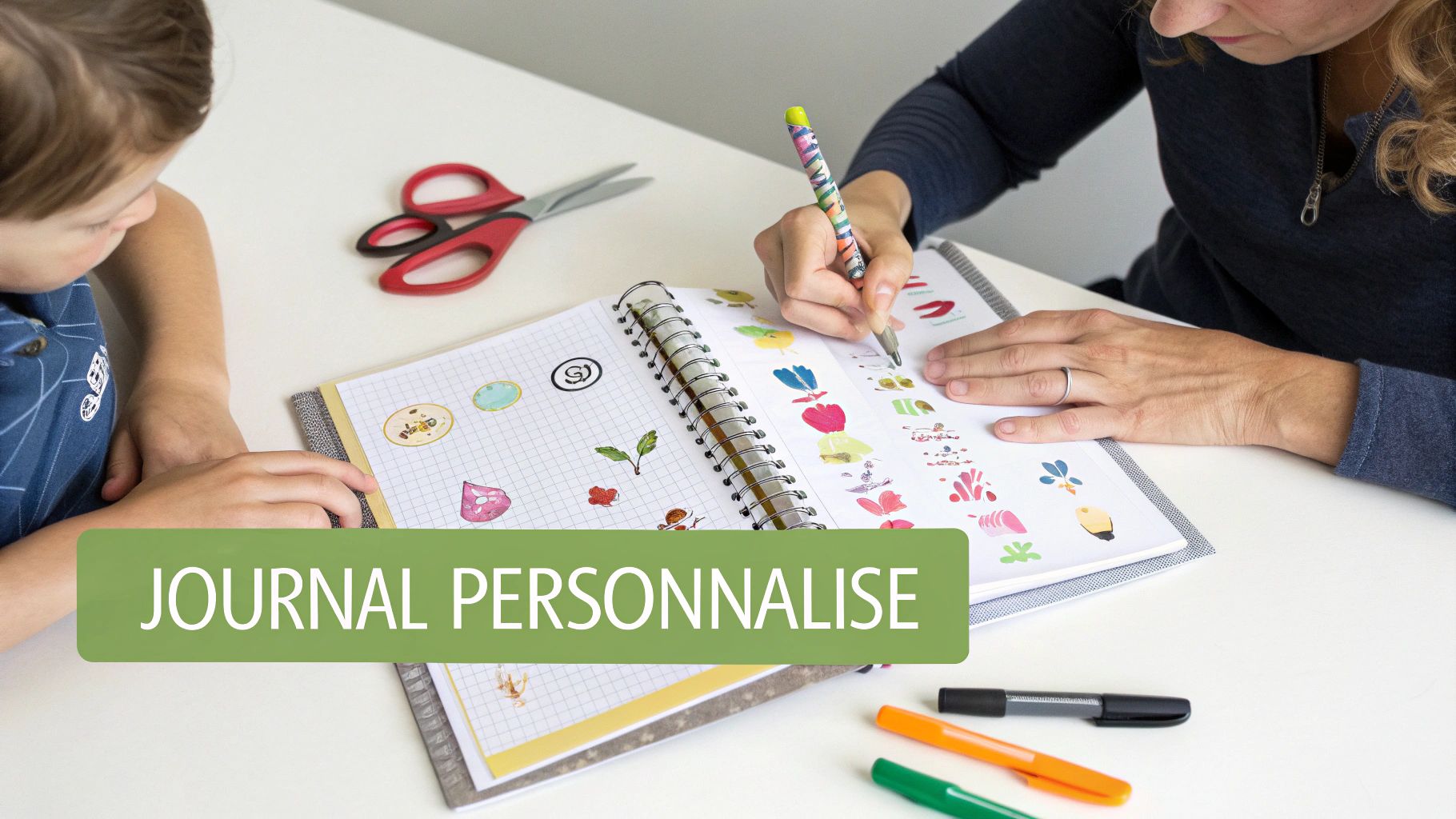
This is where the magic truly happens. The inside of the journal should become a reflection of their personality and passions. Your role is to help them imagine sections that resonate with them, so that writing becomes a genuine pleasure, not a chore.
Use this chart as inspiration to create fun and useful sections in your child's journal, tailored to their interests and age.
Section idea
Goal for the child
Example of a concrete activity
The weather of my emotions
To put words and images to what he feels.
Draw a sun (joy), a cloud (sadness) or a lightning bolt (anger) to describe your day.
My proudest corner
Boost self-esteem by noting one's successes.
"Today, I managed to tie my shoelaces all by myself" or "I shared my snack with a friend".
My crazy inventions
Unleash the imagination without any limits.
To draw an incredible machine or to tell a dream he had last night.
The gratitude page
Learn to see the positive in your daily life.
List 3 things he is happy or grateful for this week.
My superpowers
Identify your strengths and unique qualities.
Write down a quality he likes about himself or a talent he has discovered (ex: "I am good at making others laugh").
To take it a step further, why not suggest that they transform photos into line drawings for free ? It's a great activity to illustrate their journal with family portraits or holiday memories to color.
To help him get started and avoid the anxiety of the blank page, you can slip in a few open questions here and there.
"The funniest thing that happened to me today was..."
"If I had a superpower for a day, I would..."
"Today, I learned that..."
"A question I ask myself about the world..."
By creating this journal with him, you are giving him much more than just a notebook. You are telling him: "Your story, your thoughts and your emotions matter. Tell them."
How to make journaling a nurturing family ritual
That's it! You've found the perfect free youth newspaper or even made a custom notebook with your child. The initial enthusiasm is palpable. But the real challenge, as a parent, is to make this wonderful initiative a lasting family tradition, not just another activity that ends up gathering dust.
The secret? Gently integrate this moment into the family routine. The idea is not to impose a writing assignment, but rather to extend an invitation, to create a time for pause and connection away from the frantic pace of daily life.
The goal is for journaling to become something anticipated and positive. Think of it like a bedtime story: it's not a chore, but a moment of pleasure and calm that you look forward to sharing.
Finding the right niche and the right spot
Choosing the right time is crucial for establishing a habit. There's no magic formula, as every family has its own rhythm. The most important thing is to find a time slot that works for you and your child.
In the evening, just before bedtime: It's a golden moment to let go of the day's emotions. A few minutes to doodle or draw, and there you have it: a wonderful way to clear your head, savor your small successes, and leave your worries behind.
In the morning, upon waking: For early risers, starting the day by writing can provide a great boost. It can be as simple as writing "Today, I feel like laughing" or "I'm going to try to be more patient."
Once you've chosen the time, think about the location. No need to rearrange the whole house! A small, dedicated space is all you need. Prepare a box or basket with all the necessary materials: newspaper, markers, stickers, scissors, glue… The important thing is that it's easily accessible and inviting.
A nurturing environment has a direct impact on our creativity. A cozy and inspiring space transforms a simple activity into a truly comforting ritual.
Your role as a parent: to guide without forcing
Your attitude will make all the difference. Your mission, should you choose to accept it, is to encourage without ever putting pressure on her. The newspaper is her secret garden, her space of total freedom.
The easiest way? Lead by example. Nothing is more inspiring than seeing you, too, taking the time to write in your own journal. Simply share what it brings you: "It helps me feel calmer" or "I like to think back on the good moments of my day."
Respect their privacy. That's the golden rule. Reassure them that their journal is a private space and that you will never read it without their permission. This trust is key to them feeling free to express themselves without filters and fully enjoying the benefits of writing.
And what about dealing with the dreaded "I don't know what to write"? Instead of giving instructions, ask open-ended and fun questions. Rather than "Tell us about your day," try a different approach: "If your day were an animal, which one would it be and why?" or "Draw the most surprising thing you saw today." These little creative tricks can unlock the imagination and transform the fear of the blank page into a game.
Free newspaper or guided newspaper: which to choose for your development?
A free children's journal , whether printed at home or made with a few sheets of paper, is a wonderful first step. It's a space of complete freedom, a blank page where your child's imagination can flourish without any constraints. Think of it as the perfect playground for a first exploration.
But after a while, you might wonder if a more structured framework would help them progress further. That's where guided journaling comes in, offering a different but equally valuable approach to personal development.
The charms of a free, homemade newspaper
The number one advantage of the free format is its flexibility. There are no rules, which is incredibly liberating for a child who just wants to doodle, stick in souvenirs, or invent their own secret codes. This approach is fantastic for developing their independence and initiative.
The strengths of this option for its development:
Creativity without limits : Your child is the sole captain of the ship. They can draw, write poems, invent stories, or simply fill a page with stickers. Anything goes.
Zero cost : There is absolutely no financial investment, making it accessible to all families.
Total adaptability : The journal evolves with your child, reflecting their current passions, whether it's dinosaurs one week and space the next.
This freedom is truly precious, especially for younger people who are just discovering the pleasure of putting their ideas on paper.
When a guided journal takes on its full meaning for self-confidence
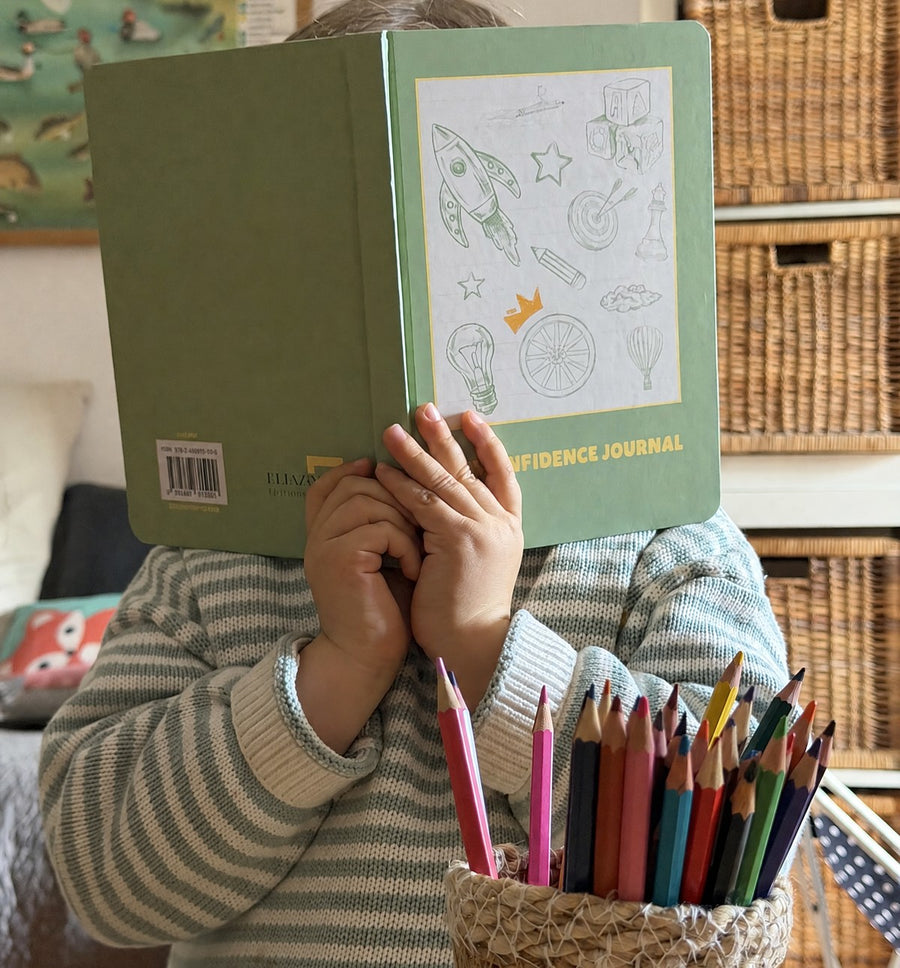
A guided journal, like the My Book Story notebook, provides a reassuring framework that can make all the difference. Far from stifling creativity, it channels it to help the child grow personally.
Think of the guided journal as a caring coach. It asks the right questions, the ones that help the child explore parts of themselves they might not have addressed on their own, such as gratitude, anger management, or self-confidence.
This is an excellent avenue to explore if you notice that your child:
Often lacks inspiration and throws out the famous "I don't know what to write".
She wants to explore her emotions but has trouble putting them into words.
Needs a slightly more structured ritual to stay motivated over time.
It is interesting to note that even though the children's publishing market represents €370.7 million in France, it is currently experiencing a slight decline, as indicated in the summary of figures for children's publishing in 2024-2025 . In this context, free resources are essential to spark children's interest. The two approaches—free and paid—are not opposed, but complementary. One can be an unfiltered creative outlet, the other a targeted tool for building self-confidence.
Your questions (and our answers) about diaries
The idea of starting a journal with your child appeals to you, but you still have some questions? That's perfectly normal! Let's go over the most frequently asked questions so you can get started with confidence.
Budget is often the first thing that comes to mind. And that makes sense; we want to try a new activity without necessarily making a financial commitment. Moreover, an Ipsos study showed that free access is a major criterion for young people, who only want to pay for what they actually use. If this topic interests you, you can take a look at the study's findings on Ipsos.com . A free youth newspaper is therefore an excellent way to take the first step.
At what age can one really start?
There's no strict rule, but the 6-7 age range is often ideal. This is the time when children gain confidence with writing and drawing, while also beginning to put words (or shapes) to what they feel.
That said, the most important thing is your child's desire. If they're curious, love to invent and tell stories, even at 5 years old, go for it! A drawing-based journal will be perfect for them.
How can I reassure him that his diary is indeed... secret?
This is the cornerstone of this whole adventure. The journal is her space, her secret garden. You must explain to her very clearly from the beginning that this notebook belongs to her, and that you will never read it without her permission .
Respecting her privacy is the key to trust. It's what will give her the security she needs to express herself freely, to talk about her joys as well as her fears, and to truly enjoy the moment.
To make this rule even more concrete, why not find him a small box or a special pouch where he can hide his diary, away from prying eyes?
My child doesn't really like to write, what should I do?
Above all, don't force him! A journal isn't just a series of sentences. If the blank page intimidates him, there are plenty of other equally wonderful ways to express himself:
The drawing: He can draw a highlight of his day, an emotion in the form of a little monster, or even one of his dreams.
Collage: Keep old magazines and suggest that he/she cut out images that represent what he/she liked or felt.
Lists: Lists are easy and fun! For example: "The 3 things that made me laugh today" or "My 3 superpowers of the day".
Colors: Sometimes, all you need to do is color a page with the color that matches your mood. Simple and effective.
The goal is for it to be a moment of pleasure and creativity, not an extra chore. The most important thing is that he finds the means of expression that suits him.
The My Book Story journal was designed to guide children step by step, blending writing, drawing, and fun activities. It's an excellent complement to a homemade journal, providing a supportive environment to foster their confidence and well-being. Discover how the My Book Story journal can guide your child .