


What if you gave your child their own secret garden? A little corner just for them, where they could share their thoughts, their joys of the day, and even their little worries. That's exactly what a children's journal offers. It's much more than just a notebook; it's a real tool to help 6- to 12-year-olds discover themselves, find their emotional balance , and build self-confidence that will last a lifetime.
A journey to the heart of your child's emotions thanks to the journal
As parents, we're always looking for ideas to help our children thrive. Journaling is a simple yet incredibly powerful practice for doing just that. It's giving your child a space of their own, free from judgment, where they can safely explore their inner world.
Think of your journal as a confidant who never repeats anything. It's the perfect place to put words to emotions that can sometimes seem a little confusing. This great whirlwind of feelings then transforms into clearer, easier-to-understand thoughts.
A valuable habit for growing up
Far from being a simple hobby, introducing your child to journaling is giving them a tool that will stay with them forever. By learning early on to recognize and name their feelings, they lay the foundation for solid emotional intelligence. This self-understanding will help them better navigate friendships and the challenges of school.
Parent tip: Present the journal as a treasure chest for thoughts. Tell them, "This is your secret space to draw your dreams, share your adventures, or even confide what's bothering you. There's no right or wrong way!"
This simple and fun activity allows children to:
- Put words to their emotions and learn to manage them better.
- Let their creativity run free , without the pressure of a grade or a result.
- Build their self-confidence by seeing their ideas and progress written down on paper.
A journal isn't just another homework assignment. It's a friend, a companion. The important thing isn't to make zero spelling mistakes, but to express yourself freely. It's a gift that shows your child that their voice matters.
A moment of sharing that strengthens bonds
Journaling can also become a lovely family ritual. Of course, the contents of your journal remain your secret, but simply sharing this quiet time can strengthen your bond. Why not sit next to each other, each with their journal, to create a little bubble of tranquility?
This shows your child that you value these moments of pause and reflection. It also opens the door to dialogue: they know you're there to listen if they ever want to share a thought or emotion. By encouraging them in this way, you're investing in their well-being, both today and tomorrow.
What are the benefits of keeping a diary for your child?
Suggesting that your child keep a journal is much more than just a distraction. It's offering them an inner adventure, a sort of personal toolbox that they will fill and enrich page after page. Between the ages of 6 and 12 , this simple habit can become an incredible support to help them grow, feeling good in their mind and in their shoes.

Behind this seemingly innocuous gesture lies a formidable driving force for development. Keeping a child's journal reinforces several essential pillars of their personality. Let's take a look at the four most important ones.
1. Tame the world of emotions
Between the ages of 6 and 12, emotions are often a real roller coaster! One moment, it's the euphoria of a good grade, and the next, the heartbreak of an argument in the playground. The newspaper is precisely the ideal and safe place where he can deposit all this whirlwind.
By putting words or drawings to what they feel, your child learns to recognize and name their emotions. This is the very first, fundamental step toward understanding and better managing them. Instead of letting frustration or anger overwhelm them, they learn to take a step back and express them in a healthier way.
Concrete example: If your child is upset after an argument, suggest they draw their anger. Is it an erupting volcano? A black cloud? This exercise allows them to visualize the emotion and detach from it, rather than keeping it inside.
The journal acts as a mirror for emotions. By writing, "Today I am angry because...", the child transforms an abstract and overwhelming feeling into a concrete, much less intimidating thought.
This ability is called emotional intelligence , and it's one of the greatest gifts you can give them for their future life. Numerous studies confirm this: good emotional intelligence is directly linked to better relationships with others, greater academic success, and overall well-being throughout life.
2. Let your creativity run free
The newspaper is a playground where the only rule is that there are none. It's a far cry from school exercises with strict instructions to follow. Here, it's a space of total freedom where the imagination can run wild without restraint.
And this creativity can take many different forms:
- Inventing stories: He can create fantastic worlds, brave heroes or completely crazy adventures.
- Drawing your dreams: Drawing is often a more instinctive means of expression for children, a way of putting into images what is in their heads.
- Making collages: Cutting out photos from magazines to create your own world is also a great way to express yourself.
- Write poems or songs: A great and fun way to play with words, rhymes and sounds.
By encouraging him to explore all of this, you help him strengthen his ability to think differently and find original solutions to life's big and small challenges.
3. Build rock-solid self-confidence
As the weeks and months pass, his journal becomes a testament to his growth. Simply rereading what he wrote some time ago allows him to see how far he's come. He rediscovers his victories, even the smallest ones, and remembers how he managed to overcome difficult times.
It's a powerful mechanism for building self-esteem. Their journal becomes tangible proof of their abilities and resilience. They understand that their thoughts, fears, and joys have value, simply because they are their own.
Action for parents: From time to time, suggest (without insisting) that they reread a page from a few months ago together. Highlight their progress: "Remember how difficult that was for you? Look how well you've handled the situation since then!"
This idea that we can overcome challenges and emerge stronger is fundamental. It's a concept that has inspired many publications, such as "MAX" magazine in France, which chronicled the lives of modern heroes, showing that failure is often just a stepping stone to success. To learn more about this inspiring approach, take a look at Wikipedia .
4. Improve your writing, without seeming to
Finally, a very concrete but equally important benefit: the improvement of his French language skills. Keeping a journal for young people leads him to practice writing very regularly, but in a setting that remains a pleasure, without any pressure to perform.
Without even realizing it, they learn to better organize their ideas, find more precise words, and construct increasingly rich sentences. This ease they gain while having fun will inevitably have a positive impact on their grades at school, without writing ever being seen as a chore. The journal transforms a school skill into a real tool for self-expression.
How to Choose the Perfect Journal for Your Child
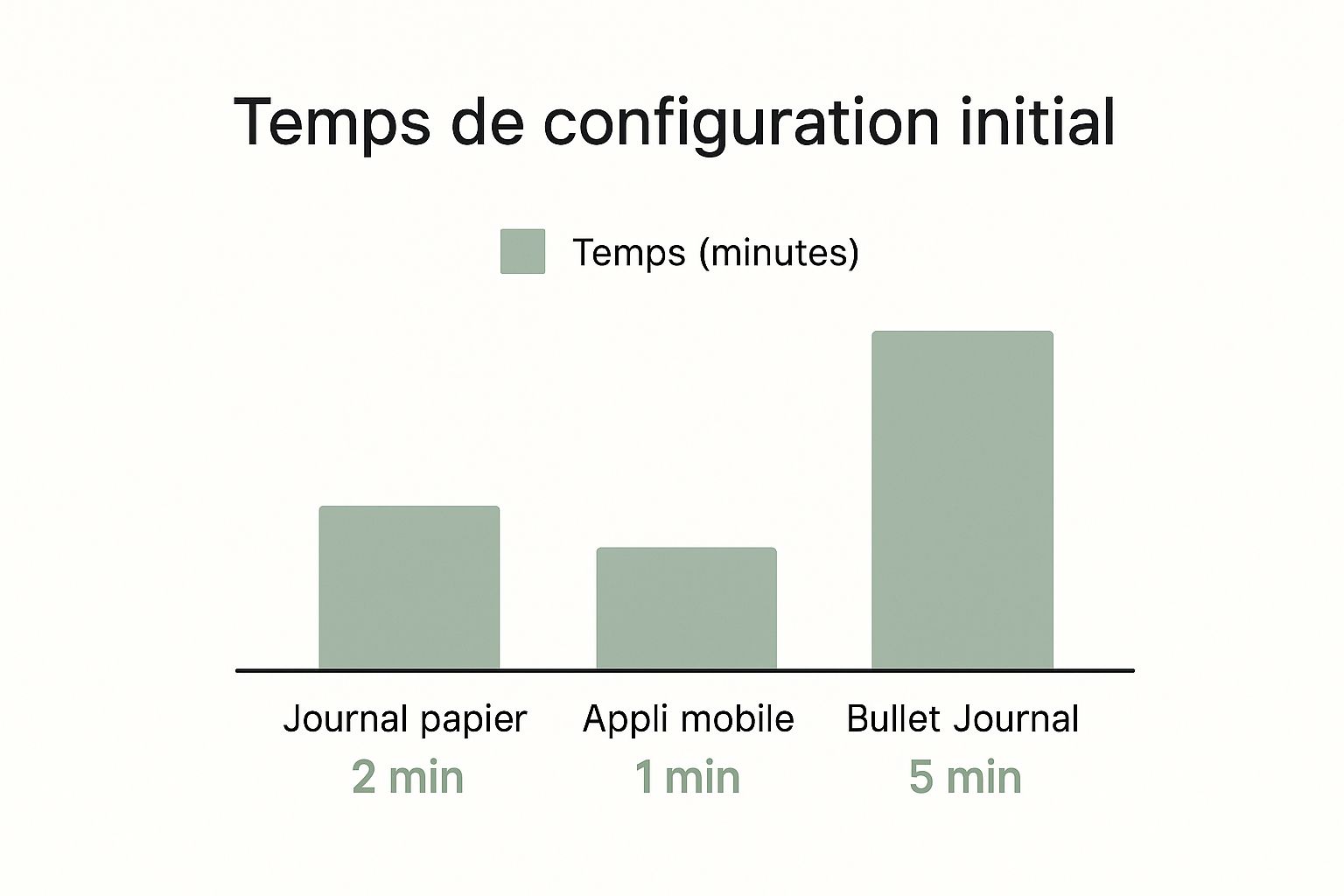
Finding the right journal is a bit like finding the right friend for your child: one who will listen without judgment and encourage them to open up. It's the first step toward making writing a real pleasure. The key question is simple: does your child need a guide to get started, or a large playground to let their imagination run wild?
On one hand, there's the classic, simple notebook, with its blank or lined pages. It's the realm of freedom! It's perfect for the child who's already bursting with ideas, who loves to doodle, invent stories, or who just needs a space of their own to let their thoughts flow without any constraints.
On the other hand, there are guided journals, such as the My Book Story notebook. They are designed to guide the child with questions, themes or small activities for each day. This is the ideal solution for the more timid, those who might feel a little lost when faced with a blank page and who appreciate having a little help to start thinking.
The little details that make all the difference
Beyond the type of journal, there are some practical aspects that can really motivate your child to write regularly. After all, the object itself should be something they enjoy!
- A cover that suits him : Choose it together! Whether it's his favorite animal, a world of superheroes, or vibrant colors, the first impression is essential for him to make his notebook his own.
- A handy size : For the hands of 6-12 year olds , the A5 format is often perfect. It is neither too big nor too intimidating, and slips easily into a bag or onto a bedside table.
- Paper Softness : Good quality paper, thick enough so that the marker doesn't bleed through, makes the writing experience much more enjoyable. It's details like this that make you want to return to your journal, day after day.
The important thing is to involve them in the choice. When a child chooses their own journal, it is no longer just a notebook, but their confidant, their secret garden.
Comparison of Types of Children's Newspapers
To help you see things more clearly, this table compares the different formats to help you choose the one that best suits your child's personality.
| Type of newspaper | Ideal for... | Benefits | Disadvantages |
|---|---|---|---|
| Classic Notebook | The creative and independent child, the budding artist, the future writer. | Total freedom, encourages imagination, can be used in multiple ways (drawing, collage, writing). | Can be intimidating (writer's block) for a child who needs guidance. |
| Guided Journal | The child who needs structure, the explorer of feelings, the one who is just starting out. | Provides food for thought, facilitates regularity, helps structure thoughts. | Less room for spontaneous creativity, themes may sometimes not match the mood of the day. |
Every child is different, and the "best" journal will always be the one they enjoy opening. Don't hesitate to observe what naturally attracts them.
The good news is that the children's book market in France is incredibly rich. Our specialist publishing houses offer a wide variety of journals, ensuring you'll find the perfect youth journal . If you're interested in the dynamics of French-language children's publishing , this analysis will tell you more.
Establish a positive journaling ritual as a family
Introducing a new habit into an already busy daily routine can sometimes feel like one more task on the list. But the idea behind a children's journal isn't to add a constraint. Quite the opposite: it's to open a little interlude of pleasure and sharing.
So, how do you turn this moment into a ritual everyone looks forward to? The secret is to approach it gently, creatively, and, above all, with zero pressure. Journaling isn't a school assignment. It's a welcome break, a moment to breathe. For it to work, the practice needs to adapt to your child's and your family's rhythm. You don't "do" journaling; you "live" a journaling moment.

Finding the perfect moment
The "right" time is simply the one that works best for you. There are no golden rules. The important thing is to explore together to see what best suits your child's personality.
Think of it as a little decompression bubble. For some, it'll be right after school. It's perfect for "letting things off" after a day full of learning and excitement, and for a smooth transition into the evening at home.
For others, the ideal time slot will be in the evening, just before bed. It's a wonderful way to wrap up the day, put aside little worries so they don't drag them under the covers, and remember the happy moments. A routine like this can really help you get a more peaceful night's sleep.
The key is to stay flexible. If one day your child prefers to play rather than write, that's perfectly normal. The key is to suggest, never impose. That's how journaling will always remain synonymous with fun and freedom.
Create a little corner that makes you want to
Where we sit plays a huge role in our creativity and sense of well-being. No need to rearrange everything! A small, well-designed corner is enough to create an atmosphere that invites writing and daydreaming.
Some simple ideas for a successful “journaling corner”:
- A cozy spot : A large cushion on the floor, a small pouf in a corner of your room, or even your designated spot on the sofa can become the official journaling spot.
- Dream-worthy supplies : Imagine colorful pens, glittery markers, fun pencils, and a box full of stickers. These little treasures turn writing into a creative and visual game.
- Everything within reach : Keep your newspaper and supplies in plain sight and easy to grab. If everything is tucked away in a drawer, the urge is likely to disappear as quickly as it arrived.
The goal is to create a visual invitation. When your child sees this colorful and cozy little space, they'll naturally be more eager to move in.
Lead by example to build trust
Children learn a lot by imitating us. The simplest and most powerful way to encourage them is to show them that you, too, are taking the time to sit back and think.
Sit down next to him with your own notebook. No need to share what you're writing. Just experiencing this quiet moment together, side by side, sends a powerful message. It shows that taking time for yourself is normal and important.
It is also a golden opportunity to build a climate of total trust, which is the basis of everything.
The golden rules of trust:
- Zero judgment : The journal is his territory. Whether he draws monsters, writes about his anger, his joys, or his fears, everything has its place.
- No correction : This is perhaps the most important tip. Never correct his spelling or grammar mistakes. The newspaper is not an academic exercise; it is his space for free expression.
- Respect his secret garden : His journal is his. Assure him that you will never read it without his permission. This rule is non-negotiable so he feels completely safe.
At the same time, be available. Tell him clearly: "What you write is yours, but if you want to read me a passage or talk about something, I'm always here to listen." This open door shows him that he can come to you, further strengthening your bond.
Creative ideas to liven up your journal pages
The infamous "blank page"... it can be intimidating, even for the most creative kids. So how can you turn a youth journal into a playground where inspiration never runs out? The trick is to see it not as homework, but rather as a treasure chest filled with fun and varied activities.
Rather than asking the classic question "Tell me about your day," I'm going to give you some creative ideas, "prompts," as they say in English, specially designed for 6- to 12-year-olds. These little invitations transform the journal into a space for limitless exploration. Each page becomes a new adventure.
Emotions and Inner Weather
Journaling is a safe space, a valuable ally in helping your child understand the whirlwind of emotions they may be experiencing. One method I really like is using visual metaphors. It's a gentle and very effective way to encourage them to put words or drawings about what's going on inside them.
Here are some ideas to help him draw or describe his weather today:
- What is the weather like in your heart today? Is it a bright sun (joy), a few passing clouds (a little sadness), a big storm (anger), or even a rainbow (pride, calm restored)?
- Draw your feeling as a little monster. Is it tiny and shy? Big and grumpy? Colorful and full of energy? You can even give it a funny name.
- The map of your emotions. If your feelings were islands, what would they look like? We could imagine the Island of Joy, the Volcano of Anger, the Forest of Worries...
This playful approach helps defuse strong emotions. It helps children gain perspective, an essential skill for balance. It's a concrete way to show them that all feelings are normal and have their place.
Cultivate gratitude and small joys
Learning to notice the beautiful moments in everyday life is a superpower for well-being and self-confidence. By doing this, you train your brain to see the positive, even when the day hasn't been easy. And for that, a journal is a fantastic tool.
The goal isn't to look for extraordinary events, but to find the magic in the little things. It's a habit that fuels optimism and helps build a more serene outlook on life.
To keep it fun, offer your child themed lists:
- The 3 joys of the day. List three little things that made him feel good today: a hug, a dessert he loves, a joke that made him burst out laughing.
- The gratitude jar. Draw a large jar and, each day, add a small piece of paper drawn or written to it that represents something for which you are grateful.
- The “thank you” list. Write a thank you to a person, an animal, or even an object that made your day better.
These simple activities, if practiced regularly, have a huge impact on a child's perception of daily life. They strengthen their sense of inner security.
Explore your imagination without limits
The youth newspaper is also a laboratory of ideas, a secret place where anything is possible. It's here that your child can dream, invent, and explore the facets of their personality in complete freedom. Stimulating their imagination is essential for developing their creativity and ability to find solutions.
Some ideas to get the adventure started:
- Your dream superpower. If you could have one, what would it be? Draw your superhero costume and tell us about your very first mission.
- A letter to your "future self." What would you like to say to the person you will be in 10 years? What are your dreams, your hopes, your questions?
- Create your own comic strip. Invent a character and imagine a short adventure in a few panels. No need to be a great artist; stick figures are perfect for getting started!
- Collage of your desires. Cut out pictures from old magazines that represent things you like or would like to do (travel, activities, jobs) and create a page full of inspiration.
By encouraging these explorations, you help your child connect with their deepest desires and build a positive image of their future. It's a great way to build confidence in their own ideas.
The newspaper, a companion for life
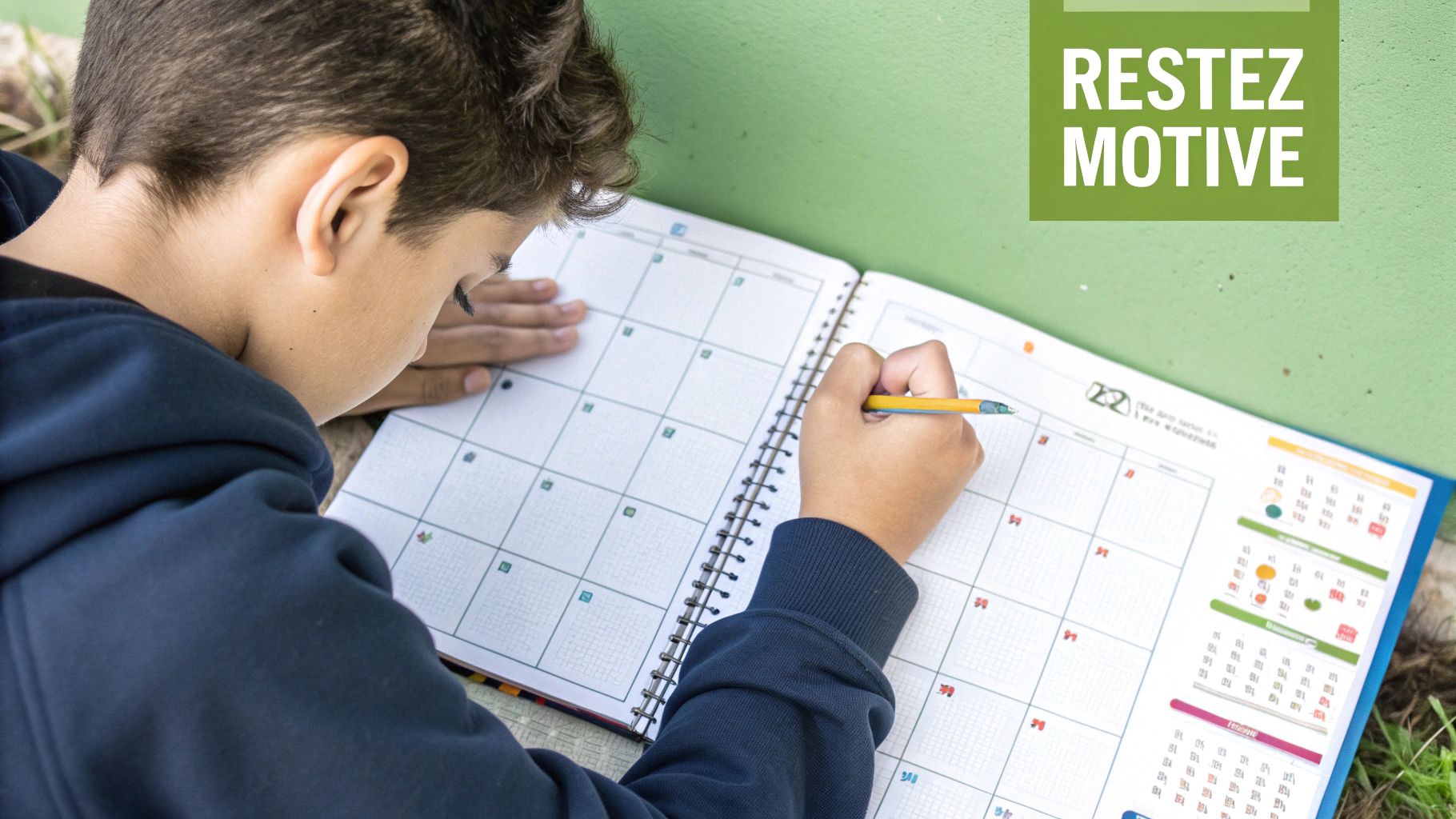
Giving a child a journal is more than just a gift. It's giving them a true companion, a silent confidant who will listen to their joys and sorrows, without ever judging them.
This notebook will quickly become a valuable tool to help them navigate the ups and downs of childhood. You are directly investing in their future well-being by teaching them, starting today, to better understand themselves, to put their emotions into words, and to find their own voice.
Embark on this family adventure
The best part? You can accompany them on this wonderful adventure, with curiosity and kindness. The idea isn't to aim for perfection, but to share and discover together.
To start, keep things simple. Choose a notebook he likes, a few colored pens, and enjoy this new bonding moment. The important thing is to create a small, positive habit, without pressure.
This ritual will become a precious moment that will strengthen your bond. At the same time, your child will develop essential skills for a healthy and balanced life. It's a gift that will continue to bear fruit long after childhood.
Questions you may have about the children's newspaper
Embarking on the journaling adventure with your child is great! But it often brings its share of practical questions. It's perfectly normal to want everything to go as smoothly as possible. To help you accompany your child with complete peace of mind, here are clear answers to the most frequently asked questions.
At what age can we start?
There's no official age limit. The right time is often when your child starts showing an interest in drawing or writing, usually around age 6. The most important thing is to follow their pace and curiosity. If they already enjoy telling stories or doodling in the corner, it's the perfect sign that a children's journal could become their best friend.
To begin, offer them something they'll enjoy, something colorful and fun. The idea is to present the newspaper as a game, a new way to express themselves, and certainly not as a duty.
How should I react if he writes negative things?
You may find that while glancing at his notebook (with his permission, of course!) or during a conversation, you discover that he is pouring out his sadness or anger. Your first reaction is crucial. Think of this journal as a safe place, his own secret garden where he can say anything.
The fact that he's expressing negative emotions in it is actually a great sign. It means he feels confident enough to share everything he's feeling in it. If the content concerns you, don't just tell him you've read his journal. Instead, start a more general discussion about his well-being: ask him how things are going at school or with his friends.
The journal is a safety valve. It allows the child to "get out" what's weighing them down in order to better understand it, without fear of being judged. It's a key step in learning to tame their frustrations.
Should I correct his spelling mistakes?
The answer is a resounding no ! The newspaper must absolutely remain a space of total freedom, without any academic pressure. The goal is for him to express himself, not for him to write a perfect dictation.
Correcting his mistakes would turn this fun time into an exercise in disguise and risk discouraging him very quickly. Remember that every page, even with mistakes, is a small victory for his self-confidence and creativity.
What if he stops writing in it?
It's very common for a child to put their notebook aside for a while. The golden rule: never force them to write. If they stop, it may simply be because they don't feel the need to at that moment.
Suggest they take a break, quite simply. You can also try to revive their interest in more subtle and fun ways, by giving them a new notebook or proposing a creative activity like collage. Sometimes, going digital can also be an option. A study on media consumption has shown that young people are not abandoning traditional formats, but are supplementing them with digital. To learn more about the evolution of young people's reading habits , this study offers interesting avenues for reflection.
The My Book Story notebook is designed to make writing an exciting adventure, with guided activities and inspiring themes. Page after page, it helps your child develop confidence, creativity, and emotional balance.
Discover the My Book Story notebook and give him an unforgettable growth companion .