


What if a simple notebook could become a superpower for your child? A tool capable of boosting their confidence and helping them cultivate joy every day. That's exactly what a gratitude journal offers: a simple family ritual that's easy to implement and has a big impact on the emotional well-being of children aged 6 to 12.
How gratitude can transform your everyday family life
A gratitude journal is not just a checklist. Think of it more as a daily treasure hunt, where the nuggets of gold are the small and big joys experienced: a comforting hug before going to school, the pride of having succeeded at a difficult exercise, or a fit of laughter shared with family.
By taking the time to notice these moments, your child trains their brain to see the positive. The idea isn't to deny worries or frustrations, but rather to strengthen their ability to also recognize all that is going well. It's a simple habit that can quickly become a precious family ritual, strengthening bonds and communication.
Concrete benefits for the child's well-being
Making room for gratitude in your routine is a bit like building the foundations of a stronger house, better able to withstand life's storms. It lays the groundwork for your child to develop resilience and self-confidence.
And this effect isn't just a feeling. Since 2018, several primary schools in France have tested gratitude workshops. The results are striking: 85% of teachers noticed improved attention in class, and 72% a decrease in conflicts between students. If you'd like to explore this topic further, you can find more details about gratitude in children .
Far from being a constraint, keeping this journal quickly transforms into a creative adventure that strengthens bonds and nourishes the well-being of the whole family.
Developing your child's emotional superpowers
Keeping a gratitude journal is a bit like giving your child's mind superhero training. Far from being a simple pastime, this habit is a real tool for personal development. It helps them build a kind of emotional armor for life.
Every time your child takes the time to note a small moment of happiness, they unknowingly strengthen their ability to manage more difficult emotions. Think of the sadness after an argument with a friend, or the frustration with a challenging assignment. This daily practice builds their resilience.
Little by little, he learns not to let worries overwhelm him and to see challenges as steps to take, not insurmountable mountains. This shift in perspective directly boosts his self-esteem.
A gentler view of everyday life
The benefits of gratitude don't stop at managing emotions. It's like putting on glasses that help your child see the world more positively and develop their optimism.
The infographic below clearly shows the progress that can be observed in children who keep a gratitude journal regularly for several weeks.
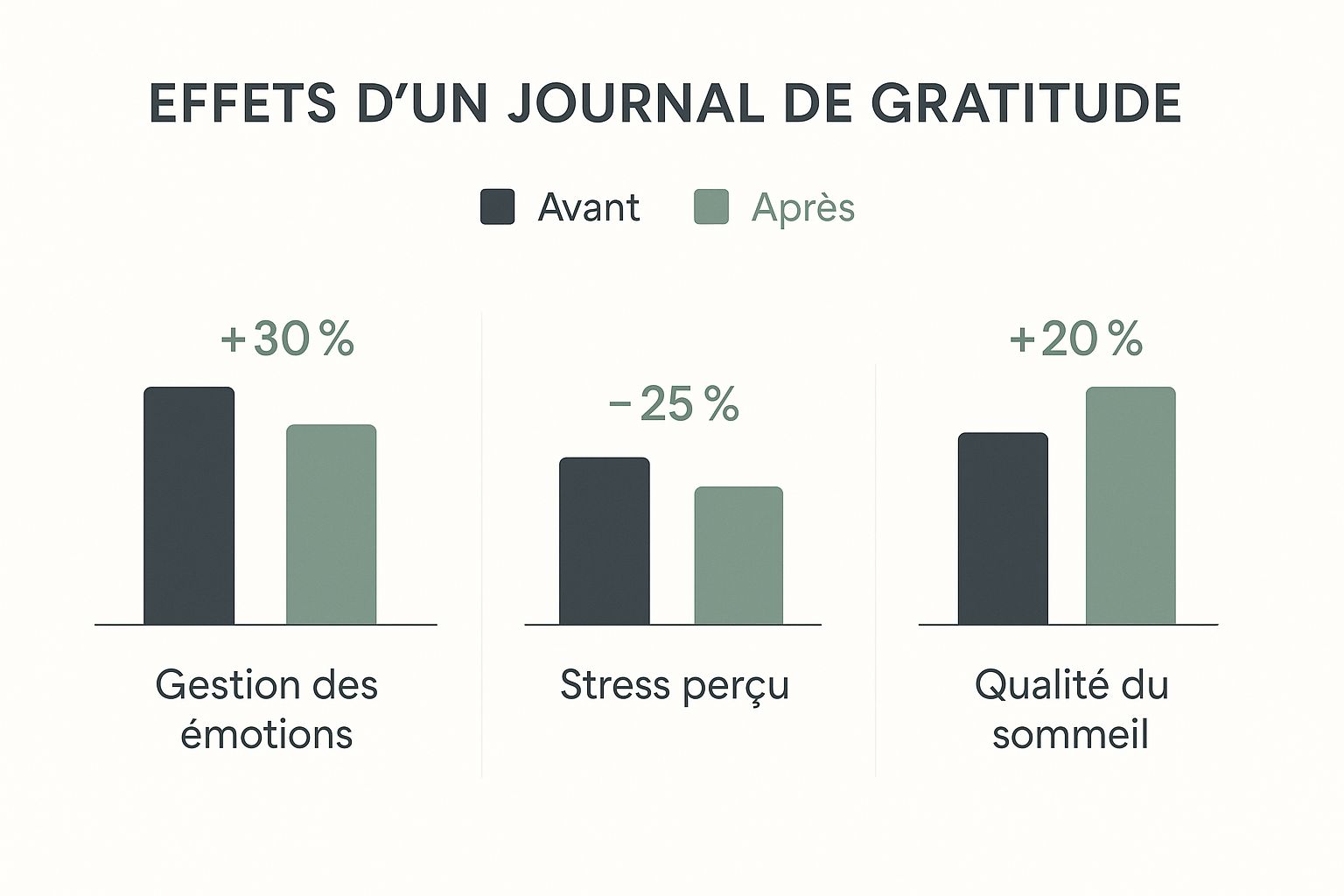
These figures are clear: focusing on the positive really helps children feel less stressed and sleep better. And when you're calmer, you're naturally more attentive at school and get along better with others.
Imagine gratitude as an inner compass. Every day, it helps your child focus their attention on what makes them feel good and gives them strength, even when things don't go as planned.
This practice even has an impact on overall well-being. Studies have shown that among adults who practice gratitude, 45% experience a decrease in anxiety and 38% sleep better. If you're interested in this topic, you can learn more about the effects of gratitude .
By introducing them to gratitude, you're not just giving them a pretty notebook. You're giving them an essential skill to move forward in life with confidence and optimism.
Starting a gratitude journal as a family: a practical guide for parents
The idea of a family gratitude journal appeals to you, but you're not quite sure where to start? Don't worry. Far from being just another chore, it's first and foremost a simple and heartwarming moment of sharing. The goal isn't to be perfect, but to create a small, authentic ritual of connection with your child.

The very first step is to choose a medium that will appeal to your child. There are no rules! The important thing is that the object itself is a small source of joy.
Making gratitude fun and creative
To get children aged 6 to 12 interested, it needs to be fun. A simple notebook can do the trick, but there are plenty of other ways to capture the little joys of everyday life.
Every family is different, and what works for one won't necessarily work for another. Here are some suggestions to help you find the format that suits you best, depending on your child's age and personality.
Creative ideas for a family gratitude journal
| Method | Ideal for... | Practical advice for parents |
|---|---|---|
| The secret notebook | Children who love to write or draw and have their own secret space. A pretty notebook with a lock can make the experience very special. | Let your child personalize it with stickers or drawings. Respect their privacy unless they spontaneously wish to share. |
| The jar of happiness | The whole family, including the youngest members who can't yet write. It's a very concrete and visual activity that strengthens bonds. | Take a large, clear jar. Write or draw a small piece of paper on each thing you're grateful for, then place it inside. Once a week, read them all together! |
| The Wall of Gratitude | Children are very visual and creative. It's a family artwork that evolves and constantly reminds us of good times. | Use colorful sticky notes. Each day, your child sticks their gratitude notes on a wall or a large board. It's very motivating to see the wall fill up. |
The important thing is to try things out and see what your child enjoys most. Don't hesitate to change methods if their enthusiasm wanes!
Create a ritual that fits your daily routine
Once you've chosen the medium, you need to find the right time. For a habit to become firmly established, it must naturally fit into your routine, without ever becoming a chore.
The easiest way is to link it to an existing moment. For example, dinner is often an excellent time to share the good moments of the day. A bedtime story is also a lovely opportunity to end the day on a gentle and soothing note.
The most important thing is consistency, not length. Five minutes of sincere sharing each day will have far more impact than one long session once a month.
Ask the right questions to inspire your child
For a child, the word "gratitude" can seem a little abstract. To help them, nothing beats simple, open-ended questions that will guide their thinking. The idea is to help them remember the feelings, people, or events that made them feel good.
Here are some examples to start the conversation:
- What's the funniest thing that happened to you today?
- Who made you smile or helped you at school?
- What was the best time you spent outdoors?
- What did you manage to do today that made you proud?
- Have you heard a song that you liked?
And above all, lead by example! Share your own little joys too. Encourage your child to draw, make collages, or use stickers to illustrate their thoughts. The more fun the process is, the more they'll want to continue.
5 creative ideas to liven up your gratitude ritual
To ensure your family gratitude journal remains a pleasure and doesn't turn into a chore, the key is to vary your approach. If the classic journal is starting to gather dust, don't panic! There are countless creative ways to cultivate gratitude together. The idea is to make this ritual a fun, engaging activity, a genuine moment of sharing and creativity.
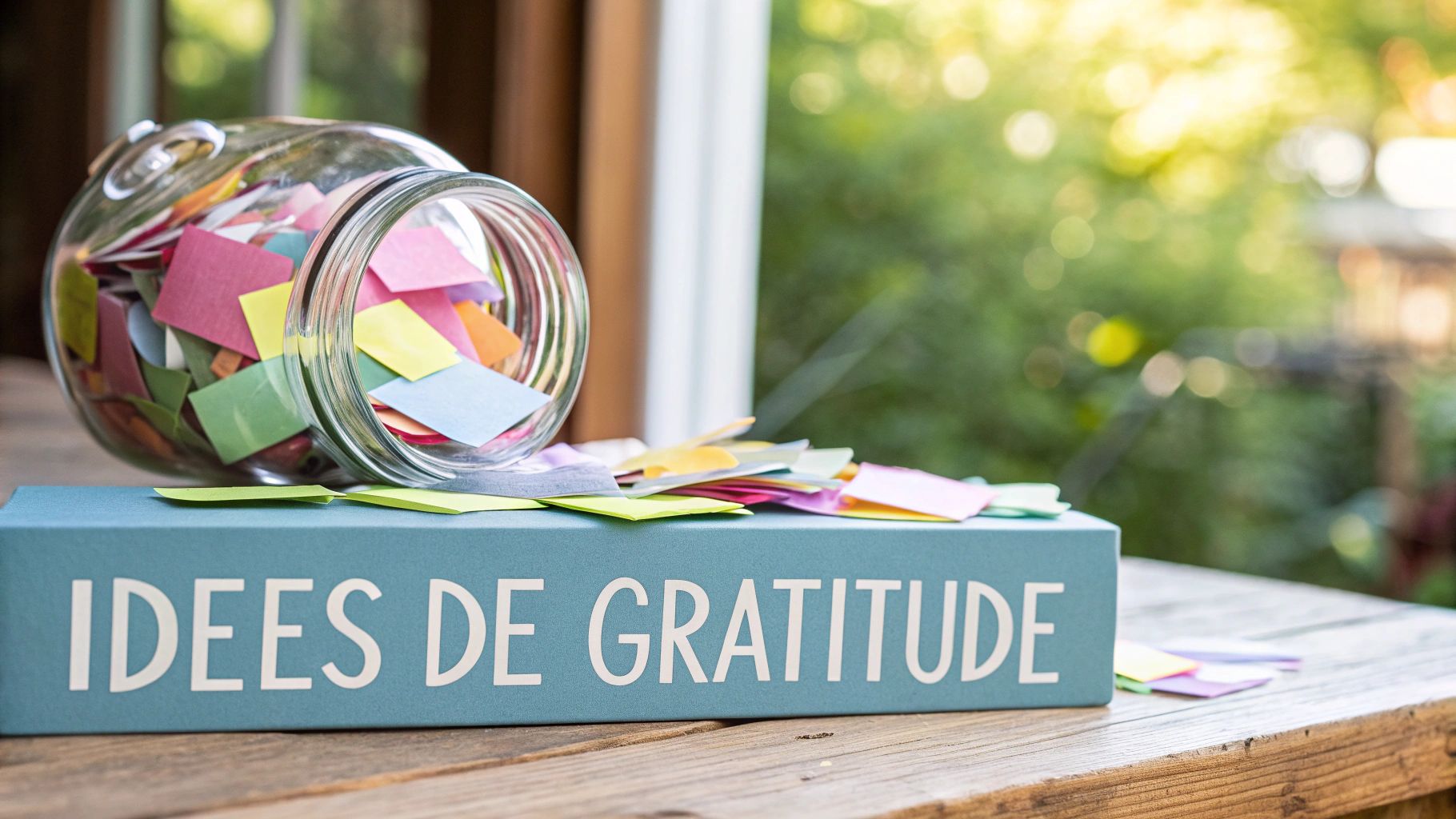
Changing the format slightly can reignite the spark and keep your child motivated over time. It's by maintaining the fun aspect that the magic truly happens.
Creative alternatives to the printed newspaper
Here are five simple ideas to reinvent your gratitude practice and make it even more fun for a child aged 6 to 12.
-
The Jar of Little Joys
Take a large, clear jar and some small pieces of colored paper. Each day, a family member writes (or draws, that works too!) one thing they're happy about and puts it in the jar. On Sunday, we have a little celebration: we open the jar and take turns reading the week's gratitudes. It's a great way to literally see happiness accumulate. -
The Tree of Gratitude
Go for a walk and find a beautiful branch to place in a vase. Prepare some leaves cut out of colored paper. Whenever your child wants to say thank you, they can write it on a leaf and hang it on the tree. It becomes a beautiful living decoration that constantly reminds you of all the lovely moments. -
The Gratitude Challenge
Why not launch a month-long challenge? For example: one week to thank nature, another for friends, or even a challenge focusing on the five senses ("Today, I am grateful for something I tasted"). This helps the child see gratitude everywhere and avoids getting stuck saying the same thing over and over.
Gratitude is like a muscle. The more you exercise it in different ways, the easier and more natural it becomes to see the positive in your daily life.
-
The Walk of Thanks
The next time you go for a walk, organize a gratitude scavenger hunt. The game? Each person has to find and name five things they appreciate around them: the caress of the sun, the color of a flower, the laughter of a passerby… It's a great way to practice mindfulness as a family without even realizing it. -
The Gratitude Stones
Each family member chooses a pretty, smooth pebble. In the evening, before falling asleep, each person holds their stone in their hand and recalls the best moment of their day. The stone becomes a little talisman, a physical and reassuring reminder of something positive.
Incorporating these variations makes the exercise much more dynamic. Moreover, numerous studies show that practicing gratitude reduces stress by 23% and boosts feelings of happiness. To delve deeper into the subject, you can discover how to keep a gratitude journal with even more tips.
Overcoming small challenges along the way
Even with the best intentions, there will inevitably be days when enthusiasm wanes a little. That's perfectly normal. The goal isn't to strive for perfection, but to maintain this time as a source of joy and connection. A gratitude journal should never become just another chore on your to-do list, but rather a habit that benefits both your child and you.
Sometimes inspiration can be scarce. Does your child tell you every night that they're grateful for "Mom, Dad, and video games"? Don't panic, it's a classic phase! To help them look a little deeper, the trick is to ask more specific questions.
When inspiration is lacking: parenting tips
Instead of the somewhat broad question, "What are you grateful for today?", try guiding him towards what he experienced with his five senses. For example:
- Taste: What was the most delicious thing you ate in the cafeteria?
- Sense of smell: Did you smell something nice when you got home from school? Like pancakes?
- The view: What's the prettiest color you've seen today?
- Touch: Who gave you the softest hug of the day?
- Hearing: What music made you want to dance today?
This approach helps him reconnect with his senses and notice those pleasant little details that we tend to forget.
Remember, you are the best motivator for your child. Share your own moments of gratitude, even the simplest ones. When they hear you say you're happy to have seen a rainbow, they'll learn to notice those things too.
And if one evening you really lack motivation, don't force it. You can easily skip a day or two, or even change your approach for a while. The important thing is that this ritual remains a relaxing moment, not an obligation. The key is to preserve this little bubble of positivity that strengthens your family bonds.
Frequently asked questions from parents about the gratitude journal
Do you have questions about setting up a gratitude journal at home? That's perfectly normal! Here are some answers to help you get started smoothly.
At what age can a child start a gratitude journal?
A child can start as young as 5 or 6 years old , in a very simple way. If they can't write yet, no problem! Gratitude can be expressed through drawing or simply verbally, during an evening conversation.
The important thing is that the tool is age-appropriate. The idea is to make this a game, a pleasant break, and definitely not another school task.
My child always writes the same thing, what should I do?
It's a classic, and it's not a big deal at all! It's often a sign that they just need a little push to help them look at things differently and develop their creativity.
Instead of the somewhat broad question, "What are you grateful for?", try mixing things up. For example, ask, "What made you laugh today?" or "What's the coolest sound you heard?" The goal is to encourage them to notice the little things that brighten their day.
The best advice? Lead by example! When you share your own gratitude, the ritual becomes more vibrant and authentic. Your child will feel more comfortable opening up in turn, and what was just a simple exercise transforms into a genuine moment of connection.
The My Book Story journal was designed to accompany your child on this wonderful adventure of personal development. Its daily activities are designed to boost their confidence and well-being in a fun way. Discover how it can enrich your gratitude ritual at mybookstory.co .