


A gratitude journal for children is a simple notebook where they can write down, draw, or paste what brightened their day. Much more than a simple hobby, it's a wonderful tool to help them develop optimism, self-confidence, and emotional intelligence. By supporting them in this practice, you're creating a valuable family ritual that strengthens your bond and their well-being.
Why Gratitude Is a Superpower for Your Child
Offering your child a gratitude journal isn't just about giving them a new hobby. It's about giving them an inner compass to navigate the sometimes turbulent world of their emotions more calmly.
Between the ages of 6 and 12 , children are building their worldview and personality. Simply taking a few minutes to recall a laugh with a friend, a kind word from their teacher, or a small personal achievement can transform their perspective. This habit teaches them to focus on what's going well, rather than dwelling on frustrations, even when the day has been difficult.
Far from being an extra duty, this moment becomes a warm ritual, a perfect opportunity to discuss what really matters to him. It's an invitation to share his joys, and it strengthens complicity and trust within the family.
A real asset for his emotional intelligence
Keeping a gratitude journal is like doing gymnastics for the heart and mind. By putting words or pictures to what they're feeling, your child learns to better understand themselves and their emotions.
By focusing on the positive, a child learns to reframe their thoughts. It's not about ignoring difficulties, but about giving more weight to moments of joy, which strengthens their resilience in the face of life's challenges.
Over time, this regular practice brings concrete benefits for its development:
- He develops his empathy: By thanking others for their gestures, he becomes aware of their positive impact on his life and learns to recognize the kindness around him.
- It strengthens his optimism: Practicing looking for the good in each day helps him cultivate a more confident and positive outlook on the future.
- He manages his stress better: Recalling pleasant memories before sleeping can soothe anxiety and promote more peaceful sleep.
Child development experts agree: cultivating gratitude is essential for growth. It's a skill that will serve your child throughout their lives. To learn more, you can discover other tips for cultivating gratitude as a family at les6doigtsdelamain.com .
How to Start a Gratitude Journal Without Pressure
To make a child's gratitude journal a pleasure and not a chore, the way you introduce it is essential. Present it as a creative adventure to share, far from another school assignment.
Rather than imposing the concept, invite them to create something special together. A phrase like "What if we made our own secret notebook of good times?" can pique their curiosity. The emphasis is on play, creativity, and sharing, which makes the activity much more engaging.
The adventure really begins when you choose or make the newspaper. By involving your child from this stage, you give them a sense of ownership and excitement.
Make the journal unique and personal
Turn the preparation into a creative workshop at home. The important thing is to let them choose what they like, so this notebook is truly theirs.
Here are some practical tips for parents:
- Choosing a notebook: Let him choose a notebook that inspires him. Whether it has a sequined cover, a small lock, or colorful pages, the item should make him want to open it.
- Creative materials: Prepare markers, colored pencils, and stickers with their favorite themes (dinosaurs, unicorns, space, etc.). The materials should encourage creativity, not performance.
- The first page: Make it their personal space. They can write their name, draw themselves as a happy superhero, or stick a photo that makes them happy. It's their world.
By giving them control over the appearance of their journal, you're showing them that this space is entirely theirs. There's no right or wrong way. It's a place for free expression, without judgment.
This creative moment is already a great opportunity to focus on the positive. By making this launch a fun and collaborative project, you'll establish a ritual that your child will look forward to.
Create a soothing and lasting family ritual
To make your child's gratitude journal a habit, the secret is to gently integrate it into your daily routine. Forget the constraints and see it as a bubble of complicity, a special moment just for you.
The "best time" is the one that fits into your family's rhythm. For some families, it's just before turning out the lights. It's a wonderful way to calm the mind, revisit the day's fond memories, and drift off to a peaceful sleep. For others, it's after dinner, transforming writing into a moment of sharing where everyone recounts the little things that made them happy.
The important thing is regularity, not rigidity. If you skip one night, it's not a big deal. The goal is to create a positive feeling around this ritual, not a source of additional stress.
Finding the Right Rhythm for Your Family
The key is to make journaling a pleasant habit. Flexibility will be your best ally in making this ritual stick.
Here are some practical tips for parents:
- Start slowly: There's no need to aim for every night. Two or three times a week is a good start. If your child likes it, you can increase the frequency.
- Lead by example: Participate too! Share your own gratitude. Your enthusiasm is contagious and shows that this moment is important to you too.
- Create a cozy atmosphere: Dim lighting, a hot drink, soft music... Transform these few minutes into a true moment of well-being and connection.
The goal isn't perfection, but connection. Filling pages is secondary. What really matters is strengthening your bond and cultivating a positive mindset together.
This type of ritual has a direct impact on children's well-being. An Ipsos survey showed that for 92% of French children , happiness comes above all from simple moments spent with family. Moreover, 65% of parents believe that gestures as simple as telling each other about their day are essential. The gratitude journal fits perfectly with this logic. To learn more, you can consult the complete results of the study on Ipsos.com .
Creative ideas to feed your journal
The blank page can sometimes be intimidating, even for a child with a vibrant imagination. If "Today I am grateful for..." becomes repetitive, it's time to vary your approach so that your child's gratitude journal remains a vibrant and fun space for expression.
The goal isn't to list, but to feel. To do this, encourage creativity. Suggest that they draw the funniest moment of their day , create a collage with images that make them smile, or even mime a situation that made them happy.
This simple visual breaks down the practice into three key steps: choosing the right moment, exploring a creative idea, and taking the time to feel the associated positive emotion.
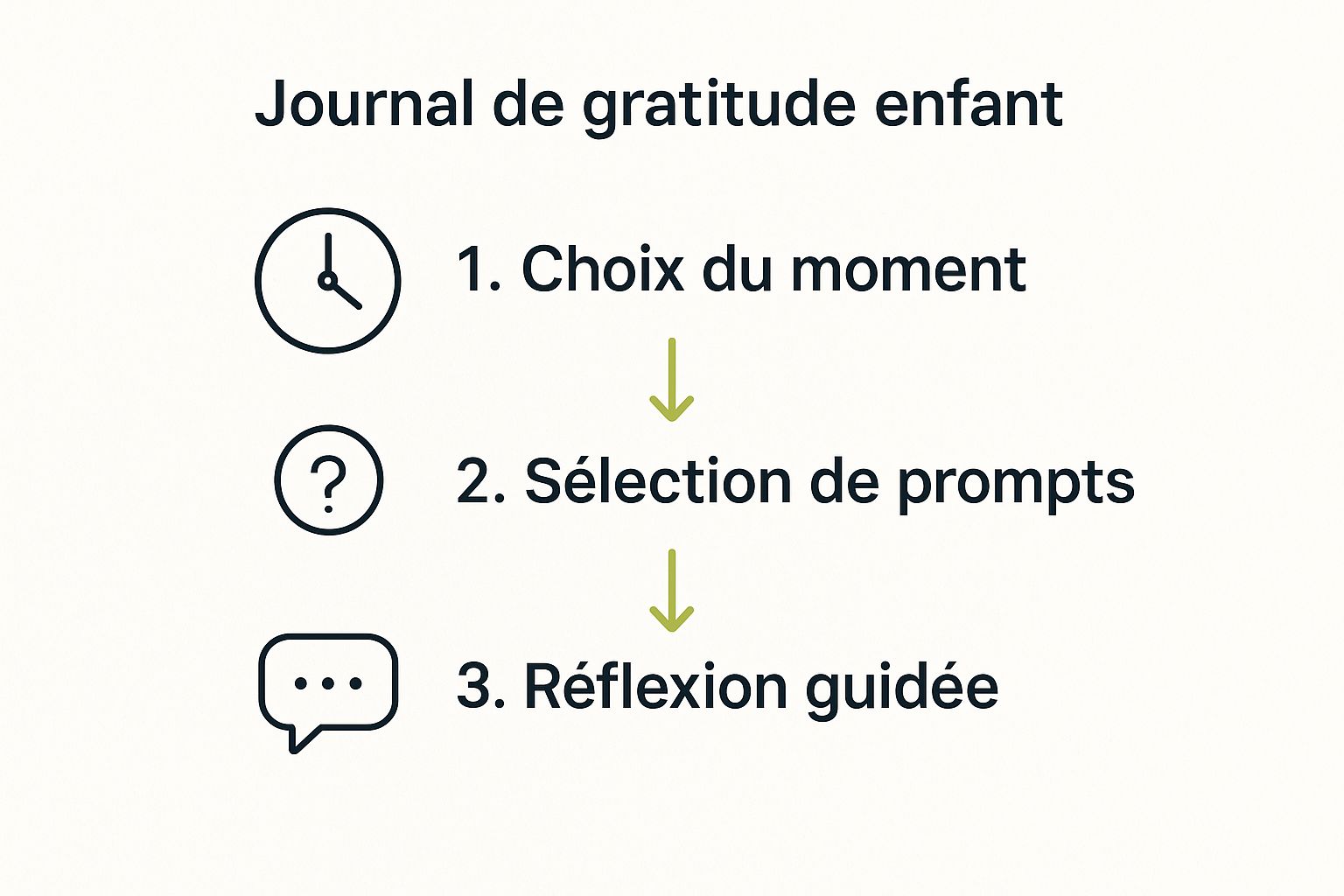
This journey shows that gratitude is an active process that helps the child connect with their feelings, in a gentle and guided way.
Themes to stimulate your imagination
To avoid routine, create weekly themes. This turns your journal into a treasure hunt and provides a fun framework for exploring gratitude from all angles.
Here are some concrete examples to offer your child:
- Superpower Week: Each day, he identifies one of his qualities (his kindness, his courage, his creativity) that he has used and is proud of. This is excellent for building his self-confidence.
- Nature Treasure Hunt: The challenge is to notice a small detail in nature each day that they find beautiful: a flower, an insect, the shape of a cloud. They can write it down, draw it, or glue a found element (leaf, petal, etc.).
- Five Senses Week: Each day is dedicated to one sense. Monday, smell: what smell did he like (toast, rain)? Tuesday, hearing: what pleasant sound did he hear (a song, a friend's laughter)?
To give you even more ideas, here is an inspiration board to vary the pleasures and keep your child motivated.
Examples of Gratitude Journal Themes and Ideas
This chart offers creative inspiration to vary journal entries and keep children engaged.
| Type of idea | Example for 6-8 year olds | Example for 9-12 year olds |
|---|---|---|
| Focus on yourself | Draw what makes you proud of yourself today. | List 3 qualities you used this week. |
| Focus on others | Write the name of a friend who made you laugh and why. | Tell us about a time when someone helped you or was kind to you. |
| Focus on nature | Glue a leaf from a tree that you find pretty. | Describe the sky tonight with 3 poetic adjectives. |
| Focus on the senses | What is the best dish you ate today? | Write down the memory associated with a song you heard. |
These examples are starting points. Feel free to adapt them and invent others with your child!
The important thing is to show them that there are a thousand and one ways to say thank you to life. By varying your approaches, you keep their curiosity alive. The journal then becomes much more than a notebook: it's an exploration of themselves and the world around them.
Another idea kids love: inventing a short story based on a positive moment in the day. It's a double bonus: it cultivates gratitude while developing creativity and storytelling skills.
What to do when your child's motivation drops?
Has the initial enthusiasm given way to a "I don't feel like it tonight"? This is a completely normal stage. The secret is to manage this slump gently and with listening so as not to turn this moment of sharing into a source of conflict.
When your child expresses a lack of desire, acknowledge their feelings without judgment. Try to understand what's behind it: Are they tired? Bored by the routine? A kind conversation will always be more effective than persisting. The goal is to preserve the pleasure of this ritual.
Adjusting the shot without giving up everything
Forcing it would be counterproductive and risk creating aversion. Instead, flexibly offer alternatives.
Here are some concrete ways to boost motivation:
- Space out appointments: If the daily routine becomes a strain, switch to a weekly ritual, such as the Sunday evening "fun review."
- Relive memories: Take the time to leaf through the first pages of your journal together. Remembering all those little moments of joy from the past is often the best way to rekindle the flame.
- Take a break: Sometimes all it takes is putting the journal aside for a few days or a week. The urge will often return on its own, without pressure.
- Change the format: Suggest an oral discussion rather than a written one, or suggest creating a "gratitude box" where everyone leaves small pieces of paper.
The goal isn't to fill pages, but to connect with your positive emotions. A single line written with a smile will have a thousand times more impact than a long text written reluctantly. Your listening skills and flexibility are your best tools.
Positive parenting experts confirm: gratitude is often linked to moments spent together. Memories created as a family are far more valuable than objects. These rituals strengthen well-being and encourage self-compassion, or the ability to be kinder to oneself. For more information, read how to prioritize presence over gifts at Triplep-parentalite.ca .
Questions Parents Ask (and Our Answers!)
Embarking on the adventure of creating a gratitude journal with your child often raises practical questions. This is completely normal! Here are some clear answers to help you get started with confidence.
One of the first questions is what the ideal age is. There's no hard and fast rule, but it's usually around the age of 6 or 7 that children begin to gain the perspective they need to verbalize what gratitude is. Before this age, drawing or collage are wonderful ways to express their little joys.
What if my child makes spelling mistakes?
Above all, don't get out the red pen! The gratitude journal is their secret garden, a space for free expression, free from the pressures of school. Correcting their writing risks breaking the spontaneity and turning this moment into a lesson. The goal is for them to feel comfortable sharing what's on their heart, without fear of judgment. Sincerity of emotion takes precedence over perfect grammar.
My child only gives thanks for material things, is this normal?
Yes, and it's a very common milestone! A new toy, a candy... For a child, these are immediate and tangible sources of joy. Welcome their words with kindness, without devaluing them.
Your role as a guide is to show him that there are other treasures. By sharing your own gratitude—a comforting hug, a shared laugh, the beauty of a sunset—you gently open his eyes. He will understand through imitation that the most beautiful things in life cannot be bought.
Celebrate every contribution, whether material or not. Every small happiness noted is a seed of positivity that will germinate over time.
The My Book Story notebook was designed to guide your child through this journey. Filled with fun activities and inspiring chapters, its pages help them cultivate gratitude and self-confidence, step by step. Discover how it can enrich your family ritual .