


A gratitude journal is quite simple: a notebook where your child can write, or even draw, about the little and big things they are grateful for. The idea is to help them focus on joyful moments, even the smallest ones, to encourage them to see the bright side of life and feel more confident. It's a wonderful tool to support their emotional development and boost their self-esteem.
Gratitude, a small ritual that changes everything for your child
You might be wondering if a simple notebook can really have an impact on your child's well-being. The answer is a resounding yes! Far from being a passing fad, cultivating gratitude is a powerful mental exercise with real benefits for the development of children aged 6 to 12 .

By incorporating a gratitude journal into your family routine, you offer your child a space of their own to recognize and savor the good moments of their day. This could be a morning hug, a fit of laughter with a friend, or the pride of finally understanding a math problem.
Concrete benefits for his inner balance
Practicing gratitude regularly is a bit like training an emotional muscle. Your child learns not to dwell on what's wrong, but also to see all the richness that surrounds them every day.
This very simple training has several direct advantages for its development:
- Better managing his emotions : By putting words to what makes him feel good, he becomes aware of his emotions and gradually learns to better manage them.
- Developing optimism : Training your brain to look for the positive naturally makes it more optimistic and more resilient in the face of life's small challenges.
- Boosting self-esteem : Noting small victories or qualities he admires in others nourishes his sense of worth and strengthens his self-confidence.
A 2003 study highlighted these effects in adults: after ten weeks, participants who kept a gratitude journal reported a 25% increase in their happiness levels and improved sleep for 30% of them. Even though the study was conducted on adults, it clearly demonstrates the power of this habit, a potential that is just as great for our children. To learn more about the effects of gratitude, you can consult this interesting article .
A ritual that unites the family
Beyond your child's well-being, this journal can become a wonderful family ritual. It's the perfect opportunity to open up a genuine discussion, far removed from the usual questions like "How was school?".
By sharing your own little joys of the day, you're not just setting an example. You're creating a genuine moment of connection where everyone feels heard and valued. That's how a simple habit transforms into a factory of happy memories.
This time for sharing becomes an opportunity to talk about their day, their friends, and what made them proud. It is in these conversations that trust and complicity are built, essential foundations for their development and for a harmonious home environment.
How to gently introduce the journaling ritual?
The idea of introducing a new habit can sometimes be daunting. We might imagine it as just another chore to add to the list. But here, the key to success is to present the gratitude journal not as a duty, but as an exciting new adventure to experience together. The goal? To create a cozy haven, a moment of shared joy that you look forward to, just for you and your child.
To get off to a good start, the medium is crucial. It needs to spark their curiosity! A simple notebook can do the trick, of course. But a creative and somewhat structured journal, like My Book Story , can really help get them started. It offers a framework that is both fun and stimulating, guiding the child without restricting them. The important thing is that the journal itself makes them want to dive in.
Finding the right moment and the right tone
Timing is everything! We're not trying to cram yet another task into an already overloaded schedule. We need to find that perfect little window of opportunity, that moment when your child is naturally calmer and more receptive.
Every family has its own rhythm, but here are some suggestions for incorporating this family ritual:
- After snack time : It's often an ideal moment to pause, a little break to unwind after school.
- During the evening journey : If you are driving home, it's a great opportunity to chat freely, without the pressure of "face to face".
- Just before bedtime story : This is my favorite moment. It becomes a soothing ritual that ends the day on a positive note and prepares for a peaceful sleep.
Once you've found the right moment, your approach is crucial. It needs to be gentle, almost intriguing. Forget directive phrases like, "Okay, you have to write down three things you're grateful for." Instead, opt for an invitation that acknowledges their emotions and sparks their curiosity.
Try a phrase like, "What if we created our secret book of happy moments?" or start a conversation: "I had a great day, want to tell you why? What was the best moment of your day?" Suddenly, the exercise transforms into a game, a genuine sharing experience.
Transforming writing into a creative game
For a child between 6 and 12 years old, play is the best motivator. If the very idea of writing is a deterrent, don't panic! There are countless ways to express gratitude. The most important thing is that this journal becomes their own private sanctuary, their personal space for creation.
Here are some ideas to make the experience more fun and creative:
- The gratitude drawing : Suggest that they draw the person or moment that brightened their day.
- Today's treasure hunt : In the evening, launch a challenge: find a "treasure" from their day (a kind word received, a ray of sunshine on their face, a particularly fun game...).
- Take turns sharing : Go for it! Lead by example by sharing your own moment of gratitude. Your authenticity and enthusiasm are incredibly contagious.
This practice is no longer anecdotal. Many families are turning to more intentional lifestyle habits to promote the well-being and personal development of their children. Cultivating gratitude is a fundamental trend that fits perfectly within this quest for meaning and family connection.
Concrete ideas to stimulate your child's creativity
A blank page, even in a gratitude journal, can sometimes intimidate a child. We all know the famous "I don't know what to write." It's a classic obstacle, but fortunately, it's very easy to overcome. The trick? Offer a flexible and fun framework to help them move beyond the obvious answers like "thank you for my toys."
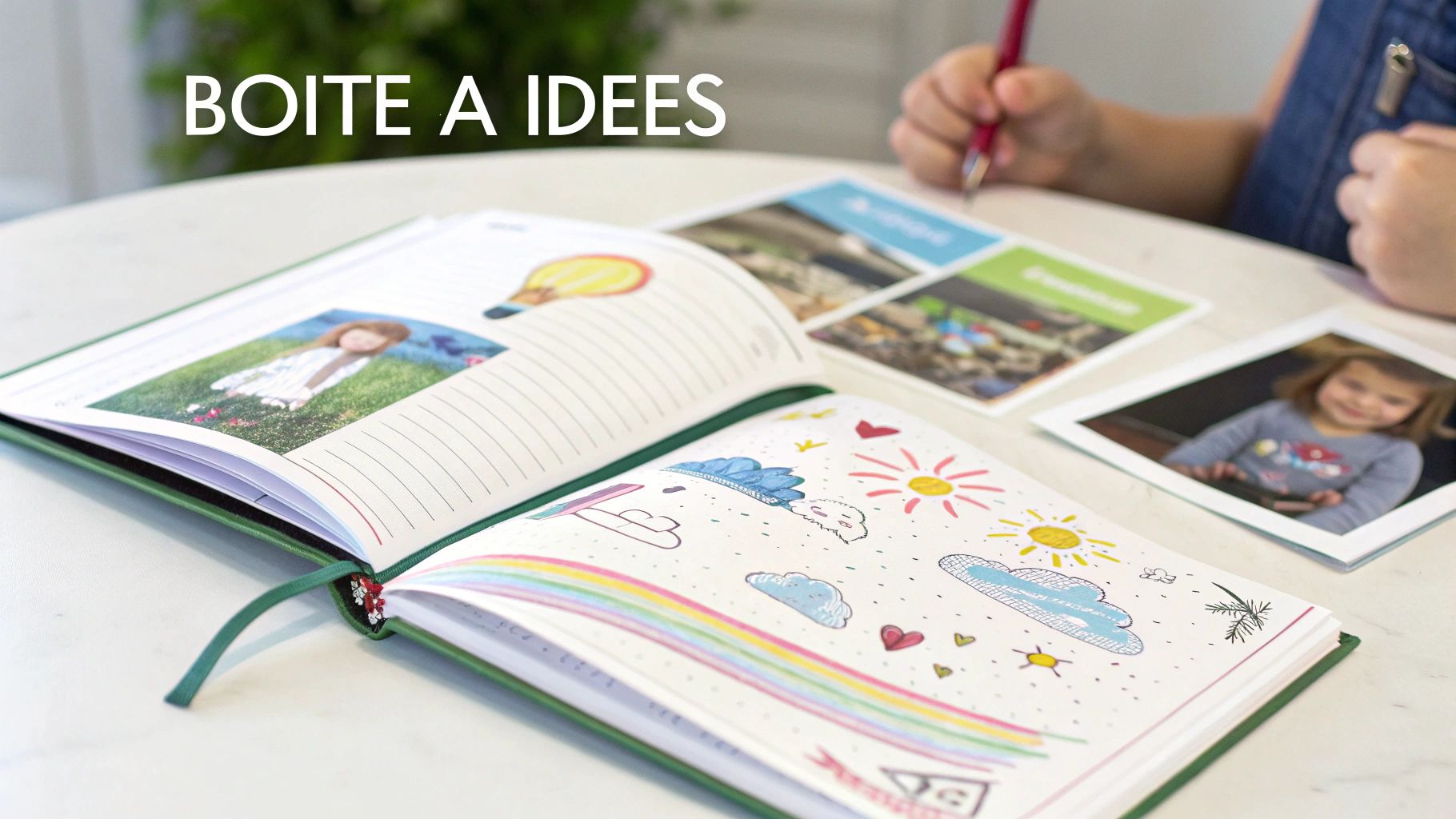
To keep the spark alive and prevent routine from setting in, one of the techniques I find most effective is introducing weekly themes. This transforms the exercise into a kind of little exploration game, guiding his thinking towards aspects of his life he doesn't always consider.
Spice up the newspaper with themes each week
Rather than asking the same question night after night, why not offer him a little "mission" for the week? This playful approach encourages him to look around him with fresh eyes and to really pay attention to the details of everyday life.
Here are some themes that are always a hit with children aged 6 to 12 :
- The week of the 5 senses : Each day, we focus on one sense. Monday, sight (a beautiful, funny cloud), Tuesday, hearing (a song that makes you want to dance), Wednesday, taste (the super cake for afternoon tea)... you get the idea!
- Nature Week : The goal is to spot a little wonder of nature. It could be a flower that grew on the way to school, the song of a bird, or just the warmth of the sun on your face.
- Friends Week : We focus on the nice gestures from friends. A classmate lent him a pencil, another shared his snack, or he simply had a good laugh with his best friend.
- My week of successes : Here, gratitude is directed towards oneself. One can note something one is proud of: having succeeded at a difficult exercise, having helped someone, or even having overcome a small fear.
This simple yet incredibly effective structure keeps his interest alive and greatly enriches the content of his gratitude journal . He discovers for himself that happiness is hidden in a multitude of small things.
Here are some question ideas to get you started
To help you get started, here's a table with theme ideas and questions suitable for your child's age. Feel free to use it as inspiration and create your own!
| Theme of the week | Examples of questions for 6-8 year olds | Examples of questions for 9-12 year olds |
|---|---|---|
| The people I love | Who did you feel love for today? What kind thing did a member of your family do for you? | Think of an interesting conversation you had today. Who taught you something new this week? |
| Small victories | What did you manage to do all by yourself today? What are you most proud of this week? | What challenge have you recently faced? What quality helped you overcome a difficulty? |
| The world around me | What's the most beautiful color you've seen today? What sound made you smile? | Where do you feel most at ease and why? What discovery surprised you this week (in a book, a film, outdoors...)? |
| My body in action | What fun thing did your body allow you to do today (run, jump, dance)? | How did you take care of yourself this week? What physical ability are you grateful for (sight, hearing, movement...)? |
The important thing is to vary the activities so that the journal remains an exciting exploration rather than a chore.
Go far beyond words
For a child, especially between the ages of 6 and 8 , expression often comes much better through drawing or collage than through writing. It is therefore crucial that their journal be a space of total freedom, not a writing exercise.
The goal is not to fill lines, but to capture an emotion. If a drawing, a collage, or even a simple color expresses joy better than a sentence, it's a tremendous achievement.
Encourage him to make his notebook his own so that it becomes a unique work of art, a true personal treasure.
Some ideas to add variety to your creative activities:
- Drawing of the day : He can simply draw the moment or person who brightened his day.
- Memory collage : Keep movie tickets, candy wrappers, or leaves collected on walks. He can stick them in his journal.
- The photo of happiness : With your help or his own camera, he can take a picture of something that made him happy and add it to his notebook.
- The speech bubble : For younger children, it's really fun. They can draw a character and have it say "thank you for..." in a speech bubble.
By making the process more creative, you transform a simple habit into a powerful developmental tool. It teaches not only gratitude but also how to express emotions in different ways, which strengthens self-confidence and emotional intelligence.
Knowing how to adapt to your child's age and personality
You know better than anyone: every child is unique. What works for one won't necessarily work for another. That's why a "copy-and-paste" approach to gratitude journaling is often doomed to failure.
The key to success is observing your child, understanding what makes them tick, and personalizing this little ritual so that it truly reflects them. The idea is for them to make it their own, so it's not just "another parent thing."
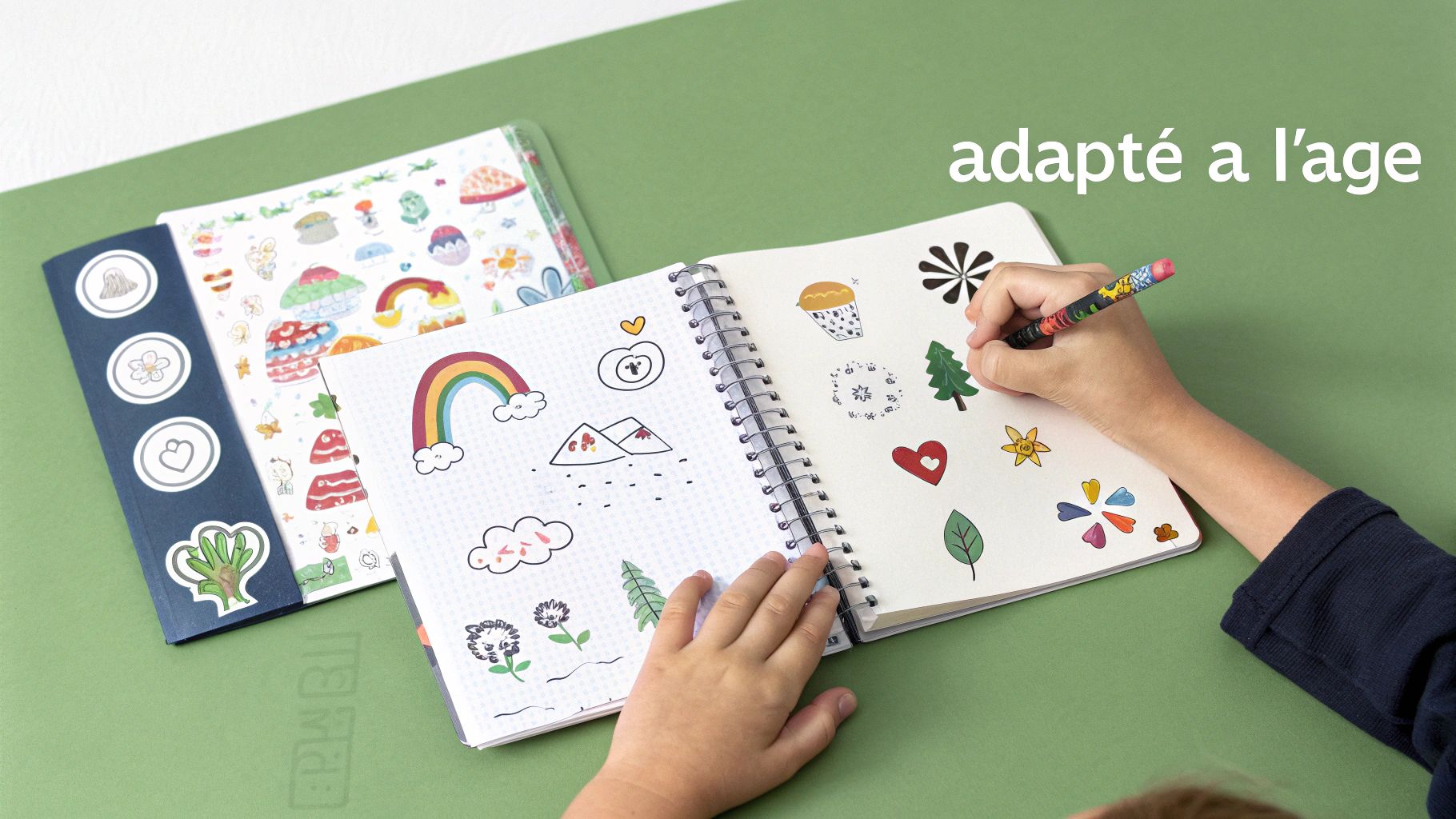
A 7-year- old will not express their gratitude in the same way as an 11-year-old pre-teen. Therefore, the support and expectations must be adjusted so that the exercise remains a pleasure and not a chore.
For younger children (6-8 years old): creativity above all
At this age, everything is expressed through play and visuals. Writing can still be a bit laborious, even intimidating. The goal is therefore to make the journal as creative and concrete as possible.
- Drawing before words : A bright sun for a beautiful day in the park, a smiling man for a hug... A drawing is often much more eloquent than a sentence that one struggles to write.
- Stickers to the rescue : Smileys, stars, hearts... They allow children to symbolize positive emotions in a simple and fun way. It's an easy and satisfying victory for them.
- Become their personal secretary : Ask them to tell you about their day. Listen, then ask, "What could we write to remember this great moment?" All you have to do is write down their sentence. This validates their thoughts without making them worry about spelling mistakes.
For pre-teens (9-12 years old): encourage introspection
From the age of 9 or 10 , thinking becomes more complex. They begin to reflect on themselves and the world. This is the perfect time to encourage slightly deeper introspection, but always gently.
We can encourage them to go beyond "thank you for my toys" and explore more personal ideas:
- His own achievements : "What are you particularly proud of today?"
- Lessons learned from difficulty : "Even though it was hard, what did that moment teach you about yourself?"
- Self-gratitude : "What quality did you use today that helped you or helped someone else?"
The goal isn't to turn them into philosophers, but to help them realize that gratitude can also stem from their own strengths and their ability to overcome small challenges. It's a powerful tool for building strong self-confidence.
Adjusting to his temperament
Beyond age, there is character. Adapting the gratitude journal to one's temperament gives oneself the best chance of this habit becoming a lasting habit.
- The creative, the artist : He'll love a journal to customize. Collages, glitter, markers of all colors... For him, form is as important as content.
- The pragmatist, the one who gets straight to the point : A simple bulleted list is enough for him. "1. The goal in football. 2. The slice of cake. 3. Grandma's joke." It's clear, efficient, and it suits him very well.
- For the shy or reluctant child : Above all, don't force anything. Lead by example by keeping your own journal next to them. Share, without being pushy, one or two things that made you happy. Acknowledge even the smallest effort on their part, even if they only write a single word. Your patience will eventually pay off.
The most important thing is that this journal becomes his secret garden, a space without judgment where he feels totally free to be himself.
Maintaining motivation over the long term
Starting a new habit is often the easiest part. The real challenge is sticking with it once the initial enthusiasm has waned a bit.
How can we ensure that this famous gratitude journal doesn't end up gathering dust under the bed? The secret is to transform this little ritual into a family tradition, a moment that is both comforting and vibrant.
A foolproof trick is to make proofreading a little event. Once a month, for example, take the time to look through the pages you've already written together. It's a bit like opening a treasure chest filled with happy memories. This little retrospective makes the benefits of the exercise very tangible and gives renewed meaning to the process, especially when inspiration is lacking.
Make the habit fun and rewarding
To keep the spark alive, nothing beats adding a little playfulness. By setting mini-challenges, you transform a simple routine into a much more motivating adventure. The idea isn't to aim for performance, but to celebrate your child's consistency and commitment.
Here are some simple ideas to gamify the experience:
- Reward milestones : Agree on a small, special reward after a certain number of pages are completed. For example, after 10 consecutive days of writing, we'll have a family movie night with popcorn!
- The Gratitude Chain : For each day the journal is completed, add a link to a paper chain that you hang in their room. Watching the chain grow longer is a very visual and tangible way to acknowledge their perseverance.
This positive approach reinforces the idea that journaling is a source of joy, not a chore. By fostering a positive mindset, this practice also allows children to improve their French language skills by putting words to their emotions and memories. To learn more about how to keep a journal, you can read this informative article .
Your role as a guide is crucial, but it must remain discreet. The important thing is to create a caring space where your child feels supported and never judged.
Your role: to provide support with genuine kindness.
Your own enthusiasm is contagious! Feel free to participate in the ritual, but without being too intrusive. You could, for example, keep your own journal next to him, sharing your own gratitudes to show him that it's a practice that benefits everyone.
Above all, celebrate the effort more than the result. Whether he wrote three full lines or just made a small drawing, the important thing is that he took this time for himself. A simple "It's great that you took this time for your journal today" is much more powerful than a comment on what he wrote.
By valuing his regularity, you anchor the habit over time and strengthen his self-confidence.
Questions you ask yourself about the gratitude journal
When starting a new routine at home, it's normal to have lots of questions. So, to help you begin this exciting adventure with confidence, here are some practical answers to the most common doubts parents have.
Do we need to write every day?
The secret is to make this moment a pleasure, not an extra chore. Consistency always trumps quantity.
To start, aiming for 2 or 3 times a week is perfect. This allows them to get into the habit without it becoming a chore. Let your child find their own natural rhythm. Some days, ideas will flow, others won't, and that's perfectly fine.
What if he always writes the same thing?
Ah, the famous trio of "my parents," "my toys," and "chocolate cake"! Don't panic, it's perfectly normal at first. Far from being a failure, it simply shows what matters most to him, his pillars of happiness.
To help him mix things up a bit, you can try:
- Suggest themes: Why not a "nature week" where we seek out the little joys of the outdoors? Or a "friends week"?
- Ask more specific questions: Instead of the classic "What did you enjoy today?", try a different approach. "What's the funniest thing you've heard?" or "What's the nicest sound you've heard today?"
The goal is not performance or originality at all costs. It is simply to help him, little by little, to open his eyes to the richness of the small joys that surround him.
Do I have the right to read what he writes?
Here, trust is key. Your child's journal is their private sanctuary. A space that belongs to them alone, where they should feel 100% free and safe to express themselves, without filters.
Agree on this from the start. You can suggest he share a page with you if he wants , but never force him. A simple "If you ever feel like reading something that makes you happy, I'd really appreciate it" is enough. By respecting his personal space, you show him that his thoughts are important, whether he keeps them to himself or not. And that strengthens your bond tremendously.
The My Book Story journal was specifically designed to guide children through this exploration. It's a fun yet structured framework, ideal for cultivating gratitude while giving free rein to creativity.
Discover the My Book Story notebook