


Forget just a notebook. A children's journal is much more than that. It's a truly personal space, a secret garden where your child can explore their thoughts, celebrate their victories, and learn to manage their emotions—all in a fun and positive way.
Discover the children's newspaper, a powerful tool for growing up
Looking for a way to help your child thrive? Consider a personal development journal. It's a great resource for parents of children between the ages of 6 and 12. This is a time of life full of discoveries, new friendships, and small challenges.
Far from the classic diary where you secretly recount your day, this modern version is entirely focused on well-being. It's a travel companion that encourages creativity and positive thinking, without any pressure.
A space all to yourself
The idea is simple: provide a safe haven where your child can be 100% themselves. A safe place to put words, drawings, or colors to what they feel, without fear of being judged. This little dialogue with oneself is essential for building strong self-confidence.
As a parent, here are some ideas to encourage him:
- Draw his mood : Suggest that he use the colors that come to mind to represent how he feels today.
- List three small joys : Help him remember happy moments, such as a compliment received or a successful board game.
- Create a "superpowers page" : Guide him to identify and write down all his unique qualities.
More than a notebook, a caring guide
Journaling isn't just about writing. It's also about having fun with short, playful activities that help you get to know yourself better. The goal isn't to fill pages, but to take a few minutes to connect with your inner world.
By giving your child a journal, you're giving them more than just a notebook. It's a toolbox for learning to bounce back, understand their emotions, and celebrate the unique person they are.
These simple little rituals are perfect for developing what's called emotional intelligence. Your child learns to name their feelings, express what they need, and find creative solutions to their little worries. It's a great habit that will last a lifetime and help them approach challenges with more calm and confidence.
Why Journaling Is a Great Personal Development Tool

Pre-adolescence, between the ages of 6 and 12, is a time of great change. Between school, friendships forming and breaking, and self-discovery, your child is often navigating unsettled waters. Journaling is like an anchor in the midst of this turmoil: a safe space to deposit their thoughts without fear of judgment.
It's a very concrete way to distance yourself from what's happening and untangle the whirlwind of emotions that can sometimes overwhelm you. By writing or drawing, an abstract and heavy feeling suddenly becomes something tangible, visible, and therefore much easier to manage.
A tool to tame your emotions
The mental health of our children is a real concern. A recent survey reveals a rather worrying reality: more than one in four adolescents (25%) are likely to suffer from an anxiety disorder, and 40% show symptoms of depression. Although these figures concern teenagers, they highlight the importance of building solid foundations from childhood. If you are interested in the subject, you can take a look at this study on adolescent morale .
In this context, the teen and children's newspaper becomes a valuable ally. Far from being a miracle solution, it acts rather as a healthy and constructive outlet.
To help your child get started, here are some simple ideas to suggest:
- The worry map : He can draw a map with small "islands" that represent his current anxieties (a difficult test, an argument with a friend, etc.). Simply putting them on paper and visualizing them already helps to put them into perspective.
- The Anger Page : When frustration mounts, he can devote an entire page to his anger. The idea? Let loose! Scribble, write in huge letters, use bright colors... It's a great way to release that energy without it turning against him or others.
- Gratitude Jar : Each day, he can draw or write one positive thing in a "jar" drawn on a page. This simple exercise helps train his brain to see the bright side of things, too.
Your role as a parent: discreet but essential support
As a parent, your mission is to create a trusting environment. You can, of course, provide supplies, such as a fun notebook like My Book Story and crayons. But the most important thing is to guarantee him the space and privacy he needs.
Your role isn't to read what he writes. It's to assure him that this journal is his secret garden, a 100% private space. It's this trust that will give him the freedom to truly express himself and build his emotional autonomy.
By encouraging this habit, you're giving them more than just a notebook. You're giving them a fundamental life skill: the ability to understand themselves, manage their emotions, and face challenges with greater strength. It's a gift that will last a long time and help them grow with greater peace of mind.
How to Choose the Perfect Journal for Your Child
Finding the right journal is a bit like the first step in inspiring your child to get started. Think of it like choosing a playmate: the right tool can transform a simple curiosity into a true passion. The idea is to find the medium that will make them want to open it, not see it as just another chore.
There are plenty of options, and the key is to think about your child's personality. A simple, unlined notebook is the perfect playground for young artists bursting with imagination. Conversely, a guided journal with activities can really help overcome the infamous fear of the blank page.
Think about your child's needs
For a young person embarking on the adventure of keeping a teen or children's journal , a notebook with a few ideas for reflection is often an excellent starting point. Simple prompts like "draw your mood of the day" or "list your three superpowers" can make all the difference and make the exercise fun.
The best advice? Involve your child in the choice. Let them choose the cover that appeals to them, the format that seems practical. This simple gesture allows them to take ownership of the object before they've even written the first word. It's also a great time for you to share, an opportunity to discuss their tastes and validate their decisions.
The image below clearly shows how beneficial journaling can be for your child's well-being.
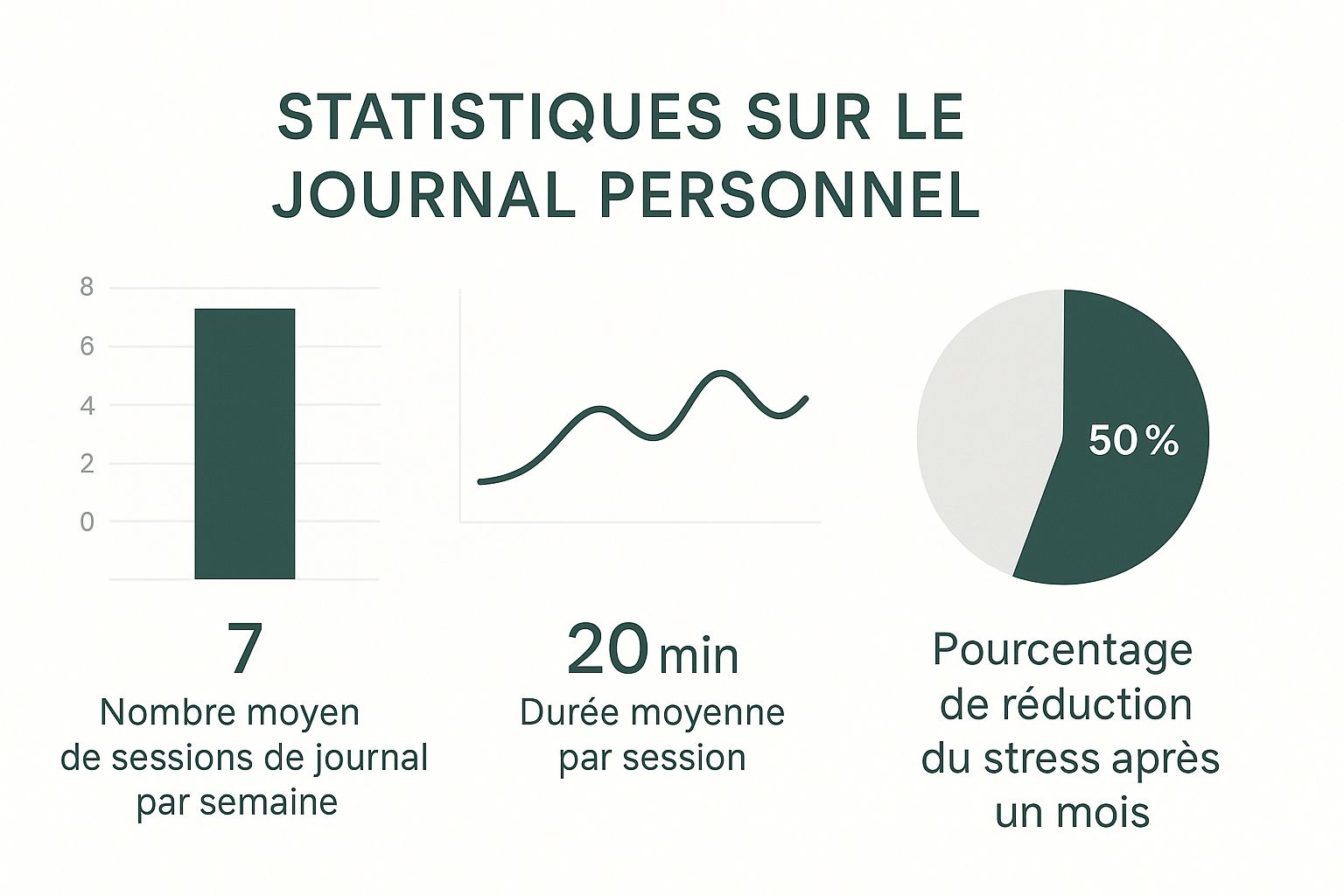
These figures confirm it: even a short but regular practice has truly positive effects on stress management and mood.
Comparison of types of newspapers for children and pre-teens
To help you navigate, here's a quick table comparing the different options. The goal is to guide you toward the journal that best suits your child's personality and needs.
| Type of newspaper | Ideal for... | Benefits | Disadvantages |
|---|---|---|---|
| Blank Notebook | Very creative and independent children, who love to draw, stick and write without any constraints. | Total freedom, encourages imagination, a versatile medium for all forms of expression. | Can be intimidating for a beginner (the famous blank page syndrome), lacks structure. |
| Guided Journal | Children who need a little help getting started or who like to have a clear framework. | Offers varied activities, reassures and inspires, helps create a routine easily. | Less room for completely free expression, can become repetitive if the activities are not enjoyed. |
| Theme Journal | Children who are passionate about a specific subject (nature, emotions, gratitude, projects, etc.). | Focused on an interest, allows you to explore a subject in depth, very motivating. | Less suitable for a general exploration of everyday thoughts and feelings. |
Ultimately, the choice will really depend on what resonates most with your child. The most important thing is that this journal becomes their own space, a confidant where they can explore their inner world safely and with pleasure.
Introduce your child to journaling, without pressure

For a new habit to take hold, it must be synonymous with pleasure, not constraint. That's the golden rule. The key to introducing journaling is to present it as a game, a moment of creativity all to yourself, and especially not as another duty. Forget performance. Here, we explore and have fun.
The approach must be very gentle. If your child feels it's an obligation, there's a good chance he or she will give up very quickly. The goal is to create a positive association, a little ritual that we look forward to returning to.
Create a creative family ritual
A simple yet incredibly effective tip: set up a family "creative time." You don't need to spend hours on it. Just a few minutes each evening , all together. Imagine that quiet moment where everyone, parents and children, take out their notebooks and let their imaginations run wild.
This shared moment strengthens bonds and makes the practice completely normal. When a child sees their parents taking this time for themselves, it shows them by example that it's important to take care of their inner world.
Here are some ideas to help you get started with this ritual gently:
- Drawing of the day : “Draw the funniest thing that happened to you today.”
- The list of 3 joys : “Write down three little things that you liked about your day.”
- The internal weather : “What’s the weather like in your head? Bright sunshine, a few clouds, or a little rain?”
The important thing is to value every effort , regardless of the result. A simple scribble or three words is already perfect. Praise the intention, not the quality of what is produced.
The Secret Garden: An Essential Trust Pact
For your child to truly take ownership of their journal, there is one non-negotiable condition: guaranteed confidentiality . This is absolutely crucial. From the start, be very clear: this notebook is their private space, their secret garden.
Remind him that his journal is his, and his alone. You will never read it without his explicit permission. This promise is the foundation of trust that will allow him to express himself freely and honestly.
This pact is the foundation of a strong, trusting relationship between you. It helps your child understand that they have the right to privacy and that their thoughts are respected. It's this security that will encourage them to explore their inner world without filters and make their journal a true ally in their daily lives.
How to keep the creative flame burning?
For a child to want to return to their journal day after day, it needs to be a fun experience. Monotony is journaling's worst enemy! This is where you, as a parent, can play a guiding role by suggesting new ideas to spark inspiration.
The idea is to show him that his journal is much more than just a summary of his day. It's his personal playground, a space of total freedom where he can explore who he is, without judgment. Encourage him to see his journal as a collection of his thoughts, dreams, and whatever else comes to mind.
Beyond the "dear diary..."
To break the routine, why not invite them to create themed pages? These little missions transform their notebook into a true inner adventure, where each page becomes an opportunity to get to know themselves better.
Here are some simple but very effective ideas to suggest to him:
- My Pride Page : A list of all your accomplishments, big and small. It could be a good grade, a compliment you received, or simply the fact that you dared to speak up in class. It's a great boost for your self-esteem!
- My Emotions Weather : He can draw an "emotions wheel" with different parts (joy, anger, sadness, surprise, etc.) and color in the box that corresponds to his mood each day. It's a very visual way to put words to what he feels.
- My Dream Collage : Armed with scissors, glue, and old magazines, he can create a page with his desires and goals. Seeing his dreams in pictures is a great source of motivation.
A notebook to express yourself in all its forms
Journaling isn't just about writing! It's an open door to all forms of creativity. The important thing is to encourage them to vary their pleasures and try new things.
Remind him that there are no rules. No "right" or "wrong" way. It's his journal, his world. Every blank page is a chance to learn a little more about himself.
He could, for example, try to:
- Write a poem or song lyrics to translate your emotions into rhyme.
- Invent a comic book character that resembles him and make him experience adventures inspired by his life.
- Create a "gratitude jar." Every day, he writes down a small piece of happiness on a piece of paper and slips it into an envelope stuck to a page.
This variety is essential to keep their interest intact. Children like to juggle between different formats. Moreover, even traditional youth press is adapting to this need for diversity. The circulation of the magazine Le Monde des Ados , for example, fell from 25,698 copies in 2021 to 18,322 in 2024. This figure shows that young people are looking for more interactive experiences. You can see the evolution of circulation on the ACPM website . By making your newspaper a multi-faceted space, you are directly responding to this need for novelty.
Your frequently asked questions about the children's newspaper
As a parent, it's perfectly normal to have questions before introducing a new tool to your child. Journaling for children or pre-teens is a simple but incredibly enriching practice, and it's essential that you feel comfortable supporting it.
This section is here to answer your most common questions in a clear and reassuring manner. The idea is to give you the keys to making this experience positive and lasting, while respecting your child's pace and personal space.
How do I know if my child is ready to start a journal?
There's no ideal age, because every child is unique. The best indicator is their own curiosity. If they enjoy drawing, making up stories, or are starting to ask deeper questions about their emotions, it's probably a good time to suggest a teen journal (kids' version).
Above all, never present it as a homework assignment. Think of it instead as a treasure trove, a secret space just for him. The important thing is that the desire comes from him. If he's not receptive right away, no worries. Leave the notebook at his disposal; he might grab it later.
What if my child doesn't want to write?
It's a common fear, but rest assured: journaling isn't just about writing! If the words aren't coming, encourage them to explore other ways of expressing themselves.
Here are some fun ideas to get started without writing a single line:
- Drawing or doodling to express a mood or describe a scene from your day.
- Collage with magazine images to create a page about your dreams or passions.
- Stickers and colored markers to decorate the pages and make them more lively.
- Bulleted lists to jot down random ideas, desires or things he liked.
The important thing isn't to produce a perfect text. It's to offer an outlet to your inner world. The simple act of opening your notebook and leaving a trace, whatever it may be, is already a great step forward for your well-being.
Should he use it every day?
Absolutely not! The idea of a daily practice can quickly become intimidating. The goal is to create a positive habit, not to add a new constraint. Keeping a journal for children should remain a pleasure.
Suggest that he open it whenever he feels like it: after a great day, when he's feeling a little down, or simply when he has a few minutes to himself. Even once or twice a week is already excellent for helping him get to know himself better and develop his creativity. Regularity will come naturally if he enjoys it.
Can I read what he writes?
The answer is simple and straightforward: no , unless he explicitly invites you to do so. Respecting his secret garden is the keystone of this practice. His journal is his trusted space, a place where he should feel completely free to express himself without filter or judgment.
Crossing this boundary risks breaking the bond he has with his journal, and more importantly, with you. Your role is to guarantee this safe haven for him. Show him that you respect his privacy, and he'll feel even more encouraged to use this tool for growth. It's a powerful act of trust that will only strengthen your relationship.
The My Book Story notebook was designed to guide your child on this creative and personal adventure. With its fun activities and inspiring themes, it offers a supportive environment to explore their emotions and build their self-confidence, page after page. Discover it now at mybookstory.co .