


The whirlwind of the holiday season often means a frantic search for gifts and endless preparations. But what if, this year, we pressed pause? What if we chose to make this time a true opportunity to reconnect as a family, nurture our children's creativity, and create memories that will last far longer than the latest trendy toy?
Making celebrations a true moment of sharing and growth
We often put a lot of pressure on ourselves to make everything perfect. Yet, if you think about it, the real magic of Christmas, for children aged 6 to 12 , is not found under the tree, but in the quality time we spend together, quite simply.
This short guide was designed for you, parents, to give you concrete ideas and transform the holiday season into an enriching adventure for your children's emotional well-being. The idea is to provide you with some tools to help them express their emotions, let their imaginations run wild, and, in the process, boost their self-confidence.
Getting back to basics, quite simply
Instead of chasing unattainable perfection, why not focus on the intention behind each moment? An evening spent crafting paper decorations can leave a far more lasting impression on a child than an expensive and complicated outing. It's these small, simple but regular rituals that create a cocoon of emotional security and a sense of belonging.
Over the next few pages, we will see together how:
- Establish family rituals that will become precious memories.
- Imagine an Advent calendar filled with experiences to live rather than trinkets.
- Organize creative workshops so that your children feel proud of themselves.
- Choose gifts that are meaningful and help them grow.
The important thing is not to have perfect holidays, but to have holidays where we are truly present for each other. Every activity, even the simplest, becomes an excuse to talk, laugh, and reconnect, far from the commercial hustle and bustle.
Think of this guide as a toolbox for creating precious, heartwarming moments that will last long after the decorations have been put away. Ready to rediscover the joy of being together?
Create family rituals to build strong bonds
Rituals are like the anchor of our childhood memories. During the holiday season, they provide a reassuring framework and that sense of belonging so important for children's development, especially between the ages of 6 and 12. Forget complicated or expensive traditions; the most memorable moments are often the simplest.
These small, shared habits become precious anchors in the whirlwind of the holiday season. They allow children to feel safe, connected, and valued. It is in these quality moments that the true magic of Christmas happens.
Traditions that truly reflect who you are
No need to copy Christmas movie traditions! The best ritual is the one that resonates with your family, your values, and your energy. The idea is to create authentic moments of sharing that open the door to creativity and dialogue.
Try to think of rituals that can grow with your children. An activity that amuses a 7-year-old can easily be adapted to captivate their 11-year-old brother or sister as well.
The key is consistency, not perfection. A simple weekly ritual will have a far greater impact on your child's well-being than one big, stressful outing. It's the repetition of these moments of connection that builds a sense of security and creates lifelong memories.
Here are some ideas to inspire you and create your own family traditions, designed to encourage expression and sharing.
Some simple ritual ideas that make a big difference
Rather than a long list, here are a few concepts that you can adapt and develop over the years:
-
The Elves' Weekly Workshop : Each week of Advent, set aside an evening to create something together. It could be making decorations for the tree, greeting cards for the family, or baking Christmas cookies. What matters is doing it together , valuing everyone's efforts more than the final result.
- Parent tip : Ask your child, "What was your favorite part of making this?" to help them realize the fun of the creative process.
-
The Little Circle of Gratitude at Bedtime : Every evening, before going to bed, take five minutes for everyone to share one good thing from their day. This simple ritual helps children see the positive and develop their emotional intelligence. It's a supportive space to express joy, pride, or gratitude.
- Example : "Today, I was proud of myself when I managed to help my friend at school."
-
Christmas movie night, but better : Transform a simple movie night into a real experience. Build a fort in the living room, prepare a "secret recipe" hot chocolate, and after the film, take some time to discuss your favorite characters or what the story inspired in you.
- Question to ask : "If you had been the hero of the film, what would you have done differently?"
These shared moments, which cost almost nothing, are what create the most precious memories. They become the heart of your traditions, evolving with your children and strengthening your bonds, year after year.
Make a truly special Advent calendar
What if this year, we forgot about chocolates for a moment and reinvented the Advent calendar? The idea is simple: transform this countdown into a real family adventure. We replace the small material surprises with moments to share, creative challenges, and memories to create together.
Instead of focusing on what we will receive , we emphasize what we can do , create , and share . Each day, a small envelope or box reveals a fun activity. For children aged 6 to 12 , it's a golden opportunity to develop their confidence, express their emotions, and strengthen family bonds, far removed from the frenzy of consumerism.
One day your child becomes a chef, the next a director, and the day after that, an act of kindness. The countdown to Christmas transforms into a joyful and meaningful journey.
Transforming waiting into a creative adventure
The real magic of this calendar is that it reflects you. You know your child better than anyone. Are they an artist at heart, a budding scientist, or a nature lover? Tailor the activities to their interests while inviting them to explore new facets of their personality.
The goal isn't to overwhelm you, quite the opposite. It's about creating little moments of magic in your daily routine. A task might only last ten minutes , but the impact on your relationship and your child's self-esteem will be much more lasting.
This calendar is a wonderful excuse to spark conversations, share laughter, and create unforgettable memories. It reminds us that the greatest gifts are often the moments spent together.
To give you a little boost, we've gathered some ideas in a table. Take inspiration from it and feel free to adapt them to your own style!
Ideas for a creative Advent calendar
Here are some examples of daily activities for a calendar focused on sharing, creativity, and emotions.
| Day | Activity Theme | Example for 6-8 year olds | Example for 9-12 year olds |
|---|---|---|---|
| Day 3 | Culinary Creativity | "Invent a magical hot chocolate recipe with secret ingredients (cinnamon, marshmallows...)." | "Create a signature Christmas 'mocktail' for the family and give it a festive name." |
| Day 8 | Artistic Expression | "Organize a mini puppet show with your stuffed animals on the theme of Christmas." | "Write and direct a short Christmas play where each family member has a role." |
| Day 15 | Act of Kindness | "Make a nice greeting card for a lonely person in the neighborhood or a shopkeeper." | "Offer your help to wrap some Christmas presents for a family member." |
| Day 21 | Family Adventure | "Build the biggest and coziest blanket fort in the living room." | "Organize a 'Christmas board game night' by choosing the games and explaining the rules." |
These examples are just a starting point. The important thing is to have fun and let everyone's creativity shine.
How can you integrate these moments into your routine?
The key to success is to turn these activities into little rituals, easy to integrate into your already busy daily life. There's no need to aim for perfection; a simple activity after school or just before bedtime is more than enough.
The idea is to create warm and regular landmarks that gently and intentionally punctuate the Advent period.
By linking these moments to existing routines, such as the evening meal or a bedtime story, you ensure they don't become a chore, but a genuine shared pleasure. That's how the magic happens.
Christmas activities to boost self-confidence
The holiday season is a golden opportunity to help our children grow and thrive. It's the perfect time to put away screens and embark on projects where they are the true heroes of the story.
By entrusting them with small responsibilities suited to their age, we send them a very strong message: "I trust you, I know you can do it." Each completed task, even the simplest, then becomes a small building block that strengthens their self-esteem.
Let them take the reins of creativity
The idea isn't to impose complicated tasks on them, but rather to create a space where they feel free to take initiative. Offer them projects where they have a say from start to finish. You might be amazed by their ingenuity!
These shared moments are precious. They teach them to organize their ideas, to deal with small unforeseen events and, above all, to feel that immense pride in work accomplished by oneself.
The goal isn't perfection, but rather to celebrate the creative process. A slightly misshapen Christmas shortbread cookie, made with love, will always taste better than a perfect store-bought cake. It's the effort and intention that truly matter.
Here are some concrete ideas to transform your children into true conductors of the preparations, while nurturing their confidence.
-
The Great Christmas Baking Workshop: How about organizing a family shortbread cookie competition? Your children can be in charge of almost everything: choosing an easy recipe, preparing the dough (with a helping hand in the oven, of course), and above all, letting their inner artist shine with the decorations. Provide them with cookie cutters, colored sprinkles, icings… and admire the results!
-
The Christmas Theater Troupe: Suggest they put on a little show for the rest of the family on Christmas Day. They can invent a story, assign roles, and even make costumes and sets using old sheets, cardboard, and a lot of imagination. It's a fantastic activity to encourage collaboration and public speaking skills.
Focusing on shared experiences enriches the holidays without breaking the bank. Moreover, many families (as this CSA study confirms) are looking to rediscover a more authentic Christmas.
Our role as parent-coaches
In all these activities, our role is that of a supportive guide, not a site manager. The biggest challenge? Resisting the urge to "do it for them" to make it "faster" or "better done".
Here's how to gently guide them:
- Ask open-ended questions: Instead of saying "Do it this way," try "Hmm, how do you think we could make it stay in place?" This encourages them to think and find their own solutions.
- Value the effort, not just the result: A "I loved seeing you concentrate on decorating this cookie" or "What a great idea you had for the reindeer costume!" is much more powerful than a simple "It's pretty."
- Acknowledge all emotions: If your child is frustrated because their Kapla tower collapsed, validate their feelings. "I see you're disappointed, that's normal. It's frustrating when things don't work out the way we want. Shall we take a break and try again together?"
These creative moments are incredible opportunities to talk about pride, patience, but also frustration and the joy of overcoming a small obstacle. Each project becomes a mini life lesson that builds their self-confidence.
Choose gifts that have meaning
Ah, the holiday season... Children's eyes light up with wonder, but they're also overwhelmed by endless gift lists. We often wonder how to make the right choice, how to give something that will have a real impact on their personal development, beyond the excitement of unwrapping.
The idea is to find a gift that will nurture their curiosity and self-confidence, rather than adding yet another toy that will end up at the bottom of a toy box. A well-chosen gift becomes an invitation to share a moment, and that's priceless.
Focus on experiences and creativity
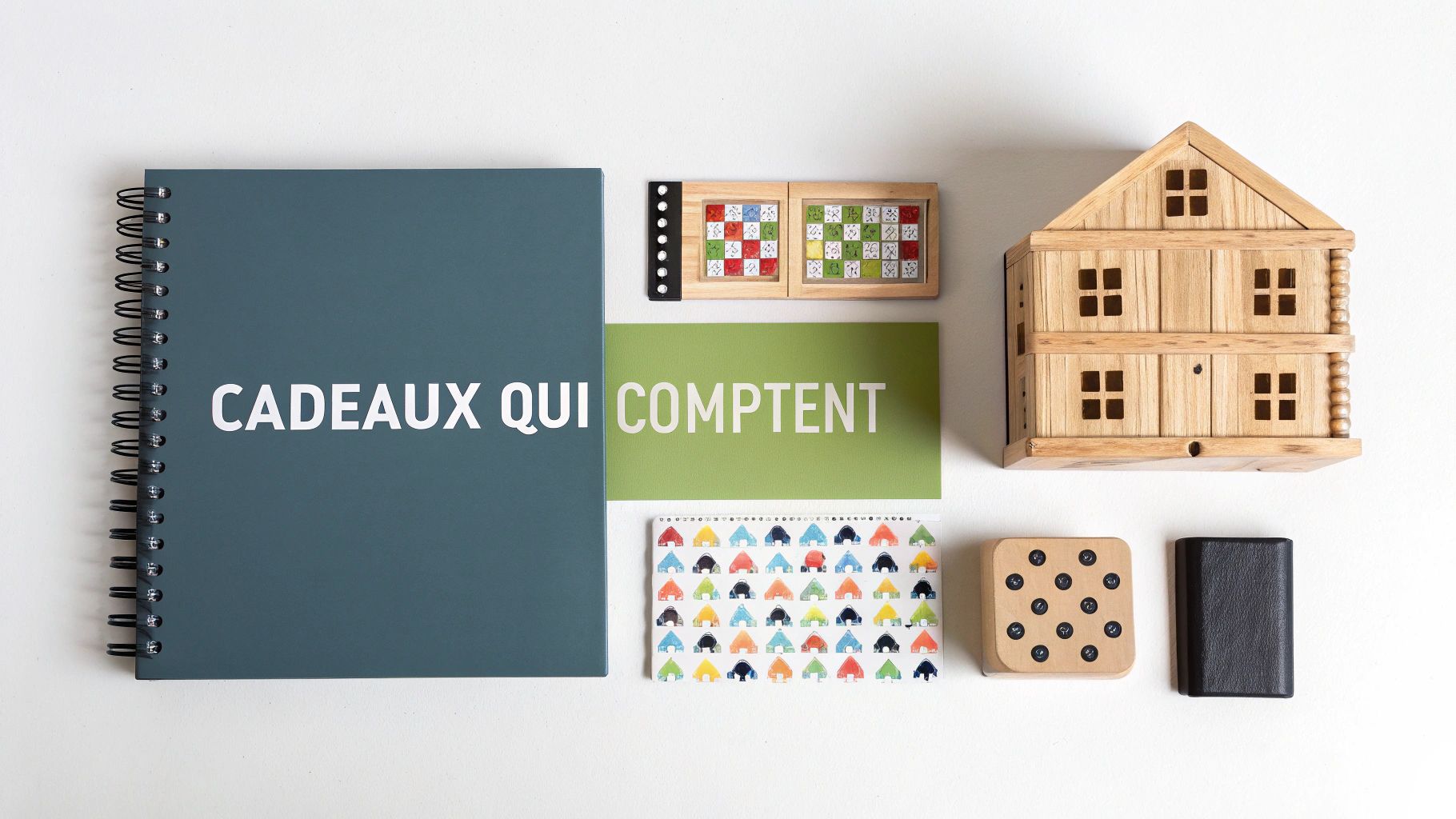
Rather than an electronic gadget that will capture their attention for a few weeks at most, why not offer a gateway to a new world? A wooden construction kit, a subscription to a discovery magazine, a pretty notebook for drawing or writing... these gifts have a much more lasting impact on their development.
They encourage the child to become an active participant, to think about solutions, to express who they truly are. It's an excellent way to boost their confidence in their own abilities.
The most beautiful gift is the one that whispers to your child: "I see you, I believe in you, and I can't wait to share this with you." It's a bridge between you, a memory factory.
Family habits are evolving in this direction, favoring more thoughtful choices ( more information on Christmas consumer trends ). We're returning to the essentials: gifts that foster connection and personal growth.
Ideas for every personality
Every child has their own world. Here are some ideas to find the perfect gift that will support their personal development.
-
For the little creative one:
- A quality notebook like My Book Story is perfect for encouraging her to put her thoughts and stories down on paper.
- A pottery kit for beginners or a beautiful watercolor set.
- Tickets for a show, concert or exhibition that will inspire him/her.
-
For the young explorer:
- A cooperative board game, where you win (or lose) all together, which strengthens team spirit.
- A subscription to a magazine about nature, space or science.
- A kit to build an easy-to-use birdhouse or microscope.
-
For the budding adventurer:
- A large scratch-off world map to mark the countries discovered with family or in books.
- An introduction to climbing or a day of treetop adventure to develop self-confidence and pushing your limits.
- A pretty compass accompanied by a book on survival techniques for curious little ones.
Each of these ideas is an invitation to develop a new passion, to learn while having fun and, above all, to create precious memories together.
What if the magic of the holidays didn't end in January?
The Christmas frenzy shouldn't disappear along with the decorations. Quite the opposite! It's the perfect springboard for establishing new family habits that will last all year round.
This unique holiday energy is a real opportunity. Let's take advantage of it to transform Christmas rituals into regular get-togethers. The idea is to capitalize on this strengthened bond to foster smoother communication and lasting emotional well-being every day.
From Christmas to year-round: how to maintain good habits?
The precious moments you created during the holidays can absolutely be adapted to the rest of the year. It's simpler than you think.
-
The monthly creative workshop : Your famous "Elf Workshop" can easily become a monthly creative gathering. The theme simply changes with the seasons: masks for Carnival, planting in spring, or land art in autumn.
-
Sunday's little recap : Keep up this simple ritual of the gratitude circle every Sunday evening. It's a wonderful way to gently wrap up the week, remember the little joys, and cultivate appreciation within the family.
The greatest gift is your attention. These rituals you start at Christmas are actually the perfect way to continue giving that gift, week after week.
These regular moments of sharing build a real sense of security and belonging for your children. They become solid reference points that help them grow, long after the last string of lights has been put away.
Some questions you may have about your children's well-being at Christmas
The holiday season is a bit of an emotional rollercoaster for 6-12 year olds. Excitement is at its peak, but fatigue and overstimulation are never far behind. So, how can we best support them through this joyful whirlwind?
How can I manage my child's overexcitement?
The secret is anticipation and maintaining a reassuring environment. Try to keep stable routines for meals and bedtime.
Remember to incorporate "quiet moments" into the day, away from the noise and bustle. An hour of reading, a quiet puzzle, or even just some drawing in their room is perfect for recharging their batteries and preventing them from reaching a breaking point. Teaching your child to recognize their own signs of tiredness is an essential skill.
What if he's disappointed by a gift?
This is a great learning opportunity! The first thing to do is to acknowledge your emotion without judgment. A simple "I see you're disappointed, it's normal to expect something different" can make all the difference. It's a chance to validate your feelings.
Then, you can gently redirect the conversation towards the intention behind the gift and gratitude. Remind them that the joy of Christmas is not just about the object, but also the pleasure of giving and receiving.
How can we help him wait patiently until the big day?
This waiting period can sometimes turn into anxiety. An activity-based Advent calendar, as mentioned earlier, is a fantastic tool for this. It provides concrete markers and transforms a somewhat passive wait into a genuine creative adventure. Each day brings its own little activity and moment of connection, and the countdown immediately becomes more fun and peaceful.
To transform each day into a little creative adventure and help your child put words to their emotions, take a look at the My Book Story journal. It's the perfect companion for a peaceful and meaningful holiday season .