


The "growth mindset" is a simple yet incredibly powerful idea to pass on to our children: their abilities are not fixed. Their intelligence, creativity, talents... all of this can develop with effort, perseverance, and by learning from their mistakes.
The growth mindset explained to your child
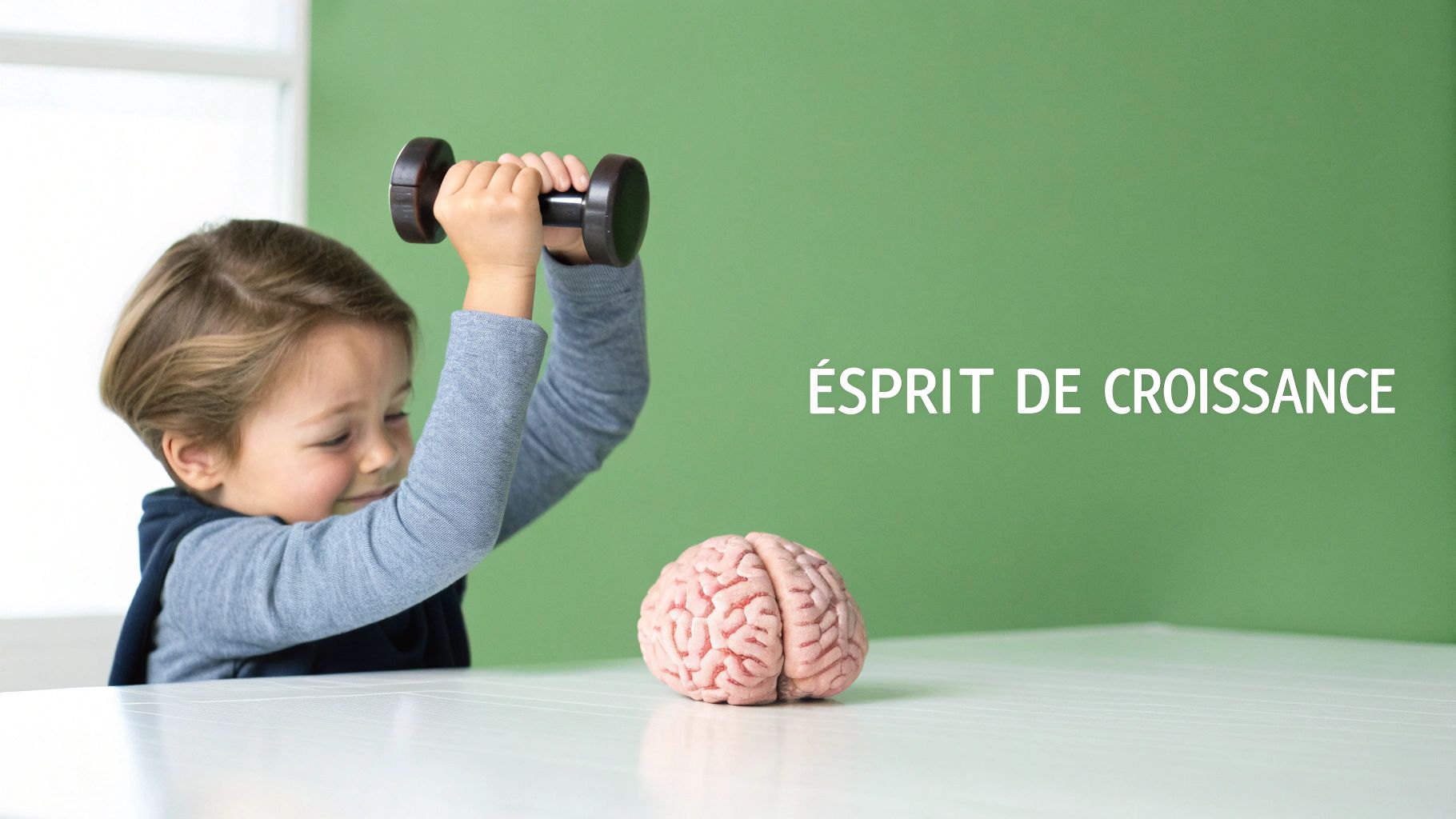
To better understand, let's try an analogy. Imagine that your child's brain isn't a box filled at birth with well-defined gifts, but rather a muscle. The more they train it with new challenges, the stronger and more efficient it becomes. That's the growth mindset.
This perspective was brought to light by psychologist Carol Dweck. She demonstrated that our children's talents are not a given. On the contrary, they flourish thanks to their tenacity, good work methods, and, above all, by viewing failures not as a dead end, but as a valuable opportunity to do better next time.
A superpower for self-confidence
For a child between 6 and 12 years old, cultivating this mindset changes everything. A slightly tricky math problem is no longer proof that they are "bad at it," but a fun challenge to get their brain working. A drawing that doesn't look like what they had in mind becomes an opportunity to invent something new.
In concrete terms, here's the difference:
- Challenges become exciting , instead of being a source of anxiety.
- Making a mistake is no longer a catastrophe , it's just useful information for improvement.
- Effort is seen as the key , the path that leads to success and pride.
This way of thinking is a pillar for building solid self-confidence, which is not based on the need to be perfect, but on the pride of progressing.
An approach that resonates in France
Far from being just an American theory, this approach resonates strongly here. The good news is that most young people already believe it! A 2018 OECD PISA survey showed that approximately 70% of French students believe that intelligence is something that can grow over time. If you would like to delve deeper into the topic of youth well-being, the Public Health France website offers valuable resources.
As a parent, understanding and passing on a growth mindset to your child is giving them a priceless gift. It's giving them the tools to become more resilient, more curious, and simply happier to learn and create.
Identify your child's inner dialogue
The words your child uses every day offer a true window into their way of thinking. Do you hear them say, "I'm terrible at drawing," after an attempt that didn't satisfy them? Or something more like, "My idea did n't work out the way I wanted"? This difference, which may seem minor, is actually fundamental. It reveals a great deal about their mindset when faced with creative and academic challenges.
Learning to decode this inner dialogue is the very first step in helping him reach greater fulfillment. The idea isn't to judge him, of course, but simply to understand what's going on in his mind. By grasping his thought patterns, you can help him build his confidence and creativity on a solid foundation.
Listening beyond words
The phrases we hear are often just the tip of the iceberg. A somewhat blunt statement like "My drawing is ugly" can hide a much deeper fear: the fear of not being good enough, or simply the fear of failure.
Similarly, a child who gives up on a board game with a "I always lose anyway" isn't just expressing frustration. They're revealing a limiting belief about their own abilities. These thoughts, far from being harmless, directly influence their motivation to persevere and their desire to try new things.
By noticing these little phrases, you're not just pointing out a fixed mindset. You're discovering a golden opportunity to show them that another way of seeing things exists. A perspective where effort and learning are the true heroes of their personal journey.
To help you better distinguish between the two types of discourse, here are some examples taken from situations that you surely know by heart.
Fixed mindset vs. growth mindset in children
This chart highlights the typical thoughts and reactions of a child based on their state of mind in everyday situations. It allows you to visualize the difference concretely and will give you tools to support them.
| Situation | Thought associated with a fixed state of mind | Thought associated with a growth mindset |
|---|---|---|
| A difficult math homework | "I'll never manage it, I'm too useless." | "It's difficult, I'll try another method or ask for help." |
| An error in a drawing | "I messed everything up, it's awful. I'm not doing it again." | "Oops, that's not what I meant to do. How can I improve it or integrate it?" |
| A lost board game | "It's not fair, I'm bad at this game." | "Well done! Next time, I'll try a new strategy to win." |
| Learning a new sport | "The others are much better than me, I'm ridiculous." | "I'm not very good yet, but I feel like I'm improving with every training session." |
As you can see, the same situation can be interpreted in two radically different ways. The right-hand column doesn't deny the difficulty; on the contrary! It transforms it into a challenge to be met.
This is the very essence of the growth mindset : seeing every obstacle not as an insurmountable wall, but as a stepping stone to growth. As a parent, your role is precisely to help your child build this bridge between "I can't" and "I can't yet ."
The impact of a "growth mindset" on your child's emotional well-being
Adopting a growth mindset isn't just a trick to get your child better grades. It's much deeper than that. It's one of the pillars of their emotional balance and well-being. In fact, this approach allows them to develop a quality essential for their entire life: resilience .
When a child sees a challenge not as a risk, but as an opportunity to learn, their self-esteem is built on solid foundations. It no longer depends on an impossible perfection, but on the pride they derive from their efforts and their ability to overcome obstacles.
This shift in perspective is enormous, especially in light of the performance anxiety often observed in 6-12 year olds . A child who isn't afraid of making mistakes is a child freer to explore, ask questions, and simply be creative.
Less anxiety, more boldness and creativity
One of the first visible effects is a reduction in stress related to the fear of failure. Your child understands that their worth isn't measured by every little mistake. This inner security gives them the courage to try.
- He embarks on new experiences without fear of ridicule, whether it's trying a new sport or joining an artistic project.
- He asks more questions because he knows that we learn by questioning, not by pretending to know everything.
- He recovers more quickly after a failure , which he sees as simple information to do better next time.
This image illustrates very well how a child with a fixed mindset and another with a growth mindset react differently to challenges, mistakes, and effort.

It's immediately clear that where one person sees an insurmountable obstacle, the other sees an opportunity to become stronger. Experiences that could be discouraging then transform into stepping stones for growth and increased confidence.
A valuable tool for his psychological balance
Helping your child cultivate a growth mindset is therefore a wonderful gift for their well-being. You give them tools to manage the small and large frustrations of daily life, which strengthens their self-confidence and their ability to thrive in the world.
A growth mindset gives children permission not to be perfect, but the motivation to always improve. This is the foundation of a healthy psychological balance.
This approach is particularly relevant today. In France, mental health has become a major issue, to the point of being designated a major national cause for 2025. This shows how crucial it is to act early to promote the well-being of our children.
By encouraging perseverance and a positive view of learning from mistakes, the "growth mindset" is a powerful tool to help our children thrive. For more details on this initiative, you can consult the government information on the website solidarites.gouv.fr . By integrating this philosophy into your daily life, you offer your child an inner compass that will guide them towards a more peaceful life.
5 concrete strategies to cultivate this mindset at home
Understanding the theory is good. Putting it into practice at home is even better! For a growth mindset to truly take root in your daily life, there's no need to revolutionize your habits. It's more about gently adjusting the way you interact with your child.
Here are five simple and effective approaches to help him develop a growth mindset, day after day.
1. Value the process, not just the result
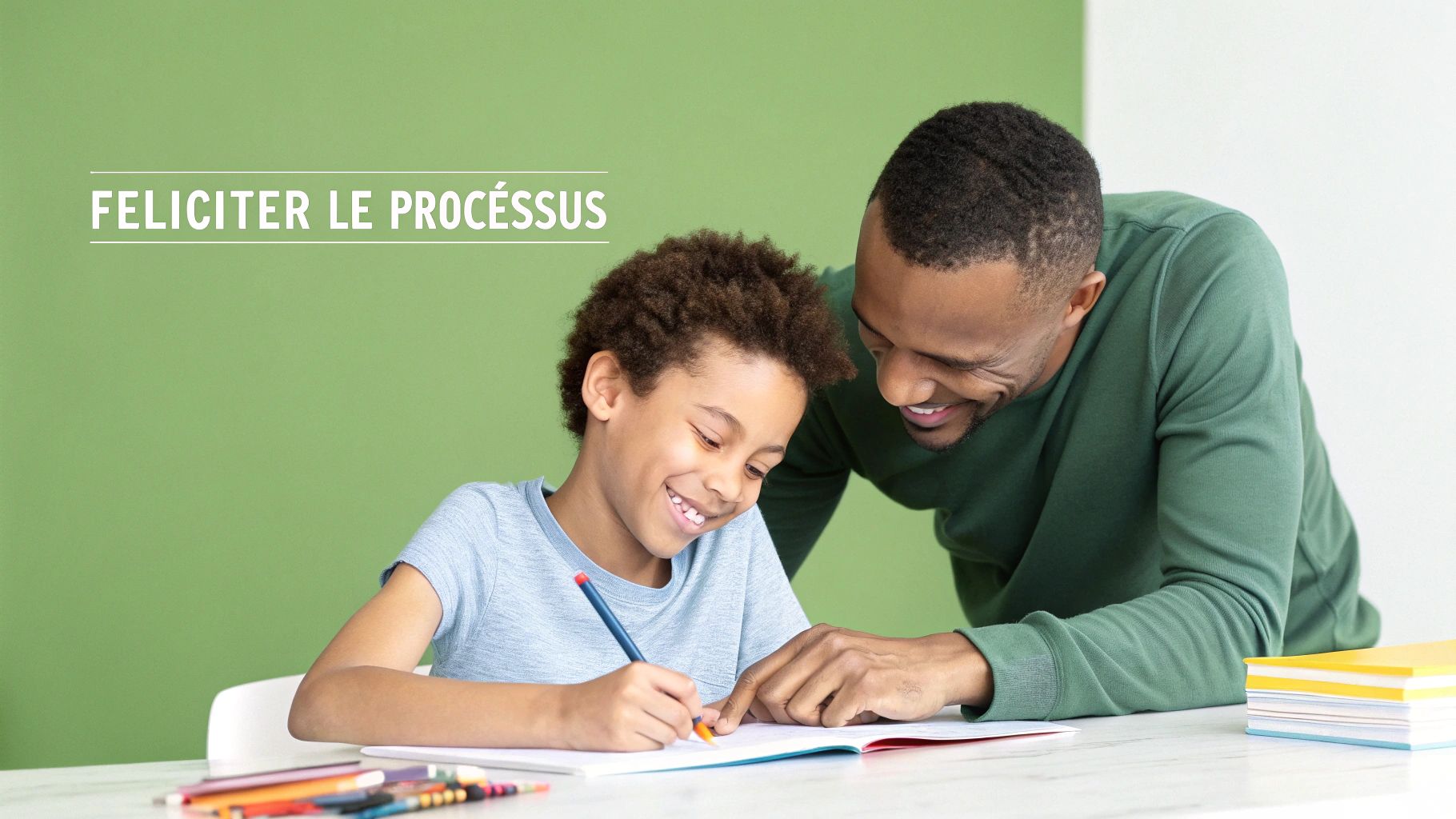
The way we praise our children directly influences their view of success. Instead of only praising the good grade or the goal scored, focus on the entire journey they took to get there.
This is called "praising the process." By doing this, you highlight what your child truly controls: their effort, their perseverance, the strategies they've tried. You send them a powerful message: it's hard work and creativity that lead to success.
Practical advice:
-
Rather than: "You got 18/20, you're so smart!"
-
Try this: "I saw how hard you worked for this test. Your focus and method really paid off!"
-
Rather than: "Your drawing is magnificent!"
-
Try this: "I love how you blended those colors to create that shade. You can tell you put time and effort into it!"
2. Make mistakes an ally in learning
For a child, failure can quickly become a tragedy, proof that they are "not good enough." Our role, as parents, is to change this perspective. Present each mistake not as a dead end, but as valuable information, a clue that guides them toward the solution.
An error is nothing more than an attempt that hasn't worked yet. It's a normal and even essential step in learning, whether it's riding a bike, mastering a video game, or solving a math problem.
Talk about your own mistakes and what you learned from them. By showing that you're not perfect, you give your child permission to be perfect too. You show them that learning is a lifelong journey.
3. Use the magic of the word "again"
This little word can change everything. It transforms a declaration of defeat into a step on a journey. The phrase "I can't do it" sounds like a final period. But "I can't do it yet " opens a door to the future.
Encourage your child to add this word to the end of their frustration sentences. This helps them understand that their current abilities are just a starting point and that they have the power to develop them further.
4. Talk about the brain like a muscle
Use simple images to explain neuroplasticity to him. Tell him that his brain is like a muscle: the more you work it on difficult things, the stronger it gets.
Explain to him that every time he learns something new or really has to concentrate, he creates new connections, like little pathways forming in his mind. This image helps him see the value of making an effort, even when the result isn't immediate.
5. Be her role model of perseverance.
Your actions will always resonate more strongly than your words. Show your child how you yourself approach everyday challenges. Let them see you try, make mistakes, and persevere with a positive attitude.
Whether you're learning a new recipe, assembling furniture, or starting a new hobby, your approach to overcoming challenges is his best lesson. It's by observing you that he'll most naturally understand what a growth mindset means.
Transforming the concept into fun family rituals
To make a growth mindset second nature to your child, the secret is to integrate it into everyday life through fun family moments. Abstract concepts take root much better when they are linked to positive emotions and shared memories.
The idea is to create joyful rituals around effort and learning. These small habits, woven into your family life, will show your child that a growth mindset isn't just something for school, but a real way of looking at life.
Create this week's creative challenge
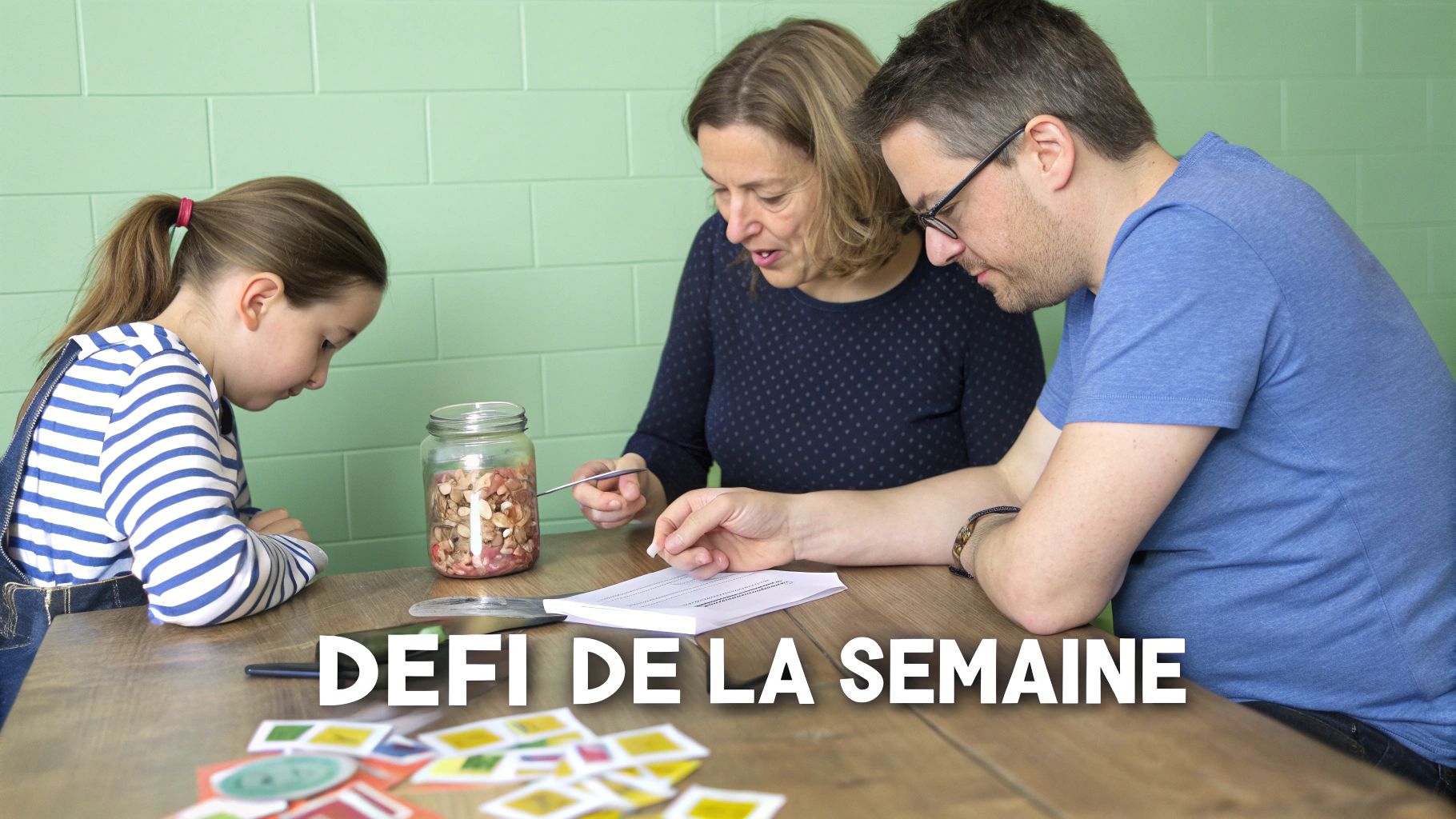
Each week, launch a family challenge. The principle is simple: each family member chooses to learn something new, even if it seems complicated at first. The goal isn't to succeed immediately, but to get started and have fun along the way.
- Dad is trying to make homemade bread for the first time.
- Mom is learning a few words of Italian on an app.
- Your child is practicing a new magic trick or memorizing a poem.
On Sunday evenings, at dinner, everyone shares how they're doing, what was difficult, and what they learned from trying. This shows that everyone, even the adults, continues to learn and that making an effort is normal and even fun.
Establish a celebration of "useful mistakes"
This ritual is perfect for taking the pressure off failures and encouraging risk-taking. Every evening, when everyone gets together, they share their "useful mistake" of the day. That is, a blunder or failure that, in the end, led to a learning experience.
By sharing your own blunders, like putting salt in your coffee instead of sugar, you show that making mistakes isn't a big deal. It's just information, and sometimes it even becomes a good story to tell!
Your child will then see that their own mistakes are not catastrophes. They will understand that failure is not a wall, but just a sign indicating another direction to try.
The progress log to see how far we've come
A simple notebook can become a powerful tool for building self-confidence. The idea is not to keep a personal diary, but rather a "learning log" where one can visualize their progress.
Invite your child to write down or draw their attempts. It could be the steps involved in learning to ride a bike, a photo of a cake finally baked successfully after several tries, or a sentence they couldn't read but have now mastered. Tools like the My Book Story journal are designed to guide children in this creative exploration of their own progress.
This notebook becomes concrete proof that his efforts are paying off. By flipping through it, he won't see his mistakes, but a courageous journey. It's a personal and tangible way to help him grasp the meaning of a growth mindset .
Your questions (and our answers) about the growth mindset
Putting a growth mindset into practice every day can raise questions. That's perfectly normal! Here are answers to your most frequently asked questions to help you confidently support your child.
My child gives up as soon as things get difficult, how can I help them?
The famous "I can't do it, I give up!" is a classic. The first thing to do is to acknowledge their frustration without judgment. You can say, "I can see that it's upsetting you. It's normal to feel this way when you're stuck on something."
Next, help him shift his attention from the obstacle to the action. Ask him open-ended questions:
- "What's the smallest thing you could try right now?"
- "Is there another way to approach this problem?"
- "What if we took a short break and came back to it with a fresh perspective afterwards?"
The goal is not to solve the problem for him, but to show him that a difficulty is an invitation to try another strategy. This is a key skill for his self-confidence.
Should I stop telling my child he is intelligent?
No, the idea isn't to ban the word, but to use it more effectively. A general compliment like "You're so smart!" can unintentionally put pressure on him to constantly appear intelligent. He might then avoid challenges that could tarnish that image.
The trick is to be specific and link your compliment to a concrete effort or strategy he has implemented.
Instead of saying, "You're good at math."
Try this instead: "I thought it was really clever how you used a drawing to understand this problem. That's a great strategy you came up with!"
You don't value a gift, but rather the effort, perseverance, and creativity involved. This is far more powerful for building strong and lasting self-confidence.
What can you do if your school is only interested in results?
That's an excellent question, because we can't control everything. However, your influence as a parent is immense. Even if the school focuses primarily on grades, you can create an environment at home that values learning and the process.
When he comes home from school, instead of asking the traditional "So, what did you get?", try asking questions that celebrate the learning process:
- "What new and interesting things did you learn today?"
- "Was there a challenge you managed to overcome? Tell me about it."
- "Did you ask a good question in class?"
By simply changing your questions, you show her what is really important to you: her curiosity, her effort, and her enjoyment of learning.
Does this mean that my child can succeed at absolutely everything?
A growth mindset isn't a magic formula that guarantees success in every area. The idea is more subtle: it suggests that everyone's initial potential is unknown and can be immensely developed through effort, strategy, and the help of others.
The goal is not perfection, but progress. It's about encouraging your child to focus on their own journey. The objective is to replace comparison with others with pride in their own path and personal improvements, even the smallest ones.
To help you turn these ideas into concrete moments of sharing, the My Book Story journal is a truly well-designed tool. It offers a guided space where your child can record their efforts, celebrate their small victories, and become aware of their incredible capacity to grow, day after day. Take a look at the My Book Story journal and give them a companion on their journey of development.