


The best self-help books for children are much more than just stories. They are veritable toolboxes to help them understand themselves. Through captivating narratives, they learn to manage their emotions, cultivate their self-confidence, and develop their creativity. Forget textbooks! These are adventures that transform reading time into a meaningful conversation between you and your child, strengthening the family bond.
How the right book can change your child's life
Imagine a book that doesn't just tell a story, but helps your child unlock their full potential. For children aged 6-12, these books are true companions on their journey. They gently guide them through the sometimes confusing world of their emotions, not with grand lessons, but with endearing characters and compassionate stories.
When a child identifies with a hero who overcomes their shyness or learns to manage their anger, they understand something essential: they are not alone in experiencing this. These stories are like a mirror that reflects their own experiences and whispers to them that they have the inner resources to succeed.
Tools for growing from within
These readings are designed to sow seeds of skills that will flourish throughout their lives.
- Emotional intelligence: They put words to feelings that may seem confusing. A child who can say "I feel frustrated, like the little fox in the story" has already taken a giant step toward understanding and managing their feelings. Practical tip: After reading, ask, "Have you ever felt like that?"
- Self-confidence: By seeing characters face their fears and celebrate their small victories, your child discovers that failure is just a step and that their efforts have value, regardless of the outcome.
- Resilience and creativity: The heroes' adventures encourage problem-solving. They show that there are often several ways to overcome an obstacle, which stimulates imagination and the ability to persevere.
It's no coincidence that this type of reading is becoming increasingly popular. In France, the personal development market represents approximately 32% of the total book market . This figure clearly demonstrates how much families are seeking practical tools to support their children's well-being. To learn more, you can consult this article on the success of personal development at fautquonenparle.fr .
Integrating these books into your daily life is much more than encouraging reading. It's opening up an ongoing dialogue about what truly matters: courage, empathy, and the joy of being oneself. It's a precious gift for their future well-being.
Choosing the perfect book for your child
Finding the right personal development book for your child is a bit like finding the right key for a lock. There's no one-size-fits-all solution. Every child is unique, with their own challenges, questions, and way of seeing the world. The goal is to find the story that will resonate with them, right here and now.
Age is of course a crucial first indicator.
Between the ages of 6 and 8 , children are like visual sponges. They need short stories, enhanced by gentle illustrations and simple plots. This is the ideal age for books that help them put words to big emotions like fear of the dark, explosive joy, or jealousy of a classmate.
A few years later, between the ages of 9 and 12 , they are ready to explore more nuanced narratives. Pre-teens love stories with characters they can relate to, facing very real dilemmas: an argument with a best friend, the fear of failing at school, or a lack of self-confidence. They look for stories that make them think and encourage them to find their own solutions.
Identify the need behind reading
But beyond age, the most important question to ask is: "What does my child really need right now?"
-
To boost their confidence: Look for stories where the hero doubts themselves but ultimately succeeds thanks to their perseverance. Stories that celebrate the right to make mistakes are fantastic for taking the drama out of failure and showing them that making mistakes is part of learning. For example: a character who messes up their drawing several times before being proud of it.
-
To soothe anxiety: Choose books with calming tones, featuring characters who learn to manage their worries. Some stories even offer simple breathing or visualization techniques—real tools to use every day. Tip: Practice the "balloon breathing" described in the book together before bed.
-
To nurture creativity: Opt for adventures that go off the beaten track! Characters who invent, explore and ask a thousand questions show that curiosity is a wonderful quality.
This diagram clearly shows how a simple story can affect several pillars of a child's well-being: their self-confidence, their ability to manage their emotions, and their resilience in the face of small and large challenges.
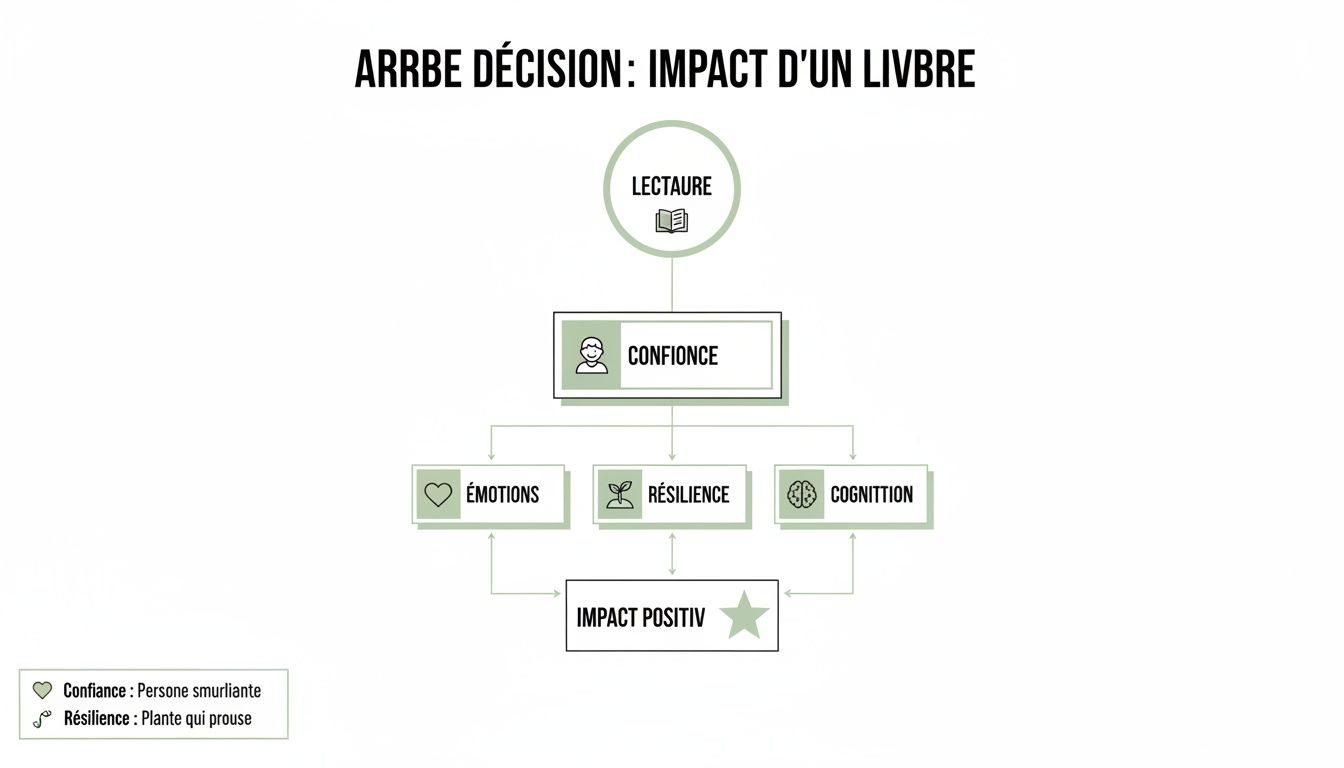
This shows that choosing a book is never a trivial matter. It is an intentional act that can foster a specific skill and open the door to very rich family conversations.
Book selection guide based on emotional need
To help you navigate this, this chart links your child's emotional challenges to types of stories that can support them. It's an excellent starting point for making an informed choice.
| Child's needs | Preferred type of story | Examples of themes | Recommended age |
|---|---|---|---|
| Lack of confidence | The hero overcomes a personal challenge. | Trying something new, daring to speak up, accepting one's imperfections. | 6-12 years old |
| Anger management | The character learns to understand their emotion. | Identify the triggers, find ways to calm down, express your frustration. | 6-10 years old |
| Fear of change | The story explores a life transition. | Moving house, changing schools, the arrival of a little brother or sister. | 6-9 years old |
| Developing empathy | The story is told from someone else's point of view. | Understanding the feelings of others, the importance of friendship, tolerance. | 8-12 years old |
With these few tips, you are better equipped to transform reading into a real support for your child's development.
Our selection of books to help you grow in confidence
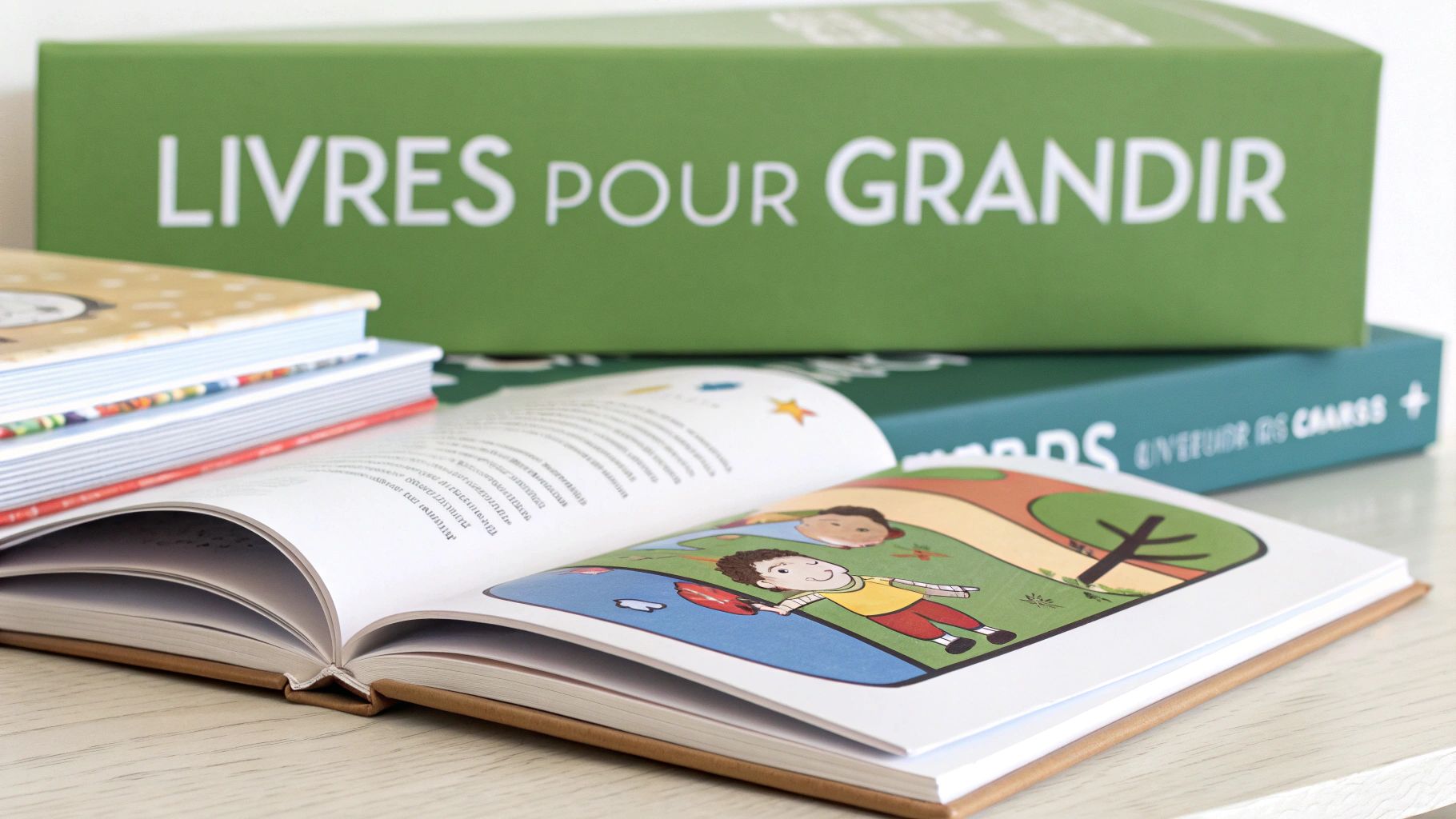
Now that we've seen how to choose a good book, it's time for the best part: filling your child's library with stories that will truly inspire them. Here's a small selection of our favorites, real gems for cultivating confidence and creativity in 6-12 year olds .
Each book is a gateway to a world where emotions are explored without taboo and where obstacles become stepping stones for growth. It's no coincidence that these self-help books for children are increasingly popular. The French market for well-being books, which includes them, was already worth €111.6 million in 2018. This demonstrates the strong interest families have in these resources! To delve deeper into the subject, you can take a look at this article from Sciences Humaines .
Stories to encourage you to be yourself
Some books have that little something extra, that magic that can transform the way a child sees themselves. They whisper in their ear that their differences are actually treasures and that making mistakes is never a big deal, it's just another way to learn.
-
"The Boy, the Mole, the Fox and the Horse" by Charlie Mackesy: It's much more than a book; it's a gentle and poetic conversation about friendship, kindness, and the courage to be yourself. With its short sentences and tender drawings, it distills life lessons that are as profound as they are easy to understand.
-
The key takeaway: The importance of accepting one's own vulnerability. As the Horse so aptly put it: "Asking for help is not giving up. It's refusing to give up."
-
"What an Emotion!" by Cécile Gabriel and Cécile Roederer: A visual and super fun guide to help young children put words to what's happening inside. Each emotion is associated with a color and a concrete situation, making emotional intelligence easy and fun to grasp.
-
Why does it work so well? It gives children a real vocabulary of emotions. And when you can name what you feel, it's immediately easier to communicate it to others.
Cultivating resilience and creativity
Knowing how to bounce back after a disappointment or failure is a skill that can be learned. The following books celebrate perseverance and imagination as true superpowers.
"The biggest obstacle is not failure, but the fear of failure." This idea, found in many stories about resilience, teaches children that every attempt is already a small victory, regardless of the result.
"The Curious Incident of the Dog in the Night-Time" by Mark Haddon (best suited for ages 9-12): This novel takes us inside the mind of Christopher, a 15-year-old boy with a unique perspective on the world, who decides to investigate the mysterious death of his neighbor's dog. It's a touching and powerful story about being different, courage, and solving problems in your own way.
His relentless logic in decoding a world filled with emotions shows that there is no single way to be brilliant.
"The Big Book of Our Superpowers" by Susanna Isern: This picture book is a great way to remind every child that we all have talents, even if they aren't spectacular. Knowing how to listen, making others laugh, telling stories... Every child can discover their own hidden strength.
- Key themes: Self-acceptance, celebrating differences, confidence in one's own abilities.
"How to Squash Monsters?" by Catherine Leblanc and Roland Garrigue: A humorous approach to defusing fears! This book offers completely wacky "recipes" for getting rid of creatures hiding under the bed, showing children that with a little imagination, they have power over their anxieties.
These few suggestions are an excellent starting point for creating a library that will grow with your child. Each book becomes an opportunity to share, laugh, and boost their self-esteem, one page at a time.
Making reading a creative family ritual
A book is a bit like a seed. For it to germinate and fully blossom, it needs to be nurtured. The best self-help books for children truly come into their own when they are transformed into a genuine moment of sharing, a ritual that nourishes family bonds as much as the mind.
The idea isn't just to read a story from beginning to end. It's to bring it to life, together. It's the perfect opportunity to ask open-ended questions, the kind that don't have a "right" or "wrong" answer, but that invite you to talk about your emotions and what you've experienced.
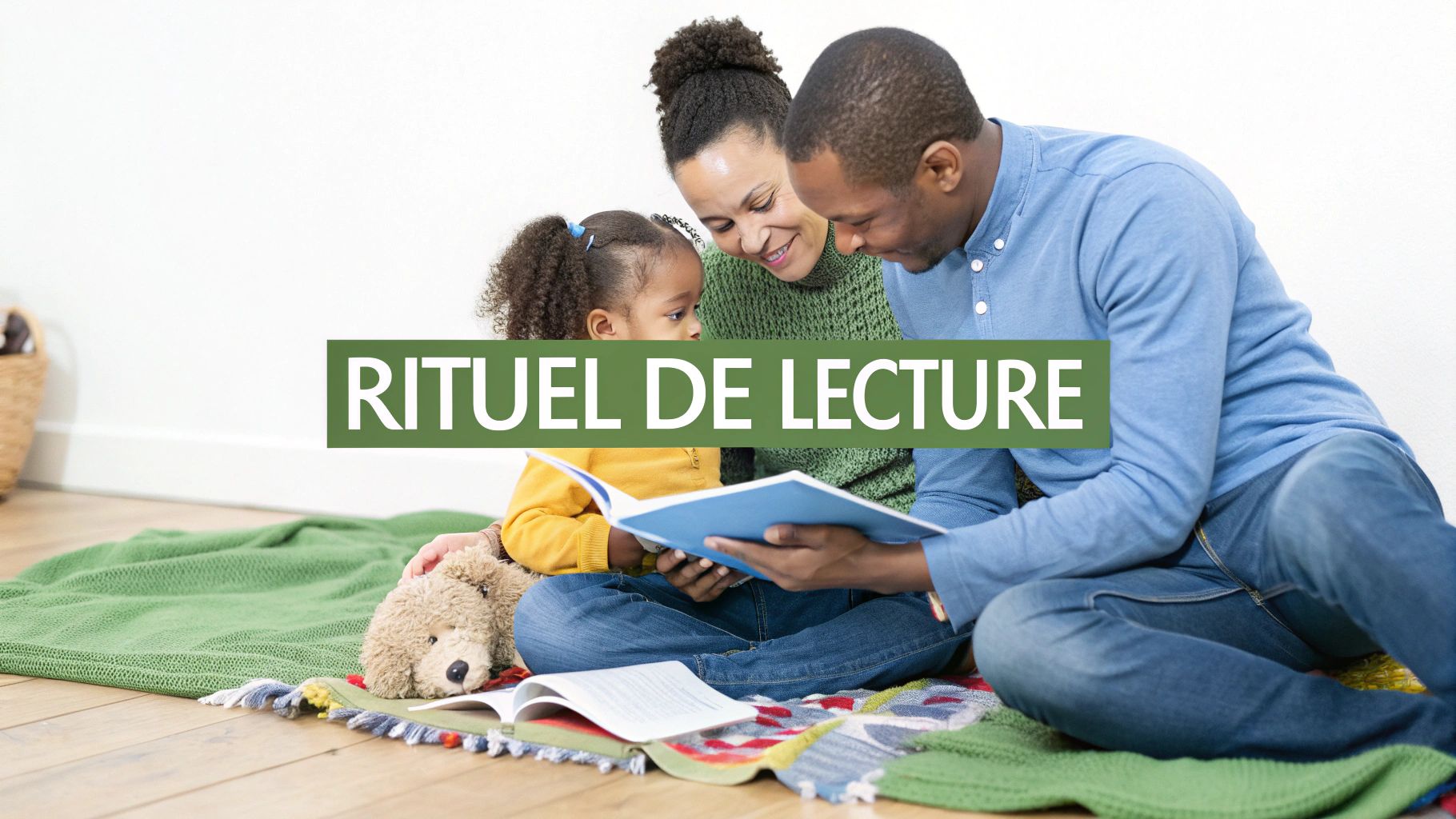
Bringing history to life to better connect
When reading becomes interactive, the experience is immediately more impactful for a child. They are no longer a simple spectator, but an active participant who creates and makes the book's message their own.
Here are a few simple ideas to get you started:
- The creative reading journal: After a chapter, why not suggest that your child draw their favorite scene? Or even write next to it what they think the character was feeling at that moment. It's a great way to help them put words to emotions.
- What if we reinvented the ending? For creative little ones, ask them to imagine a different ending to the story. It's a great way to stimulate their imagination and show them that there are often several solutions to a problem.
- Family Theater: Choose a scene you enjoyed and act it out together! You don't need much, just a few props. Embodying the characters is a great way to develop empathy.
These playtime moments are much more than simple distractions. They anchor the lessons of the book in a concrete and joyful experience, which strengthens your child's confidence in a lasting way.
By talking about the characters' emotions, you open the door for them to talk about their own. A simple question like, "Why do you think the little fox was so sad?" can spark an incredibly rich discussion about their own sorrows or frustrations.
Create rituals inspired by books
Stories don't have to stay confined to the pages of a book. They can find their way into your daily life through objects or habits. By making the book's messages tangible, you make them more powerful.
A concrete example: the courage box
Imagine you're reading a story about a character who overcomes their fear. What if you made a "courage box" together?
- Decorate a box: A simple shoebox will do. Let your child personalize it with anything that evokes strength and courage: bright colors, drawings, stickers...
- We fill it with "talismans": Every time your child shows courage (daring to speak up, tasting a new food), write this small achievement on a piece of paper and slip it into the box.
- We use it on days of doubt: When he feels a little less confident, he can open his box and reread all his successes. It's a powerful, physical reminder of all the times he's already been amazing.
By making reading a creative ritual, you're not just teaching them to love books. You're offering them a safe space to explore their feelings, gain confidence, and, most importantly, build precious family memories.
What are the long-term benefits of these readings for your child?
The stories you read together today are so much more than just a tender moment. Imagine them as seeds you sow, which will germinate throughout their life. A good self-help book is a true gateway to their inner world.
Each page turned is a small investment in skills that will support them well beyond childhood. By following a character through their doubts and small victories, your child gently learns to build their own inner strength.
Developing one's emotional intelligence and empathy
One of the most valuable gifts these books offer is the development of emotional intelligence . When a character feels sadness, joy, or anger, your child learns to put words to their own feelings. A child who can say "I'm disappointed" or "I'm scared" is a child who already understands themselves better.
And it doesn't stop there. This understanding naturally extends to others. These stories are superb exercises in empathy. They invite children to ask themselves simple questions like, "What do you think the hero felt at that moment?" This is how they learn to put themselves in other people's shoes, an essential quality for building healthy relationships later in life.
A child who reads stories about difference, friendship, or helping others is much more likely to become an open-minded and tolerant adult. Reading is a window onto the world, but also onto the hearts of others.
Building resilience to become a stronger adult
Life is full of challenges, both big and small. These books convey a fundamental lesson: an obstacle isn't necessarily an insurmountable wall, but often a hurdle to overcome. Seeing a hero face a difficulty, fail, and then try again and again instills in your child the idea that perseverance is a true strength.
This develops his ability to find creative solutions to problems, a skill that will be useful both at school and in his adult life. It's a real investment in his well-being, giving him lasting confidence in his ability to overcome challenges.
- Learning to solve problems: He discovers that a situation often has several possible outcomes.
- Having confidence in his abilities: He understands that he has within him the resources to cope with what is happening.
- Maintaining a positive outlook: He learns that failure is not an end, but just an opportunity to learn something new.
The publishing world understands this well. Even though book sales fluctuate, the popularity of certain titles remains constant. This clearly demonstrates that parents are looking for authentic tools to support their children. To learn more, you can consult the market trends on Livres Hebdo .
In short, these moments of shared reading are an invaluable investment. You are giving your child a kind of inner compass that will help them navigate life with more confidence, empathy, and resilience.
Answers to your questions
Starting to read self-help books with your child is a great idea, but it can also raise a lot of questions. That's perfectly normal! We're here to answer them simply, so that this new adventure is first and foremost a moment of shared enjoyment.
Here are some clarifications to guide you with confidence.
At what age should I start?
From age 6 , it's absolutely possible! At this age, it's best to choose picture books with lots of illustrations that depict simple emotions. The pictures help enormously to understand what's happening. The idea is to follow their pace, to sense what interests them, without ever forcing anything.
To give you a little idea:
- Between 6 and 8 years old: Focus on short stories with a positive and easy-to-understand message. Books that help children name major emotions (joy, anger, sadness) are perfect.
- Between 9 and 12 years old: We can start exploring slightly richer stories, with characters who resemble them. This is the ideal age to address themes such as minor arguments between friends, the fear of failure at school, or how to learn to love oneself a little more.
Ultimately, it's not so much age that matters as the discussion the book will spark between you. It's this moment of sharing that is truly precious.
What if my child doesn't connect with the chosen book?
Above all, don't force him. Reading should remain a pleasure, not a chore. If he doesn't like a book, see it as a great opportunity for discussion, rather than a failure.
Try to understand what's holding him back. Ask him simple questions: "What don't you like about this story?", "Are the drawings not to your taste?", "Does the subject bore you?". His answers are like gold nuggets for better understanding what he wants right now.
The goal isn't to finish a book at all costs, but to find the one that will spark an interest. Next time, take him to the bookstore and let him choose. Giving him that little bit of decision-making power makes all the difference to his motivation!
Do these books replace a visit to a therapist?
No, and it's very important to make that distinction. These books are wonderful tools for opening up dialogue at home, for preventing certain difficulties, or simply for supporting your child on a daily basis. They help them put words to their feelings and start conversations that we don't always know how to begin.
They're a bit like a first-aid kit for emotions, but they can never replace professional advice. If you feel your child is truly struggling, very anxious, or that their difficulties are impacting their daily life, don't hesitate to consult a doctor or psychologist. Only they can make a diagnosis and offer tailored support.
Think of these books as great allies, but not as a miracle solution.
And if you want to take it a step further, to turn each story into a true creative adventure, the My Book Story notebook is the perfect companion. It helps your child express their feelings, build their confidence, and keep track of their discoveries.
Discover how the My Book Story notebook can enrich your family reading moments .