


More than just a toy, these "life-changing gifts" are designed to nurture your child's long-term self-confidence, creativity, and emotional well-being. Rather than aiming for immediate gratification, they plant seeds that will sprout into valuable skills for the future.
Going beyond the traditional toy to offer meaning
In a world where children's rooms are often overflowing with toys, many parents wonder how to give a gift that truly matters. How do you choose a present that won't end up at the bottom of a toy box, but will genuinely contribute to your child's development? This is precisely where the idea of giving a meaningful gift comes in.
This approach shifts the focus from material value to personal growth value. The goal is no longer simply to entertain for a moment, but to inspire, educate, and build connections.
A new intention behind the gift
Giving a gift then becomes a thoughtful act, a way to actively support a child's development. Memorable experiences and tools that stimulate essential human qualities are preferred.
A "life-changing gift" is based on three fundamental pillars for child development:
- Nurturing self-confidence: The gift helps the child discover their own strengths, overcome small challenges, and feel genuine pride in what they accomplish.
- Encouraging creativity: It offers a space for children to imagine, create and express themselves freely, far removed from the rules imposed by overly directive toys.
- Strengthening family ties: Often, these gifts turn into a shared activity, creating precious memories that strengthen the parent-child bond.
The goal is simple: to choose gifts that won't gather dust, but will create memories and shape personalities. It's about transforming a family ritual into a powerful tool for development.
Adopting this approach doesn't mean banning all traditional toys, far from it. It's more about finding a balance between fleeting pleasures and lasting gifts—those that help a child better understand themselves and the world around them. From this perspective, every gift becomes an opportunity to plant a seed for the curious and fulfilled adult your child will become.
What makes a gift truly special and memorable?
Imagine classic toys for a moment. They're a bit like candy: instant gratification that fades quickly. A gift that truly changes the game is something else entirely. Think of it more like learning to grow your own vegetables. It takes a little effort at first, it's true, but it nurtures your child's curiosity and confidence in the very long run.
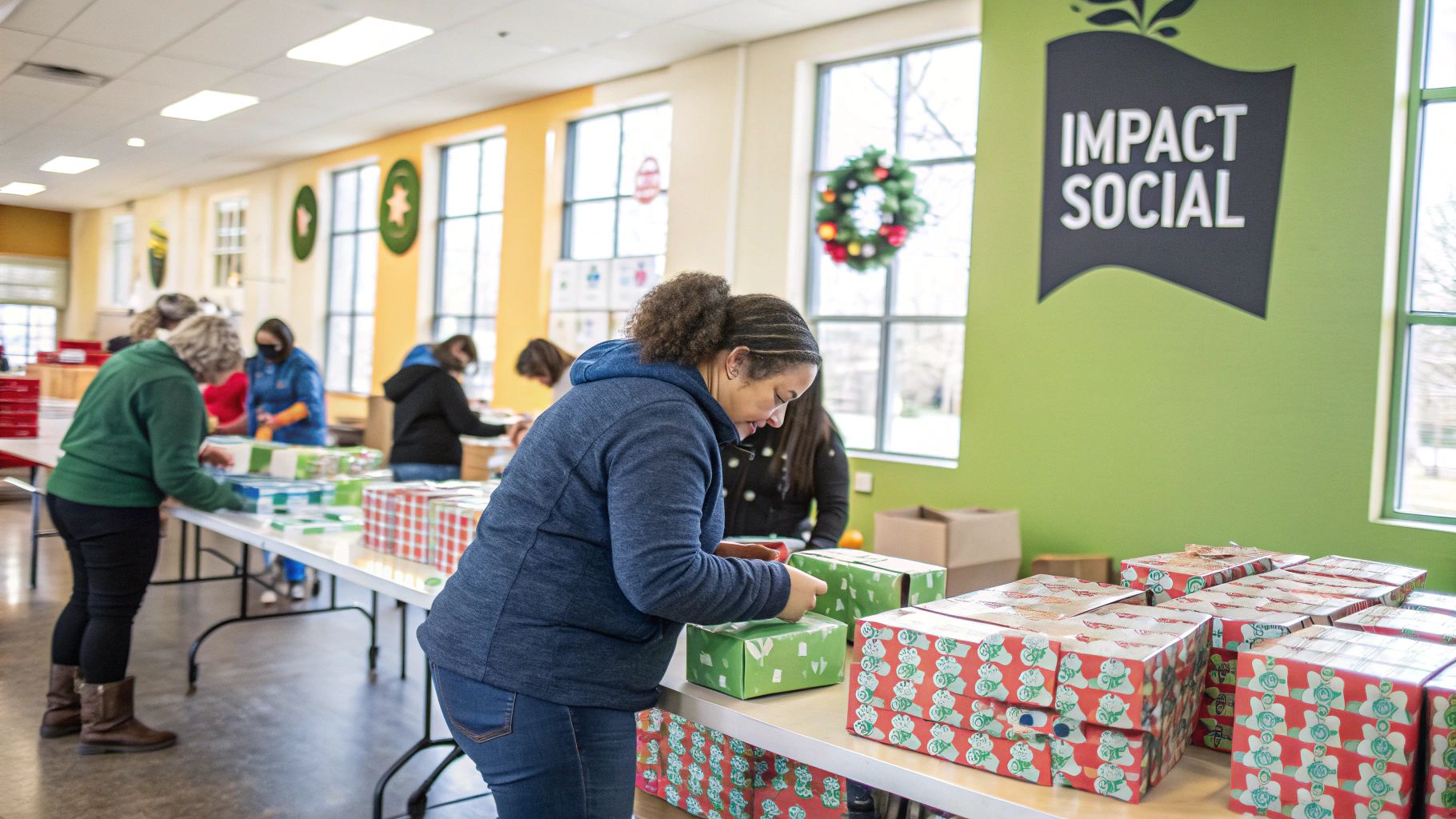
This idea is gaining traction. Today's parents are looking to give meaningful gifts, far more than just material possessions. And the figures bear this out: during the holidays, 77% of French people prioritize staying within their budget, and the resale of unwanted gifts skyrockets. A staggering 44% of people resell presents they don't need. This trend reveals a deep desire to give more weight to our choices. You can explore these consumer trends in detail on Ipsos.com .
More than the object itself, it's the intention that counts.
What truly distinguishes a memorable gift is neither its price nor its complexity. It's the intention behind it. The goal isn't just to provide a moment of amusement, but to plant a seed, to spark something positive in the child.
It could be a kit to build a treehouse, a subscription to a children's science magazine, or even a simple "voucher for a night under the stars" with mom or dad. The real value lies in the experience and what it leaves behind.
These gifts are based on three fundamental pillars. They transform the simple act of giving into a golden opportunity to grow together.
A memorable gift isn't what the child unwraps, but what they become because of it. It's an investment in their curiosity, creativity, and the memories they will create.
The 3 pillars of a meaningful gift
For a gift to have a real impact on your child's development, it must touch on at least one of these three essential areas:
-
Developing a skill. The gift encourages the child to learn something concrete. This can be a manual skill (crafting, sewing), a social skill (playing in a team) or a creative skill (drawing, inventing a story).
-
Strengthening family bonds. A gift becomes the perfect excuse to spend quality time together. Consider a cooperative board game, a cooking workshop where everyone participates, or creating a ritual like a weekly reading night.
-
Awaken curiosity. It opens a window onto an unknown world and sparks a desire to learn more. A star chart, a magnifying glass for observing insects, or a book about volcanoes can be the starting point of a true passion.
By choosing a gift that is based on one of these pillars, you're not just filling a shelf. You're giving your child a tool to grow, explore, and discover themselves. And that's a far more precious legacy than any toy.
The impact of these gifts on child development
A meaningful gift is so much more than the fleeting joy of opening a package. Its impact on a child between the ages of 6 and 12 is profound and lasting. This is a crucial period when personality is formed, and these gifts are not mere objects. They are true stepping stones to growth.
Think of a child learning to build a birdhouse with their grandfather. They're not just learning how to hammer a nail. They feel immense pride when the first birds come to nest there. This success, however modest, is another step in building their self-confidence.
Strengthening trust and resilience
A gift that helps him grow is excellent training for life. It teaches the child that satisfaction is earned through effort, and that failure is never an end in itself, but just a step.
A puzzle that's a little too complicated, a pottery class where the first creation collapses, or a magic trick that requires hours of practice… all these experiences are incredibly formative. Children learn to manage their frustration, to understand why things didn't work out, and above all, to persevere. It's resilience in action, a skill far more useful than a toy that lights up at the push of a button.
A gift that challenges a child sends a powerful message: "I believe in you. I know you are capable of overcoming this obstacle and succeeding on your own." It is this parental confidence that truly nurtures self-esteem.
Building memories and family ties
What's even more precious is that many of these gifts are experiences to share. A family cooking workshop, a hike to learn to identify trees, or a weekend camping under the stars… all of this creates memories that will never fade.
These moments of connection are the foundation of a child's emotional security. They build a treasure trove of happy memories that strengthen their sense of belonging and emotional well-being. And that is priceless. These gifts write your family's story.
- Practical tip for parents: The next time you cook, turn it into a "private cooking class" for your child. Give them an apron, a clear task like mixing ingredients, and celebrate the final dish together, whether it's perfect or not. This shared time is the real gift.
Ultimately, the value of these gifts lies in what they leave behind. Not an object gathering dust on a shelf, but a newly acquired skill, a boost in self-confidence, and a cherished memory. That's what makes them truly life-changing gifts .
How to choose the right gift for your child
Finding the perfect gift that will change a child's life isn't about giving in to the latest trend or buying the flashiest toy. The key is much simpler and closer to home: simply observe and listen carefully to your child.
It all starts long before you set foot in a store. Take the time to listen to what he says, to notice what sparks his curiosity on a daily basis. Do his eyes light up when he looks at the stars? Does he spend hours drawing fantastical creatures? Does a song on the radio make him spontaneously dance? These little clues are like nuggets of gold.
Putting aside one's own desires
One of the biggest pitfalls for us parents is projecting our own passions or unfulfilled dreams onto our children. The goal isn't to give them what you would have loved to have at their age, but rather to give them a tool or an experience that will help them explore their own world.
Seen from this perspective, the search for gifts becomes a true moment of connection. You're no longer looking for a simple object; you're trying to understand what resonates with your child, here and now.
The image below offers a sort of decision tree to guide you, starting from simple criteria such as budget, impact and sustainability.
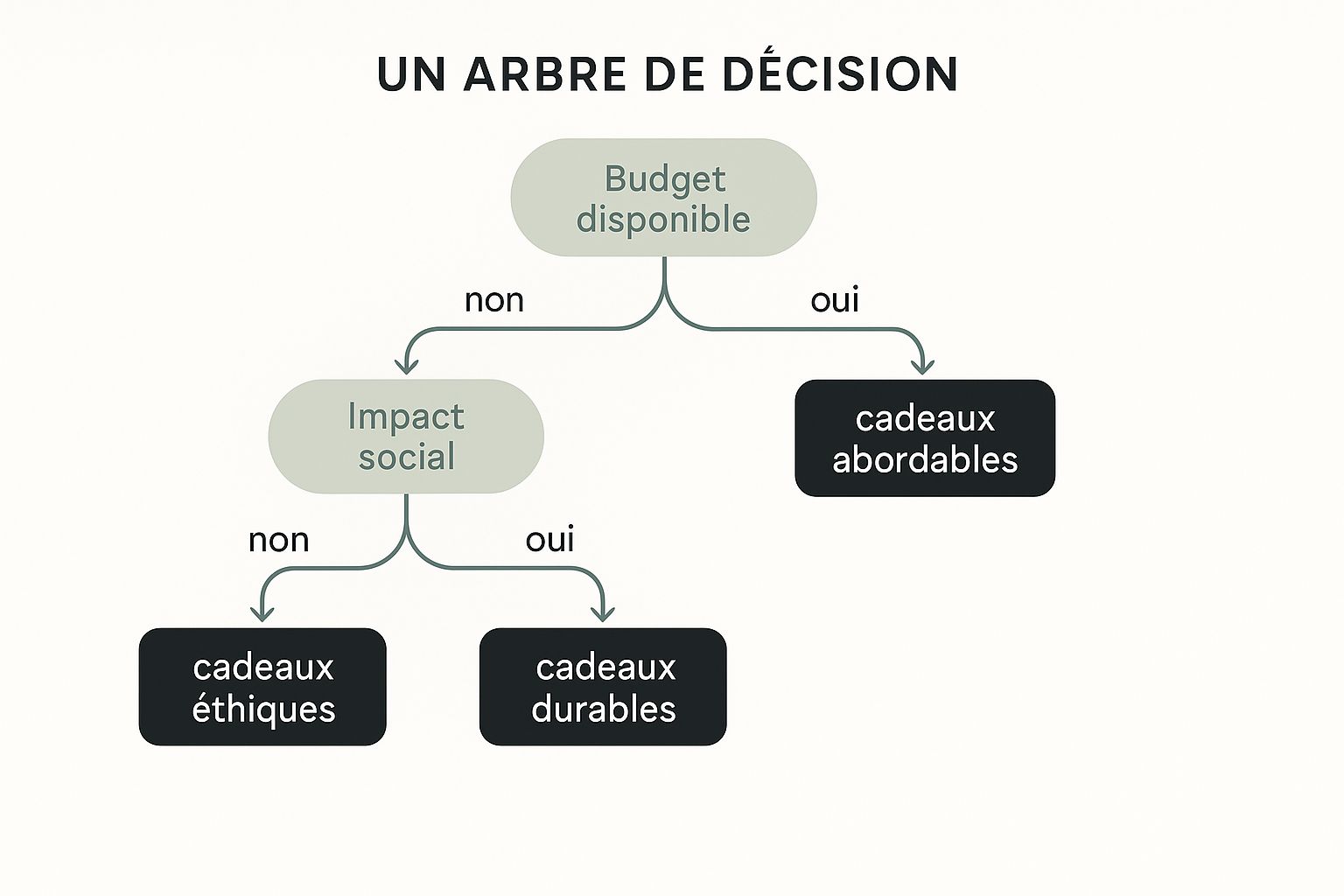
This image clearly demonstrates that, regardless of budget, there is always a way to find an option that makes a lasting impression.
An evaluation grid to help you make an informed choice
To help you gain clarity and compare your different ideas, here's a simple evaluation grid. Think of it as a filter, to ensure your choice aligns with your intention to help the child grow.
Evaluation grid for choosing a 'gift for change'
| Gift type (Example) | Potential for creativity | Strengthening ties | Skills development | Durability over time |
|---|---|---|---|---|
| Gardening kit | Medium (follow steps) | Very high (activity for two) | Patience, observation | High (seasonal) |
| Watercolor box | Very high (free) | Raised (created together) | Fine motor skills, colors | Very high (long duration) |
| Cooperative board game | Low (rules to follow) | Very high (team) | Strategy, communication | Very high (replayable) |
| Ticket for a concert | Weak (spectator) | Very high (shared memory) | Musical curiosity | Weak (single moment) |
This painting shows how a simple box of watercolors, which may seem ordinary, actually ticks all the boxes: it stimulates the imagination, can become a great family activity, helps develop precision of movement and, of course, it will be useful for a very long time.
Choosing a gift in this way is an act of love and listening. It's saying to your child: "I see you, I hear you, and I want to help you become the person you already are."
This type of gift can also be an opportunity to discuss important values, such as generosity. In fact, it's a strong value in France: donations reached an estimated €9.2 billion in 2022, of which €5.4 billion came from individuals. Why not include a donation to a charity in the child's name? It's a wonderful way to instill in them the meaning of sharing. To learn more, you can consult the statistics on French charitable giving on the website Francegenerosites.org .
Gift ideas that foster growth, for all passions.
Finding the perfect gift, one that will truly resonate with a child, can seem like a real challenge. However, the key isn't to strive for perfection, but to find something that reflects their unique personality and stage of life. The goal? To spark a new passion or help them develop a skill that will serve them throughout their life.
To help you see things more clearly, here are some concrete suggestions. These are examples of gifts designed to stimulate curiosity, creativity, and emotional well-being – fundamental qualities for healthy development.
For the creative little one (6-8 years old)
At this age, imagination is like an erupting volcano, and little hands are becoming increasingly dexterous. Gifts that allow children to make, build, and create are perfect. They subtly teach patience and the pride of seeing a project take shape.
- A creative box subscription: Every month, it's a surprise! The child receives a complete kit to complete a new project (mosaic, modeling, painting, etc.). It's a great way to introduce them to different techniques and boost their perseverance.
- A puppet-making kit: The adventure begins with creating the characters, then continues with inventing stories to act out. It's a wonderful activity for developing language and self-confidence.
- A real sketchbook with quality pencils: By giving them materials that aren't "just for kids," you send a powerful message. You value their talent and encourage them to take their passion seriously.
For the budding explorer (9-12 years old)
Pre-adolescence is the age of big questions about the world around us. Children want to understand how things work, from the infinitely small to the infinitely large. It's the perfect time to nurture this thirst for discovery.
- A geology kit to unearth the Earth's treasures: Armed with a small hammer and a magnifying glass, your child will learn to identify rocks and minerals during your walks in nature.
- A star chart and a pair of binoculars: Learning to recognize the constellations is a somewhat magical experience. It's a fascinating gateway to astronomy, which also teaches the patience of observation.
- A kit to build an insect hotel: Here's a fun and hands-on way to understand the importance of biodiversity. Children can closely observe the essential role these little creatures play in our ecosystem.
The most beautiful gift is the one that says: "Your curiosity is precious. Keep exploring, asking questions, and being amazed." It's an invitation to never stop learning.
For the sensitive child who is outwardly oriented
Emotional development is just as fundamental as academic learning. Knowing how to show empathy and generosity is a key skill. Certain gifts are perfect for opening a child's heart to the world and to others.
- Sponsoring an animal in a shelter: The child will receive regular updates about their sponsored animal. It's a very concrete way to introduce them to responsibility and commitment to a cause.
- A "voucher book" for moments to share: Here, we forget about objects to offer the most precious thing: your time. A "voucher for a screen-free game night," a "cooking lesson to learn Grandma's recipe," or a "day where you decide everything." These memories are priceless.
- A kit to organize a collection in the neighborhood: Help him choose a cause that is close to his heart (toys for a hospital, food for a food bank) and manage his project from A to Z. It's an incredible lesson in organization, communication and the joy of giving.
Incorporate “gifts for change” into your family rituals
Adopting the " gifts for change" philosophy doesn't mean declaring war on traditional toys. Not at all! It's more about an adjustment, a small shift in approach that you can gently introduce into your family routines. The goal is simple: to find the right balance between immediate enjoyment and long-term development.
No need to revolutionize everything. You can start small. For the next birthday, why not slip a "gift for change" alongside a more traditional present? It's a simple and natural way to start a conversation on the subject.
Rethinking the ritual of gift-giving
The idea is to show your child that the value of a gift isn't measured by its size, its shiny packaging, or its price. Its true worth lies in the intention behind it, the experiences and memories it will create.
By choosing gifts that foster confidence, creativity, or family bonds, you're not just giving an object. You're giving an opportunity to grow.
Each gift then becomes like a small seed that you plant. A seed that will help your child become the curious, confident, and strong adult of tomorrow.
It's a true act of love that transforms a simple tradition into a precious learning experience. Gift after gift, you build a foundation of values and memories that will stay with them for life.
Parents' questions: our answers
Changing the way you give gifts often raises practical questions. How do you deal with the advertising that bombards our children? And how do you explain this approach to Grandma, who loves buying the latest trendy toy? Don't panic, here are some concrete tips to guide you.
What should I do when my child only wants the toy they saw on TV?
It's a classic situation! Your child's eyes light up at the sight of the latest plastic robot or singing doll. That's normal; marketing is doing its job very well. The goal is definitely not to say "no" and create frustration. The idea is to open up a world of possibilities.
Practical tip for parents: Suggest that your child make two lists for their birthday or Christmas. On the first list, they can write down all the toys they dream of. And on the second, which you can call the "dream adventure list," they can write down experiences that excite them. It can be anything: visiting a castle, learning magic tricks, sleeping in a treehouse, or even taking a pottery class.
The goal is not to pit toys and experiences against each other. It's to show him that there are a thousand and one ways to have fun and be happy.
How can I explain my actions to my family?
Are your loved ones the type to arrive with a big gift under their arm? Communication is key, without ever being judgmental. No need to give them a lecture on child psychology. Simply explain that this year, your goal is to spend more quality time together and create beautiful family memories .
Practical tip for parents: Suggest a group gift. Several people can contribute to fund a slightly more expensive experience, such as a pony riding camp, music lessons, or a yearly membership to the local museum. It's a way to gently shift habits without imposing anything.
For children aged 6 to 12 , the My Book Story journal is a wonderful companion for personal development. It's designed to cultivate their confidence, creativity, and inner peace through fun and supportive activities. Discover why it could be the next truly meaningful gift for your child at mybookstory.co .