


Finding a Christmas gift idea for your child can quickly become a real headache. On one hand, there's their wish list, often inspired by the latest trends. On the other, there's your desire as a parent to give something meaningful, something more than just a fleeting toy. This is precisely where the magic can happen: what if this search became an opportunity to nurture your child's confidence, creativity, and emotional well-being?
How to find the perfect Christmas gift for your child
The idea is to see each gift not as an object, but as a building block that helps your child grow. Instead of aiming for instant gratification that fades after a few hours, let's explore how a thoughtful present can become a genuine tool for their personal development. It's not about rejecting popular toys, but rather about learning to recognize those that offer more than just entertainment.
We're talking about gifts that open doors, ignite passions, and develop socio-emotional skills. It's a way to make Christmas more intentional and, ultimately, more enriching for the whole family.
A truly successful gift isn't necessarily the one that makes the most noise on Christmas Day, but the one that continues to nurture the child's growth long afterward. It transforms into a memory, a talent, or even a new passion.
By approaching things from this angle, you're no longer simply ticking a box on a list. You're making a concrete investment in your child's development.
In this guide, we will explore together how to:
- Nurturing one's secret garden : Discovering how a gift can boost one's self-confidence and imagination.
- Choosing with the heart and the head : Using simple criteria to evaluate the potential of a gift idea for its development.
- Create real family rituals : Transform the opening of the package into a precious memory of parent-child connection.
Let's get started on finding the perfect gift, the one that will leave a mark far beyond the torn wrapping paper.
Choose a gift that nourishes their inner world
Think of Christmas gifts as a meal. Some are like treats: wonderful in the moment, but quickly forgotten, offering no real nourishment for the mind. Others, on the contrary, are like a good, balanced meal. They nurture curiosity, creativity, and self-confidence in the long run.
For a child between 6 and 12 years old , this is a pivotal period when their inner world is rapidly developing. Giving them a Christmas gift that supports them on this journey is one of the most meaningful things a parent can do. The goal isn't to deny them immediate gratification, but to choose gifts that provide them with real tools for growth. A simple game can then become an opportunity to learn perseverance, to put words to their emotions, or to unleash their imagination.
The difference between just entertaining and truly nourishing
A toy that merely entertains occupies a child for a while. A gift that nourishes them opens up a whole world of possibilities. The former is often a passive experience, while the latter invites action, reflection, and creation.
Tip for parents: Take a simple example like a beginner's coding kit. It's not just fun; it teaches logic, patience, and problem-solving skills. Similarly, a cooperative board game, where the whole team wins or loses together, is a fantastic lesson in communication and empathy. Each game adds another small step towards developing their ability to collaborate and manage frustration.
A "balanced meal" gift is not just about satisfying a passing craving. It addresses a much deeper need in the child: the need to feel competent, creative, and connected to others.
This perspective changes everything in the search for the perfect gift. The question is no longer simply "What would please them?", but rather "What will help them flourish?".
To see things more clearly, here's how to distinguish between them:
- The "sweet" gift : Its use is often one-time and very specific. The satisfaction is immediate, but short-lived.
- The "balanced meal" gift : It's much more versatile. It encourages imagination, and the pleasure comes from the creative process, not just the result.
By choosing a gift that nurtures their inner world, you're giving them much more than just an object. You're giving them the tools to grow, strengthen their confidence, and better understand the world around them.
Criteria for a successful and lasting gift idea
Finding the perfect Christmas gift is a bit like searching for a nugget of gold. To avoid getting lost in the jungle of toys, all you need is a good compass. Here's a simple method, based on criteria focused on child development, to make a choice that will have an impact far beyond Christmas morning.
The first, and most important, point is to connect with your child's true passions . Observe them. What excites them every day, away from screens and advertisements? Do they spend hours inventing fantastical worlds, building forts, or asking questions about how things work? A gift that resonates with their deep curiosity will never end up at the back of a closet.
The potential for growth and autonomy
Next, consider whether the gift can grow with the child. A toy with only one function will quickly be forgotten, whereas a complex building set, a coding kit, or a musical instrument offers years of discovery. It's a gift that evolves alongside their skills.
Advice for parents: Ask yourself this essential question: does this gift encourage them to become a creator rather than a simple consumer ? Does it make them an actor or a spectator? A game with overly rigid rules stifles the imagination, while a gift that allows them to invent their own stories stimulates their initiative and creativity.
This small diagram perfectly illustrates the difference between a gift that brings immediate pleasure and a gift that contributes to one's personal development.
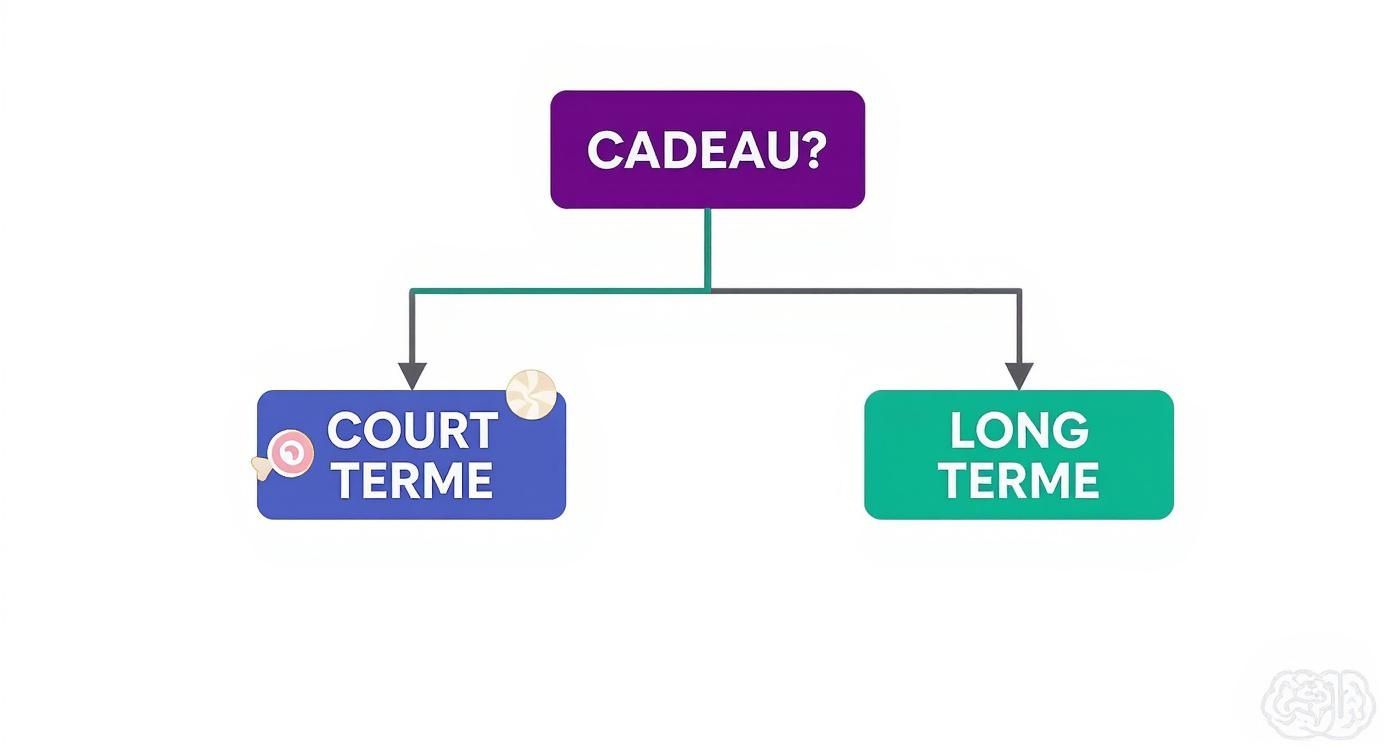
Ultimately, the choice often boils down to prioritizing tomorrow's self-confidence over the excitement of a few minutes.
Sustainability, a value that can be learned.
Finally, consider durability, both physical and emotional . A well-made, sturdy object teaches respect for things and lasts for years. It's also a choice that reflects more conscious consumption, an important value to pass on. Moreover, more and more families are prioritizing meaningful gifts, as evidenced by information on more responsible consumption .
In short, a lasting gift is one that continues to offer something long after it has been unwrapped. It becomes a tool for learning, a medium for creating, or an excuse to share a moment with family.
This grid can help you quickly assess the potential of each idea.
Evaluation grid for your Christmas gift idea
Use this chart to compare different gift ideas based on criteria focused on child development.
| Selection criteria | Questions to ask yourself | Example of a 'low potential' gift | Example of a gift with 'high potential' |
|---|---|---|---|
| Creativity & Autonomy | Can a child invent their own rules and stories? | Video game with a very linear storyline | A kit to create your own book or board game |
| Emotional Development | Does the gift help to express or understand one's emotions? | Action figure figurine | A diary or a card game about emotions |
| Sustainability & Evolution | Will the gift still be worthwhile in a year? | trendy toy | A musical instrument or a LEGO Technic set |
| Family Tie | Does the gift encourage spending time together? | Portable game console (for single-player use) | A cooperative board game or a gardening kit |
By keeping these points in mind, you are sure to choose a gift that truly matters.
Even though we're talking about Christmas here, this philosophy of "meaningful gifts" works for all occasions. If you're looking for more inspiration, articles like the one on 5 Gift Ideas for Mother's Day share the same approach.
The impact of a gift that tells its own story
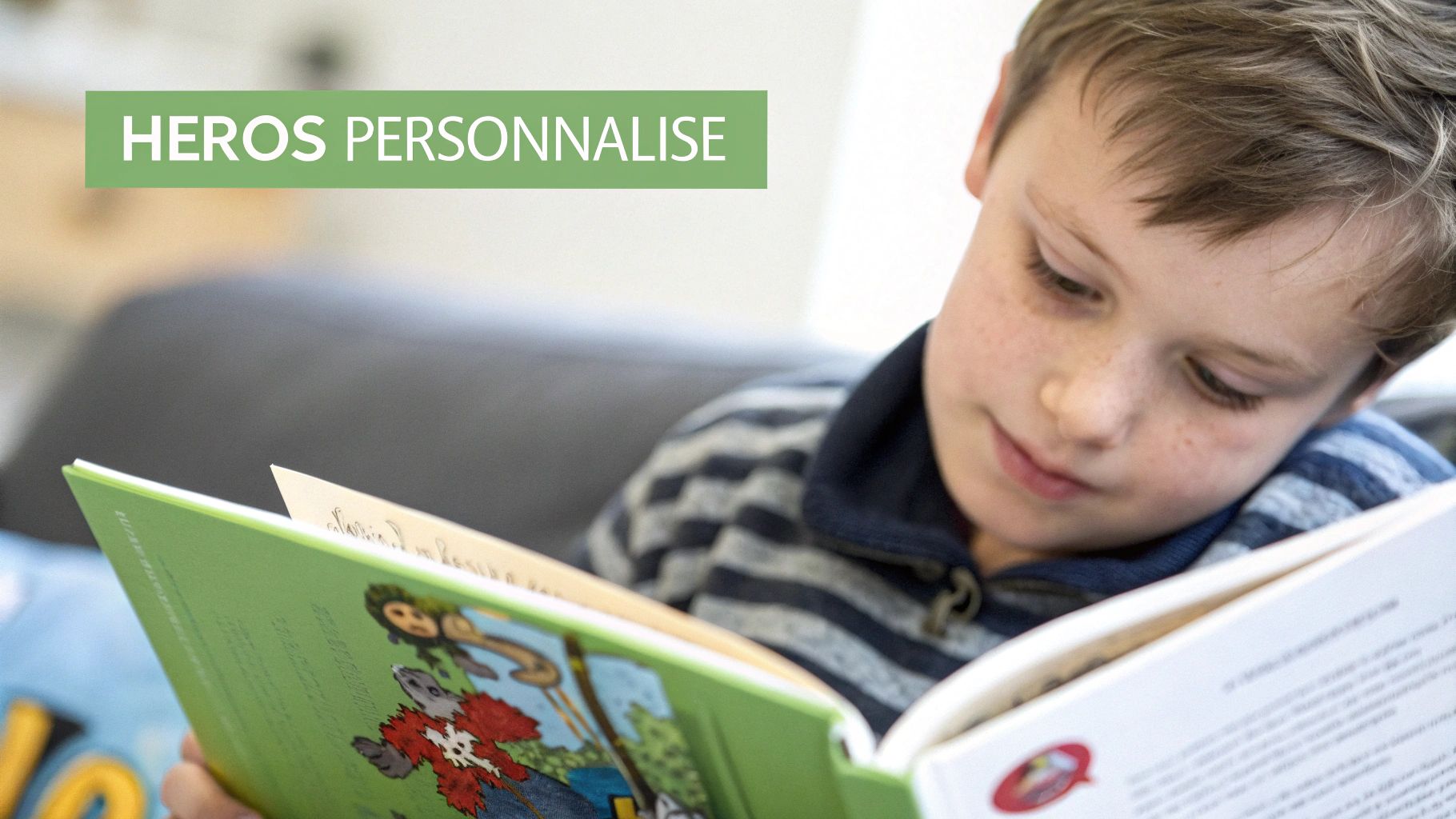
There are gifts that truly touch the heart. A personalized book, where your child becomes the hero of their own adventure, is a perfect example. It's the kind of Christmas gift idea that fosters self-confidence far more than a simple object ever could.
Imagine his reaction when he discovers himself as the main character, the one who is courageous, clever, and overcomes obstacles. He's not just reading a story; he's making those qualities his own. This boosts his self-esteem in a very concrete and natural way. Personalization creates a unique, almost intimate connection with the book, transforming reading into an anticipated and magical moment, far removed from a simple school assignment.
A mirror to build oneself
This type of gift acts like a positive mirror. It helps the child see themselves in the best possible light, to imagine themselves in situations where they demonstrate courage, kindness, or perseverance. It's a wonderful tool for boosting their imagination and showing them concretely all that they are capable of.
A gift like this fits perfectly into a more intentional approach to consumption, favoring durable and emotionally resonant objects. A personalized book is, by definition, a unique item to be treasured for a lifetime. It fully satisfies this need for durability, not only material but also emotional.
A concrete example: When Chloé read her name in the book, she whispered, "I'm the heroine!" This gift became a valuable tool for discussing perseverance with her, a central theme of her personalized story.
A gift like this goes far beyond reading. It opens a door to discussing important topics with your child, such as self-confidence, managing emotions, and the importance of never giving up. It's a gift that continues to give, long after the Christmas lights have gone out.
Make gift-giving an unforgettable family ritual
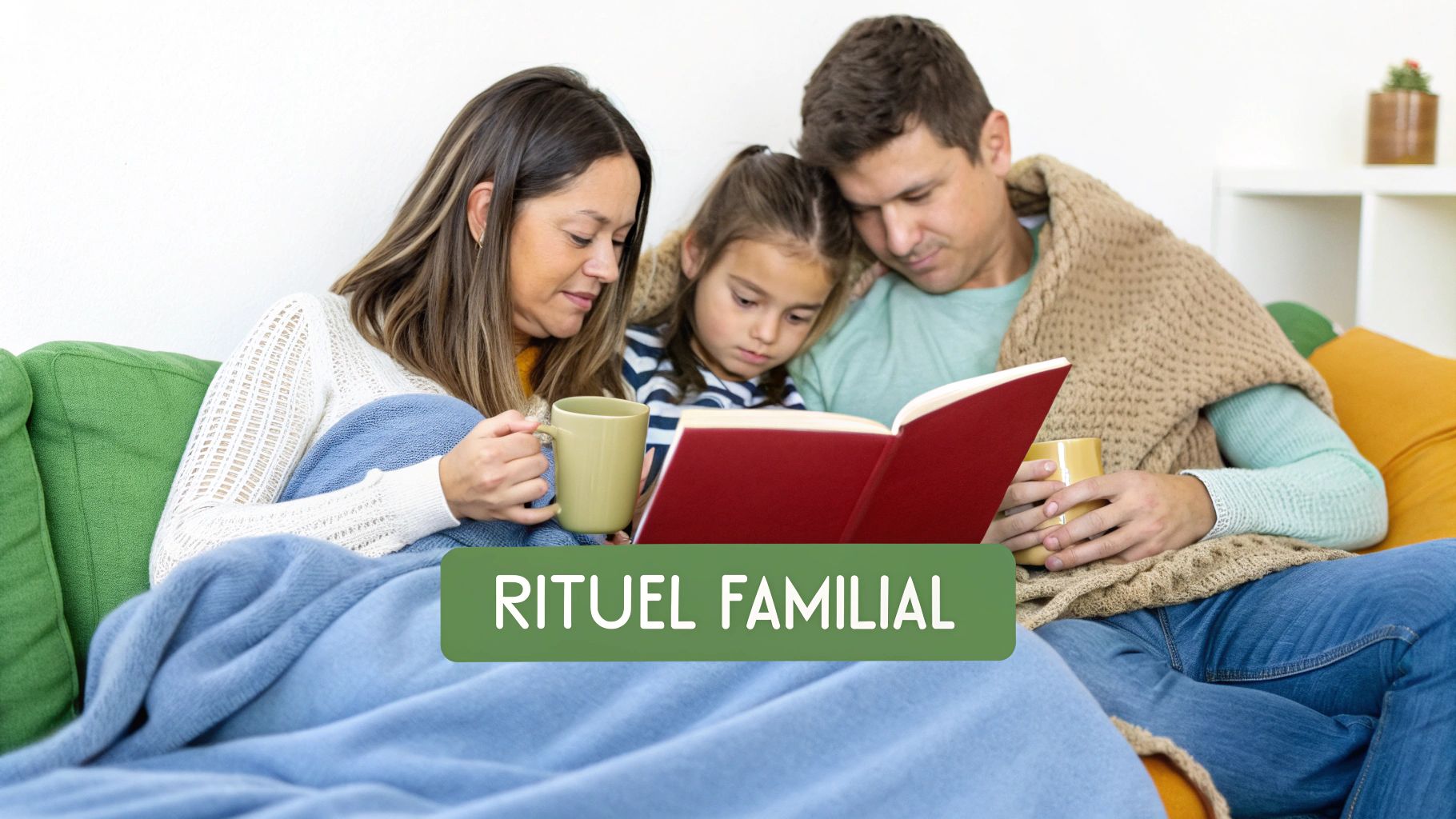
The true magic of a gift is revealed long after the wrapping paper has been torn. It takes shape in the way it's shared and incorporated into family rituals. Unwrapping a package offers instant joy, that's true, but transforming that experience into a shared moment—that's what creates memories that last a lifetime.
The idea is to create a small ritual that anchors the gift in a moment of parent-child connection. It's this ritual, far more than the object itself, that becomes the true treasure. Your presence, your enthusiasm… that's what multiplies the value of any gift.
Create moments that truly matter
Instead of letting your child discover their new toy alone in their room, plan a special time to enjoy it together. This quality time shows them that you're passionate about their world and that this gift is an invitation to experience new adventures as a family.
Here are some actionable tips for parents to turn a gift into a ritual:
- For a personalized book: Organize a "first reading evening". Settle comfortably under a blanket with hot chocolates and read the story aloud, perhaps taking turns.
- For a science kit: Plan a "little geniuses' afternoon". Put on old t-shirts as lab coats and carry out the experiments hand in hand.
- For a board game: Establish "Friday game night". The new game becomes the star of your next family gathering.
- For drawing materials: Prepare an "artist's studio". Take out large sheets of paper, put on some music and create side by side, each at their own pace.
These shared moments are the very heart of the gift. They send a powerful message to your child: "You are important, and I love spending time with you exploring what you enjoy."
These experiences strengthen family bonds and link the gift to a lasting positive emotion. In the end, your child will remember this warm moment of connection more than the object itself. And that's a gift that never fades.
A Christmas that has meaning for the whole family
Finding the perfect Christmas gift is so much more than just a toy hunt. It's a real opportunity to contribute to your child's development. Ultimately, what truly matters isn't the price tag, but the care and love you put into your choice.
By choosing gifts that stimulate their imagination, correspond to their true interests, and will accompany them as they grow, you are giving them something far more precious than a simple object. You are giving them tools to build their confidence, opportunities to share unique moments with family, and, above all, memories that will last a lifetime.
Moreover, intention is increasingly taking precedence over budget. In France, even though the overall holiday budget tends to decrease, families plan to spend an average of €297 on gifts alone. This figure is interesting: it shows that people are primarily looking for quality and meaning, not necessarily quantity. To learn more about this topic, you can take a look at this article on Christmas consumer trends .
Our parenting tips for a truly successful Christmas
If we had one piece of advice to give you, it would be this: take the time to choose each gift with your heart.
Forget the pressure of buying trendy toys that will be forgotten by January. Instead, look for that little spark, that unique gift that will bring lasting joy and support their personal growth. That's how you'll make this Christmas an unforgettable and meaningful time for your whole family.
Some questions that parents ask themselves
Choosing a meaningful Christmas gift isn't always easy. Here are a few tips to help you see things more clearly.
How can I be sure that a gift focused on development will please her?
The secret is to observe what truly captivates your child, beyond current trends. If they can spend hours inventing imaginary worlds, a story-creation kit is sure to be a hit.
Tip for parents: Involve him subtly, without spoiling the surprise. Start a conversation: "If you had the power to invent or learn anything, what would you choose?" His answer will be a goldmine for finding a Christmas gift idea that truly resonates with him.
How can you come up with a creative idea when you have a small budget?
The value of a gift is never measured by its price, but by the emotion it evokes and the connection it creates. Affordable and enriching options exist! Consider, for example, a subscription to a children's magazine that will pique their curiosity throughout the year.
You can also create your own "budding artist kit" with drawing or crafting materials. Ultimately, the most beautiful gift remains the thought and the time you share together around this activity.
A personalized book, isn't that a bit "babyish" for a 10-year-old?
Not at all! The 6-to-12-year-old age group is actually perfect for this type of gift. It's the age when they read more independently and their personalities begin to develop. Discovering themselves as the hero of an adventure that reflects their own challenges or strengths is incredibly powerful for their self-confidence at this key stage of their development.
Ready to give a gift that helps your child grow? Discover the My Book Story notebook, a perfect companion for cultivating self-confidence and creativity. https://mybookstory.co/products/le-carnet-my-book-story