


Imagine for a moment... What if a simple conversation could turn into a real moment of sharing and discovery with your child? That's exactly what the question game offers, a simple and powerful way to talk with children aged 6 to 12 to build even stronger family bonds.
What exactly is the question game?
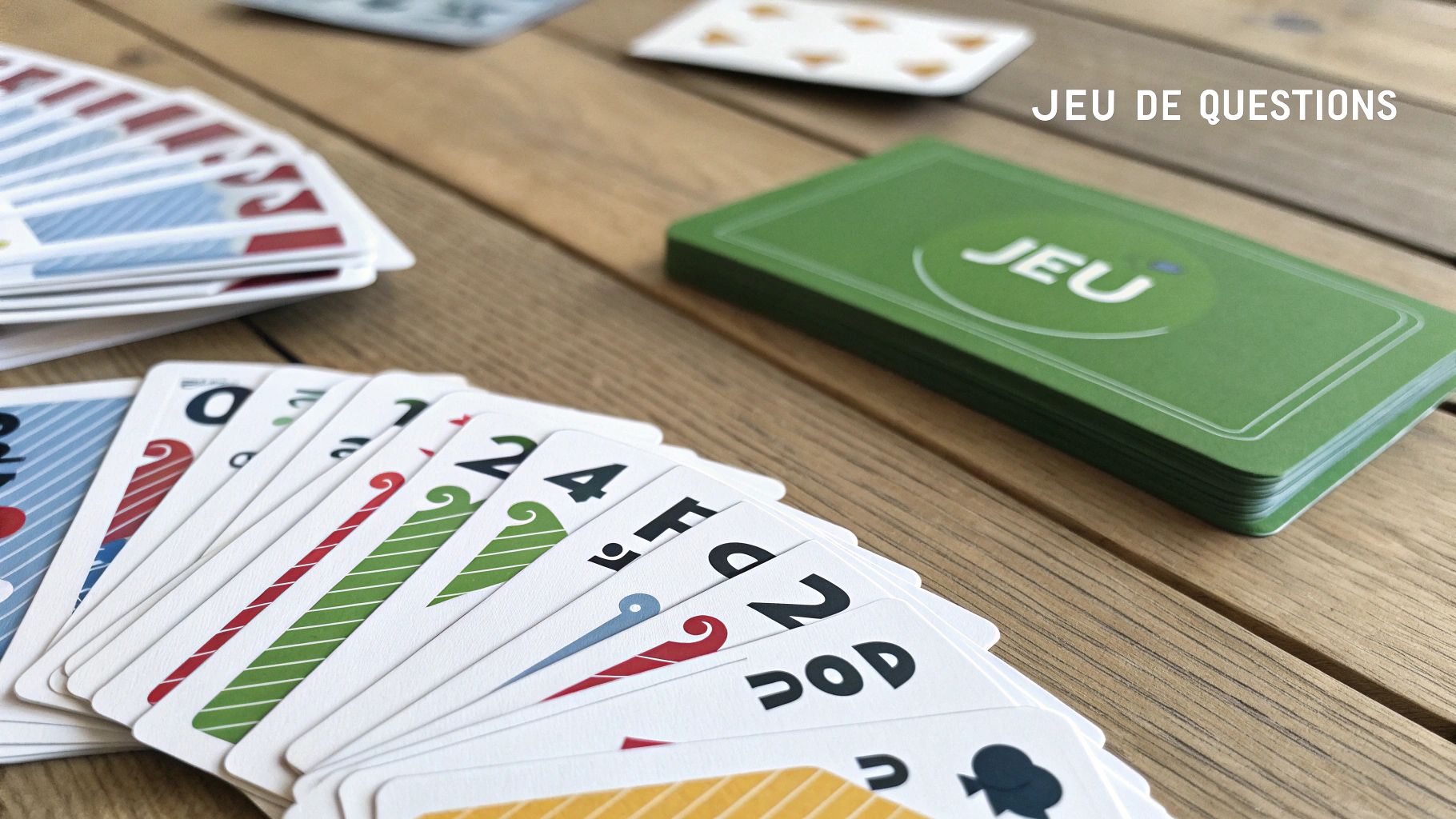
The principle is child's play, but its impact is immense. Forget general knowledge quizzes with a right or wrong answer. Here, the idea is quite different: you're invited to explore your child's inner world together.
See each question as a small key capable of unlocking the doors to your imagination, emotions, and dreams. We go far beyond the classic and often disappointing "How was your day?" to ask questions that invite genuine sharing.
A playground for growing together
The primary goal is to create a bubble of trust and kindness. It's a moment just for you, where your child feels that their voice truly matters, that their ideas are valuable, and that their emotions are valid.
This playful approach to communication is a real asset for its development. It allows it to:
- Boost his self-confidence by showing him that his opinion is valuable.
- Awaken their creativity by encouraging them to imagine, dream, and see things differently.
- Developing their emotional intelligence , by helping them put words to what they feel.
A trend that is gaining ground in France
This type of interaction is not only beneficial, but it's also increasingly popular. The quiz format appeals to many families in France because it skillfully blends the fun of games with the richness of emotional learning. This is clearly evident on platforms like YouTube, where educational and positive content is a huge hit. It demonstrates that parents and children are seeking more stimulating and meaningful interactions. To see how it works, take a look at this educational channel that manages to make 2,000 years of history fascinating in quiz format.
By turning conversation into a game, we break down barriers. We open the door to more sincere, more genuine discussions. That's the spirit of the question game: a simple little ritual to create great memories.
How this game fosters your child's development
A question game isn't just a fun way to spend time with the family. It's so much more than that. Each question you ask is like a little seed you plant, a subtle but effective nudge to help your child grow and thrive.
Far from being a mere pastime, this simple habit has a direct impact on essential aspects of his personality. It's a fantastic tool to help him build skills that will serve him throughout his life.
Boosting self-confidence
One of the first effects you'll notice is a real boost in self-confidence . Imagine the scene: your child shares a slightly crazy idea, a secret dream, or a little fear, and you listen, truly, without judgment. The message they receive is crystal clear: "What you think is important."
This validation is crucial. He understands that his ideas have value, which encourages him to speak up and trust his own judgment. The goal isn't to shower him with compliments, but to offer him a safe space where he knows his feelings are welcomed and respected.
Each question asked is a door you open for your child to explore who they are and assert themselves. It's an immense gift for their self-esteem.
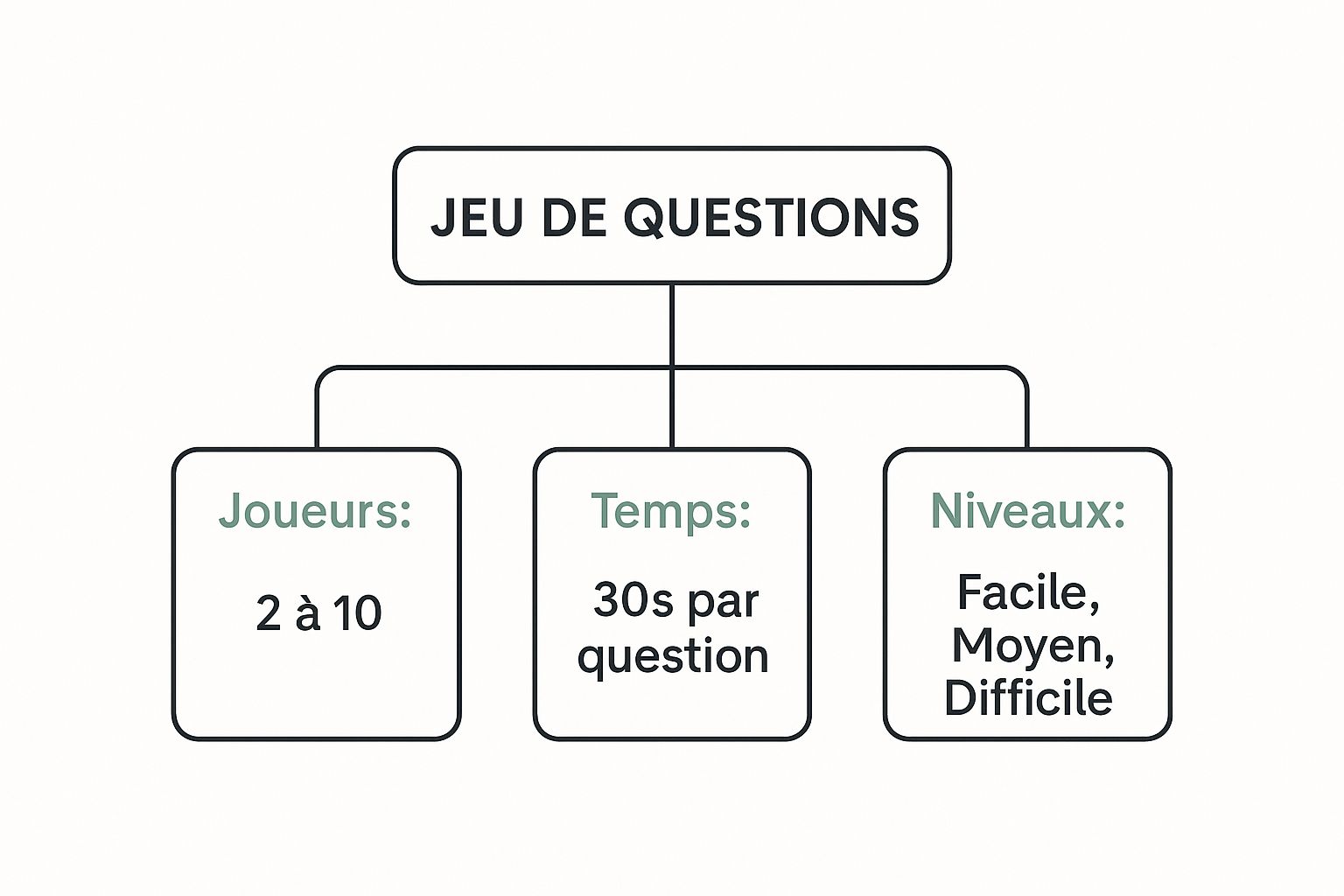
This simple diagram clearly shows how a few basic rules are enough to create a fun and fair framework for everyone.
Stimulating creativity and emotional intelligence
The question game is also an incredible playground for the imagination. A question like "If you could invent a new holiday, what would it celebrate?" encourages him to think differently, to create, to dream aloud.
At the same time, you're working on their emotional intelligence , without them even realizing it. When you ask them, "How did you feel when you finally finished your drawing?", you're actually helping them to:
- To put a name to one's emotions , to identify them clearly.
- Understanding what triggers your feelings is an essential step in learning to manage them.
- Developing empathy , simply by listening to what others feel and share.
To summarize the impact of this game on child development, the table below provides a clear view of the benefits.
Impact of question games on a child's skills
This table summarizes the direct benefits of question games on different areas of child development.
| Skills developed | Example of a positive impact | Preferred question type |
|---|---|---|
| Self-confidence | The child dares to express their opinions without fear of judgment. | "And what do you think?" or "What's your best idea on this subject?" |
| Creativity | He learns to imagine original solutions and to think outside the box. | "If you had a magic wand, what would you change?" |
| Emotional Intelligence | He identifies, names and better understands his own emotions and those of others. | "How were you feeling at that moment?" |
| Communication skills | He learns to formulate his thoughts and to listen attentively. | "Can you explain to me how it worked?" |
This table highlights how well-chosen questions can have a very concrete and positive effect.
Finally, it also strengthens their communication skills. Children practice organizing their thoughts to be understood and listening to what others have to say. These are the two pillars of healthy relationships for the future. Moreover, the desire to learn while having fun is everywhere, even on screens. The success of apps like the "French History Quiz" clearly demonstrates this. This enthusiasm shows that there is a real demand for playful learning methods, and quiz games fit perfectly into this trend. To learn more, you can take a look at the gaming engagement on Google Play .
How to transform the question game into a family ritual?
Turning a simple game into a family tradition, one of those precious memories that are cherished later in life, is much easier than you might think. The secret? Consistency. The idea isn't to add another constraint to already busy schedules, but to create a little ritual that everyone looks forward to.
Integrating this question game into your daily routine is child's play. It's not about blocking out an hour in the calendar, but rather about seizing those little moments of pause that you already share.

Find the perfect time for you
Every family has its own rhythm, its own music. The best moment will be the one that fits naturally into your daily life, without forcing it.
Here are some ideas to inspire you:
- During dinner : Instead of discussing tomorrow's plans, ask a question. It's a great way to disconnect from screens and truly reconnect.
- On the way to school : These few minutes by car or bus can turn into a mini-adventure where you discuss your dreams and desires.
- At bedtime : The atmosphere is calm, conducive to confidences. It's the perfect moment for gentler questions about emotions or dreams from the day.
The important thing is to choose a time when everyone is available, even for just five minutes. A short but sincere exchange is better than a long session where no one is really in the right frame of mind.
Create a cocoon of trust
For your child to feel comfortable sharing their thoughts, even the most outlandish or secret ones, the atmosphere you create is essential. This time must be a haven of kindness, a space where anything can be said without fear of judgment.
The only golden rule is that there are no right or wrong answers. Every thought, every emotion is welcomed with open arms.
This sense of security is key to encouraging honesty. Your child needs to feel that what they confide will be treated with respect and love. This is achieved through active listening, without interrupting, and by validating their emotions with simple phrases like, "I understand why you felt that way."
Give your ritual a concrete form
To make this moment even more special, why not give it a physical form? Creating an object dedicated to your game anchors this habit in everyday life and makes it a true family treasure.
Here are some concrete ideas for parents:
- The magic question box : Take a simple shoebox and decorate it together. Each person can slip questions onto slips of paper into it during the week. On the day, everyone takes turns drawing from the box!
- Our Conversation Journal : Use a pretty notebook, like the My Book Story journal, to write down questions and answers. Imagine the joy of rereading it in a few years and seeing how your child's thoughts have evolved!
- The jar of funny challenges : Mix the questions with small, friendly challenges ("Give the nicest compliment to the person on your right"). It's perfect for relaxing the atmosphere and strengthening bonds.
By creating these objects, you show your child that this time spent together is important. You're not just playing a game; you're creating memories and strengthening the bonds that unite you, day after day.
50 conversation starter question ideas
Sometimes, the hardest part is getting started. Finding the right question to break the ice can seem daunting. To give you a little boost, here are 50 examples to spark lively and laughter-filled conversations with your child.
Think of this list as a box of ideas, a starting point. The goal isn't to follow everything to the letter, but rather to pick and choose what inspires you and adapt it to your child's unique personality. Even better, invent your own questions based on what they're currently passionate about!
To get the imagination off the ground
These questions are like passports to fantastical worlds, where anything is possible. They're perfect for encouraging your child to think outside the box and share their wildest ideas, without any barriers.
- If you could choose a superpower, which would it be and what would you do with it?
- Imagine if our pets started talking. What do you think they would say to us?
- If you had to invent a new holiday, what would we celebrate?
- If you could build a cabin anywhere in the world, where would you put it?
- Draw me a picture in your head of the kindest monster that exists. What does it look like?
- If your toys came to life at night while you slept, what would they do?
- Tell me about the funniest or craziest dream you've ever had.
- If you could add one new rule to the school, what would it be?
- Imagine you are a great explorer. What unknown land would you like to discover first?
- If you could transform into any animal for a day, which one would you choose?
To learn how to talk about your emotions
Being able to put words to what one feels is a fundamental skill. These questions are a gentle way to help your child identify and express their emotions in a space where they feel safe and heard.
Each response is a small window into their inner world. Welcome everything they share, whether it be joy or more complicated feelings, with the same compassionate listening.
- What's the nicest thing someone has done for you this week?
- Tell me about a time when you felt really proud of yourself.
- Is there anything that's bothering you a little right now?
- What's the last thing that made you laugh really, really hard?
- How does it feel inside when you succeed at something difficult?
- What is your favorite feeling? (for example, being happy, calm, excited)
- What makes you a little sad from time to time?
- Describe a time when you felt truly loved.
- If anger were a color, what color would it be for you today?
- When you're a little scared, what gives you courage?
To strengthen your bond
This little question game is also a golden opportunity to forge even stronger bonds. These few ideas invite you to share memories, tastes, and dreams, building a wonderful connection through conversation.
To help you get started, here are a few suggestions. The idea is to initiate a conversation where everyone can express themselves freely and learn more about each other.
Question ideas by topic
| Question category | Main objective | Example question |
|---|---|---|
| Shared memories | Strengthening the emotional bond through good times. | "What is your best memory with me?" |
| Mutual curiosity | To show a genuine interest in the other person's world. | "If you could ask me any question, what would it be?" |
| Family rituals | Value the traditions that unite you. | "What is your favorite family tradition?" |
| Joint activities | Identify what you enjoy doing together. | "What do you like doing most, just the two of you?" |
| Transmission | Recognizing shared knowledge and values. | "Is there anything you would like to teach me?" |
This table is just an overview, of course! Feel free to invent your own categories based on what matters to you and your family.
And above all, remember the golden rule: this game is a two-way street. Once your child has answered, it's your turn to share your own answer. This makes the conversation much richer and shows them that sharing works both ways. It's the best way to strengthen your connection.
Transforming everyday conversations into unforgettable memories
The conversations we have with our children are a little bit of everything: bursts of laughter, whispered secrets, and slightly crazy dreams shared in hushed tones. But imagine for a second if these precious moments didn't vanish with time. What if they could become a true family treasure, an object we could hold in our hands and rediscover years later?

This is precisely where the idea of a journal like My Book Story becomes so valuable. By taking the time to write down your child's answers, you're doing much more than simply writing. You're transforming fleeting conversations into lasting memories. It's a simple gesture, but one imbued with immense emotional value.
To see his thoughts grow, page after page
A journal is like a time machine. It becomes a privileged witness to your child's development. The answer to the question "What is your biggest dream?" will obviously not be the same at age 7 as it is at age 11. Rereading these pages together, a few years later, is an incredible way to retrace the journey, see their interests evolve, and their personality develop.
It's also a very concrete way to show him how much he's grown. Not just in height, but in maturity, ideas, and character. This little trip down memory lane boosts his self-confidence because he has proof of his own progress right before his eyes.
Preserving these exchanges is a form of transmission. Moreover, this idea of memory is found everywhere, even in games. Did you know that in some history quizzes, 74% of players know the date of the abolition of the death penalty in France? This clearly demonstrates our attachment to shared historical markers. If you're interested, you can take a look at these statistics on French history here .
The journal transforms words into a legacy. It captures the essence of childhood and preserves it for the future, creating a bridge between who your child is today and who they will become tomorrow.
Make the newspaper an ally, not a chore
To ensure this habit takes root smoothly, there's only one golden rule: journaling must remain a pleasure. It then becomes much more than just a notebook; it's a true tool for fostering dialogue.
Here are some practical tips for parents:
- Set aside a short weekly time . One page per week dedicated to your quiz is enough. It can become your little Sunday evening ritual, a quiet moment to remember the good times of the week.
- Let their creativity flow . Your child doesn't have to limit themselves to words! Encourage them to draw, make collages, and add color. The journal becomes their own unique space for expression.
- Switch roles! Suggest that they ask you questions in turn, and play along by writing down your own answers. This exchange strengthens the bond and shows them that you, too, have a whole world to share.
Asking questions: a small habit that changes everything in everyday life
As you've probably gathered, the question game is much more than just a simple pastime. It's a real investment in the relationship you're building with your child, day after day. It's a simple yet incredibly effective way to nurture their curiosity, develop their empathy, and strengthen that precious bond of trust you share.
Imagine that each question is a small key. Not a key to interrogate him, but a key that unlocks a door to his inner world. A fascinating universe, filled with thoughts, dreams, and emotions just waiting to be shared with you.
There's no need to wait for the perfect occasion. The magic of these exchanges lies precisely in the small moments of everyday life. A single question, asked this evening at dinner, can be enough to spark a wonderful conversation and create a lasting memory.
So why not start today? Begin with a simple question, the one that comes naturally to you. You'll be surprised to see how this little ritual can build solid foundations of complicity and understanding.
Ultimately, it's these small moments of genuine sharing that will forge your child's most cherished memories. By playing this game, you're doing much more than just chatting: you're building a true emotional legacy for them.
Questions you may have about family trivia games
Adopting a new habit at home always raises a number of questions. And that's perfectly normal! To help you embark on this exciting adventure with confidence, here are some answers to the most frequently asked questions from parents.
My child is a little shy, what should I do if he doesn't want to answer?
Above all, no pressure. Shyness is a perfectly natural reaction, especially at the beginning. The goal isn't to get an answer at all costs, but to create a little bubble of trust where your child feels free to speak... or not.
Advice for parents: If your child is hesitant, lead by example. Answer the question yourself, in your own words, simply. You can also introduce a "pass" rule: they can say "I'll pass" or choose another question. The important thing is that they understand this is a game, a fun activity, not an interrogation.
At what pace should we play?
There are no hard and fast rules here. The quality of the time spent together will always be more important than the quantity . Some families will love making it a little ritual every evening at dinner. Others will find their happiness in a pleasant, quiet get-together on Sunday morning.
Advice for parents: The key is to find a rhythm that works for your family. A genuine five-minute chat once a week is better than a game that feels like an obligation every night. Listen to your own desires, and those of your children. Play should remain what it is: a source of shared joy.
What do you do when the children are of very different ages?
Excellent question, and it's a challenge for many parents! The key is to adapt the level of the questions to each child. You don't speak to a 6-year-old the same way you speak to a 12-year-old.
- For a 6-year-old: Stick to concrete things, things that are part of their world. Instead of asking "What is happiness?", say: "What made you smile the most today?" It's direct and speaks to their day.
- For a 12-year-old: Here, you can start exploring more abstract ideas that encourage reflection. A question like, "If you had the power to change one thing in the world, what would it be and why?" invites them to share their perspective and values.
And to keep track of all these precious exchanges, the My Book Story journal is a wonderful companion. It's their own special space where your child can write, draw, and see their thoughts evolve over time. Take a look at the My Book Story website to see how it could enrich your family ritual.