


We often have a very specific image in mind when we give a creative journal to our child. We expect an explosion of imagination, pages that magically fill with stories and drawings. But in real life, creativity sometimes needs a little nudge to get started. Understanding this gap between our expectations and reality is key to making this journal a true moment of sharing, growth, and emotional well-being for your child.
Navigating between the dream and the reality of creative journaling
As parents, we all have this slightly idealized vision: our child, sitting quietly, absorbed in their My Book Story journal, filling the pages with incredible stories and vibrant illustrations. It's a beautiful image, full of promise for their personal development.
However, reality is often a little different. The initial enthusiasm can quickly give way to the dreaded blank page syndrome. The "I don't know what to draw" or "I don't know what to write" moment arrives sooner than expected. This isn't a failure, far from it. It's simply a normal stage in the creative process and development of a child between the ages of 6 and 12.
Common parental expectations vs. the child's lived reality
To get a clearer picture, let's compare what we imagine as parents and what the child actually experiences with their new journal.
| What we expect as parents... | ...and what the child often experiences |
|---|---|
| Immediate autonomy | We think he will use it on his own, every day, spontaneously. |
| Explosive creativity | We expect masterpieces and complex stories from the very first page. |
| Fluid emotional expression | We hope that he will effortlessly confide his deepest feelings there. |
| Constant motivation | We can imagine a pleasure and curiosity that never wanes. |
This chart doesn't mean that journaling isn't a good idea. On the contrary! It simply shows where we, as parents, can gently intervene to support our child. The goal isn't to create a work of art, but to create a safe space where they feel secure exploring their inner world and building their self-confidence.
True success isn't a perfectly filled-out journal. It's the trust and dialogue it helps to build, little by little, between you and your child.
This guide is precisely here to give you the keys and concrete tips to transform these small challenges into a close and fulfilling family ritual.
Breaking the myth of spontaneous creativity in children
Many parents imagine that the My Book Story notebook will magically transform their child into an artist. It's a lovely expectation, but the reality is more nuanced. Creativity, especially in 6- to 12-year-olds , isn't a switch you flip; it's a small flame that needs to be nurtured with care.
This gap between expectation and reality is perfectly normal. If your child seems stuck staring at a blank page, it's often not due to a lack of ideas, but rather a fear of "doing it wrong" or not meeting your expectations. This simple apprehension can completely paralyze them. That's where you, as a parent, come in.
To become a benevolent guide, not a judge
Your role isn't to expect a masterpiece on every page, but to become its guide and biggest supporter. The goal? To transform what might seem like a chore ("create something") into a fun game of exploration. Every stroke, even the most hesitant, is a victory for its self-confidence.
Here are some practical tips to help him get started, without any pressure:
- Introduce sentence starters: Give them a starting point they can complete by writing or drawing. For example: "If I were a superhero, my power would be... because..." or "Today, my day was the color... because..."
- Suggest some fun little drawing challenges: Keep it light and playful. How about "Draw a funny creature by mixing your favorite animal and a vegetable"? Or "Imagine a secret treehouse in the clouds"?
- Playing with doodles together: Make a random doodle on the page and challenge your partner to transform it into something recognizable. A simple cloud can become a sheep, and a loop, a smiling face. Take turns for a fun, bonding moment!
A child's creativity isn't measured by the perfection of their drawing. It's measured by the freedom they feel while exploring it. The important thing is to embark on the adventure, not to arrive at a perfect destination.
By adopting this approach, you completely change the rules. The journal is no longer a talent test, but a true playground for personal development. This supportive approach will give them the courage to take risks and, above all, to trust their own ideas.
Helping your child express their emotions through writing and drawing
We all dream that this journal will become our child's secret confidant, a place where they can share their joys, anger, and fears. It's a legitimate expectation and a wonderful idea for their emotional well-being. But let's be realistic: a child between 6 and 12 years old doesn't always have the vocabulary to describe complex emotions. Putting words to what one feels is a skill that is learned, little by little.
This gap between the expectation of fluent expression and the reality of learning is common. We see it everywhere, even on a national scale. Take an external example: a survey on the concerns of the French often reveals a disconnect between collective aspirations and everyday experience. Similarly, expecting a child to express their emotions clearly sometimes means forgetting that they are still developing their emotional intelligence.
Providing the right tools to translate emotions into words and images
Your role, as a parent, is to guide him. You can give him the tools to transform a somewhat vague feeling into a clearer thought. The idea is not to force him, but rather to build bridges between his inner world and the blank page that awaits him.
Here are some concrete suggestions to help him:
- Try the "emotional weather forecast" : Suggest that they draw a sun for joy, a cloud for sadness, or a storm for anger next to the date. It's a simple and visual way to help them identify what they're feeling, without needing long explanations.
- Ask open and kind questions : Instead of the classic "So, how was your day?", try more targeted questions that encourage reflection. "What was the funniest moment of today?" or "Is there anything that made you a little sad?"
- Validate every emotion, without ever judging : It is essential that your child feels safe. Simple phrases like "I understand that you felt that way" or "It's normal to be angry sometimes" create a climate of trust where everything can be said and recorded in the journal.
The journal is not an end in itself. It is above all a wonderful pretext for getting to know each other, with your kind support in the background.
With a little help, his journal can truly become the precious friend you envisioned. It will become a wonderful tool to help him manage his emotions, build his self-confidence, and prepare for the future.
Turning the newspaper into a shared family ritual
We all have this expectation: our child grabbing their new journal and diving into it with passion, completely independently. But let's be honest, after the initial enthusiasm, the journal often ends up gathering dust on a shelf. It's a classic gap between expectation and reality, but it's absolutely not inevitable. The key is to transform what could be a solitary activity into a genuine ritual of family connection.
Instead of leaving your child alone with a blank page, why not integrate this moment into your routine? Think of it as a quiet time after dinner or just before bedtime stories. The idea is to create a shared space, a moment everyone looks forward to.
This gap between desire and practice is found in many areas. For example, even though the entrepreneurial spirit has never been stronger in France, as shown by certain data on French entrepreneurial aspirations , the reality requires a framework and support to materialize. Similarly, creative journaling needs a supportive environment and a little encouragement to truly flourish.
The infographic below clearly shows how, with the right parental support, we move from a somewhat passive expectation (the child who manages on their own) to a much richer reality for their development.
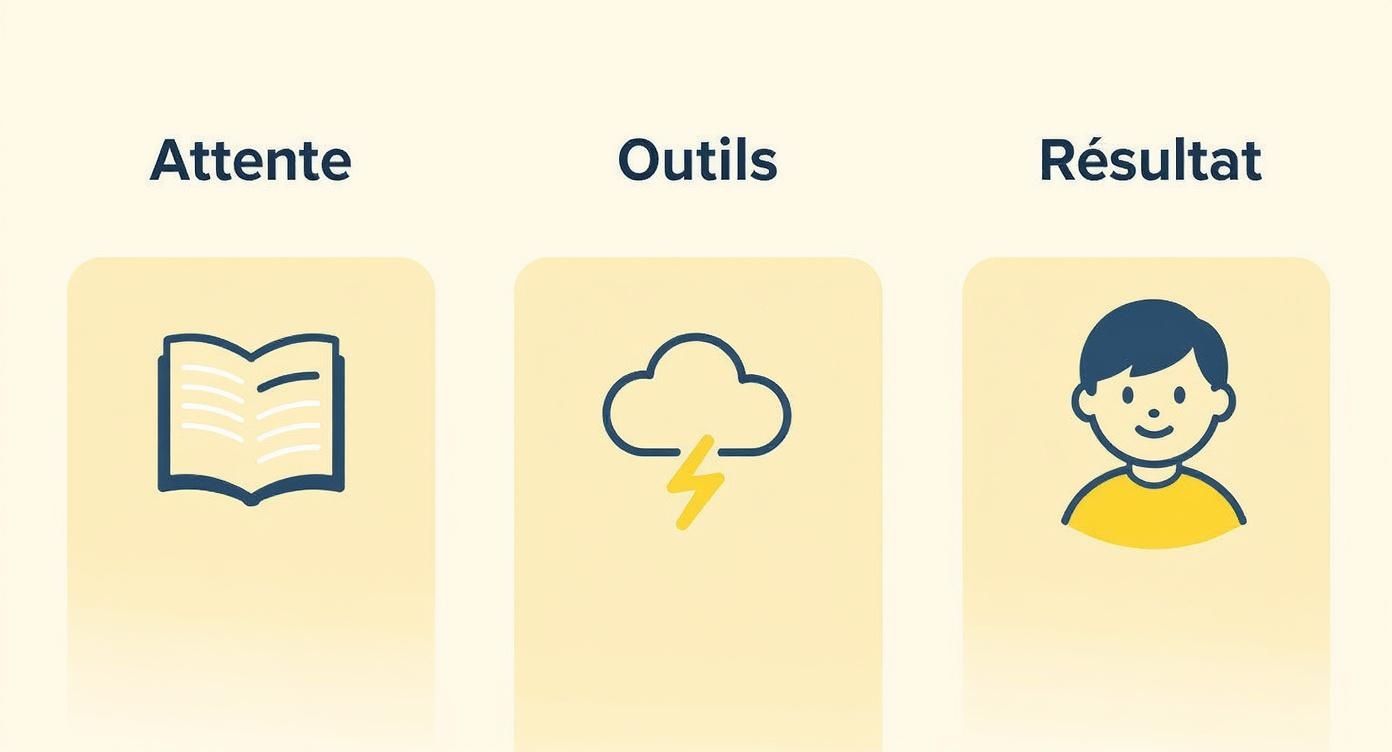
It perfectly illustrates that your presence and the right tools are the bridge that leads to a positive and fulfilling outcome for your child.
Create a special and shared moment
For it to become a true family ritual, the atmosphere is paramount. It's not just another chore, but an invitation to relax and bond.
- Make yourself comfortable : A hot drink, such as herbal tea or hot chocolate, can be enough to mark this break and make it special.
- Create a calming atmosphere : A little soft music in the background often helps to concentrate and feel good.
- Lead by example, without imposing anything : Take your own notebook and put it next to his. You can jot down your thoughts, draw something, or simply list a few positive moments from your day. Just sharing the activity is enough to take the pressure off writing.
This shared moment forges an incredibly strong and reassuring bond. The journal then becomes a pretext for spending quality time together, which strengthens your child's emotional security far more than a perfectly filled page.
The way you approach this moment can change everything. The following table compares two parenting approaches to help you visualize the difference.
Comparison of parental approaches to the diary
| Criteria | Approach to Waiting (Child alone) | Approach to the Ritual (Parent-Child) | Result for the Child |
|---|---|---|---|
| Perception of activity | Perceived as a "homework" or a task to be done alone. | Seen as a moment of play and sharing. | The child develops a positive and voluntary relationship with writing and creativity. |
| Blocking management | The child feels alone facing the blank page, risking giving up. | The parent suggests ideas, asks questions, and reassures. | The child gains confidence and learns to overcome creative obstacles. |
| Emotional expression | Difficulty expressing complex emotions without help. | The child is guided to name and understand their emotions in a safe environment. | Improving emotional intelligence and family communication. |
| Motivation | External and fragile, dependent on the mood of the moment. | Internal, fueled by the pleasure of the shared moment. | Motivation becomes sustainable and the habit is more easily established. |
By choosing the ritual approach, you are not just giving your child a journal; you are offering them a safe space to express themselves and a precious memory of connection with you.
Overcoming the fear of the blank page and perfectionism
One of the most common, and often unconscious, expectations is our desire for our child's journal to be "perfect" or impressive. Even young children can feel this pressure and become completely blocked, terrified of disappointing us or not living up to these expectations.
However, the reality of the My Book Story journal is quite different. It wasn't designed for performance, but for experimentation and personal growth. It's a true playground for ideas, where every doodle has its place and importance. For your child to truly make it their own, it's crucial to defuse this quest for the perfect page.
Change your posture to unleash your child's creativity
This gap between our aspirations and reality isn't limited to the family sphere. A survey analyzing young people's aspirations and disillusionment with work, for example, reveals very high expectations for their future jobs, often followed by a confrontation with the realities of the job market. Similarly, our expectations as parents, however well-intentioned, can create unnecessary pressure on our children.
To help your child thrive, sometimes all it takes is changing the way we react to their creations.
- Value the effort, not just the result: Rather than saying "It's magnificent!", try an approach that invites discussion and values the process. For example: "I love how you used all those colors. Tell me the story behind them." or "I can see you really enjoyed making this!"
- Celebrate "mistakes" as opportunities: A line that goes outside the lines? A color that bleeds? Present it as a fun discovery, a "surprise idea" from the pencil that makes the drawing unique and special.
- Encourage exploration and risk-taking: Use language that shows anything is possible. Phrases like "What if you tried drawing with your left hand just to see?" or "What crazy idea could you add here for fun?" completely demystify the act of creating.
This change in attitude is fundamental. It allows the child to associate their journal with the freedom to be themselves, fostering healthy and lasting self-esteem.
By adopting this approach, you transform the dilemma of expectations versus reality into a tremendous opportunity for your child's growth. The journal then becomes a true ally for their emotional well-being.
How can we transform the experience into a truly positive moment?
Ultimately, for the journal adventure to be a success, we sometimes simply need to adjust our expectations as parents. The idea isn't for your child to produce a work of art, but for them to find in these pages a refuge to discover themselves, explore their feelings, and, in the process, strengthen their bond of trust with you.
The true magic of this project isn't in the number of pages filled. It's in the shared laughter, the whispered confidences, and above all, the simple joy your child takes in creating. Every drawing, however clumsy, every hesitant word, is a small victory for their development.
The secrets of a successful family adventure
Never forget that your role is that of a supporter, not a judge. To ensure the experience is enriching for both you and your child, keep these three ideas in mind:
- Patience is your best ally: Creativity cannot be forced. There will be good days and bad days. That's part of the process, and it's perfectly normal in a child's development.
- Encouragement above all: What matters is the journey, not the destination. Praise the effort, the courage to embark on it, whatever form it takes.
- Your presence makes all the difference: Simply being there, attentive and available, is the greatest gift. Sharing this moment, even in silence, transforms it into a precious ritual of connection that nurtures their emotional security.
Think of it as a marathon, not a sprint. Every little step, every moment of connection, makes this journal much more than just a notebook: a true treasure for your child's development.
So, savor this unique journey into the heart of her imagination. That's where the greatest reward for her self-esteem and your relationship lies.
We answer your questions about creative journaling
It's normal to have lots of questions when embarking on the adventure of creative journaling with your child. There can sometimes be a world of difference between what you imagine and what actually happens! Let's untangle the most frequently asked questions together so that this experience is a success for both you and your child.
My child is blocked and doesn't want to write, how should I react?
Above all, don't force it. Writing can sometimes seem intimidating, a bit like a blank page at school. The idea here is to have fun and promote well-being, not to do homework.
Parenting tip: Suggest other ways for your child to write about their day: a drawing, a collage with magazine clippings, or even stickers to represent their emotions. You can also become their "personal secretary" and write down what they dictate. The key is that the journal remains a game, a moment of shared enjoyment, and not a new chore.
Should it be used every day?
Let go of the expectation of a perfect daily ritual. The key is regularity and the quality of the moment, not frequency at all costs.
Parent tip: A 20-minute session twice a week, where you really sit down together, is often much more enriching than a rushed 5-minute session every evening that ends up feeling like a chore. Let your child find their own rhythm. When they enjoy it, the desire to do it again will naturally follow.
Do I have the right to read what he writes?
The answer is no, unless he spontaneously shows it to you. His journal is his own space, his secret garden. It's a place where he needs to feel completely safe to put everything down, without filters or fear of judgment.
By respecting his privacy, you teach him the concept of respect and strengthen your bond of trust. If he wants to share something he's proud of, a drawing, or a thought, he'll know he can come to you safely. Encourage this sharing, but never demand it.
The My Book Story creative journal was designed to guide your child on this wonderful adventure. Each page is a new invitation to discover themselves and express themselves freely, fostering their self-confidence and well-being. Discover the My Book Story journal and embark on this creative journey together .