


As parents, we've all experienced that little pang of disappointment: the gap between what we hoped for our child and what actually happens. It's the same with creative journaling. You dreamed of seeing your child pour out their thoughts and masterpieces, but instead, you find blank pages or a few scribbles. Rest assured, this is perfectly normal . It's even a healthy stage in their personal development.
The vast gap between your child's dream and notebook
Do you remember the day you gave your child that famous creative journal? You were full of good intentions. You imagined it as a special, comforting ritual, a safe haven where your child could share their emotions, boost their confidence, and let their creativity flourish. In your mind, the pages were filled with beautiful drawings and touching little stories.
But reality is often less idyllic. The notebook gathers dust on a shelf, or when it's finally opened, you find three felt-tip pen marks, stickers haphazardly placed inside, and a drawing of a video game character. This clash between your expectations and reality can easily lead to disappointment, or even worry.
Why are our expectations as parents so high?
It's simple: as parents, we want the best for our children. We provide them with tools for their development and, without realizing it, we project our own desires for them onto them.
- We would like them to express their emotions clearly: We hope that the journal will become a kind of decoder of their inner world.
- We dream that they will develop a certain discipline: We imagine that they will put in a little bit of it each day, like a soothing ritual.
- We value the artistic side: We want to see beautiful things, concrete results that reassure us about their creativity.
But this difference in perspective isn't a failure for anyone, neither for you nor for your child. It's simply a sign that you're not looking at the same thing, and that's perfectly normal.
The goal of a creative journal isn't to produce a perfect work of art. It's the exploration that counts. Every blank page, every doodle, every sticker is a small step on your personal journey.
Your role isn't to guide their steps, but rather to create a space where they feel free to try, to make mistakes, to start again, without ever fearing judgment. This guide is precisely for that purpose: to help you let go and shift your perspective. Together, we'll explore how to transform this journal into a true playground, a place for growth, and, above all, a way to strengthen the bond between you.
Understanding the (often hidden) expectations of parents
As a parent, your primary desire is for your child to thrive. That's perfectly normal. This desire, however well-intentioned, influences our expectations, sometimes without us even realizing it. By giving a creative journal, you're not just giving a notebook. You're also investing a whole host of hopes for their well-being and development.
The gap between our expectations and reality often stems from these hidden desires. We secretly hope that this journal will become a magical tool for developing certain skills, and we forget the essential point: to see it simply as a space of freedom for our child.
Deciphering our own aspirations
Our expectations reflect what matters to us. If we value discipline, we'll expect our child to complete a page every day, without a single mistake. If communication is our priority, we'll hope they'll express their emotions with precise and clear words.
Even if they stem from good intentions, these projections can create unintentional pressure. The child ends up feeling that this journal is no longer entirely their own. It becomes a place where they must fulfill a need that isn't theirs, and it's often at this point that interest begins to wane.
Identifying our expectations is the first step towards being able to set them aside. The goal isn't to stop wanting anything for our child, but to ensure that our desires don't become obstacles to their creativity.
To better visualize this discrepancy, here is a small table that contrasts the hopes of parents with the reality experienced by a child.
Table of parental expectations in the face of the child's reality
This chart highlights the contrast between parents' hopes for creative journaling and the actual use a 6-12 year old child makes of it.
| Parent's expectation | The reality of the child (6-12 years old) | Advice for adjusting your perspective |
|---|---|---|
| "My child will write about their emotions every day." | The child draws, scribbles, sticks on a sticker, then leaves the journal aside for a week. | Regularity is not an end in itself. The important thing is that the journal remains an accessible refuge when the need arises. |
| "Its pages will be neat, colorful, and full." | The pages are sometimes "draft", with a single word, a quick collage or even crossed-out words. | Disorder is part of the creative process. Every mark, even the simplest, has its purpose for the child. It's their space, not a work of art. |
| "He's going to show me and explain what he did." | The child keeps their diary secret or doesn't want to talk about it. It's their private world. | Respect their privacy. The journal is a safe space precisely because they are not obligated to share it. Trust is key. |
| "This will help him manage his anger better immediately." | It can take time. Sometimes he'll just draw monsters without any explanation. | Journaling is an outlet, not instant therapy. Let the process unfold at its own pace, without expecting any visible results. |
The most important thing to remember is that the goal is not to produce "beautiful pages", but to give the child a tool that they can freely appropriate.
This image illustrates the journey well: the parent's expectation (a very logical brain) and the child's reality (a spontaneous scribble) must come together to reach the true objective: a sincere emotional connection (the heart).
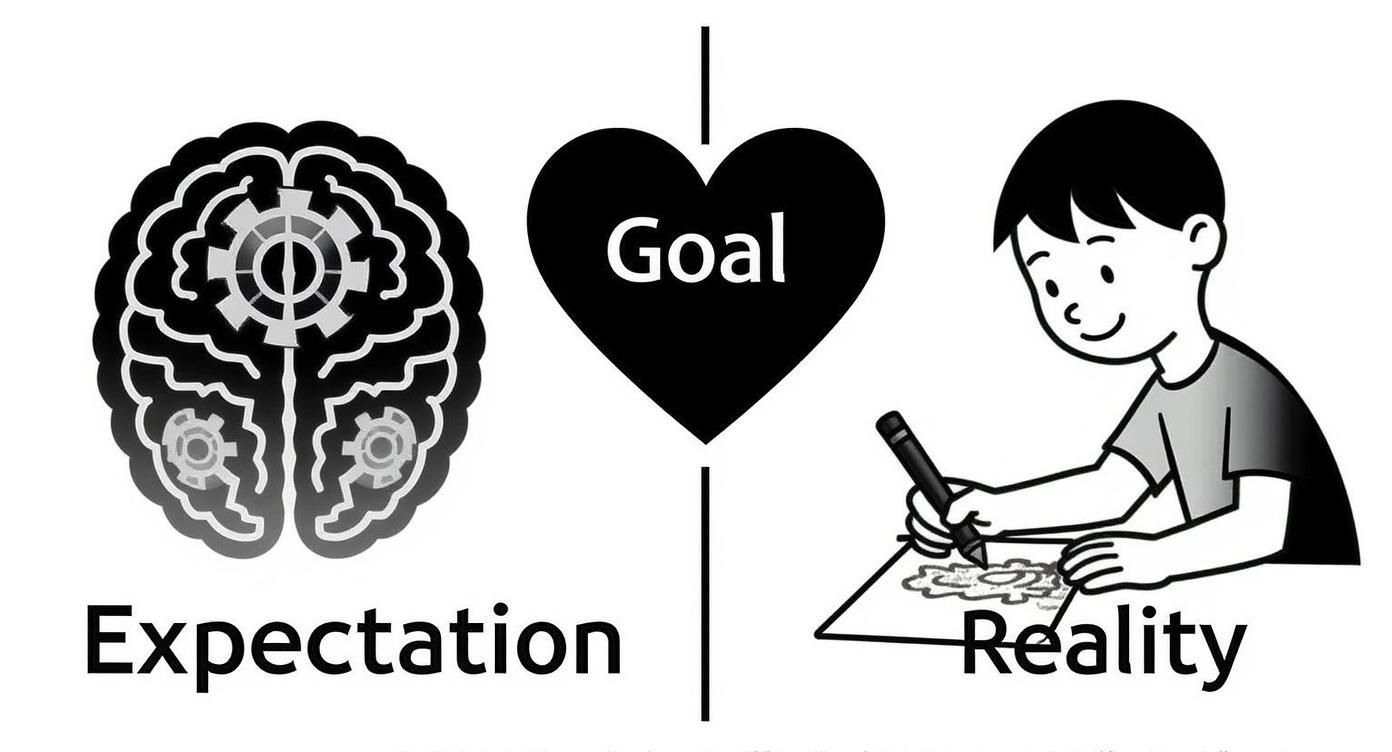
It is clear that the shortest path to a child's well-being is not to try to rationalize everything, but to accept their way of doing things, as it is, in order to better support them.
How can you tell if your expectations are getting the better of you?
It's not always easy to spot your own projections. Here are a few signs that might give you a clue:
- You feel a little disappointed. If you find yourself disappointed by an almost blank page or a simple collage, it's probably because your expectation of a "beautiful" result has taken over.
- You suggest improvements. Phrases like "You could add some color here" or "Why don't you write down what happened to you?" turn an invitation into a directive.
- You make comparisons. Whether it's with a brother, a sister, or your idea of what "other children" produce, comparison is almost always a sign of performance expectations.
Becoming aware of these reflexes is already a big step. It doesn't make you a bad parent, just a human parent. The important thing is to recognize these moments so you can adjust your approach.
By balancing your aspirations with your child's actual needs, you transform the journal. From a tool for achievement, it becomes what it should always have been: a safe haven for their imagination. You give them the freedom to be themselves, unfiltered and without pressure. And that is the greatest gift for their self-confidence.
What the newspaper really means to your child
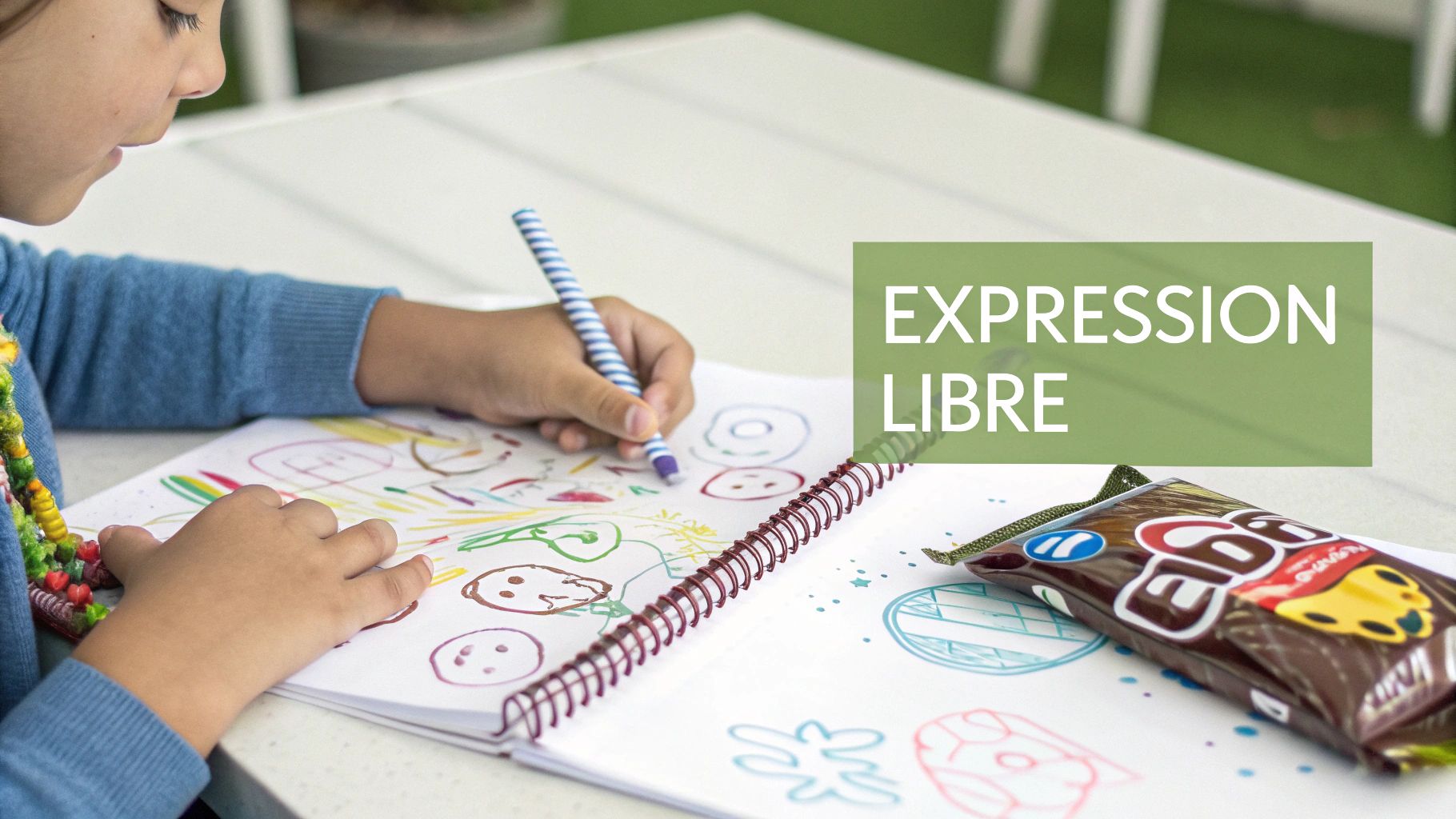
To truly grasp the gap between our expectations and reality , we need to make a small effort: change our perspective and try to see the world through our child's eyes. For us adults, a journal is often an organized tool with a specific purpose. We use it to reflect, plan, or remember. But for a child between 6 and 12 years old , the story is completely different.
Her creative journal is neither a duty nor an obligation. It is above all her secret playground , her personal laboratory. It is one of the few places in the world where there are no rules, no judgment, and above all, no "right" or "wrong" way of doing things.
This total freedom is precious to him, but it can be unsettling for us, as parents. We tend to look for logic, progression, a clear outcome. He, however, is simply looking for a space to be himself, here and now.
A space to tame one's inner world
This journal is a bit like a secret hideaway where he can give form to everything he can't yet put into words. A scary monster scribbled on a page? It's not just a drawing. It's his way of taking control of a fear that's been tormenting him.
Similarly, a candy wrapper stuck in the middle of a page is far from insignificant. It could be a time capsule of a happy memory, a shared laugh, or a small moment of pride. It's his unique way of capturing a moment of happiness.
Her diary can be many things at once:
- A paper punching bag: A page covered in angry pencil strokes, perhaps it's his way of letting out his anger without hurting anyone.
- A treasure chest: A simple cinema ticket or an autumn leaf becomes a relic, a precious memory that brings joy.
- A portal to the imagination: This is where he can invent secret codes, draw up plans for his future treehouse or bring fantastic characters to life, without any limits.
All these traces, which may seem a little chaotic to us, are in fact authentic expressions and essential to its balance.
A child's rhythm is not that of a clock.
One of the biggest frustrations for parents is seeing the journal used in a completely unpredictable way. A child might be engrossed in it for three days, then neglect it for three weeks. This is perfectly normal.
The need to express oneself is not a switch. It follows the waves of a child's inner life. Forcing them to do it every day would turn their sanctuary into a chore and destroy all the magic.
A newspaper is like a silent friend. It's there when you need it and waits patiently when you forget about it. Its true value isn't measured by the number of pages filled, but by the fact that it's always there, available unconditionally.
Moreover, this gap between expectations and reality isn't unique to families. A study by the Institut Montaigne on young people reveals a similar phenomenon in the workplace. It shows that 28% of young people feel "frustrated" because their career expectations don't align with market realities. If this parallel interests you, you can take a look at the study's findings .
Value the journey, not just the destination
To truly support your child, the most important thing is to change your perspective. You must learn to see beyond "beautiful" or "finished." Every little mark left on the page, even a simple line, is a victory in itself.
What matters isn't the final drawing, but the simple act of picking up a pencil. It's not the perfectly written word, but the desire to have wanted to tell a story. By valuing exploration and effort, you send an incredibly powerful message: "I love you for who you are, not for what you produce."
This supportive approach is the foundation upon which he will build his confidence. The journal then becomes much more than a simple notebook: it is a mirror that reflects back to him a positive image of himself, creative and resourceful.
How to support your child without imposing your expectations on them

Accepting the gap between our expectations and reality is one thing. But knowing how to react on a daily basis is another. Shifting from the role of a parent who expects results to one who supports with kindness requires a small adjustment, but believe me, the benefits for your child's confidence and your relationship are immense.
The goal isn't to stop expecting anything at all, but rather to transform that expectation into genuine curiosity. Instead of trying to guide your child toward an idea you have in mind, you become their companion on their own journey of exploration.
Create a family ritual, without any constraints
One of the best ways to encourage your child is to make journaling a shared activity, but never an obligation. The idea is to create an atmosphere that inspires creativity, where the journal is simply one option among many.
Here are some tips for gently establishing this ritual:
- Establish a "creative quiet time": After school or before bedtime, offer a moment away from screens. Provide a journal, markers, stickers, but also books or LEGOs. The child chooses what they like, and the journal becomes an invitation, not a chore.
- Have your own notebook: Lead by example! If you use a notebook yourself to write, draw, or jot down ideas, your child will see that it's a fun activity, even for grown-ups. It will pique their curiosity much more effectively than any instructions.
- Make the materials accessible: Leave a box with everything you need within easy reach. Sometimes, simply seeing the pencils and notebook can be enough to spark an urge to create, just like that, without warning.
The goal is for the newspaper to be perceived as an available and welcoming tool, not as just another duty in an already busy schedule.
Asking the right questions to open the dialogue
The way you talk about their creations can absolutely change everything. Some questions, even if well-intentioned, can unintentionally create pressure or even cut the conversation short.
The secret is to move from questions that seek an answer ("What does this represent?") to invitations that open a story ("Tell me what's happening on your page.").
This simple change of tone shows your child that you are interested in their process, their imagination, and not just the final result.
Here's a short comparison to help you:
| Instead of asking... | Try this instead... |
|---|---|
| "What you've done is lovely!" | "I really like the colors you've chosen here." |
| " What is this ? " | "This character seems to be living quite an adventure, will you tell me about it?" |
| "Why didn't you write anything?" | "I see you preferred drawing today, that's great!" |
| "Have you almost finished your page?" | "It looks like you had a lot of fun with this collage." |
By valuing the effort, the choice of colors, or the story behind a doodle, you emphasize experimentation. You teach them that the journey is as important as the destination . This is a valuable lesson for their self-confidence.
Respecting one's private space: the golden rule
A creative journal is an intimate space. For your child to feel completely safe in it, they need to know that it's their private territory. This is undoubtedly the most difficult point for us parents, because our curiosity is so natural!
However, respecting their privacy is fundamental. Never look at their journal without their clear and explicit permission. If they come to show it to you of their own accord, it's a wonderful sign of trust. Welcome this sharing as a gift, without judgment or unsolicited advice.
And if your child keeps their journal to themselves, that's also excellent news. It means they've truly made it their own, that it's become their personal sanctuary. A place where they can be themselves, without fearing the judgment of others. By respecting this need, you only strengthen your bond and show them that you respect the person they are becoming.
By adopting these few habits, you transform the journal into much more than just a notebook. It becomes a powerful tool for self-confidence, a means of family dialogue, and a sacred space where your child learns to know and love themselves, one page at a time.
When our expectations hinder their creative momentum
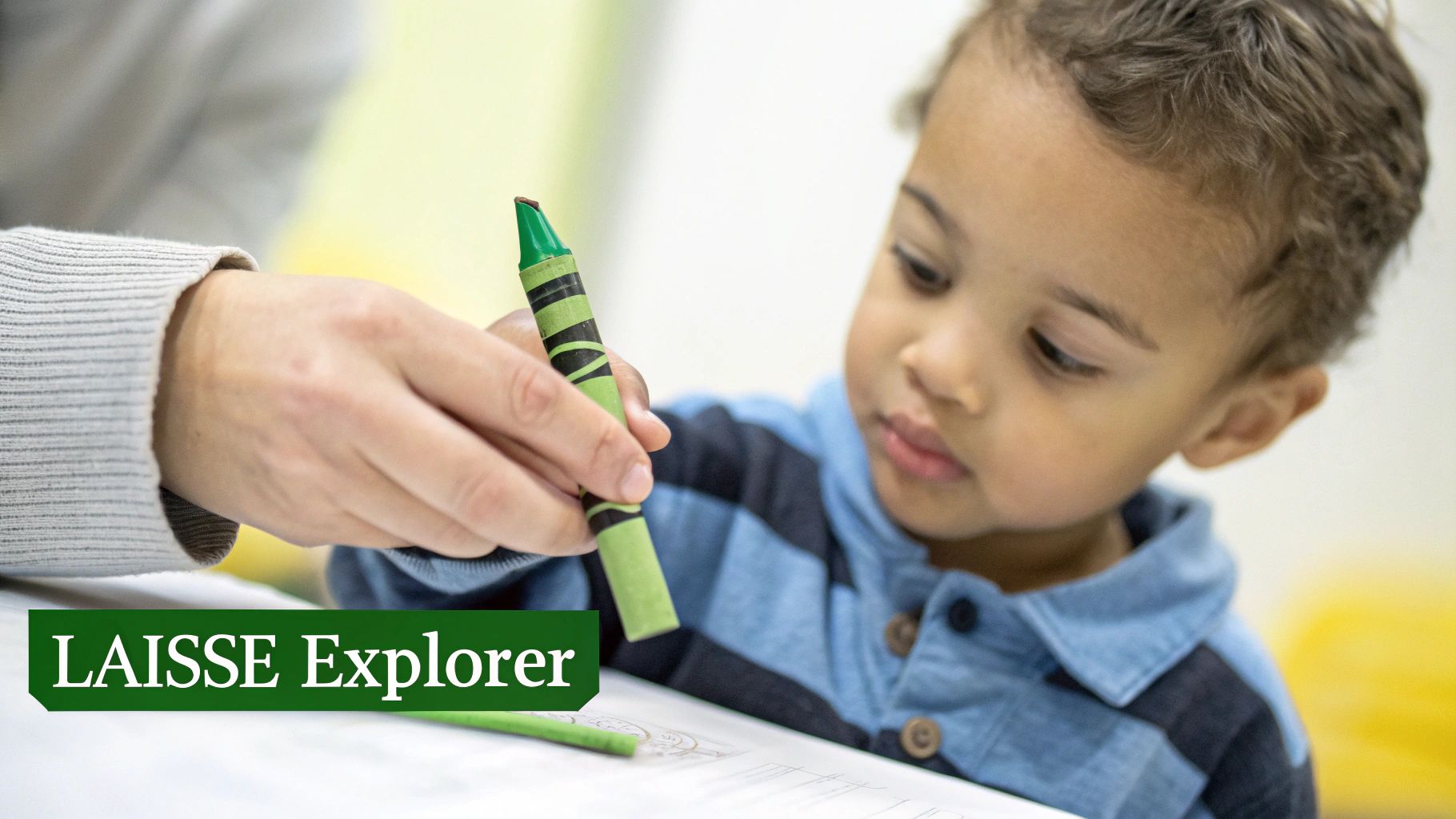
As parents, we always want to do the right thing. When we suggest a "prettier" color to our child or show them how to draw a line "better," we feel like we're helping them. Yet, these small interventions, however well-intentioned, can unintentionally stifle their creativity.
The problem often stems from the gap between our parental expectations and the reality of a child's exploration. We already envision the final product, the realized potential. But the child is still on a journey, with its detours, trials, and setbacks.
Imagine your child is an explorer discovering uncharted territory. Their journal is their blank map. If at every turn you tell them, "Don't go that way, it's a dead end" or "Look, this path is more beautiful," they will eventually become afraid to venture out alone. They will wait for your instructions, paralyzed by the fear of making the "wrong" choice.
Micro-interventions that kill experimentation in the bud
It is these seemingly innocuous little phrases that, little by little, send him an unintentional message: "Your way of doing things is not the right way." The child then learns to seek external approval rather than trusting his inner voice.
Here are some classic examples of these obstacles:
- Correcting reality: "The sky isn't green, it's blue." But in his world, the sky has the right to be any color!
- Suggesting a "better" idea: "Why don't you draw a house instead of another monster?" By doing so, you devalue what interested them at that precise moment.
- Turning play into homework: "You should write a little, you're always drawing." Suddenly, his space for freedom resembles a school exercise.
Even if they stem from good intentions, these interventions prevent him from taking risks. Yet, it is precisely by daring to make mistakes that one develops creativity and self-confidence.
How to create a psychologically safe environment
For creativity to flourish, a child needs a space where mistakes are not only accepted, but seen as a normal and useful step. This is what we call psychological safety.
The goal is not for him to create a masterpiece. It's for him to cultivate the courage to try. Every "mistake" is a discovery, every erasure a testament to audacity.
Creativity is, above all, the courage to try without fear of failure. By encouraging risk-taking within a reassuring framework like a creative journal, we give children valuable tools for their self-esteem, tools that will serve them throughout their lives.
So, how do you do it? Focus on the process, not the result. Value their effort, their curiosity, and the originality of their ideas, even if they seem strange or imperfect to you. If you'd like to explore other ways to nurture creativity beyond journaling, approaches like meditation to unlock creativity can also be beneficial.
By letting go of what his journal "should" be, he offers himself the greatest gift: the freedom to be himself, without fear of judgment.
Your child's creative journal: questions, doubts, and realities
Embarking on the adventure of creative journaling with your child is wonderful, but it often comes with its share of questions. We have expectations, hopes, and then… the reality of everyday life hits. Don't panic, it's perfectly normal. Let's untangle the most common situations together.
My child has given up on their journal. How can I get them motivated again?
It's a classic! The first and most important thing to do: never force it. Journaling should remain a pleasurable activity, not just another chore on the to-do list. Simply leave the notebook in plain sight, easily accessible in their creative corner, without mentioning it.
Often, the best way to rekindle their interest is to lead by example. Take a notebook for yourself and sit down next to it to draw or write, without expecting anything in return. Sometimes, a small thing is all it takes: new, shiny stickers or fun markers can get things going again. You can also incorporate the journal into a fun project: "What if we drew the plans for our awesome treehouse in your notebook?" The desire almost always returns on its own, once the initial pressure has subsided.
Help! He only draws monsters and fight scenes!
Take a deep breath: this is excellent news! His journal has become a refuge, a safe place where he can release all the strong emotions he can't yet put into words. Drawing his fears, anger, or frustrations is an incredibly healthy way to understand and manage them.
Welcome their drawings without judgment. A simple phrase like, "Wow, this character looks super powerful!" can open up a discussion without being intrusive. Forbidding this kind of drawing would be telling them that certain emotions are "forbidden," which is the exact opposite of what you want.
A creative journal is a space where all emotions, even the darkest ones, have a place. By giving your child permission to draw them, you offer them a powerful tool for building their inner strength.
Should you correct your spelling mistakes?
The answer to that is a resounding no. Creative journaling is a space for total freedom, not a French exercise. If you take out the red pen, you're sending the message that form is more important than content, that their ideas and emotions matter less than spelling.
This reflex, while well-intentioned, can quickly paralyze him and shatter his confidence in this tool. The absolute priority is that he feels free to express himself without fear of making mistakes. Spelling is learned at school; here, it's the heart that speaks.
My child doesn't want to show me what they did. Is that serious?
Not at all, quite the opposite! It's a sign that he has made this journal his own private sanctuary. This is an essential step in developing his autonomy and privacy, especially between the ages of 6 and 12 .
Respecting his refusal is the greatest act of trust you can give him. Simply tell him that your door is always open if he ever wants to share, but that this journal belongs to him and him alone. It is this trust you place in him that will motivate him to continue his inner exploration.
The My Book Story notebook was designed precisely for this purpose: to offer your child a framework that guides them without constraining them, to help them explore their inner world, their emotions and their creativity.
Discover the My Book Story notebook and make each page a new step towards self-confidence.