


So, My Book Story promises to make your child the star of their own book. On paper, it's a fantastic idea, isn't it? We can easily imagine our child, alone at their table, brimming with inspiration and creating a story from start to finish.
However, reality is often a little different, and that's where the real magic happens. It's not so much a solo activity as a true adventure to share as a family. Your role as a parent becomes essential: you are the guide who helps them find the words, bring their wildest ideas to life, and nurture their self-confidence.
Launch your child's creative adventure
This slight gap between expectation and reality turns out to be the greatest gift of the experience. You think you're buying a simple writing tool, and you end up with a golden opportunity to create a family ritual, spending quality time together and stimulating both your creativity and theirs.
Ultimately, the goal isn't just to print a book. It's to weave memories and gently develop valuable socio-emotional skills. This collaborative creative process is the perfect opportunity to:
- Strengthen your bond: Creating together means sharing laughter, doubts, and moments of pride. It's a true ritual that unites the family.
- Boosting his self-confidence: Each completed page is a small victory that helps him grow and shows him that he is capable of completing a project.
- Helping him express his emotions: Through his characters and stories, he learns to put words to what he feels, in a safe environment.
Parents' expectations regarding the actual benefits for the child
When parents discover My Book Story, many have a very specific idea in mind: they imagine their child will start writing a book all by themselves, and quickly. This is a perfectly normal expectation. However, the true magic of the experience often lies elsewhere, in the gap between the initial idea and the lived reality.
The goal isn't so much the speed of execution as the journey undertaken together. The child learns to persevere, to carry out a project from start to finish, which is an essential life skill. Writing, far from being a solitary activity, becomes a wonderful opportunity for family interaction and sharing.
Ultimately, the most significant benefits go far beyond the simple story written on paper. We observe improved emotional management and a genuine increase in self-confidence.
This image perfectly captures the contrast between the expectation of immediate autonomy and the beautiful complicity that arises from this shared project.
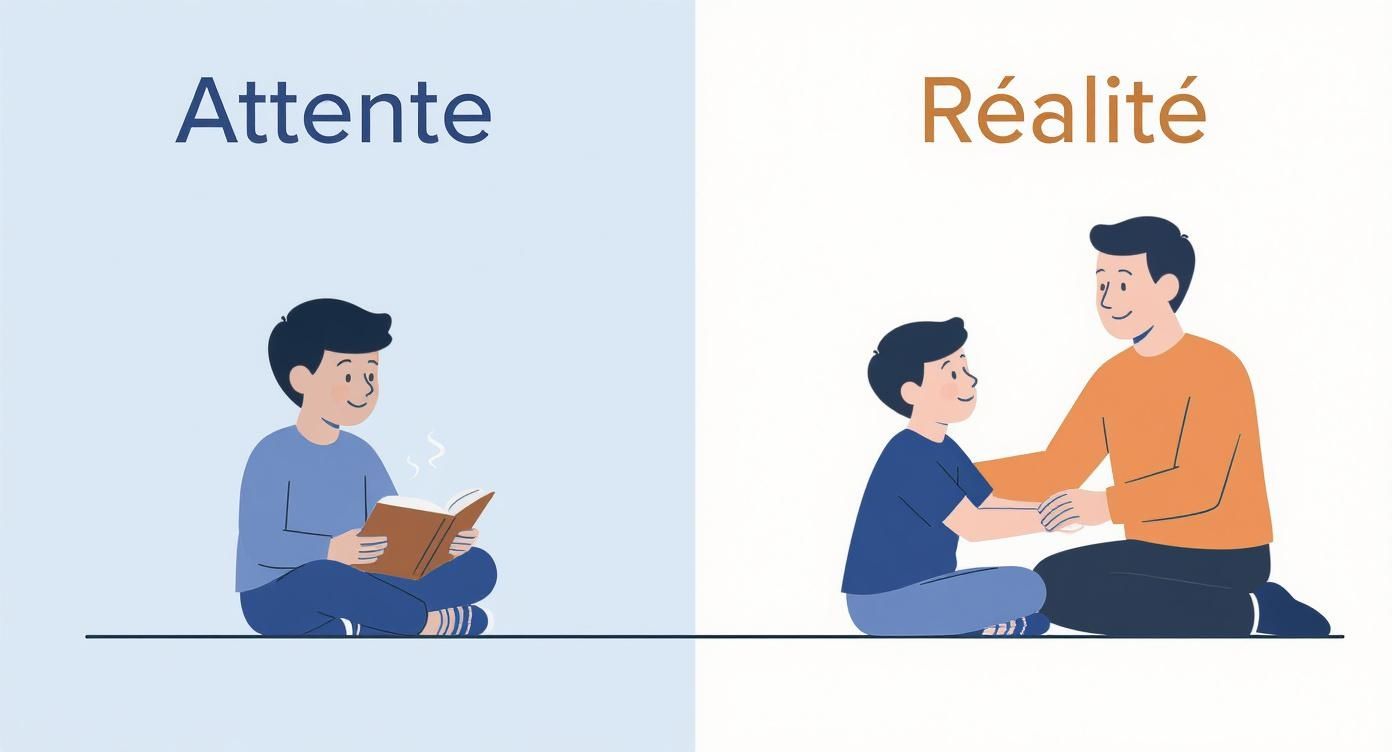
The real victory isn't that the child manages on their own, but that they feel encouraged and supported in their creative endeavors. This phenomenon isn't unique to writing; it's also seen in other contexts, as these testimonials from parents on the benefits of academic support demonstrate, where progress often goes beyond simple grades.
Comparative table of expectations and reality with My Book Story
To better visualize this gap, here is a table that highlights the difference between the initial expectations of parents and the concrete benefits observed in children aged 6 to 12 .
| Shared parental expectation | Observed reality and concrete benefit for the child |
|---|---|
| My child will write their book alone and quickly. | The child learns perseverance on a long-term project, with the support of their parents. This strengthens family bonds. |
| It's an activity to develop writing skills. | Writing is a pretext for better expressing one's emotions, structuring one's thoughts, and gaining clarity. |
| He will improve his French skills. | Yes, but above all he will develop confidence in his creative abilities , which is transferable to other subjects. |
| It will be an independent activity for him. | This becomes a special moment for dialogue, where the child shares their imaginary world and feels listened to. |
As we can see, the results obtained with My Book Story often go far beyond the initial objective. The experience enriches both the child and the parent-child relationship, transforming a simple writing project into a human and family adventure.
The parent, a guide for the imagination

One of the biggest surprises for parents is discovering their own role in the adventure. We often imagine it as a tool that will keep the child occupied independently. In reality, your presence is the true driving force behind your child's creativity. It's not about telling them what to do, but rather about guiding and encouraging their ideas.
This gap between expectations and reality is quite universal. We even see it in the workplace: a recent study showed that 56% of French workers expect their professional expectations to change, clearly illustrating this disconnect between expectations and reality. If you're interested, you can consult the details of this barometer on professional life .
Your role is not that of a teacher, but that of an adventure partner. Celebrate every small step forward to build their motivation and confidence.
To make writing a truly special moment of connection, why not create a ritual? A simple "creative quarter-hour" after school can work wonders. To stimulate their imagination without imposing your own ideas, ask them open-ended questions. For example: "What if the dragon, deep down, was afraid of the dark?" or "What color would a giant's tears be?"
Developing trust that goes far beyond words

We often think the main goal is to improve our writing, but the surprising thing is how much My Book Story becomes a springboard for self-confidence. That's where we discover the true power of creation.
Every choice your child makes, from the hero's name to the final plot twist, is a small personal victory. By overcoming writer's block with your help, they learn to persevere and realize the value of their own ideas.
The real treasure is not the printed story, but the pride and confidence gained along the way.
Take a slightly shy child: they can use their characters to express strong emotions, but within a safe and supportive environment. Another child, by showing their finished book to the whole family, experiences the tangible result of their efforts. This confidence they build is an asset that will stay with them everywhere, at school and in their social life.
When reality surpasses all expectations
Sometimes, the creative journey takes us much further than expected. Many parents tell us this, and their inspiring stories show how the experience can exceed their initial hopes. These stories are a perfect example of the positive gap between expectations and reality .
Take the story of this father who initially sought a simple activity to occupy his son. As the pages turned, he discovered a shared passion that completely transformed their relationship and strengthened their bond.
By approaching creation without preconceived ideas, we open the door to benefits that are far deeper for the child than we could have imagined.
We also think of that little girl who struggled to concentrate. Thanks to the playful and engaging nature of writing a story, her attention span improved significantly at school. These moments prove that the reality of the journey is often much richer than expected, impacting emotional well-being and self-confidence.
We answer your questions about the My Book Story adventure
As a parent, it's perfectly normal to wonder how to guide your child through this new experience. We imagine a path, and sometimes reality is a little different. Don't panic, here are a few tips to help you support them.
What should I do if my child is stuck and has run out of inspiration?
Above all, avoid putting pressure on yourself. If ideas aren't flowing, that's a sign to take a break. The goal isn't to create a masterpiece, but simply to express yourself and have fun.
Advice for parents: Suggest a change of scenery, or ask open-ended questions to get things flowing again: "What if your hero suddenly found a mysterious map?" You can even draw a scene from the story together to visualize things differently. This little block is often temporary; the important thing is that writing remains fun.
My child doesn't really like to write, is this for him?
Yes, without hesitation! My Book Story sees writing as one means of expression among others, not as an end in itself. If your child is more comfortable with crayons, let them tell their story entirely through drawings!
Advice for parents: The most important thing is to give your child a space to share their inner world and ideas. Whether they do this with words, pictures, or a combination of both, it will boost their self-confidence. Praise each drawing as you would a well-crafted sentence.
Ready to make writing a memorable family adventure? Discover the My Book Story journal and start creating beautiful memories together. Take a look at the journal right here .