


Imagine giving your child simple tools to learn more about themselves, manage their emotions, and cultivate strong self-confidence. That's the promise of personal development adapted for young children. Far from the complex concepts reserved for adults, it involves playful rituals and shared moments that strengthen family bonds while building a healthy foundation for their future well-being. Each personal development exercise becomes a building block for their resilience and emotional intelligence.
This article offers a selection of eight practical and fun exercises, specially designed for parents who want to support their children aged 6 to 12 on their path to self-fulfillment. You'll discover activities to develop gratitude, concentration, creativity, and the ability to make choices aligned with one's own values.
Each activity is an invitation to explore, dream, and grow, transforming everyday life into a wonderful adventure of self-discovery. Most of these activities can also be seamlessly integrated into a creative medium like the My Book Story journal, which guides the child step by step in this inner exploration, transforming them into the hero of their own story.
1. The Gratitude Journal: Capturing Small Daily Joys
Gratitude is a skill that can be learned and cultivated. This personal development exercise involves inviting your child to identify and write down three things each day for which they feel grateful. Far from being a simple list, this practice helps them focus their attention on the positive aspects of their day, even the smallest ones.
It's a simple yet powerful ritual for strengthening optimism and resilience. By focusing on what's going well, children learn to value moments of joy, acts of kindness, and small victories. This habit, integrated into their evening routine, for example, becomes a true shield against negativity and stress.

How do we implement this ritual?
For this exercise to be effective and enjoyable, it's important to approach it like a game or a moment of sharing, not like a chore. The goal is to create a positive association with expressing gratitude.
Here are a few tips to get you started:
- Lead by example: Share your three things you're grateful for today. Your child will be more inclined to participate if they see it's a family activity.
- Be specific: Help him find concrete examples. Instead of "I had a good day", encourage him to say "I had a good laugh with Dad when we made pancakes" or "Thank you to Grandma for her call".
- Adapt to their mood: If words fail you one day, suggest they draw a picture of their happy moment . The important thing is to keep the ritual fresh and stress-free.
- Create a regular appointment: Make this a weekly ritual. On Sunday evenings, for example, reread the things you're grateful for from the week together. It's a great way to remember the good times and strengthen your bonds.
Using a dedicated tool like the My Book Story journal, which already includes pages for gratitude, can greatly facilitate establishing this habit. It provides a fun and motivating framework for this essential exercise in building a positive outlook on life.
2. Mindfulness Meditation: Learning to Calm the Mind
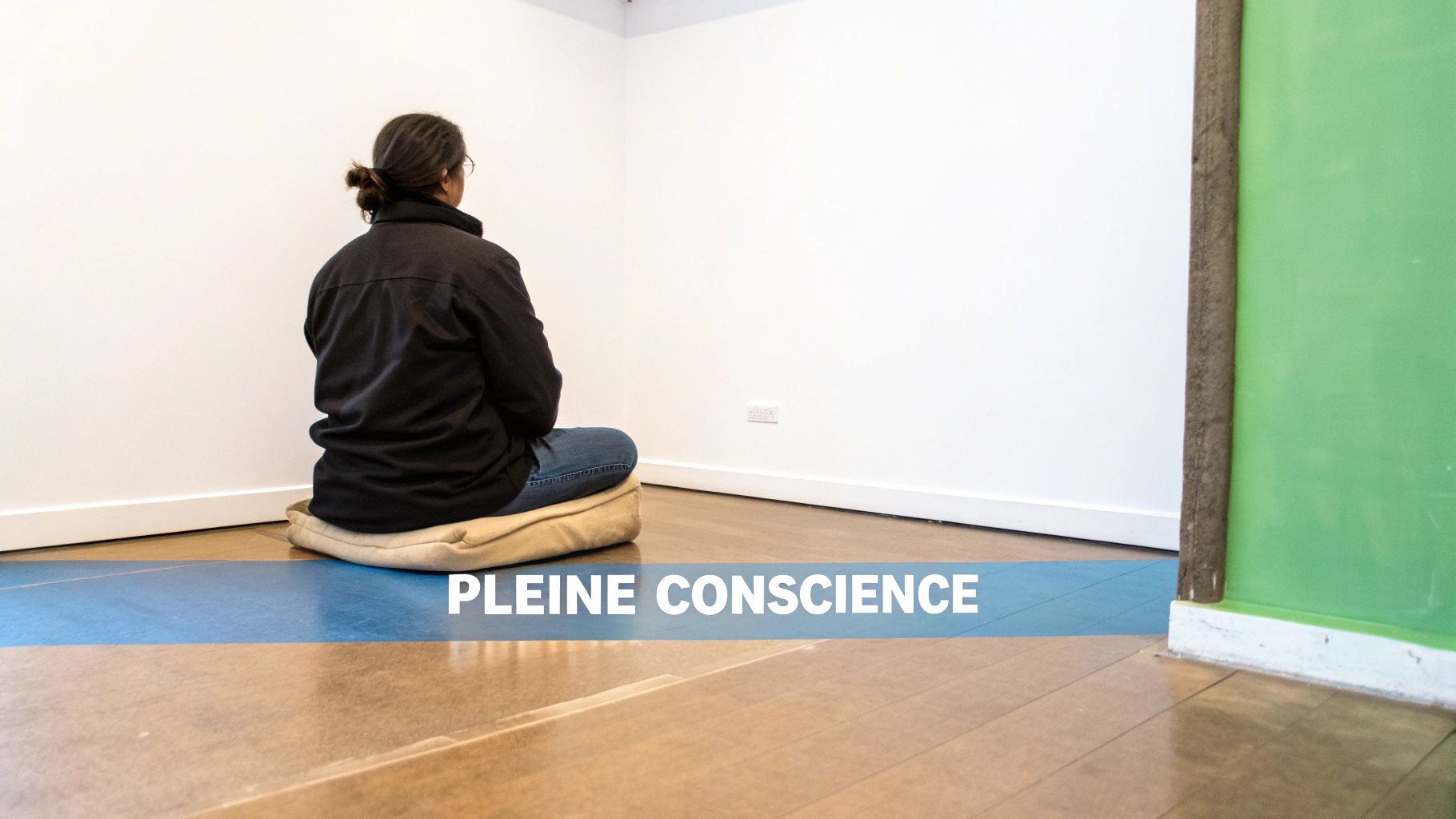
Mindfulness is a practice that teaches children to focus their attention on the present moment, without judgment. This personal development exercise helps them observe their thoughts and emotions like clouds passing in the sky, without clinging to them. It's a wonderful tool for calming anxiety, improving concentration, and developing greater self-awareness.
By guiding your child to connect with their breath, bodily sensations, or the sounds around them, you offer them an anchor to return to calm when emotional waves become too strong. This practice strengthens their ability to manage stress and react more calmly to everyday challenges.
How to introduce your child to mindfulness?
The approach should be playful and progressive, integrating short sessions into the child's routine. The goal is not to "empty their mind," but to learn to observe them with gentleness and curiosity.
Here are a few tips to get you started:
- Start short: Sessions of 2 to 5 minutes are plenty to begin with. You can use guided meditation apps specifically designed for children.
- Use images: Suggest that they imagine their belly is a balloon that inflates and deflates with each breath. This visualization makes the exercise more concrete and fun.
- Create a dedicated space: Set up a quiet corner with a comfortable cushion. This ritual helps signal to the brain that it's time to relax and refocus.
- Practice kindness: Remind him that it's normal for his mind to wander. The exercise simply consists of gently bringing his attention back to his breathing each time he notices it, without judging himself.
Incorporating moments of mindfulness, even brief ones, helps children build a peaceful relationship with their inner world. This is a valuable skill that will serve them throughout their lives, helping them better navigate emotional storms.
3. Creative Visualization: Giving Shape to Your Dreams
Creative visualization is a powerful personal development exercise that uses imagination to project oneself into a successful situation. Combined with positive affirmations, this technique helps children build a clear mental image of their goals and strengthen their confidence in their ability to achieve them.
It's a fantastic tool for transforming the fear of failure into positive energy. By imagining themselves succeeding at a presentation, scoring a goal in football, or making new friends, children prepare their minds for success. This practice helps create a connection between thoughts, emotions, and future actions.
For a visual approach to the key components of this exercise, this diagram illustrates the pillars of creative visualization.
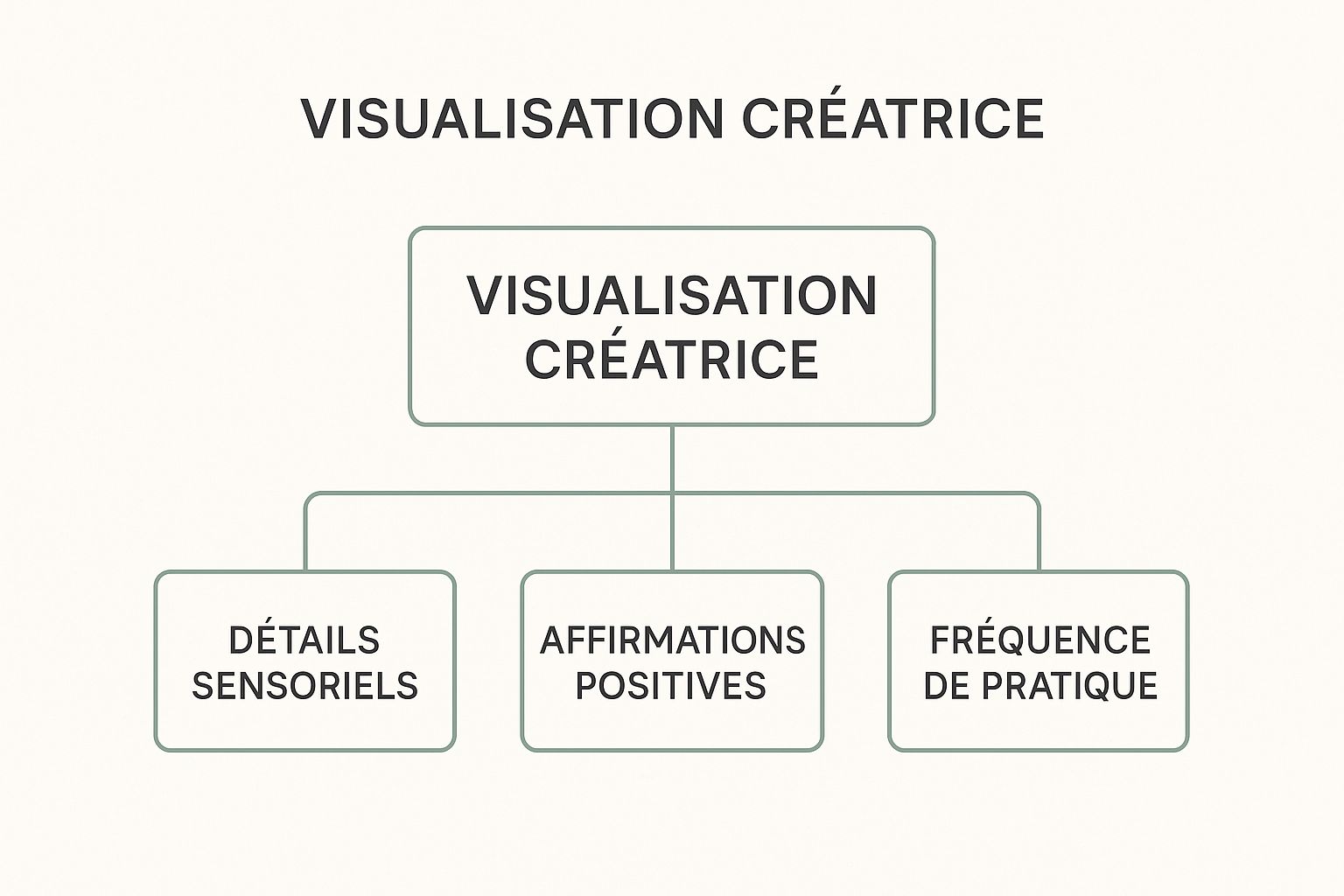
Visualization becomes truly effective when sensory details, positive affirmations, and regular practice are harmoniously combined.
How can you guide your child through this exercise?
For visualization to be an immersive and beneficial experience, it is essential to present it as a game of imagination, an inner journey where anything is possible. The goal is to make the process fun and encouraging.
Here are some suggestions to help you:
- Create a calm atmosphere: Choose a relaxing time, such as before bedtime. Guide your child with a soft voice to help them relax and close their eyes.
- Use sensory details: Encourage him to describe what he sees, hears, smells, and feels in his success scene. For example: "You are on stage, you feel the warm lights, you hear the applause, and you feel pride in your heart."
- Formulate affirmations in the present tense: Help him create short, positive sentences like "I am capable," "I am courageous," or "I succeed easily." Repeat them together.
- Anchor the emotion: The most important element is to feel the emotion of success . Ask them, "How do you feel now that you've succeeded?" Let them savor this feeling of joy and pride.
Incorporating these moments into a journal like My Book Story can help children keep track of their visualizations and affirmations. They can then draw pictures of their achieved goals or write empowering phrases, transforming the journal into a true catalyst for self-confidence.
4. The Simplified Eisenhower Matrix for Children
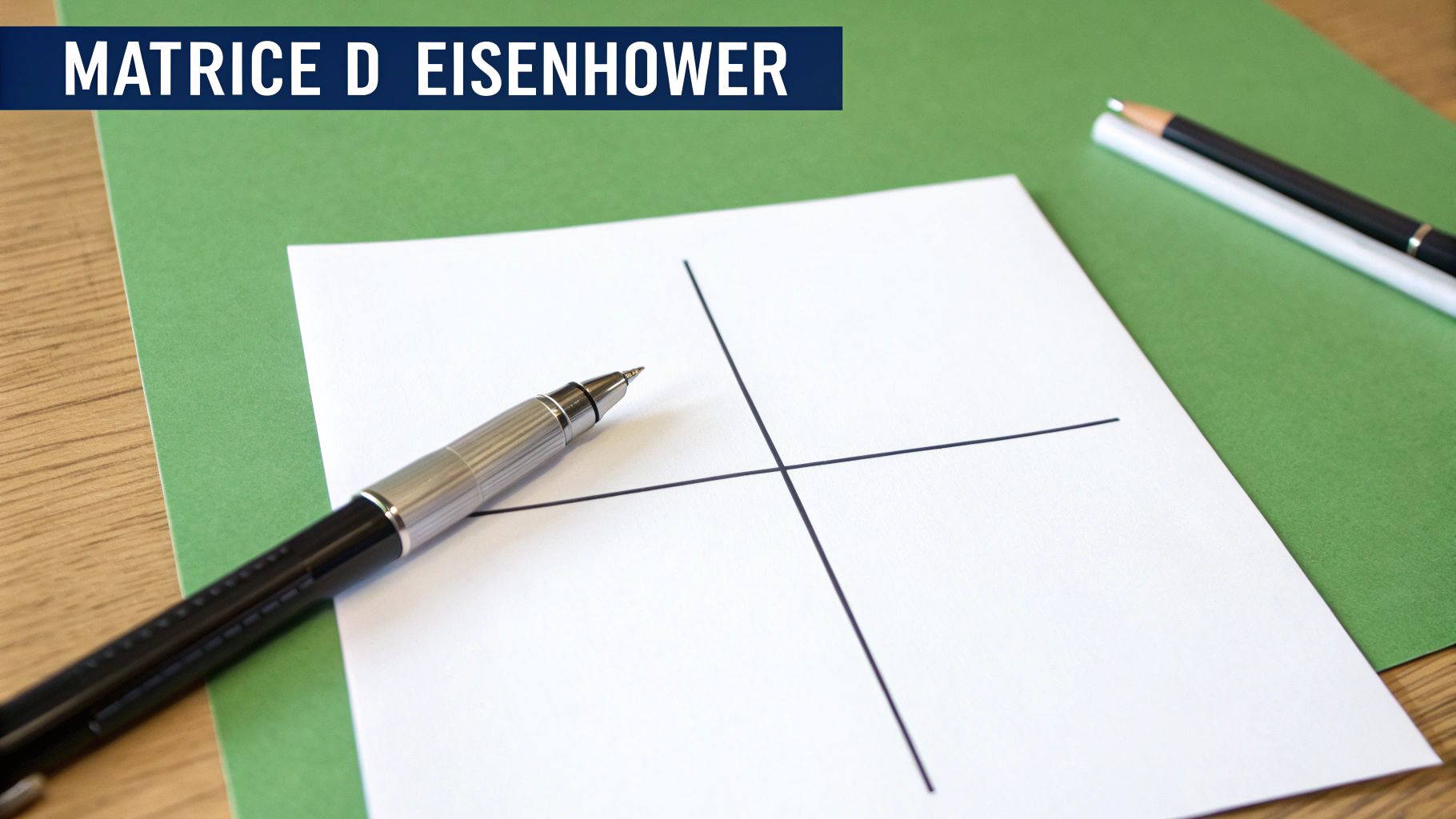
Learning to manage time and priorities is a key life skill. This personal development exercise , adapted for children, helps them categorize their tasks (homework, activities, games) according to their urgency and importance. The Eisenhower Matrix is an excellent visual tool for understanding what needs to be done now, what can wait, and what isn't so important.
This method teaches children not to get overwhelmed by a to-do list. By distinguishing between urgent and important tasks, they develop their organizational skills, independence, and decision-making abilities. This is a crucial step toward healthy stress management and better focus on what truly matters, such as preparing a presentation or tidying their room before grandparents arrive.
How do I set up this tool?
For a child, the matrix should be presented as a fun sorting game, a kind of mission to become "captain of their time." The goal is to give them control of their schedule in a playful and empowering way.
Here are a few tips to get you started:
- Simplify the concepts: Use simple words. "Urgent and important" can become the "Do it right away!" box. "Important but not urgent" becomes the "I'll set aside some time for this" box. The "Urgent but not important" and "Neither urgent nor important" boxes can be "I'm asking for help" and "For later, if I have time."
- Use colored sticky notes: Turn the exercise into a hands-on activity. Draw a large grid on a sheet of paper and ask your child to write or draw each task on a different colored sticky note before placing it in the correct box.
- Be a guide, not a boss: Discuss with him the ranking of each task. Ask questions like "What happens if you don't do your homework now?" to help him assess the urgency and importance for himself.
- Make it part of your routine: Have a quick check-in every Sunday evening or every morning before school to plan upcoming tasks. This will become a reassuring ritual that prepares you for the day.
The idea is to give him a visual framework so he can organize his thoughts and responsibilities. This tool, adaptable to journals like My Book Story , helps him develop a clear vision of his priorities, a fundamental skill for his academic and personal future.
5. SWOT Analysis: The Map of His Superpowers
Borrowed from the business world and adapted for children, the SWOT analysis (Strengths, Weaknesses, Opportunities, Threats) is a surprisingly effective personal development exercise . This tool helps them get to know themselves better by identifying their strengths (superpowers), challenges, external support, and potential obstacles. It's a fun way to build a realistic and positive self-image.
By completing these four categories, the child learns to take an objective look at themselves. They discover that their "weaknesses" are simply areas for improvement and that "threats" are challenges to overcome. This exercise develops their analytical skills and their ability to plan, valuable skills for their academic and personal life.
How do we set up this exercise?
Approach this activity like an explorer's mission where your child is the hero of their own adventure. The goal is to give them tools for understanding, without any judgment, so they feel confident enough to express themselves freely.
Here are a few tips to get you started:
- Use simple language: Translate the terms. "Strengths" becomes "Your superpowers" (e.g., "I'm good at drawing"), "Weaknesses" becomes "Your challenges to overcome" (e.g., "I have trouble concentrating for long periods").
- Guide the thinking: For "Opportunities", ask: "Who or what can help you?" (e.g., "Dad can help me with math"). For "Threats", ask: "What might bother you?" (e.g., "The noise when I'm doing my homework").
- Make it a visual project: Use four large sheets of colored paper or a dedicated section in a notebook. Let them draw or paste pictures to illustrate each category. This makes the exercise more concrete and fun.
- Create an action plan: Once the analysis is complete, discuss together: "How can you use your superpowers to turn a challenge into a success?" This empowers them and encourages them to find their own solutions.
Tools like the My Book Story journal can provide a perfect framework for this exercise, offering structured pages that encourage introspection. It's an excellent way to help them develop a personal strategy to gain confidence and achieve their goals.
6. The Pomodoro Technique: The Concentration Challenge
The ability to concentrate is a key skill, but often difficult for a child to master. The Pomodoro Technique is a personal development exercise disguised as a time management game. It consists of dividing a task, such as homework, into timed work sessions separated by short breaks.
This simple method transforms a mountain of work into a series of small, achievable steps. For a child, knowing that intense concentration will be followed by a five-minute break is incredibly motivating. This prevents mental fatigue, reduces procrastination, and shows the child that they are capable of staying focused, thus boosting their confidence in their learning abilities.
How do we implement this ritual?
The goal is to present the Pomodoro Technique as a fun challenge, not a chore. Children should see this tool as a superpower to accomplish their tasks more efficiently and free up time for play.
Here are a few tips to get you started:
- Adjust the duration: For a 6 or 7 year old, start with 10 to 15 minute sessions. Gradually increase the duration as they gain endurance and concentration.
- Use a fun timer: A visual timer, such as an hourglass or a playful app, makes the experience more tangible and engaging than a simple stopwatch on a phone.
- Set break times: Breaks should be a real time to relax. Encourage your child to get up, stretch, drink water , or do some jumping jacks. Avoid screens, which can make it harder to get back to work.
- Prepare the environment: Before starting the timer, make sure that all potential distractions (notifications, toys, etc.) are out of reach to maximize the effectiveness of the session.
Incorporating this method into homework routines or creative activities can transform a child's perception of work. They learn to manage their energy and time independently, a fundamental skill for their academic and future success.
7. Core Values: Defining Your Inner Compass
Identifying one's values is a powerful exercise in personal development , even for a child. It helps them understand what matters most to them. These values, such as kindness, courage, honesty, or creativity, become an inner compass that will help them make decisions and feel aligned with themselves.
This exercise helps children build their identity in a positive way. By putting words to what excites them, they gain confidence and learn to make choices that reflect who they are. It provides a solid foundation for developing self-esteem and understanding why some situations make them happy while others make them uncomfortable.
How do we implement this ritual?
Approach the discussion about values as a fun exploration of what makes your child unique. The goal is to help them get to know themselves, without judgment or expectation of "right answers".
Here are a few tips to get you started:
- Use stories: After reading a book or watching a film, discuss the characters' actions. "What did the hero do that was brave? Why was it important for him to be honest?"
- Talk about your own values: Simply explain what is important to you and why. For example: "For me, helping others is an essential value, which is why I am happy to help our neighbors."
- Create a "values list": Provide an illustrated list of values (friendship, respect, curiosity, etc.) and ask your child to choose the 3 or 5 that speak to them the most.
- Review together: Values can change. Take the time, once or twice a year, to revisit your "compass" to see if it's still relevant.
The My Book Story journal offers an ideal space for your child to draw or write about their values. Transforming this exercise into a creative moment reinforces its importance and helps them better integrate these principles that will guide them throughout their life.
8. The 5 Whys Method: Understanding the Origin of Emotions
When a child experiences a recurring difficulty, such as fear before going to school or frustration with homework, it is often hard to understand the root cause. This personal development exercise helps to trace the origin of a feeling or behavior by repeatedly and gently asking the question "Why?"
The goal isn't to find someone to blame, but to help your child deconstruct a complex situation to identify its true origin. By understanding the root of their problem, they can then find more suitable and lasting solutions. It's a powerful tool for developing their emotional intelligence and problem-solving skills.
How can this dialogue be established?
This exercise should be conducted gently and kindly, in a calm moment when the child feels safe to express themselves. The goal is to explore their feelings together, without judgment.
Here are a few tips to get you started:
- Start with a concrete fact: Begin with an observable behavior. For example: "I noticed that you didn't want to go to Leo's birthday party. Why?"
- Dig deeper with kindness: Follow up each answer with "Why?" questions. If the answer is "Because I don't want to," ask "Why don't you want to?" Continue until you reach the root cause (for example, the fear of not knowing what to play).
- Keep it simple and factual: Help your child formulate clear answers. The idea is not to get lost in assumptions, but to follow their train of thought.
- Don't force the five steps: Sometimes, two or three "Why?" questions are enough to clarify a situation. The important thing is to arrive at an answer that seems to be the starting point of the problem.
Incorporating this type of discussion into your routine helps children stop seeing their emotions as insurmountable obstacles and start seeing them as messages to listen to. This is a fundamental skill for building self-confidence and the ability to face life's challenges.
Comparison of 8 personal development exercises for children
| Exercise | Ideal for... | Main Benefit for the Child | How to integrate it into the family |
|---|---|---|---|
| Gratitude Journal | Cultivating optimism | Strengthens positive vision and resilience | Evening ritual before bed, sharing gratitude at the table |
| Mindfulness Meditation | Managing stress and anxiety | Improves concentration and inner calm | Short guided sessions after school or before homework |
| Creative Visualization | Boosting self-confidence | Prepare mentally for success and reduce the fear of failure | Before an important event (presentation, competition), evening story |
| Eisenhower Matrix | Learning to organize | Develops autonomy and priority management | Planning the week on Sunday with colorful sticky notes |
| SWOT Analysis | Getting to know each other better | Increases awareness of one's strengths and challenges | An annual creative activity to take stock of one's progress |
| Pomodoro Technique | Improve concentration | Makes homework less intimidating and more efficient | Using a fun timer for work sessions |
| Core Values | Building one's identity | Helps to make decisions aligned with oneself | Discussions after a film or a book, creation of a "family crest" |
| The 5 Whys Method | Understanding one's emotions | Develops emotional intelligence and problem-solving skills | Compassionate dialogue when frustration or fear arises |
Incorporate these rituals into your daily routine: the secret lies in consistency.
You've just explored a rich and varied toolbox designed to support your child on their journey of self-discovery. From gratitude journaling to the Pomodoro Technique, each personal development exercise presented in this article is a seed you can plant together. The goal isn't to turn your daily life into a training camp, but to gently integrate these practices into your family rituals.
Remember that the magic happens through repetition. A five-minute session of creative visualization each evening will have a much deeper impact than a long discussion about emotions once a month. The key is to choose one or two exercises that resonate with your child's personality and your family dynamics.
From practice to habit: building skills for life
By turning a personal development exercise into a habit, you give your child fundamental skills that will serve them throughout their life. They learn to name their emotions, identify their strengths, manage their time, and cultivate a positive mindset.
These rituals create anchor points in the day, special moments of connection away from screens. It's a time when your child feels listened to, valued, and understood. This emotional security is the foundation upon which self-confidence, resilience, and emotional intelligence can fully flourish.
The greatest gift you can give your child is not a ready-made answer, but the tools for them to find their own answers throughout their life.
Your role: the benevolent guide
Your role as a parent is not that of a teacher, but a companion on this journey. Participate in the exercises with your child, share your own gratitudes, your own concentration challenges, or your own values. Your involvement legitimizes the process and sets a good example. By seeing you practice these tools, your child will understand that it is normal and even beneficial to take care of their inner world.
Be patient and flexible. Some days you'll be enthusiastic; other days, motivation will be lacking. That's perfectly normal. The important thing is to maintain a supportive framework, adapt the activities, and celebrate every small step. This personal growth adventure is, above all, a joyful and shared exploration.
Ready to transform these exercises into a fun and creative ritual? The My Book Story journal is specially designed to guide your child on their journey of personal development, integrating gratitude, emotional management, and creativity in a playful format. Discover how My Book Story can become your child's daily companion for building confidence and exploring their potential.