


Imagine a simple, almost magical tool capable of transforming your child's doubts into radiant confidence and calming their emotional storms. This tool is mantras. Far from being reserved for adults, mantras are short, positive phrases that your child can repeat to boost their self-esteem, manage anxiety, and cultivate an optimistic mindset. They act like verbal superpowers, creating positive neural pathways with each repetition.
In this article, we'll present a selection of mantras specifically designed for children aged 6 to 12. More than just a list, we'll provide concrete strategies for playfully and effectively integrating them into your daily life, particularly through the use of a well-being journal. You'll discover how to transform this practice into a powerful family ritual, a moment of connection that nurtures your child's inner world. Prepare to explore the incredible power of words and offer your child an inner compass to navigate with serenity and confidence.
1. For calm and patience: "I am as calm as a mountain"
This first example of a mantra is a powerful tool to help your child manage strong emotions like anger, frustration, or anxiety. The image of the mountain is particularly effective for children because it is stable, strong, and unwavering. It represents a solid anchor in the face of passing emotional storms.
The idea is to teach your child to visualize this inner mountain when they feel overwhelmed. It's a perfect introduction to mindfulness and emotional regulation, key skills for their well-being.
Advice for parents: How to introduce this mantra?
This mantra works best when embodied. Here's a playful approach:
- The Mountain Game: Stand with your child, feet firmly planted on the ground. Say: "Let's imagine we are mountains, big and strong. The wind is blowing (you can blow gently), the rain is falling (pat their shoulders), but the mountain remains calm and strong." Repeat together: "I am calm like a mountain."
- Simplicity above all: The phrase is short, positive, and easy to remember. It becomes an accessible reflex, even in a moment of emotional crisis.
How to incorporate it into a family ritual?
The journal is the ideal place to explore this mantra and make it a true ally. Here are some concrete steps:
- Dedicate a page to the mantra: Invite your child to write in large letters "I am calm as a mountain" at the top of the page.
- Creative exploration: Suggest that they draw or paint their own mountain . Is it snowy, covered in forest, or bathed in sunshine? This creative activity reinforces the internalization of the mantra.
- The writing ritual: After a turbulent time (an argument, a frustration), encourage your child to open their journal to this page. They can simply copy the mantra several times or write a few words about how they felt and how the mantra helped them feel calmer.
- Link it to an action: Write a short note next to his drawing: "When I feel like a volcano, I take three breaths and think of my mountain."
This first example of a mantra is fundamental because it offers your child a simple and independent tool to regain their calm, thus strengthening their confidence in their ability to manage their emotions.
2. For self-confidence: "So Hum" ("I am")
This second example of a mantra, "So Hum," is a gentle introduction to a profound idea: that your child has their place in the world and is perfect just as they are. Originating from Sanskrit, "So Hum" naturally synchronizes with the breath: "So" on the inhale and "Hum" on the exhale. For a child, it can be simply translated as "I breathe in peace, I breathe out joy" or even "I am here, and this is good."
It's a powerful mantra for building self-esteem and a sense of inner security. It teaches children to find their anchor not in an external image like a mountain, but directly within themselves, through their breath. It's a wonderful tool for moments of doubt or social comparison, which are common at school.

Advice for parents: How to introduce this mantra?
The effectiveness of this mantra lies in its direct connection with the body and its message of unconditional acceptance:
- Breath anchoring: Make it a breathing game. Have your child place a hand on their tummy. As they inhale, they think "So" and feel their tummy expand. As they exhale, they think "Hum" and feel their tummy contract. It's a very accessible mindfulness technique.
- The inner hug: The sounds "So" and "Hum" create a soothing vibration in the chest. Explain to them that it's like giving themselves an inner hug, immediate physical comfort.
- The message of acceptance: Unlike more specific affirmations, "I am" is a simple and powerful declaration of existence. For a child wondering if they are "good enough," "smart enough," or "popular enough," this mantra answers: "You are, and that is enough."
How to incorporate it into a family ritual?
The newspaper can transform this sonic mantra into a visual and reflective experience, reinforcing its impact.
- Dedicate a page to the mantra: Write "So Hum" in stylized letters. You can draw a path that follows an inhale (upward) and an exhale (downward) to illustrate the concept.
- Creative exploration: Encourage your child to draw what makes them unique . Their freckles, their love for dinosaurs, their kindness to their little brother… The idea is to link the “I am” to all facets of their personality.
- The writing ritual: Before bedtime or after a difficult day at school, invite him to sit with his journal. He can write down one thing he is proud of himself for today, then repeat the writing of "So Hum" several times while breathing calmly.
- Link it to an action: Write together in the journal: "When I doubt myself, I place my hand on my heart, I breathe in thinking 'So' and I breathe out thinking 'Hum'."
This example of a mantra is essential because it nurtures self-confidence at its root. It doesn't ask the child to be something else, but simply to recognize and honor who they already are.
3. For empathy and kindness: "I send kindness"
This mantra example is a simplified and child-friendly version of the famous "Om Mani Padme Hum." It focuses on cultivating kindness and compassion for others. The idea is to channel the child's energy into an intentional act of kindness, even from a distance.
Introducing this mantra to your child offers them a gateway to understanding that love and kindness can be cultivated and shared. It's a mantra that calms the mind while opening the heart, an essential skill for developing healthy social relationships and strong emotional intelligence.
Advice for parents: How to introduce this mantra?
This mantra takes on its full meaning when linked to a concrete and imaginative action:
- The power of intention: Explain to your child that their thoughts can be like tiny invisible gifts. When they think "I am sending kindness," they are sending a bubble of light to someone.
- Create a story: "Imagine your heart is a factory of magical hugs. When you say this mantra, you create an invisible hug and you can send it to Grandpa and Grandma, to your sick friend, or even to our cat."
- Sing it together: Put a simple little melody to the phrase. Singing makes the repetition more fun and memorable.
How to incorporate it into a family ritual?
The journal can transform this abstract concept into a personal and concrete experience.
- Dedicate a page to the mantra: Write "I send kindness" at the top of the page.
- Creative exploration: Suggest that your child draw a large heart. Inside, they can draw or write the names of the people they wish to send kindness to today.
- The writing ritual: Before going to sleep or after a day in which he has shown (or received) kindness, he can open his journal. He can copy the mantra and write a sentence about an act of kindness he saw or did. For example: "Today, I shared my cookies with Leo."
- Link it to an action: Write next to the drawing: "When I think of someone I love, I send them kindness by repeating this mantra."
This example of a mantra is a gentle introduction to the idea that our thoughts and words can have a positive impact on ourselves and the world around us, sowing the seeds of empathy and compassion.
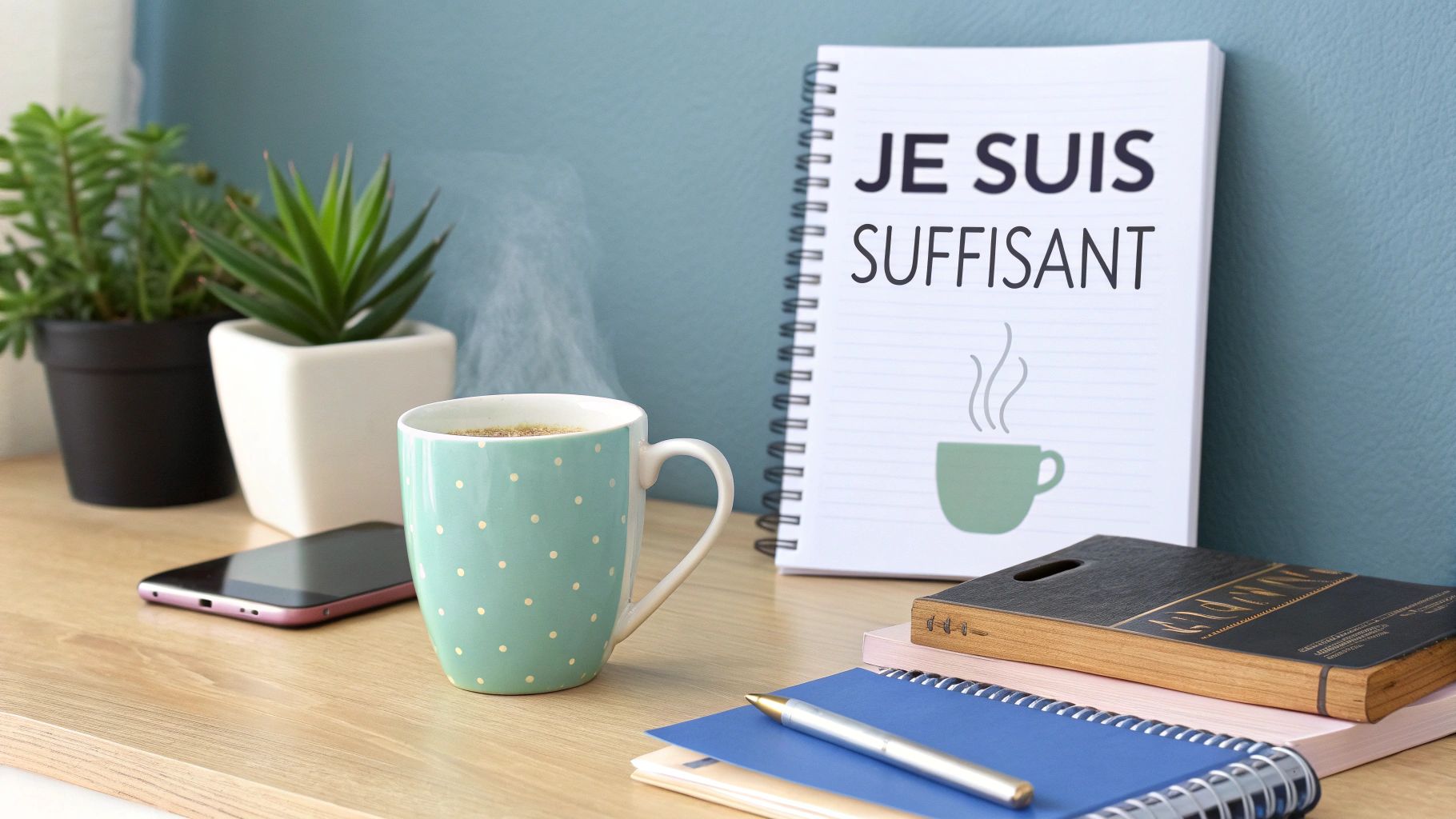
4. For self-confidence: "I am enough"
This mantra example is a true gift for your child's self-esteem. The phrase "I am enough" is simple yet profoundly transformative. It directly addresses the feeling of inadequacy, an emotion children may experience when faced with academic pressure, social comparisons, or their own self-doubt.
This mantra helps children understand that their worth does not depend on their achievements, grades, or the approval of others. It is a declaration of unconditional self-acceptance, an essential pillar for building healthy and lasting self-confidence in the face of life's challenges.
Advice for parents: How to introduce this mantra?
This mantra should be presented as a protective shield against doubts:
- The mirror game: In the morning, in front of the mirror, invite your child to look into their eyes and say, "I am enough." Do this with them to normalize the practice.
- Combating comparison: At school or during activities, children constantly compare themselves to others. Explain to them that this mantra is a superpower to remember their own worth, regardless of what others are doing.
- Rewriting inner dialogue: By repeating "I am enough," the child actively replaces negative thoughts ("I am not good enough," "I failed") with a positive and constructive affirmation. This is the basis of healthy inner dialogue.
How to incorporate it into a family ritual?
The journal is the perfect safe space for your child to take ownership of this message and make it their own.
- Dedicate a page to the mantra: Write "I am enough, exactly as I am" at the top of a new page.
- Creative exploration: Encourage your child to draw everything that makes them unique and special . This could be their freckles, their laugh, their passion for dinosaurs, or their kindness towards their little brother.
- The writing ritual: After a disappointment or a moment of doubt (a bad grade, an argument with a friend), invite him to write in his journal. He can list three things he is proud of himself for that day, even the smallest ones.
- Link it to an action: Write a short note to anchor it in your daily life: "When I doubt myself, I look at my reflection in the mirror, I breathe, and I tell myself three times: 'I am enough.'"
This mantra is an incredible tool for resilience. It teaches your child that their worth is innate and non-negotiable, a fundamental lesson for navigating life's ups and downs with confidence and serenity.
5. For authenticity: "I have the right to be myself"
This fifth example of a mantra is a direct affirmation that encourages authenticity. It is simple to understand and extremely powerful for a child learning to navigate social dynamics at school. It translates into the idea of being true to oneself, listening to one's heart, and recognizing that one's tastes and feelings are valid.
This mantra helps children connect with their true essence, beyond fears, doubts, or external expectations. It is an excellent tool for strengthening self-esteem and encouraging self-expression, fundamental pillars for healthy and balanced growth.
Advice for parents: How to introduce this mantra?
This mantra is a shield against the pressure to conform:
- Validate their emotions: Use this mantra when your child expresses a different opinion. "It's great to like dinosaurs even if your friends prefer superheroes. You have the right to be yourself."
- Simplicity above all: The sentence is direct and clear. It reinforces the idea that he has the right to be himself, unconditionally.
- An introduction to introspection: This mantra is a gentle invitation to look inward. It asks the question, "What do I truly love?" and reassures the child that their answers are the right ones for them.
How to incorporate it into a family ritual?
A journal is a safe space to explore this notion of authenticity. Here's how to make this mantra an ally for self-esteem:
- Create an "All About Me!" page: Your child can write "I have the right to be me" in the center of the page.
- Self-exploration through drawing: Using the mantra as a starting point, encourage them to draw or write about everything that makes them unique: their passions, qualities, what they love, their dreams. It's a visual celebration of their identity.
- The confidence ritual: Before an event that makes him nervous (a presentation, a competition), encourage him to open his journal to this page. He can close his eyes, place his hand on his heart, and whisper the mantra several times to reconnect with his inner strength.
- Pair it with an affirmation: Next to his drawing, write together: "When I doubt my choices, I remember all the things that make me unique and I tell myself I have the right to be me ."
This example of a mantra offers powerful support for cultivating strong self-esteem. It teaches your child that their greatest strength lies in simply being themselves.
6. For resilience: "Every mistake is an opportunity to learn"
This mantra example is essential for developing a "growth mindset." It helps to demystify failure and transform it into a learning opportunity. For a child who might be discouraged by a bad grade or a difficulty in a sport, this mantra completely changes their perspective.
It teaches perseverance and resilience, showing children that challenges are not walls, but stairs. This is a fundamental skill for academic learning and for life in general.
Advice for parents: How to introduce this mantra?
Share your own experiences to make this mantra credible and authentic:
- The power of example: The next time you make a small mistake (burning food, taking the wrong path), say aloud, "Oops, I made a mistake! This is a chance to learn. Next time, I'll set a timer." Your child will learn from your reaction.
- Focus on the process, not the result: When he encounters a difficulty, instead of saying "It's not a big deal," try "Great, you've found a way that doesn't work! What else could we try?"
- An act of courage: Present making a mistake not as a weakness, but as proof of courage. "Making a mistake means you had the courage to try something new. That's great!"
How to incorporate it into a family ritual?
The journal can become a "notebook of successes and learnings".
- Dedicate a page to "Learnings": Your child can write the mantra "Every mistake is a chance to learn" at the top of the page.
- The challenge journal: Invite him to draw or write about something difficult he tried this week. Next to it, he can note what he learned. For example: "I messed up my shoelace, but I learned that I needed to make a bigger loop."
- Creative exploration: He can draw a ladder or a staircase. On each step, he can write a lesson learned from a difficulty.
- The weekend ritual: Every Sunday, take five minutes to discuss the week's challenges and what you have all learned, as a family.
This sixth mantra example teaches your child not to be afraid of failure. It offers them an active method to transform frustration into curiosity, thus strengthening their perseverance and confidence in their ability to progress.
Comparison of 6 Mantras for Children
| Mantra | Ideal for... | Parental Advice | Suggested Family Ritual |
|---|---|---|---|
| I am as calm as a mountain | Managing anger and anxiety | Mountain role-playing game, visualization | Drawing "one's" mountain in a journal after a strong emotion. |
| So Hum (I am) | Strengthening self-confidence, grounding oneself | Breathing exercise with hand on stomach | Write down something you're proud of from the day before going to sleep. |
| I'm sending kindness | Developing empathy and compassion | Create a story of "invisible hugs" | Draw a "circle of kindness" for loved ones. |
| I am quite | Fighting against comparison and perfectionism | Mirror practice in the morning | List 3 unique things about yourself in a notebook. |
| I have the right to be myself | Encouraging authenticity and self-expression | Validate the child's tastes and opinions on a daily basis | Create an "All About Me" page with your passions and dreams. |
| Every mistake is an opportunity to learn | Cultivating resilience and perseverance | Sharing one's own mistakes and lessons learned | Keep a "challenge journal" for the week. |
Incorporating Mantras: Your Next Step to a Thriving Family
You have just explored six examples of mantras, each offering a unique gateway into your child's inner world. From the mountain anchor to the powerful affirmation "I am enough," you now have a veritable toolbox for cultivating confidence, serenity, and resilience within your home. The journey is not about mastering every mantra, but about discovering the one that resonates, the one that becomes a personal refrain for your child.
The goal isn't performance, but connection . By introducing an example of a mantra into your routine, you're not just teaching a phrase; you're offering a lasting emotional skill. You're teaching them to find an anchor in the chaos, to transform a negative thought into a positive affirmation, and to recognize their own intrinsic worth. It's a gift of immense value.
The Keys to Success: From Theory to Practice
To ensure this practice takes root, remember these few fundamental principles discussed throughout this article:
- Make the process fun: Sing the mantras, draw them, associate them with gestures or specific times of the day such as bedtime or before a school challenge.
- The power of ritual: Regular practice, even just a few minutes a day, is far more effective than one long, occasional session. Repetition creates positive neural pathways.
- Lead by example: Use these mantras yourself. Your child will learn far more from your own serenity and consistency than from any speech.
- Combining words with creativity: A wellness journal is the ideal companion. It allows you to materialize mantras, explore them through drawing, writing, and play, thus strengthening their impact.
By adopting this approach, you transform a simple phrase into a multisensory and emotional experience. The mantra ceases to be an abstract word and becomes an inner resource, a true superpower that your child can activate at any time. You're not just giving them words to feel better; you're giving them the tools to create their own well-being , an essential skill for navigating life's challenges with courage and optimism.
The true power of a mantra example lies in its ability to become a kind and compassionate inner dialogue. It's the beginning of a conversation your child will have with themselves for the rest of their life. By giving them positive words today, you're helping them build the foundations for strong self-esteem and a fulfilling mindset for tomorrow.
Ready to bring these mantras to life? The My Book Story journal is specially designed to transform these concepts into a creative and personal adventure for your child. Discover how our journal can become the perfect companion for exploring each mantra example through drawing and writing on My Book Story .