


It's not just about moving hands or numbers on a screen. The essence of time is above all the feeling it leaves us with, the value we give to each moment. For a child, understanding this is a bit like learning to appreciate the taste of a cake rather than simply swallowing it whole.
Time, a concept to be tamed together
Talking to a child between the ages of 6 and 12 about time isn't just about teaching them to tell time. It's much more subtle: it's about helping them sense and feel how time stretches or contracts. As parents, our role is to give them the tools to feel more at ease in this fast-paced world.
A simple image? Think of time as a river. Sometimes the current is swift and sweeps everything away, like an afternoon of playing with friends that flies by. Other times, the water seems to stagnate, like when you're eagerly awaiting your birthday. This metaphor helps your child put words to their feelings, whether it's excitement or impatience.
A real plus for his emotional balance
Introducing this concept, seemingly casually, is invaluable for developing essential skills. A child who begins to grasp this idea gradually learns to:
- Better manage his frustration : he understands that waiting is simply part of the journey.
- Cultivating patience : he realizes that beautiful things, like a seed becoming a flower, need time to bloom.
- Savoring the present moment : he becomes aware that each moment is unique, whether it passes quickly or slowly.
By turning this abstract idea into a small, everyday conversation, you're not just helping him grow. You're giving him an inner compass to live more calmly and strengthen his self-confidence.
There's no need for lengthy philosophical discussions. It can start simply at the dinner table: "What was your slowest moment today? And the fastest?" These simple questions, posed casually, invite him to realize that time isn't just a clock on the wall, but a unique experience, full of emotions. By exploring together what time truly means, you give him a powerful tool to better understand his own experience.
How the perception of time changes with age
"Is it still a long time?" If this question sounds familiar, especially as Christmas or a birthday approaches, you're not alone. For a child, a week can seem like an eternity. For us adults, it often flies by. This difference in perception is perfectly normal, and understanding it can truly strengthen your bond.
The explanation is partly mathematical. Studies have shown that the older we get, the more time seems to fly. Imagine: for a 5-year-old, a single year represents about 20% of their entire life. For a 50-year-old, that same year accounts for only 2% of their existence. No wonder they're so impatient! They literally experience time at a different pace.
It is therefore essential to validate their feelings. Rather than simply telling them to be patient, try a gentler, more understanding approach.
"I know it seems like a very long time to you. It's true that when you're waiting for something so wonderful, it feels like time slows down. You know, when I was your age, the week before the holidays seemed to last forever!"
With a phrase like this, you show them that you understand and take their feelings seriously. A brief moment of frustration then transforms into a wonderful opportunity to share and connect.
Visualize each person's rhythm
Each person in the family has their own relationship with time, which depends on their age, but also on their emotions. This simple diagram helps to see how the essence of time is linked to things like patience, being present in the moment, and what we feel.
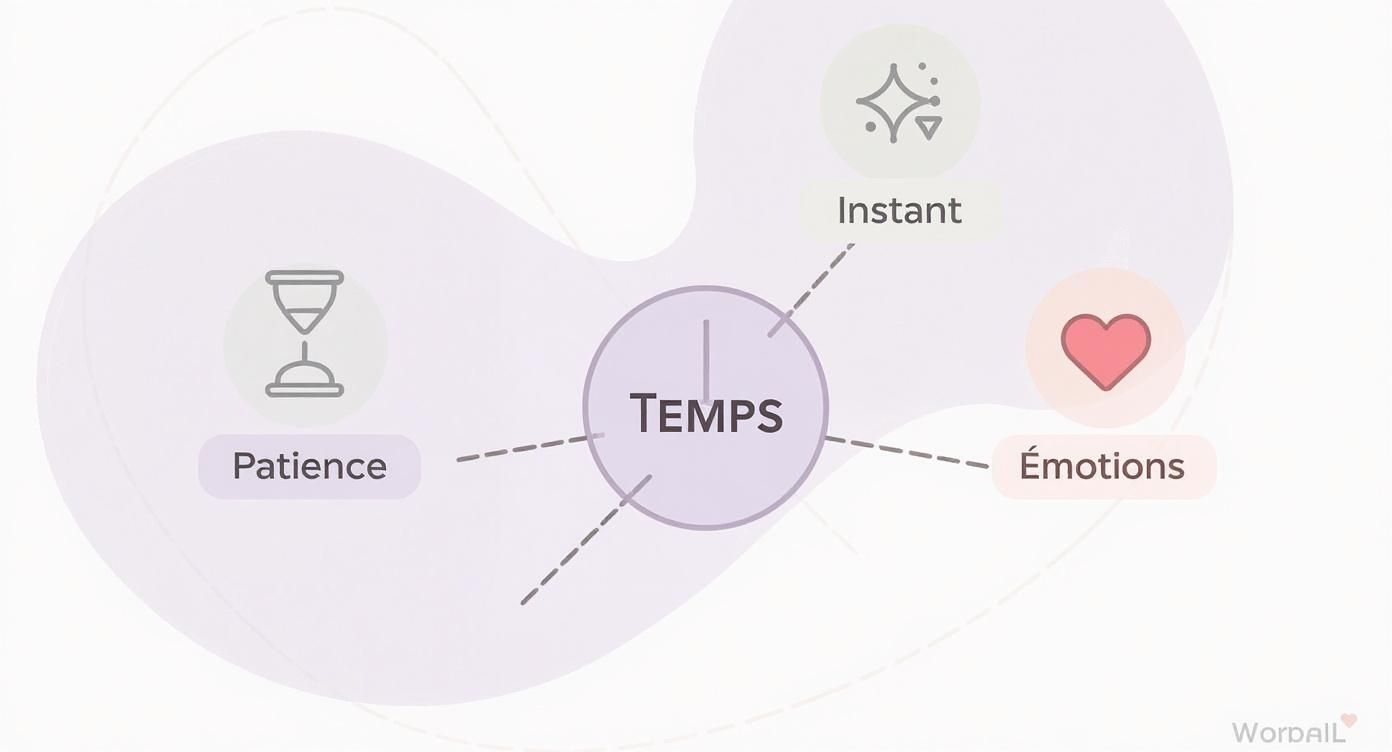
It's clear here that time isn't just a ticking clock. It's a very personal experience, connected to our emotions, our patience, and our ability to enjoy the moment.
To make all this more concrete and fun, I suggest a little activity that allows you to get a feel for the passage of time and the value of memories.
Family activity: the time capsule
Creating a time capsule is a wonderful way to show how time passes and transforms things. It's a simple little ritual that creates incredible memories and strengthens family bonds.
The equipment:
- A fairly sturdy box (made of metal or plastic)
- Paper and pens
- Small objects that have meaning for each member of the family
The steps:
- Choose a special moment : The beginning of the year, a birthday, the first day of summer... Any occasion is a good one!
- Gather your treasures : Each person chooses an object that represents something important to them right now. It could be a drawing, a photo, a letter to their "future self", or even a small toy.
- Seal and hide the box : Put everything in the box, close it securely, and decide together on a date to open it. In one year? Three years? Five years? It's up to you.
- Waiting becomes a game : Of course, impatience will be there, but this time it's shared and positive. Together, you build a joyful anticipation, a family project that teaches patience in a playful way.
This activity helps your child understand that time is not just an empty waiting period, but a period filled with changes, growth, and beautiful memories to come.
Making time tangible through play and creativity
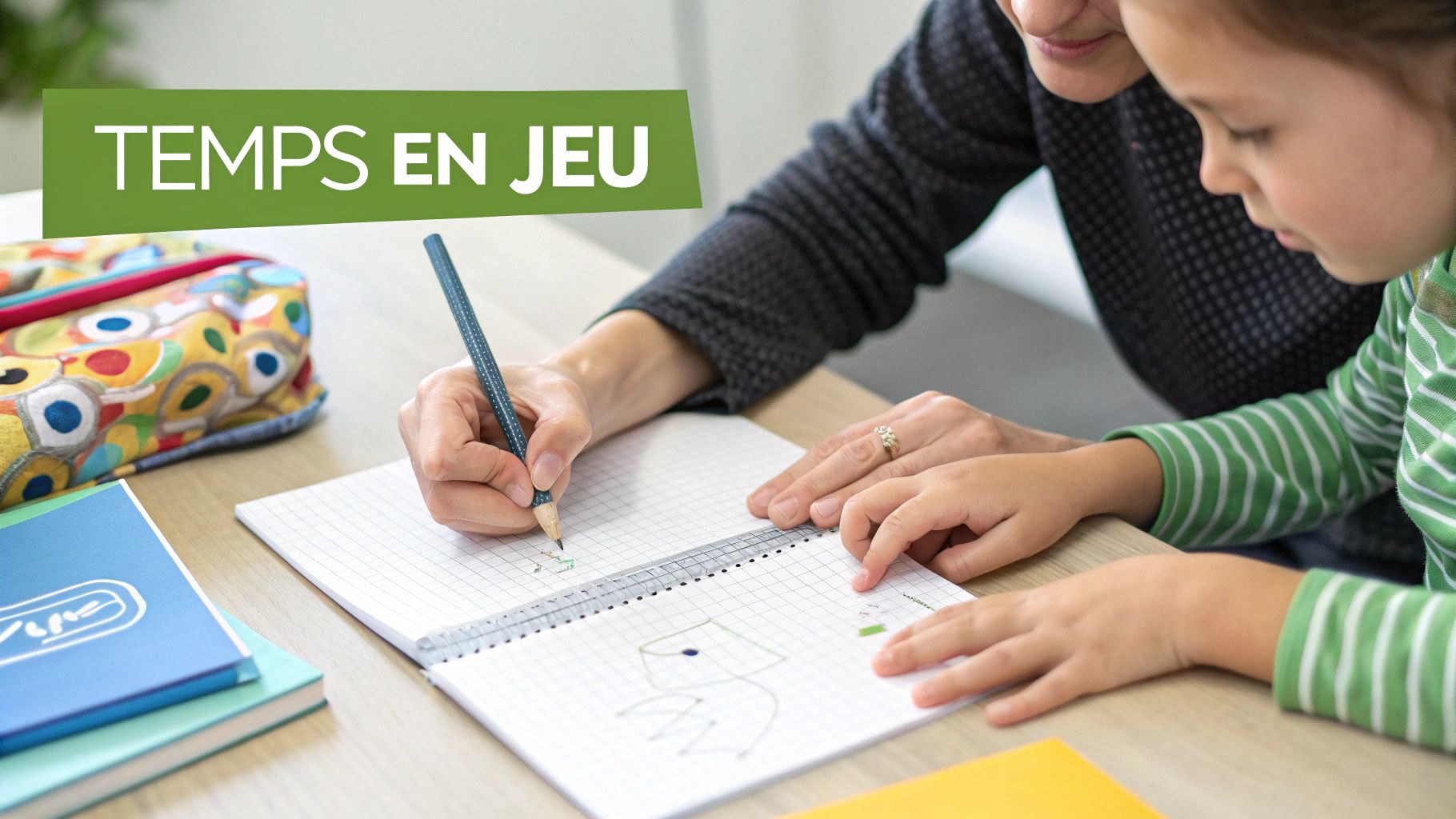
For an idea as vast as time to become real for a child, they need to touch it, see it, and perhaps even draw it. Creative activities are perfect for this. They transform this abstract concept into a true adventure, a moment of sharing as a family where you truly connect. It is by giving form to past moments that the present takes on its full value.
We're moving away from clocks and calendars to ground the understanding of the essence of time in emotion and experience. These activities can even become little rituals that strengthen family bonds. Your child will learn that time isn't just measured in minutes, but above all in precious memories and bursts of laughter.
A journal of precious moments
Here's a really simple activity, perfect for doing in the evening before bedtime. The idea? Give your child a beautiful notebook, like the one from My Book Story , which will become their personal treasure. They can use it to record a special moment from their day. It's not a traditional diary, but rather a little museum of their big and small joys.
The goal is to focus on a single moment. Perhaps it was building an awesome fort in the living room, a fit of laughter with a friend at school, or the incredible taste of strawberry ice cream.
- Drawing as a way to tell a story: For younger children or those who struggle to find the right words, a simple drawing is perfect. It's a very gentle way to express an emotion without having to use sentences.
- A few words to accompany: For older children, adding a few words to describe the scene or the feeling experienced is a great exercise. It helps them enrich their vocabulary and better understand what they are experiencing.
By looking through this journal with him, you show him that every day, even the most ordinary, is filled with little treasures that deserve to be celebrated. He learns to savor the present moment and builds a bank of positive memories.
Some questions to start the discussion:
- "Why did you choose that particular moment?"
- "If this memory had a color, what would it be?"
- "How exactly were you feeling at that moment?"
The family tree of memories
To help your child visualize time stretching across generations, there's nothing better than building a special family tree. Rather than just names and dates, this tree highlights the memories and experiences that connect your family. It's a wonderful way to connect them to their roots and help them understand that their story began long before they were born.
Take a large sheet of paper or cardboard and draw a beautiful tree. Your child stands on a low branch, you just above, then the grandparents, and so on.
On each branch, stick photos, but above all, write down short anecdotes or memorable moments:
- The day Grandpa learned to ride a bike.
- The cake recipe that Grandma loved when she was little.
- Your funniest childhood memory.
This fun activity gives a very concrete perspective on the passage of time. Your child realizes that they are part of a long and beautiful story, woven from shared life moments. It's a wonderful tool for strengthening their sense of belonging and self-confidence, showing them that they are the product of all these past experiences.
Time, an ally to boost your confidence
What if time, which we often see as something that rushes us, became your child's best friend? The idea is to help them discover that "taking their time" is a bit like a superpower. Every moment spent learning, creating, or simply being is another brick in the wall of self-confidence they're building.
Time isn't an enemy chasing us, but rather a vast playground full of possibilities. Take learning a new skill, for example. Whether it's playing a piece on the piano, completing a drawing, or finishing a model, each step takes time and requires a little patience. It's by seeing their own progress, little by little, that your child realizes they are capable of overcoming obstacles.
Every minute invested in a project becomes concrete proof of what it is capable of achieving. The important thing is not to be the best right away, but to understand that patience and practice always lead somewhere.
This way of viewing time as a tool for growth is invaluable, especially in our often fast-paced world. Did you know that mastering time has always been a major issue? For example, just after the French Revolution of 1789, France invented a brand-new Republican calendar to mark a fresh start. It's amazing how much we've always sought to organize time, even if it sometimes puts pressure on us today. To learn more about this fascinating period in French history, check out this resource from Britannica .
Our goal is simple: to help your child see time as an opportunity to have fun and grow, not as a distressing countdown.
The timed creative challenge
To show him that you can do amazing things in a very short time, why not launch some "timed creative challenges"? It's a super fun activity that proves that even five short minutes can be full of creativity.
Here are some ideas:
- The 5-minute drawing challenge: Give them a funny theme like "draw an animal that doesn't exist" or "invent a new planet", and start the clock!
- The story in 3 sentences: Take turns, you have one minute to invent a mini-story. Laughter guaranteed!
- Express construction: Using building bricks, who will build the tallest tower in two minutes?
These simple little games change the perception of time. Pressure transforms into excitement. Your child discovers that it's not the duration that counts, but the desire and pleasure put into what they do. And realizing that they can create something wonderful in the blink of an eye is excellent for their self-esteem .
Learning to savor the present moment as a family
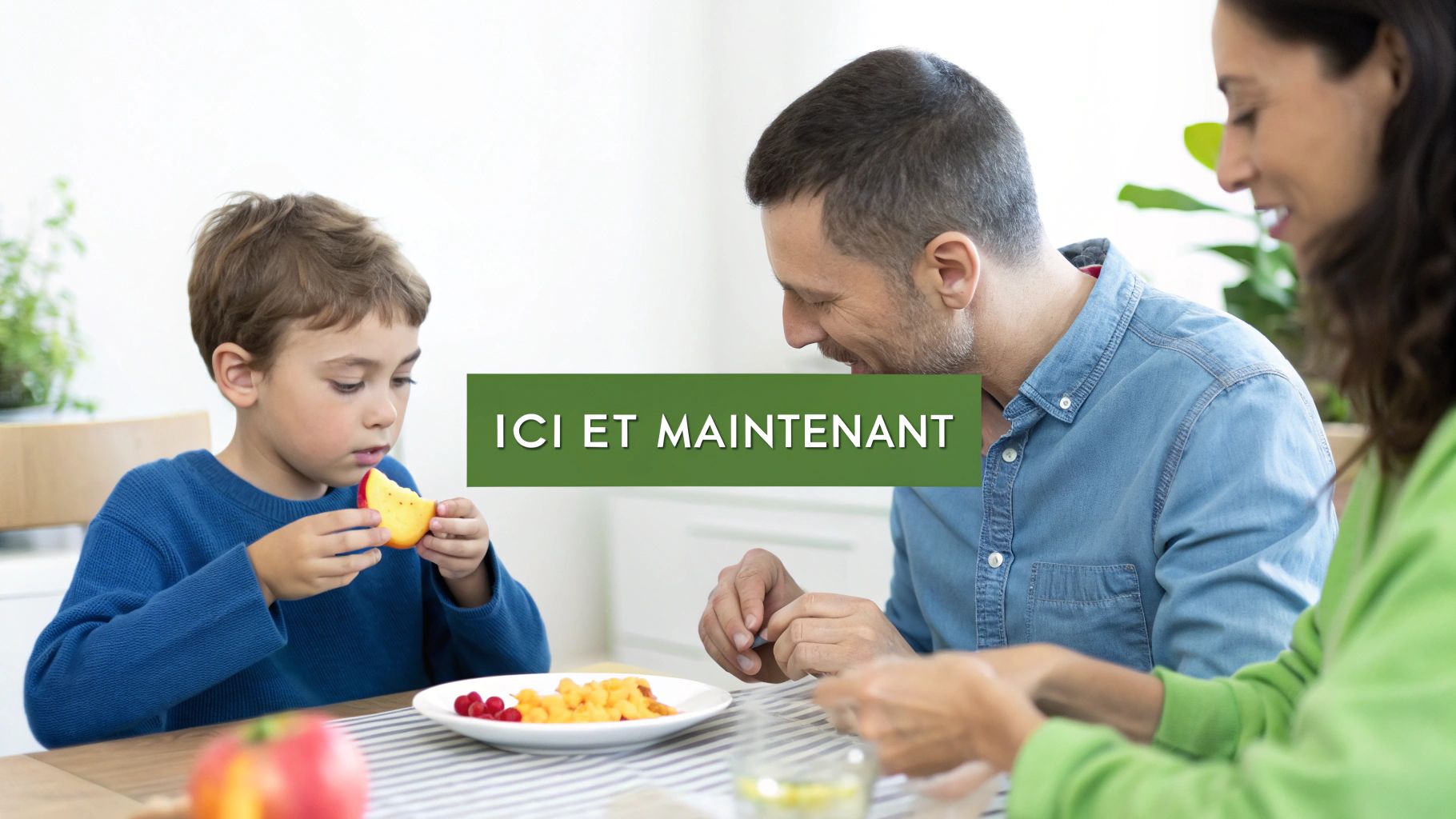
In the whirlwind of daily life, our minds tend to juggle between what needs to be done tomorrow and what we did yesterday. We almost forget the most important thing: the "now." Yet, the greatest gift we can give our children is to show them how to savor the present moment.
It is precisely in these moments that the most precious memories are forged and a true cocoon of emotional security is built.
Learning to live in the moment is a bit like learning to ride a bike. At first, it requires a little focus, but the more you practice, the more natural it becomes. It's an incredibly useful skill for calming stress and anxiety, for both children and adults. Of course, finding the time isn't always easy, and good tips for a better work-life balance can really help free up mental space to focus on what's essential.
Small rituals that create great memories
You don't need to transform your daily routine to incorporate moments of mindfulness. A few simple and fun rituals are enough to help the whole family reconnect with the present moment.
Here are a few simple ideas to try:
- The minute of silence: Once a day, take a break. Stop everything and listen closely. Ask your child, "What do you hear right now?" The ticking of the clock, a bird outside, the hum of the refrigerator... This simple exercise immediately grounds them in the present moment.
- Mindful eating: Take a food you enjoy, like a segment of clementine or a square of chocolate. Take the time to observe it, smell it, and then savor it very, very slowly. Focus on each sensation. It's a playful way to rediscover that even eating can be an adventure!
The goal isn't to be perfect, but to build a connection. Every little moment shared, even if it seems insignificant, strengthens your bond and shows your child that their feelings matter. This is an incredibly powerful message for their self-esteem.
What was the best moment of your day?
Another wonderful ritual, perfect for dinner, is the "best moment of the day" round-table. Each person takes a turn sharing a small moment of happiness they experienced during the day. It can be something very simple: a friend's smile, a ray of sunshine on the way to school, or a joke that made them laugh.
This simple habit teaches children to cultivate gratitude and to see the positive around them.
In an ever-accelerating world, these pauses are a true breath of fresh air. It's no coincidence that in 2019, 80% of women and 68% of men in France reported feeling anxious. Making time for these moments of calm is more essential than ever. If you're interested in the evolution of our lifestyles, you can take a look at this INSEE study .
The questions you ask yourself about time and children
Talking about time with a child often means venturing into somewhat murky territory, filled with questions that are as touching as they are complex. As a parent, it's easy to feel overwhelmed. Don't panic! Here are a few tips to transform these discussions into precious moments of sharing.
Remember: every question your child asks is a window into their world. It's an invitation to reassure them and show them they can count on you.
How do we approach loss or death in relation to time?
This is probably the conversation we dread the most. For a child, the idea that time stops for someone is overwhelming and can be frightening. The secret is to choose simple, sincere words that are appropriate for their age.
A beautiful image is that of a story with a beginning, a middle, and an end. Explain that a person's life is like a magnificent book. Even after turning the last page, you can reread your favorite chapters, remember the passages that made you laugh, and the adventures you loved. These memories never fade.
You could tell her, "The time we had with Grandma is over, that's true. But all her stories, her hugs, and her laughter are still here, in our hearts. It's her gift, and it's ours forever." The idea is to emphasize the love and memories, which are stronger than the passage of time.
The most important thing is never to minimize their sadness. Acknowledge their emotions, allow them to feel them. This shows them they are not alone and that you are there to go through this with them.
What should I do if my child is bored all the time?
Ah, the famous "I'm bored!" We often instinctively see boredom as a problem to be solved immediately. But in reality, it's an incredible opportunity. When a child is bored, it's because they're about to have a brilliant idea. So, before suggesting an activity, take a breath and wait a little while.
Boredom is the playground of the imagination. It is in this apparent void that the mind begins to wander, to invent worlds, games, or crazy stories.
Here are some tips to support him without doing it for him:
- The idea box: Take an old shoebox and fill it with small slips of paper with simple challenges: "Draw a three-headed monster", "Build the tallest tower of cushions", "Invent a song about your cuddly toy".
- Validate what he's feeling: "Ah, I see, you're bored. It happens. I wonder what brilliant idea your brain is secretly cooking up..."
- Put screens on pause: Screens are an easy crutch against boredom, but they prevent the brain from doing its own creative work.
Learning to tame boredom means learning to be comfortable with yourself, without needing to be constantly busy. A valuable life skill.
At what age does a child truly understand what the future is?
The concept of the future develops gradually. At age 6, a child's vision is very much rooted in the present and the immediate future: "tomorrow," "tonight," "after school." A week, a month, a year... it all remains very vague. It's usually around age 8 or 9 that the ability to project oneself into the more distant future truly begins to take shape.
To help make this concept more concrete, nothing beats visual cues:
- The family calendar: Hang a large calendar in the kitchen and mark important events together (birthdays, holidays, visits from grandpa...). It will help them see the passage of time.
- Long-term projects: Planting a small seed and watching it grow day after day is a wonderful lesson in patience and a perfect illustration of the work of time.
Talking about his dreams, about what he would like to do "when he grows up", is also a very nice way to help him imagine his future as a space full of promises and possibilities just waiting for him.
To support your child in exploring their emotions and help them build confidence day after day, discover the My Book Story journal. It's a wonderful companion on the great adventure of self-discovery. Discover the My Book Story journal right here .