


For a child to truly enjoy their day, the key isn't to fill it to the brim, but rather to help them notice the little joys of everyday life. A creative journal is a fantastic tool for this, transforming an ordinary day into a precious memory that nurtures their self-confidence.
Establish rituals for an unforgettable day
Everything moves so fast these days! For children, as for us parents, it's easy to miss the little moments that make a day special. By creating small family rituals, even very short ones, we can press the "pause" button to focus on the positive and strengthen our bonds.
Far from being a constraint, it's about integrating small, meaningful habits. These routines become reassuring points of reference for your child, teaching them to value their daily life and develop their emotional intelligence.
Turning the everyday into an adventure
The idea is to sprinkle a little magic into each passing day. Sharing a "favorite moment" at dinner or making a "silly face of the day" before bedtime is sometimes enough to make a day memorable. These little traditions are the foundation upon which your child's memories and sense of security are built.
A creative journal like My Book Story is the perfect companion to these rituals. It offers your child a personal and safe space to:
- To express what he feels without judgment, whether with a drawing, a collage or a few words.
- Celebrate your successes , even the smallest ones, such as helping a friend or succeeding at a difficult exercise.
- Keeping track of good times , transforming fleeting moments into deeply rooted happy memories.
By guiding your child to identify what makes them happy, you're not just creating beautiful memories. You're giving them tools to cultivate optimism and strong self-confidence for life.
This need to create quality time is indeed a real trend. French household spending on leisure activities has jumped by more than 40% since 2019, a record figure! This clearly demonstrates how much families are looking to make their days more meaningful. For those interested in the figures, you can consult an analysis of the leisure market on ModelesDeBusinessPlan.com .
Starting the day right: the little morning ritual
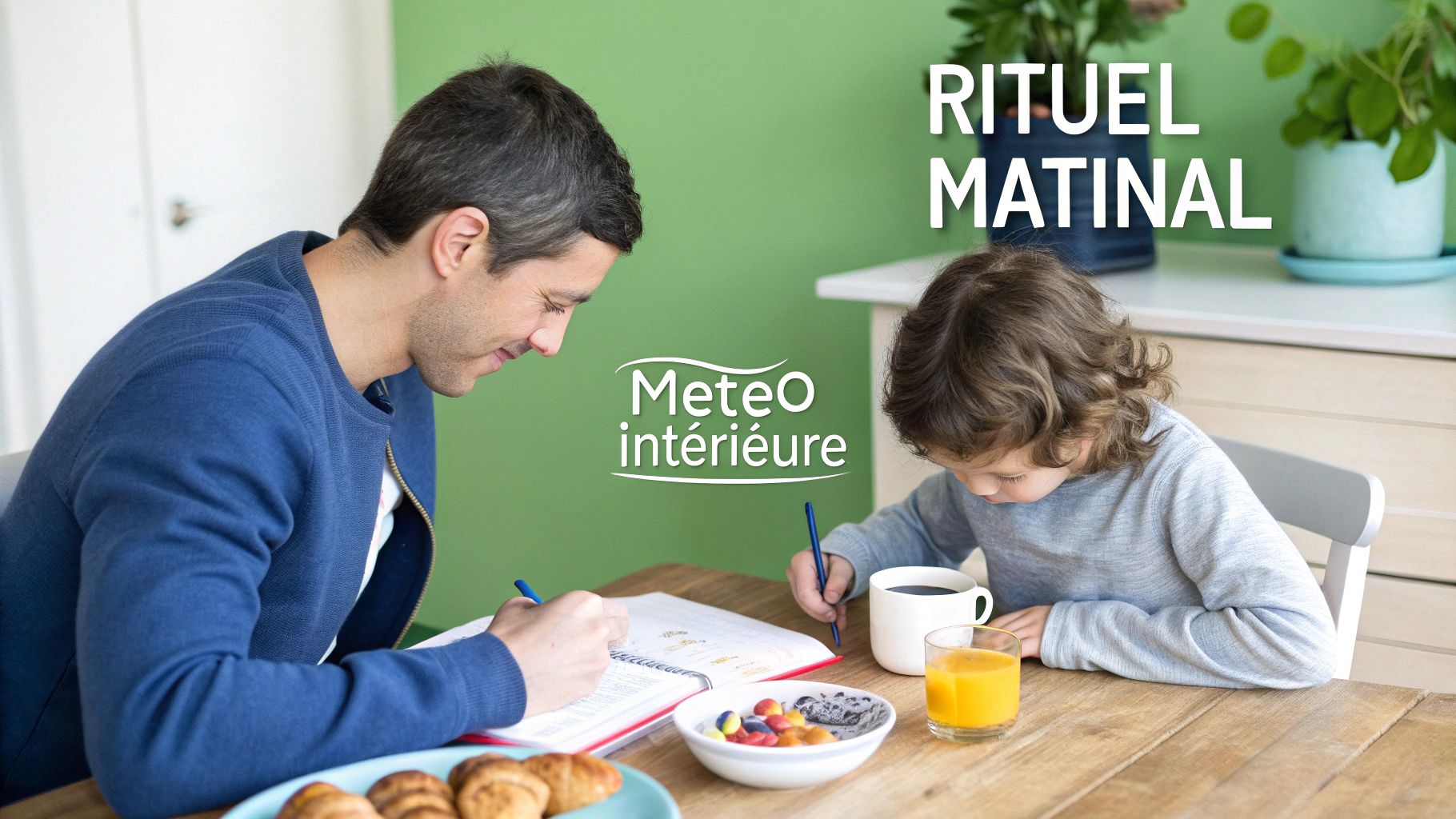
We all know that how we start the day influences everything else. A gentle awakening, even if it only lasts a few minutes, can transform a chaotic morning into a special moment of connection. Your child will feel calmer and ready to tackle their day with confidence .
No need to turn everything upside down! The idea is to create a small habit that puts everyone in a good mood. It can be as simple as a "question of the day" posted over the cereal bowls.
Try, for example, asking: "What would make you happiest today?" or "If you had one superpower for the day, what would it be?" A question like this is enough to direct your thoughts toward something positive and stimulate your imagination.
A ritual that grows with him
Obviously, the desires of a 7-year-old are not those of an 11-year-old pre-teen. The secret to a ritual that works is to adapt it.
- For 6-8 year olds : Drawing and play are their best allies. Suggest they jot down their "inner weather" in their journal. A big sun if they're happy, a little cloud if they're worried… It's a fun and easy way to put words (or rather, images) to what they're feeling.
- For 9-12 year olds : At this age, they begin to appreciate moments of introspection. Suggest that they write in their My Book Story journal one small thing they are looking forward to during the day. It could be the soccer game at recess, art class, or simply seeing their best friend.
The goal isn't to perform a perfect exercise, but to create a small moment of connection. By starting the day on a note of sharing, you reinforce their sense of security and show them that they are ready to face whatever comes their way.
This small amount of time invested in the morning becomes a solid anchor for his well-being. He learns that each day is a new adventure and that his emotions are important. It's a valuable aid in helping him fully enjoy his day, starting with breakfast.
Adventure is hidden in everyday life
A child doesn't need a spectacular outing to have a great day. The real magic lies in knowing how to transform ordinary moments into extraordinary adventures. A simple routine can become an incredible playground with just a little imagination.

The walk to school, for example, can turn into a "spy mission" where your child has to spot a certain number of cars of a specific color. And homework? Often a chore, it's true. But what if we presented it as a "superhero concentration challenge" where each completed exercise earns them an imaginary power?
These simple games require no equipment or complicated preparation. They rely solely on the power of imagination to bring joy and lightness to moments that would otherwise go unnoticed.
Turning routines into games
Creating these mini-adventures every day helps your child cultivate their creativity and see the positive in everything. It's a valuable skill that will stay with them throughout their life.
The table below will give you some concrete ideas for reinventing routines according to your child's age. The idea is to adapt the scenario so that the challenge remains fun and stimulating.
| Ideas for turning everyday life into a game |
| :--- | :--- | :--- |
| Daily Routine | Transformation into Adventure (6-8 years) | Transformation into Adventure (9-12 years) |
| Tidying your room | The "treasure timer": each toy put away is a treasure found before time runs out. | The "secret base reorganization": organize the space for a top-secret mission.
| Preparing the meal | The "alchemist chef": mixing ingredients to create a delicious and secret potion. | The "starred chef": inventing a new recipe or plating a dish worthy of a top restaurant. |
| Walk in the park | The "botanical exploration": find and identify (with your help) three types of leaves or flowers. | The "naturalist's challenge": photograph or draw five elements of nature (insect, tree, flower, etc.).
| Bedtime | The "Mission to the Planet of Dreams": each step (pajamas, brushing teeth) prepares the rocket for launch. | The "Explorer's Review": recount three discoveries from the day before falling asleep for new adventures. |
These examples are just a starting point. The important thing is to find what excites your child to transform each shared moment into a memorable experience.
The goal is not to overstimulate the child, but simply to offer them a different perspective on the world. By changing the narrative surrounding a task, we completely alter its perception and the associated emotion.
To keep track of these precious moments, the My Book Story creative journal is a perfect tool. Suggest that your child dedicate a page to "the most surprising adventure of the day." They can draw their spy mission in the car or their culinary magic potion.
Even though the adventure took place in the hallway of the house, it deserves a place in his journal. That's how he learns that every day, even the simplest, contains its share of gems worth celebrating and remembering.
Transform the evening into a moment of sharing with a creative journal
Evening arrives, and with it, calm after the day's excitement. It's the perfect time to reconnect, relax, and truly connect with your child. Using a creative journal as an evening ritual is a gentle and playful way to help them fully appreciate their day and cherish its most beautiful memories.

Far from being an additional chore, this journal is first and foremost a space for freedom. A place where expression takes all possible forms, where open and warm dialogue is created. The idea is to make this time an anticipated appointment, a bubble of connection that ends the day on a positive note.
Start the conversation, but without pressure.
We all know the famous "So, how was school?" which often elicits a simple "yes" as an answer. To go further and truly discover what's on your child's mind, nothing beats open-ended and slightly unconventional questions.
Some tips for breaking the ice gently:
- "What was your little ray of sunshine today?" A very simple question that invites her to look for the positive, even if the day was not perfect.
- "If your day were an animal, which one would it be? And why?" This is a more visual and fun approach that can help him put words to sometimes complicated emotions.
- "Tell me something that made you laugh today." Laughter is often the gateway to the best memories of the day.
The goal is to create a climate of trust, a safe space where he will feel comfortable talking about his successes as well as his little worries, without ever being afraid of being judged.
This need to experience rich and memorable moments is evident everywhere. In fact, in France, tourist numbers during the summer season increased by 3.7% , and more than 85% of stays took place within the country. These figures, which you can explore in more detail on the INSEE website, clearly demonstrate our collective desire to make the most of our days.
A journal that grows with your child
The advantage of a creative journal is that there are no rules! It adapts to each child's age, desires, and personality. It's a tool that evolves with them.
For younger children (6-8 years old), visuals are king:
At this age, drawing, colors, and collages are often their preferred means of expression. They might draw the emotion of the day, glue on a leaf picked up in the park, or use stickers to illustrate their favorite moment.
For older children (9-12 years old), writing can be explored:
They are starting to enjoy putting precise words to their thoughts. You can suggest that they make short lists (for example, "The 3 things I learned today") or even invent a short story inspired by an event from their day.
The final result isn't the most important thing. It doesn't matter if the drawing is perfect or the spelling impeccable. What truly counts is the moment of sharing you create together. By listening attentively, you show them that their feelings are important, and you nurture their self-esteem in a lasting way.
Cultivating gratitude to nurture self-confidence
Practicing gratitude is an excellent way for your child to build self-confidence. By helping them keep a journal, you're giving them a wonderful tool to see the bright side of things. This helps them learn to appreciate each day, even the less rosy ones.
This simple habit shows him that happiness isn't found only in great achievements, but also, and especially, in the small joys of everyday life. It's a valuable lesson to help him fully enjoy his day .
Finding the positive, even when it's difficult
Of course, the goal isn't to pretend everything is always fine or to ignore difficult emotions. Rather, it's about learning to find value in every experience, whether good or bad. If your child has had a tough day, help them see things from a different perspective.
Instead of focusing on what went wrong, try asking him/her open-ended questions:
- "What did you learn that was new today, even if it was difficult?"
- "What effort are you most proud of, regardless of how it ended?"
- "Was there even a tiny moment, even just a second, that made you smile?"
By encouraging him to recognize his efforts and tenacity, you show him that his worth is not limited to his successes. This is a fundamental lesson for building strong and lasting self-esteem.
This quest for balance is evident everywhere. Take sports, for example. Nearly 58% of French people aged 15 and over engage in regular physical activity, with a clear preference for individual sports. This clearly demonstrates the need for autonomy and personal well-being that we seek to integrate into our daily lives. For more information, you can consult a detailed analysis on the IPMS website .
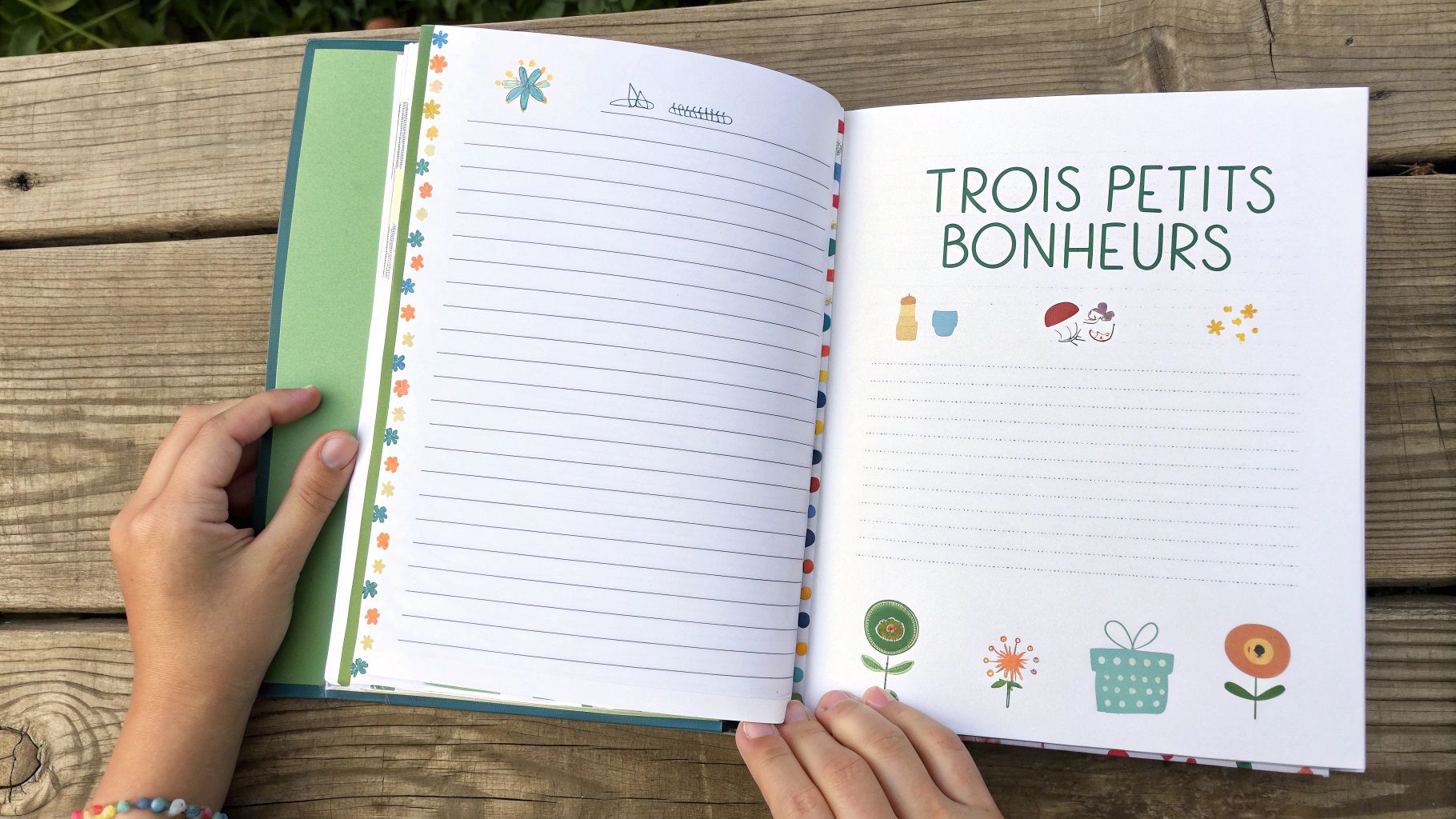
To make this moment of gratitude fun and tangible, suggest creative activities to your child in their My Book Story journal. They could list their "three little joys of the day" or even draw something that made them laugh. It's a simple habit, but one that has a real impact on optimism.
We answer your questions as parents about rituals.
Establishing new habits, even with the best intentions, always raises questions. It's perfectly normal to feel a little unsure at first. The important thing is to remain flexible and find a pace that works for your family, without putting pressure on yourself.
Here are some answers to the most frequently asked questions, to help you confidently launch these moments of sharing.
"My day was awful!" What should I do when my child says that?
Ah, that dreaded "terrible" day! Rather than desperately searching for a positive aspect, the first thing to do is acknowledge your feelings. A simple "Oh really? Tell me about it, I get the feeling you had a bad day" shows that you're listening, without judgment. Forcing positivity at that moment would be completely counterproductive.
Instead, suggest a different way for him to express himself:
- The colors of mood: "What if you drew your day with the colors you have in your heart right now?"
- The "zero" scale: "On a scale of 1 to 10, what was its zero rating? And what could have made it just a tiny bit less zero, even at 2 out of 10?"
The goal is not to deny what he feels, but to open a door for him to talk about it.
How can we find the time in our ministerial schedules?
Let's focus on quality, not duration. An effective ritual doesn't have to be long. Two minutes of genuine connection can have far more impact than a forced half-hour. Consistency is your best ally.
The secret isn't the time you spend on it, but consistency. A little bit each day is better than one long session once a week.
Think about those little moments. In the morning, while putting on shoes: "What are you most looking forward to today?" In the evening, while brushing teeth, ask them about their best memory of the day. Journaling can become a short, five-minute routine, just before bedtime stories.
My child hates drawing and writing, what can I do?
The journal is a tool, not an end in itself. The goal is to help your child express themselves and communicate with you. If pencil and paper aren't their favorites, no problem!
Here are some other avenues to explore:
- He can tell his favorite cuddly toy about his day.
- Why not build your favorite moment of the day out of building blocks?
- Use emoticon stickers or stickers so he can choose the one that best represents his day.
The important thing is to find the channel that speaks to him, the one where he will feel truly comfortable sharing his inner world.
By incorporating these little rituals, you're giving your child a precious gift: the ability to recognize and savor the small joys of everyday life. The My Book Story journal was designed to accompany you on this adventure and make each day a story that matters. Discover how it can nurture your child's confidence and creativity at mybookstory.co .