


When we talk about a child experiencing difficulties , we often picture a child going through a turbulent period, seeking the right support to learn how to navigate their emotions and challenges. This isn't a label you stick on them for life. Instead, see this phase as an invitation to better understand what's happening within them and, at the same time, to strengthen the bonds that unite you as a family.
Moving beyond the notion of a child in difficulty
Hearing the words "child in difficulty" can quickly raise a parent's anxiety. That's perfectly normal. But the first thing to do is to put things in perspective. A difficulty, whether at school, with friends, or in managing emotions, is never the end of the world.
Think of it more as a signal, a way for your child to tell you, without words, that they need a slightly different kind of help right now.
What if we saw this period not as a problem, but as an opportunity to seize? That changes everything. It's a chance to get closer to your child, to truly observe their strengths, and to help them build resilience. Every challenge you overcome together is another brick you add to the foundation of their self-confidence.
Turning the challenge into an opportunity for personal growth
The key is to think in terms of support and guidance, not "problems to solve." The goal isn't to "fix" your child, but to give them the tools to overcome obstacles on their own, knowing that you're right there to guide and reassure them.
This approach allows you to focus on concrete and positive solutions. To start seeing things from a new perspective, here are some practical tips:
- Look for their hidden strengths. A child who struggles to concentrate in class might have an incredible imagination. Your role? To help them channel this creative energy so it becomes a strength. For example: Suggest they create a comic strip to tell the story of their history lesson.
- Create a safe space. He needs to feel he can talk to you about his frustrations, fears, or sadness without being judged. This is essential for him to open up and accept your help. For example: Establish a "judgment-free time" each evening where everyone can share an emotion, even a negative one.
- Value effort, not just results. Perseverance in the face of an obstacle is far more important than an easily obtained good grade. Celebrate every small step, every effort. For example: Say, "I saw that you spent a lot of time on this difficult assignment; I'm proud of your perseverance!" rather than, "Congratulations on your good grade."
By adopting this guiding role, you transform what could have been a stressful period into a wonderful adventure of growth for the whole family. You're not fighting against a difficulty; you're building skills together that will serve them throughout their lives.
This is just the beginning. We will now take a closer look at the signs to watch for, explore the possible causes, and, most importantly, discover concrete strategies to support your child. By focusing on their emotional well-being and development, you are giving them the most precious gift: the certainty that, no matter the storm, they have everything they need within themselves (and around them) to weather it.
Identify the signals that really matter
As parents, we constantly observe our children; that's perfectly normal. The trap is letting worry take over at the slightest change. The real skill lies in learning to distinguish between a passing "rough patch" and a deeper cry for help that a child in distress is trying to send us. The goal isn't to play detective, but to remain an attentive and loving observer.
Rather than checking boxes on a list of symptoms, focus on the changes that persist over time and disrupt their daily life. A child has every right to be grumpy, tired, or moody. It's when these behaviors become the new normal that they warrant special attention.
Look beyond appearances
Every behavior is a way of communicating. A child who withdraws like an oyster isn't necessarily trying to push you away. Perhaps they simply feel overwhelmed and need to create a safe space for themselves.
Similarly, newfound irritability or repeated outbursts of anger can mask anxiety or feelings of inadequacy. It is crucial to look beyond the behavior to try to guess the underlying emotion.
Here are some avenues to explore with kindness:
- Emotional roller coaster : Does your child seem sadder, more anxious, or irritable than usual? And has this been going on for several weeks?
- The social bubble : Has he suddenly refused to see his friends or participate in activities he used to love? Is he spending much more time alone in his room?
- Loss of enthusiasm : Has he lost his passion for the game or for his hobbies? Play is the language of children. A loss of interest is often a strong signal.
A sudden and persistent change in behavior is often the surest sign that your child is going through a difficult time. It's the consistency and intensity of the signal that matter, more than the signal itself.
School, a mirror of difficulties
A sudden drop in grades or repeated negative feedback from teachers are often the first warning signs. School is a demanding environment, and it's where emotional vulnerabilities quickly become apparent. These problems can be both the cause of distress and its direct consequence.
Dropping out of school is a very real risk for children facing difficulties . In 2022, the rate of 18-24 year olds leaving the education system without a diploma was 7.6% . This figure reminds us how important it is to act quickly. To learn more, you can consult the statistics on school dropout on Jobimpact.fr.
The image below clearly illustrates the link between anxiety and the need for support in children, and shows how appropriate support can make a real difference.
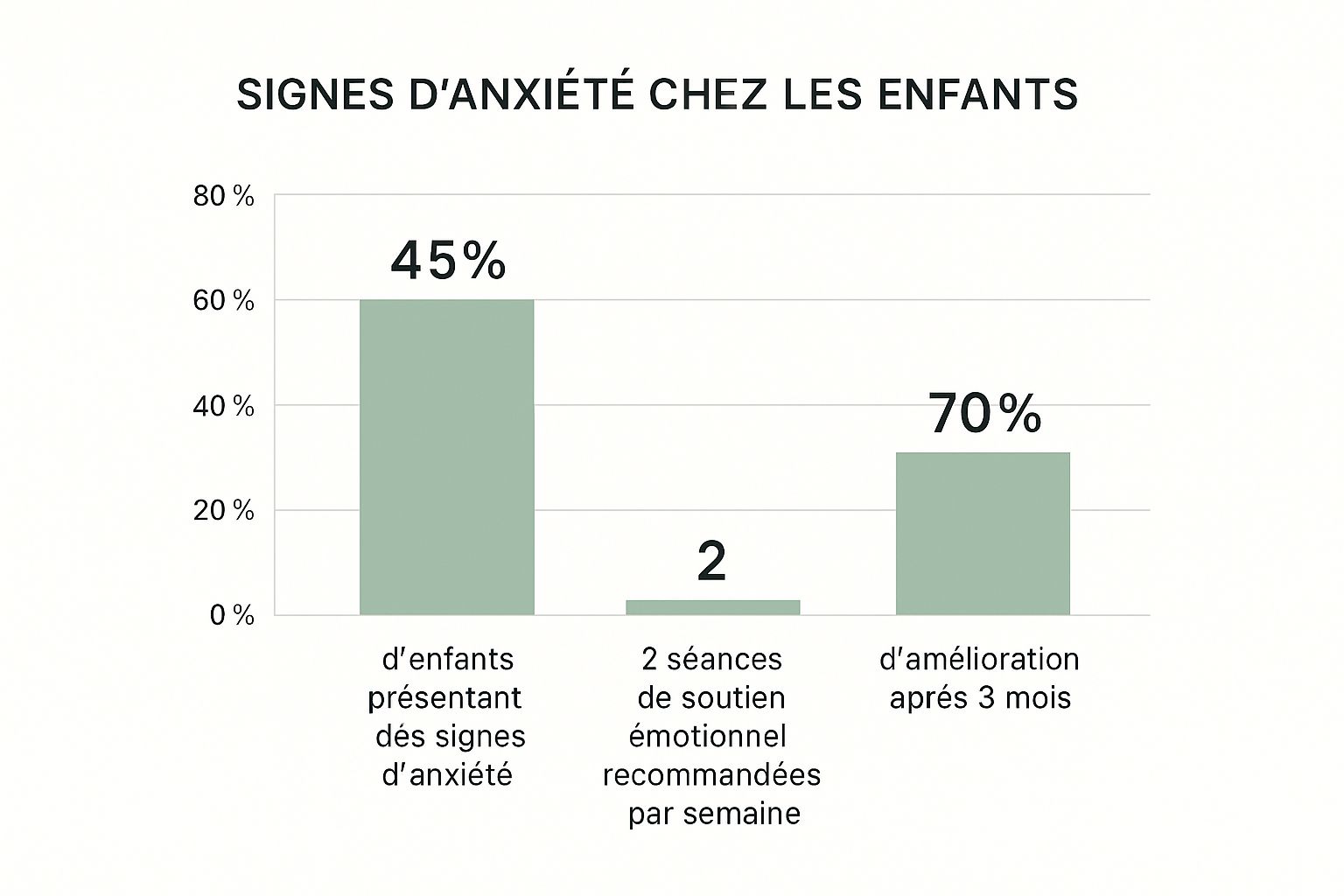
To help you structure your observations without falling into hypervigilance, here is a handy little tool.
Table for observing signs of difficulty
This chart can help you identify and track changes in your child's behavior more objectively, in different contexts of their life.
| Area of observation | Possible signs to watch for | Concrete examples | Frequency (rare, occasional, frequent) |
|---|---|---|---|
| Emotions and mood | Persistent sadness, irritability, anxiety, mood swings. | Cries for no apparent reason, gets upset over nothing, seems worried. | |
| Social life | Isolation, avoidance of friends, repeated conflicts. | Refuses to go to birthday parties, no longer talks about his friends. | |
| School and learning | Declining grades, lack of motivation, difficulty concentrating. | Homework not done, remarks from the teacher, "I don't like school anymore". | |
| Sleep and appetite | Difficulty falling asleep, frequent nightmares, loss of appetite. | Wakes up at night, systematically pushes his plate away. | |
| Games and areas of interest | Loss of interest in favorite activities, repetitive or aggressive play. | He no longer touches his beloved Legos, and abandons his sports club. |
Remember that this chart is a guide, not a diagnostic tool. Its purpose is to help you gain a clearer understanding. This data confirms that attentive support can greatly improve a child's well-being. Your role is to listen attentively and open a dialogue, without judgment, to understand what is happening internally.
Trying to understand where his difficulties come from

When we see a child struggling, our first instinct is often to want to address what we observe on the surface: their behavior. However, this is only the tip of the iceberg. To truly help them, we need to delve deeper and try to understand what's happening internally, what's fueling their distress.
Every behavior has a story, an origin. The idea isn't to point the finger at someone, but to connect with your child's emotional world. It's not about "fixing a problem," but rather about learning to listen to what they're trying to tell us, sometimes with the only means they have.
The major upheavals of life
Children are like sponges, absorbing emotions. Changes that seem minor, or at least manageable, to us can be real upheavals for them. Moving house, a separation, the arrival of a new sibling… all of these things shake their sense of security.
These transitions can manifest in very different ways. For example, a child might suddenly become aggressive at school, not out of malice, but because they feel completely overwhelmed by their parents' separation. Another might start wetting the bed again after moving house, a way of saying they need to find a reassuring, secure environment again.
Trying to understand the cause of a difficulty is a bit like looking for the right key for the right lock. As long as you keep trying to open the door with the wrong key (focusing only on the behavior), you won't get anywhere.
What's happening inside: the less visible causes
Sometimes the source is not a major external event, but something more diffuse, related to the child's personality or what he/she experiences socially.
Here are some suggestions to better understand what your child is going through :
- Hypersensitivity : A highly sensitive child may feel completely overwhelmed by the noise in the playground, or by a simple remark from a classmate. This emotional overload can lead them to withdraw or, conversely, to explode in anger.
- Tensions at school : A difficult relationship with a teacher, bullying, or simply the pressure to do well can create deep anxiety. This can manifest as stomach aches or a complete refusal to go to class.
- Specific needs : Learning difficulties that have not yet been identified, such as dyslexia or other disorders, can be a huge source of frustration. A child who struggles to keep up can quickly lose confidence and start doing everything they can to avoid school.
In some cases, the difficulties are linked to a recognized disability, which requires specific support. Moreover, efforts to improve inclusion are intensifying. It is estimated that by 2025, 85.5% of the 534,890 children recognized as having a disability will be attending mainstream schools. If you would like to learn more about inclusive education, you can consult the key figures on childhood and disability at enfancejeunesseinfos.fr .
Your role is that of a caring investigator, gathering clues to reconstruct your child's unique story.
Implementing daily support strategies

Once you've observed and begun to understand what's bothering your child, it's time to take action. No need for major changes, just concrete and caring gestures. Often, it's the small, everyday acts of kindness that build the strongest trust.
The idea is to make your home a haven. A place where your child feels safe, truly listened to, and appreciated for who they are. Home then becomes a refuge, a safe haven where they can let go of their worries and recharge.
Create a space for dialogue where he feels safe
The first step, and undoubtedly the most important, is to open a genuine channel of communication for him. He needs to feel that he can say anything, without ever fearing judgment. The goal isn't to force him to speak, but to show him that the door is always wide open.
To achieve this, your best ally is active listening . This means listening to understand, not just to respond. When he confides in you, put down your phone, turn towards him, and give him your full attention. Try to rephrase what he says in your own words, just to show him that you've understood. For example: "If I understand correctly, you're sad because you feel like your boyfriend doesn't want to play with you anymore?"
A child who feels truly listened to understands that their emotions are valid and important. This is the foundation upon which their emotional intelligence and self-esteem are built.
Strengthening the sense of security with family rituals
Family rituals are true anchors for a child. They provide a sense of stability and predictability, especially when everything else around them seems a bit chaotic. No need for complicated things!
- The evening emotional "check-in": Take five minutes at bedtime to ask them to talk about one thing that made them happy during the day, and another thing that bothered them a little. It's a simple ritual to help them identify and name their emotions.
- The special weekend breakfast: Set aside some time just for yourselves on Saturday or Sunday, where you take the time to cook and eat together, away from screens. This quality time strengthens bonds.
- Bedtime story: Even if he can already read, reading a story together before bed is an incredibly reassuring moment of calm and closeness that often opens the door to confidences.
These small, repeated habits strengthen the bonds and send a powerful message: "You are part of our tribe; here, you are safe." Unfortunately, not all children are so fortunate. A UNICEF survey reminds us of an alarming reality in France: 2,159 children sleep on the streets. To better understand this dramatic situation, you can consult Mediapart's full analysis .
Nurture their confidence by valuing effort, not just results.
To help a child regain confidence, it's essential to shift your perspective. Highlight the effort they put in rather than the results they achieve. Instead of saying, "I'm proud of your 18/20," try saying, "I saw how hard you worked for this test, and I'm really proud of your perseverance."
This approach teaches him that his worth isn't measured by his successes, but by his ability to try, to get back up after a setback, and to keep going. That's the secret to resilience. Celebrate his small victories and encourage him to see his mistakes not as failures, but as opportunities to learn and grow.
The creative journal: a gateway to emotions
When words fail, drawing, colors, or collage can take over. For a child struggling to express themselves , putting words to their feelings can sometimes feel like an insurmountable obstacle. A creative journal isn't just another homework assignment, but rather a secret garden, a space that's entirely theirs where they have the right to say anything, unfiltered and without judgment.
Think of a journal that isn't used to recount their day, but to explore their inner world. Your child could draw their anger like an erupting volcano, write a letter to their shyness asking it to leave them alone, or paste pictures that remind them of a happy moment. The idea is to give shape and color to what's happening inside.
The simple act of "expressing" one's emotions on paper, whether through scribbles, shapes, or words, has an incredibly liberating effect. Once externalized, these emotions become less overwhelming, less abstract. One can observe them, understand them, and, little by little, learn to manage them.
How to embark on this adventure?
The goal is definitely not to leave your child alone with a blank page, which can be very intimidating. Your role is to offer suggestions, little "invitations to create" to get the creative process going. The aim is for it to be fun, a game, without any pressure to produce something "beautiful."
Here are a few simple ideas to get started:
- To explore what he feels: "If your sadness were a color, what would it be? Draw it all over the page.", "What does your anger look like? A monster with claws? A big storm?", "Draw a magic shield to protect yourself when you are scared."
- To boost their confidence: "What superpower would help you feel stronger at school? Draw yourself using it!", "Make a list of 3 things you accomplished this week (even the smallest victories count!)", "Paste a photo or draw a memory that makes you really proud."
- To imagine a gentler future: "Draw your perfect day, from morning to night.", "Write three wishes you would make if you had a magic wand."
A creative journal is a silent conversation the child has with themselves. It's a concrete way to show them that all their emotions are valid and that they already have within them everything they need to manage them.
By doing this regularly, even for just a few minutes, a child learns to know themselves better. They develop their emotional intelligence and discover that they can transform a painful feeling into something creative. This is a skill that will stay with them throughout their life, far beyond the difficulties of the moment, and will nourish their self-esteem for good.
Knowing when and how to seek outside help
As a parent, you give everything for your child. You try, you adjust, you comfort. But sometimes, despite all your good intentions, you feel like you're going in circles and your child's difficulties persist.
Recognizing that you need a helping hand is never a failure. On the contrary, it's a sign of clear thinking and immense love. It means putting your child's well-being first.
Imagine you are the captain of a ship. You know perfectly well how to navigate in calm weather, but when a big storm rises, calling on an expert harbor pilot is not a weakness, it is the wisest decision to keep everyone safe.
When is the right time to seek help?
The right time is often when you feel the situation is overwhelming. When your child's distress begins to weigh heavily on their daily life, their joy of living, and the balance of the entire family. If you've already tried everything and nothing changes, it's probably time to look for a new partner.
Here are some fairly clear warning signs:
- The suffering becomes chronic : it is no longer a passing sadness, but anxiety or anger that has lasted for weeks.
- Daily life becomes a struggle : he has trouble sleeping, loses his appetite, refuses to go to school or play with his friends.
- You are at your wit's end : you feel helpless, anxious and you no longer know how to help him/her.
Seeking help is not giving up. On the contrary, it's fighting even harder by adding an expert to your team to give your child every chance to thrive.
How to approach the subject with your child?
The way you talk about it is crucial. The idea is to present it in a reassuring and positive way. Avoid at all costs scary words like "problem" or "head doctor".
We could try a gentler approach, like: "You know, sometimes big worries or deep sadness are a bit like a backpack that's too heavy. I thought we could meet someone who knows lots of tips to help children unload their burdens. We could go together, as a team, what do you say?"
The choice of professional (psychologist, psychomotor therapist, speech therapist, etc.) will of course depend on the nature of your child 's difficulties. Your family doctor is often an excellent starting point; they will be able to listen to you and guide you to the right person to support you and your child.
Questions that all parents ask themselves
When we see our child going through a difficult time, dozens of questions race through our minds. This is a perfectly normal reaction, and feeling a little lost is part of the process. Let's try to untangle it all with clear answers to the most frequently asked questions.
How can we tell if it's just a rough patch or a real problem?
The difference lies in three key areas: duration , intensity , and impact on daily life. A bout of the blues that fades in a few days is normal. But if this sadness or anger persists for several weeks, and you notice changes in their sleep, appetite, friendships, or desire to play, then it's time to take a closer look.
Should I talk to his teacher about it?
Yes, without hesitation! Creating a bridge between home and school is one of the best things you can do for a child who is struggling . The teacher shares your child's daily life, and their outside perspective is often invaluable in complementing your own.
The trick is to approach the discussion as a collaboration, not a confrontation. Think of it this way: you are both experts on your child, and together you form the strongest team to help them.
I'm very anxious about him, how do I deal with that?
Your worry is a sign of love, but it can also exhaust you. Think of yourself like a battery: to recharge your child's battery, yours needs to be fully charged. Take time to breathe, talk it over with your partner or close friends. By taking care of yourself, you'll be calmer, more patient, and better able to support your child.
To give you a helping hand and gently open up the conversation, we've created a truly special tool at My Book Story . The My Book Story journal is a creative diary designed to help your child put words to their emotions, boost their self-confidence, and become stronger in the face of challenges, all while having fun.
Discover how this travel companion can make a real difference on the My Book Story notebook presentation page .