


Does personal development for children seem a bit abstract? Think again. For 6- to 12-year-olds, it's primarily about fun activities that help them build self-confidence, better understand their emotions, and unleash their creativity. Far from lectures, we're talking about games, casual conversations, and family rituals that give them the tools to thrive.
Helping your child thrive with simple games
Personal development isn't just for adults. It's a true adventure that, from childhood, lays the foundation for a more balanced life and good mental health. The idea is simple: create moments of sharing to help your child grow up more peacefully.
Think of these activities as a toolbox. They help your child manage school stress, put words to their needs and emotions, and better cope with everyday challenges. And the good news is, incorporating these personal development exercises isn't just another chore on your to-do list. It's a golden opportunity to strengthen your bond.
A gentle approach to growing together
The goal isn't perfection. It's about creating a safe and nurturing environment where your child feels free to explore their feelings without judgment. Every little activity is a gateway to better understanding them and guiding them with kindness.
The most important thing is not the success of the exercise, but the journey you take together and the quality of this shared moment. It is in this connection that trust truly takes root.
This approach is part of a broader evolution in our society. Today, personal fulfillment is a quest for many parents, who naturally want to pass these values on to their children. A study by the Leisure Observatory showed that 98% of French people engage in at least one leisure activity per year, a sign of the importance we place on our well-being. If you are interested in this topic, you can consult the summary of the analysis report here.
The tangible benefits for your child
By incorporating these practices into your routine, even for just a few minutes, you are giving them valuable skills for their entire life.
- Better manage your emotions: Your child learns to identify what they are feeling (anger, joy, sadness), to name it and to accept it without being overwhelmed.
- Boosting his self-confidence: He becomes aware of his strengths, learns to celebrate his successes (even the smallest ones!) and builds a positive self-image.
- Stimulating his creativity: He explores new ways of expressing himself, finding solutions and letting his imagination soar.
- Easing family relationships: These small rituals create bubbles of dialogue that strengthen listening and complicity between you.
Ultimately, these exercises become quality moments, precious memories where you accompany your child in the most beautiful of explorations: the discovery of himself.
Developing your child's self-confidence on a daily basis
Self-confidence is that little inner drive that pushes a child to dare, to explore the world, and to believe in themselves. It's not something innate, far from it. It's a skill that is cultivated day after day, through small experiences, encouragement, and the loving gaze we, as parents, have for them.
To help you, here are some very practical personal development exercises that are easy to slip into the whirlwind of daily life. The idea is to transform simple moments into real springboards for your child to build a positive self-image.
The Success Jar: A Simple and Powerful Ritual
This exercise is one of our favorites because it's incredibly effective at helping a child see all their victories, even the ones that seem tiny. The principle is very simple: each day, they write down something they're proud of on a small piece of paper, then slip it into a jar or box that you've decorated together.
Note that we're not necessarily talking about extraordinary feats! Success can be:
- Finally understanding a math problem I was stuck on.
- Having helped his little sister put on her shoes.
- Having dared to raise their hand in class to ask a question.
- To have drawn a monster with absolutely brilliant colors.
What matters here is celebrating effort and progress , not just the perfect result. And when morale is low or the jar is full, we open it and reread all those little successes together. It's a concrete and touching reminder of everything he's capable of achieving.
Transform limiting thoughts with the mirror game
Children are like sponges, absorbing negative comments, whether they come from others or themselves. Sayings like "I'm terrible at drawing" or "I'll never be able to do it anyway" can quickly become a nagging inner voice that undermines their confidence. To counter this, the mirror game is a wonderful morning ritual.
Every morning, in front of the mirror, invite him to say a positive sentence about himself. At first, he'll probably need a little help. You can help him transform a discouraging "I'm useless" into a much more constructive "I'm proud of the monster I drew yesterday."
The goal is to gently help him change his inner dialogue. By repeating affirmations like "I am capable," "I have the right to make mistakes," or "I am a good friend," he gently reprograms his self-image.
To know where to start, ask yourself what your child's main need is right now.
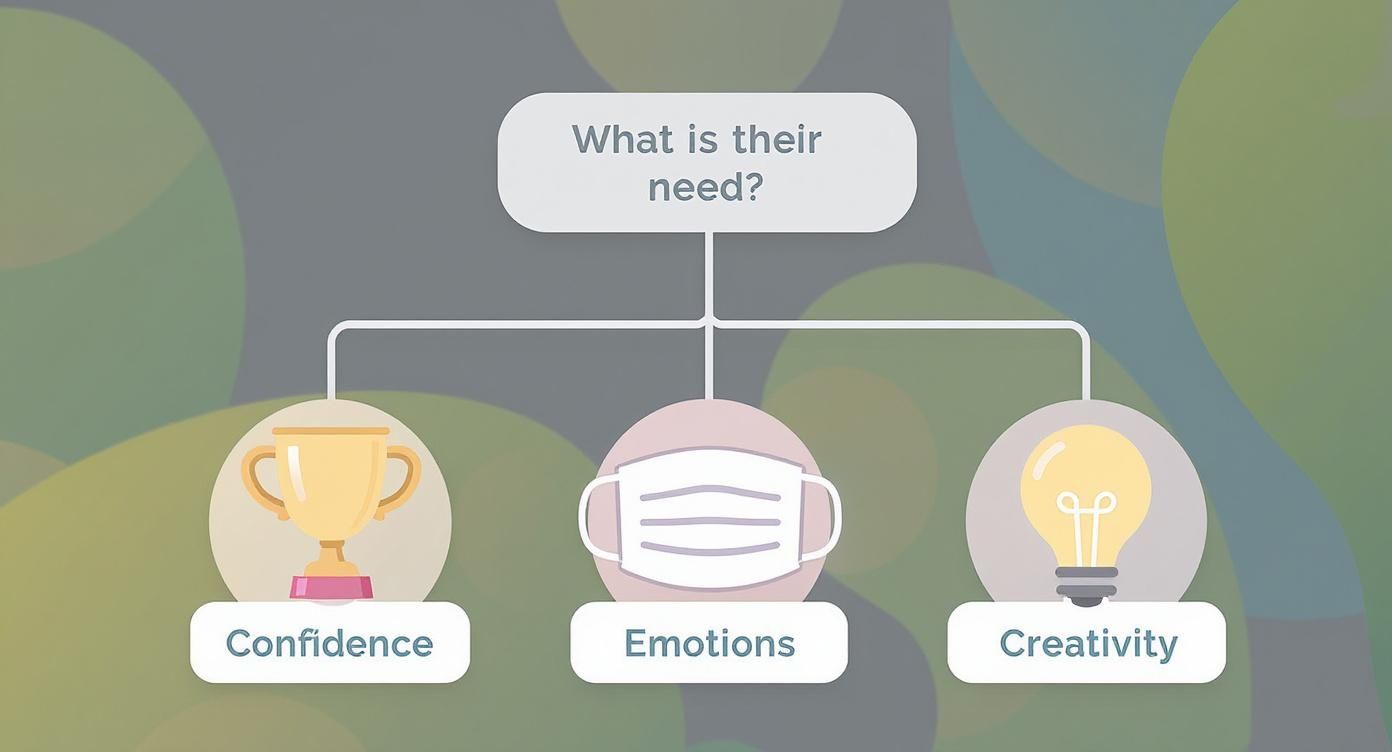
This little diagram reminds you that each exercise can serve a specific purpose: boosting confidence, helping you better understand your emotions, or unleashing your creativity.
Tools like the My Book Story journal can be great for this. They offer a space just for him where he can write about his successes, draw his emotions, or jot down his positive affirmations. It's a wonderful way to transform these little exercises into a creative and truly personal habit.
Art, a wonderful playground for emotions
Children often struggle to put words to the whirlwind of emotions they experience. A simple "things aren't going well" can mask frustration, sadness, or immense anger. This is precisely where creativity becomes their greatest ally, a secret gateway to their inner world. By offering them creative personal development exercises , we give them a universal language to express what cannot be said.
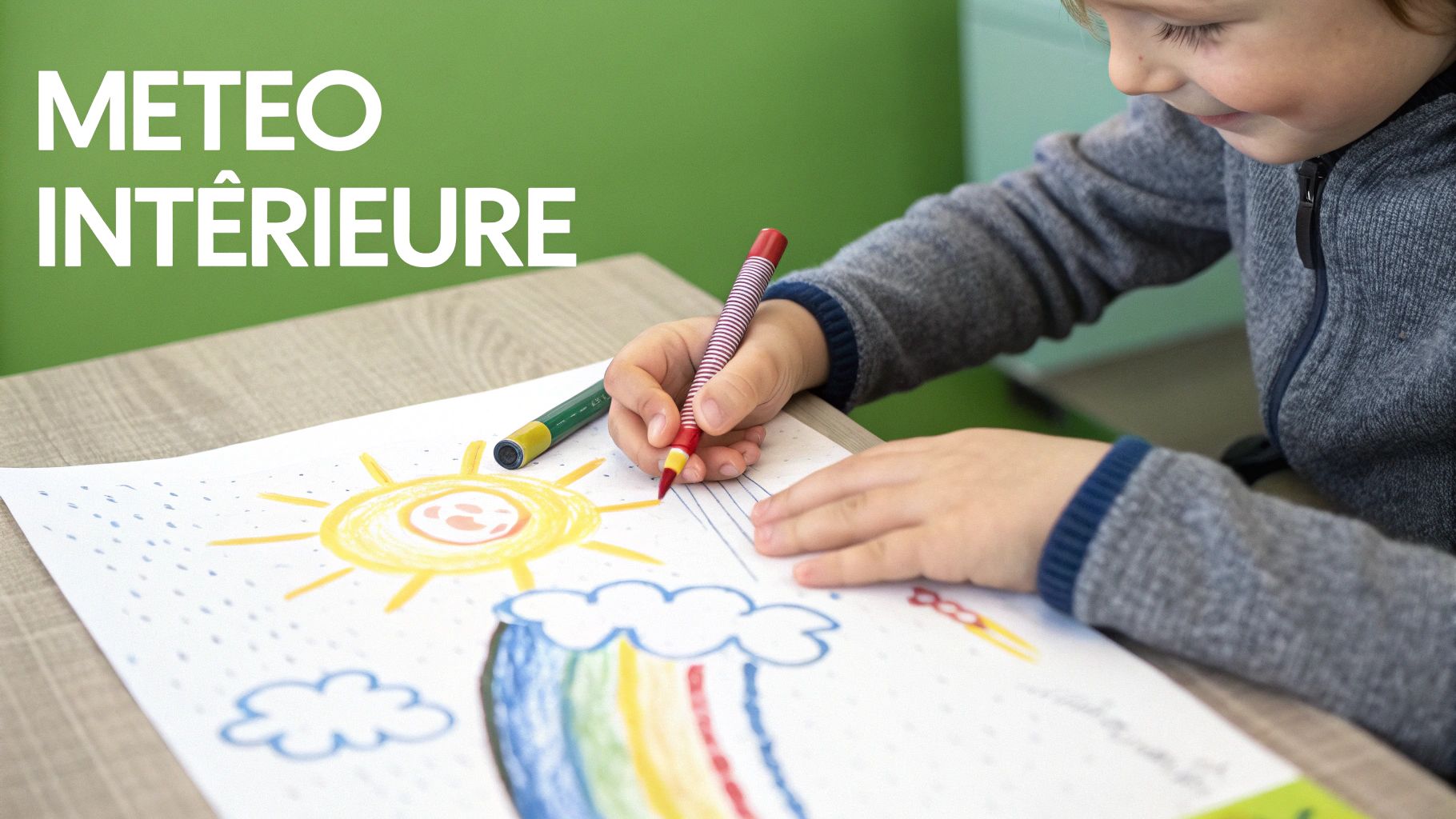
When your child draws, paints, or plays with modeling clay, they're doing much more than just a craft. They're expressing their emotions. A very dark color might tell the story of a difficult day; a tiny drawn figure could betray a feeling of helplessness. Your role isn't to interpret, but to support them and ask questions with kindness.
The exercise of indoor weather
This exercise is a classic, simple, and truly effective. The idea? Ask your child to draw what the weather is like inside them, in their heart or in their mind. Is it bright sunshine? A thunderstorm with flashes of lightning? A steady drizzle, or a fog that obscures visibility?
- Materials: A simple sheet of white paper, colored pencils, markers, or even some paint. Whatever you have on hand.
- How to do it: Invite him to close his eyes for a minute and try to "see" the sky in his heart. Then, he can draw freely, without you imposing any shapes or colors.
- Your role as guide: Once the drawing is finished, start a conversation. Use open-ended questions. "Oh, I see a big black cloud, what does that cloud look like it's carrying?" or "This sun is so yellow, what's warming your heart like that today?"
This simple tool helps him link a concrete image to an abstract emotion. This is an essential step in better understanding and expressing what he feels.
Accompanying your child means offering them a safe space where they know that all their emotions, even the most unpleasant ones like anger or jealousy, are accepted and can be explored without any judgment.
The theatre of emotions with puppets
Sometimes, it's so much easier to have a character speak than to talk about yourself. Puppet theatre is perfect for that! It's a brilliant way to reenact and defuse a real-life situation, whether it's an argument in the playground or frustration with homework.
No need for professional puppets! Socks, LEGO figures, or stick figures drawn on popsicle sticks work perfectly. The idea is to create a safe distance. By making the puppet talk, your child can express what's on their mind more freely. They can first reenact the scene as it happened, and then, why not, imagine a completely different and more positive ending.
To go further, you can explore various creative activities depending on your current emotions. Here are a few ideas to inspire you.
Ideas for creative exercises by emotion
This chart offers targeted art activities to help children explore and manage different common emotions.
| Emotion felt | Suggested creative exercise | Benefit for the child |
|---|---|---|
| Anger | Crumple up some brightly colored paper (red, orange), then glue it down to create a "volcano" | Allows for a physical and channeled release of energy. |
| Sadness | Paint with blue watercolor and let the colors spread on wet paper | It helps to accept and let sadness "flow" without holding onto it. |
| Fear | Model a "fear monster" out of modeling clay, then transform it into something funny | It gives control over the object of fear and defuses the situation. |
| Joy | Create a "burst of joy" collage using glitter, pom-poms, and sparkly papers. | It anchors the positive emotion and allows it to be fully celebrated. |
| Anxiety | Draw repetitive and calming patterns (mandalas, spirals) with fine-tipped markers | Promotes concentration and calms the nervous system. |
These ideas are just starting points. The most important thing is to observe your child and offer them tools that resonate with them.
The My Book Story journal can then become a kind of "director's notebook." It's the perfect place for your child to draw their characters, write their dialogue, and invent their stories. This creative space is entirely theirs, a haven for all their emotions. Each page turned is a chance to transform a small frustration into a grand adventure, making them the hero who learns, step by step, to navigate the waves of their inner world.
Establishing family rituals to cultivate well-being
Beyond the exercises we do from time to time, it's the family rituals that truly anchor your child's personal development in their daily life. These little habits, these regular gatherings, create a safe haven and a strong sense of belonging. This is essential for growing up peacefully.
These moments transform everyday life into precious opportunities to connect with each other and share.

Ultimately, these daily or weekly anchors are much more than simple traditions. They are genuine group exercises in personal development , where everyone learns to listen, to express themselves, and to value what others feel.
The "three joys" of dinner to see life through rose-colored glasses
One of the simplest and, honestly, most effective rituals is the "three joys" ritual (or three things you're grateful for, whatever you want to call it). The principle is child's play: at the table, each person takes a turn sharing three small joys from the day. It can be anything at all: a ray of sunshine during recess, a morning hug, a successful drawing.
This simple exercise helps your child (and you too, you'll see!) to focus on the positive. It's an active way to practice gratitude, which, without you even realizing it, strengthens optimism. They learn to see joy in small things and to put words to it.
Here are a few tips to make it work well:
- Lead by example: Go ahead and share your own "things you love". Your enthusiasm is contagious.
- No pressure: If your child has nothing to say one evening, that's perfectly fine. The important thing is to keep the door open.
- Truly listen: Welcome every little joy without judgment, with genuine interest. The goal is to connect, not to evaluate.
This ritual completely changes the atmosphere of the meal. It transforms it into a genuine moment of sharing, strengthening bonds and creating a truly positive atmosphere at home.
This week's family council
The family council is another powerful ritual, which works particularly well with children from the age of 7 or 8. The idea is to set a time, for example on Sunday evening, where everyone gets together to review the past week and talk about the week ahead.
It's a space where everyone's voice matters, regardless of age. We celebrate small victories, discuss difficulties, and work together to find solutions to conflicts or frustrations.
Please note, this is not a court of law, but rather a forum for mutual support. Your child will learn to express their needs, listen to others' perspectives, and participate in decision-making. It's a fantastic opportunity to learn communication and problem-solving skills.
For this to work, the key is consistency and kindness . Each family member must feel completely safe to express their thoughts, knowing they will be listened to and respected. You can even record decisions or new family rules in a dedicated notebook, a bit like your family's logbook. The My Book Story notebook is a great tool for your child to jot down their own reflections after these discussions, reinforcing their sense of truly being part of the team.
The art of supporting your child with kindness
In this adventure, your role is that of a patient gardener. You prepare the soil, you water, but you don't pull on the plant to make it grow faster. It's not about "successfully completing" an exercise, but about creating a space where your child feels free to explore, make mistakes, and develop at their own pace.
He's already familiar with the pressure to perform at school. Here, the idea is to create a bubble of trust where attempts are celebrated, not just successes. So yes, applaud his inner weather drawing, even if it looks like an abstract doodle. Accept his silence if he can't find anything to enjoy one evening. Your love must remain unconditional, whether he participates with a huge smile or sulks a little in his corner.
What if he refuses to participate?
It's a classic, and perfectly normal! If your child says "no," above all, avoid a confrontation. Instead, try to play detective to understand what's behind the refusal. Are they simply tired? Does the activity seem too "babyish" or, on the contrary, a little intimidating?
The most important thing isn't the result of the exercise, but the journey you take together. The real treasure is the connection and dialogue that these moments create between you.
Ask open-ended, non-judgmental questions: "I can see you're not really in the mood for that today. What would you enjoy doing instead?" Sometimes, a simple change of pace is all it takes to get things going again. If he doesn't want to draw his emotions, perhaps he'd prefer to mime them or choose a song that matches his current mood.
This gentle approach, based on regular practice, is proving its worth in many other fields. In psychology, for example, learning by doing is increasingly used to help students better understand and manage their own learning processes. It's a principle you can easily apply at home. You can discover how structured exercises are used in this context .
How should you react to an outburst of anger or tears?
Touching on someone's emotions can sometimes be a release valve. If your child explodes in anger or bursts into tears during an activity, see it as a good sign. It means they feel safe enough with you to let out what's been weighing them down.
Your mission at that moment? To be her anchor in the storm.
- Validate what he is feeling. Simple words like "I can see you're very angry" or "It's normal to be sad sometimes" are gold.
- Resist the urge to "fix" things. Don't look for a solution right away. Simply let him experience his emotion fully, without trying to calm him down at all costs.
- Offer your presence. Offer a hug, a hand on the shoulder, or simply sit beside them in silence.
The greatest gift you can give him is to show him that all his emotions, even the most unpleasant ones, have the right to exist. That's how he will gradually learn to welcome and tame them, knowing that he has a solid anchor: you.
We answer your questions about children's personal development
It's perfectly normal to have questions when embarking on personal development with your child. It's a whole new playing field! To help you gain clarity and begin this wonderful adventure with confidence, here are some practical answers.
Is my child old enough to start?
From the age of six , a child can absolutely begin to try simple exercises, especially if they are fun and visual. The "inner weather" activity, for example, is perfect for starting out. Simply draw a sun, a cloud, or a storm to express how you feel.
The secret is really to adapt the exercise to their age and current state of mind. The best approach is to observe them, listen to them, and offer activities that resonate with what they are going through, without ever forcing them.
How much time should we spend there?
A little bit every day is better than one big session once a month! Consistency is key. A short 5- to 10-minute ritual each day will have a much greater impact than an hour-long activity every now and then.
Make it a habit to share your three favorite things from the day during dinner. It only takes a few minutes, but it establishes a positive routine that will stick. The idea is to gently integrate these moments into your family life, so that it becomes a pleasure, not a chore.
What if he thinks it's a "babyish" thing?
Excellent news! It means he's growing up and his needs are changing. If he no longer enjoys an activity, it's the perfect time to involve him in what happens next. Simply ask him how he would like to talk about what he's proud of or how he'd like to manage his emotions.
Let your child choose or even invent their own rituals. This strengthens their autonomy and their desire to participate. After all, it's their personal toolbox, it has to suit them!
A pre-teen, for example, might prefer to write down their successes in a secret notebook rather than putting marbles in a jar for everyone to see. Create these rituals with them; you can be sure they will remain useful and appreciated.
Does this replace a consultation with a therapist?
Absolutely not, and it's very important to make that distinction. The exercises we offer here are tools for well-being, for building a solid foundation, and for facilitating communication within the family. They are beneficial for all children.
On the other hand, if you feel that your child is suffering, anxious or that a malaise is becoming entrenched, it is crucial to consult a professional: your doctor, a psychologist... These activities are a plus, but never replace therapeutic follow-up when necessary.
To accompany your child in their inner exploration, the My Book Story notebook is an ideal companion. It transforms these exercises into a creative and personal adventure.
Discover the My Book Story notebook and help your child become the hero of their own story.