


What if, instead of being swept along by the daily grind, you took the reins and designed a family life that truly reflects who you are? That's the whole principle of Design for Your Life : a creative method for consciously shaping a fulfilling everyday life for you and your children. Forget the beaten path; here, we use design thinking to explore, test, and build a life aligned with your family values and everyone's dreams.
Integrating design for your life into the heart of your family

The idea of "designing your life" might seem a little daunting, especially when you're already juggling the busy schedules of children between 6 and 12 years old . But rest assured, far from being a rigid concept, it's a fantastic approach to nurturing the emotional well-being of the whole family.
This isn't about adding yet another task to your already long list. It's more about a shift in perspective: seeing your family life as an exciting creative project. You then become co-creators of a daily life that fosters confidence, curiosity, and resilience in your children.
Moving from idea to reality, day after day
How can we transform this beautiful theory into concrete actions? Gently, through small rituals and conscious adjustments. The goal is simple: to turn everyday challenges into genuine opportunities for learning while having fun.
Here are some suggestions for bringing this philosophy into your home:
- Focus on experimentation, not perfection. Your child wants to build an improbable fort out of cushions? What matters is the creative process, not the sturdiness of the structure! Celebrate their initiative.
- Open the door to emotions. A simple evening ritual like "What were your highs and lows of the day?" can make sharing feelings feel completely normal and safe.
- Value everyone's ideas. When planning a weekend outing, why not organize a mini brainstorming session where every suggestion, even the most far-fetched, is welcomed with a big "What if we tried it?".
By adopting this approach, you create a safe space where your child feels free to explore who they are. By seeing them as a partner in shaping your family life, you give them the tools to become the architect of their own happiness.
With these few principles, design for your life becomes a common language that strengthens your bonds. You are no longer just parents who guide, but a team of explorers discovering the world together.
Building a meaningful family vision together
To begin shaping your family's future, it all starts with a shared vision. The idea isn't to define a predetermined career path for your child, far from it. Rather, it's about creating a warm and secure environment where their dreams have the space to grow and be heard. It's on this foundation that their self-confidence will build as they explore the world.
This approach is inspired by the Designing Your Life (DYL) philosophy, developed at Stanford University. It teaches you to see your life not as a rigid GPS route, but as an adventure filled with discoveries. Prototyping and exploration, two pillars of this method, are fantastic tools to help your child discover what truly excites them. To learn more, feel free to take a look at the principles of the DYL method, which has already won over thousands of students.
From dreams to reality: the family vision board
To bring these aspirations to life, a great idea is to create a family vision board . It's not just a Sunday craft project, but a wonderful pretext for starting conversations that are both deep and fun. Get out some old magazines, scissors, and glue, and let everyone search for images and words that resonate with them.
The goal is simple: to understand what makes your child's eyes light up, without ever judging.
- If he chooses a picture of an astronaut, ask him: "What do you like about space? The adventure, the mystery of the stars?"
- She sticks a picture of animals on it? Dig a little deeper: "Would you like to take care of them, study them, or just spend more time in nature?"
These open-ended questions transform a creative activity into a powerful moment of connection. You're not defining their future; you're simply showing them that their desires matter and deserve to be explored.
The dream journal, a secret garden for the imagination
If you're looking for a more personal approach, a dream journal is a perfect alternative. Each family member can have their own notebook, like the My Book Story , to jot down or draw their wild ideas, current desires, and grand ambitions.
The important thing is not so much the result as the ritual you establish. By dedicating regular time to this exploration, you send a powerful message: dreaming is not only permitted, it is essential for building a meaningful life.
Set aside some quiet time, once a week for example, where everyone can immerse themselves in their journal. If your child is interested, you can then share your creations. This simple exercise fosters their self-confidence, as they feel heard and their ideas are valued. As a parent, your role is not to direct, but to guide. This is the very first step in helping them become, one day, the architect of their own life.
Transforming everyday life into a creative playground
To truly "design" your child's life , the trick is to see ordinary moments as golden opportunities for learning and creating. Ingenuity isn't learned from workbooks. It's cultivated by injecting a good dose of curiosity and experimentation into everyday routines. It's all about moving from a "Why?" that blocks them to a "What if we tried?" that opens all doors.
The idea is to see the home less as a classroom and more as a laboratory of ideas. By encouraging this mindset, you help your child develop their creativity and their ability to find solutions independently.
From concept to action: playful prototyping
"Prototyping" is a key concept in design thinking . For a child, it simply means testing ideas on a small scale, without any pressure. The goal isn't to succeed on the first try, but simply to try.
Let's take a concrete example. Your child complains that their play area is always messy. Instead of telling them to tidy up, suggest they become the architect of their own space. Start the discussion with open-ended questions: "How would you imagine a play area where you could find everything super easily? Draw me a little picture!" This approach is a way to value their initiative and make them an active participant in the solution.
This timeline clearly illustrates how somewhat vague ideas can transform into a clear vision, and then into an action plan. It's a process you can encourage daily, even for small things.
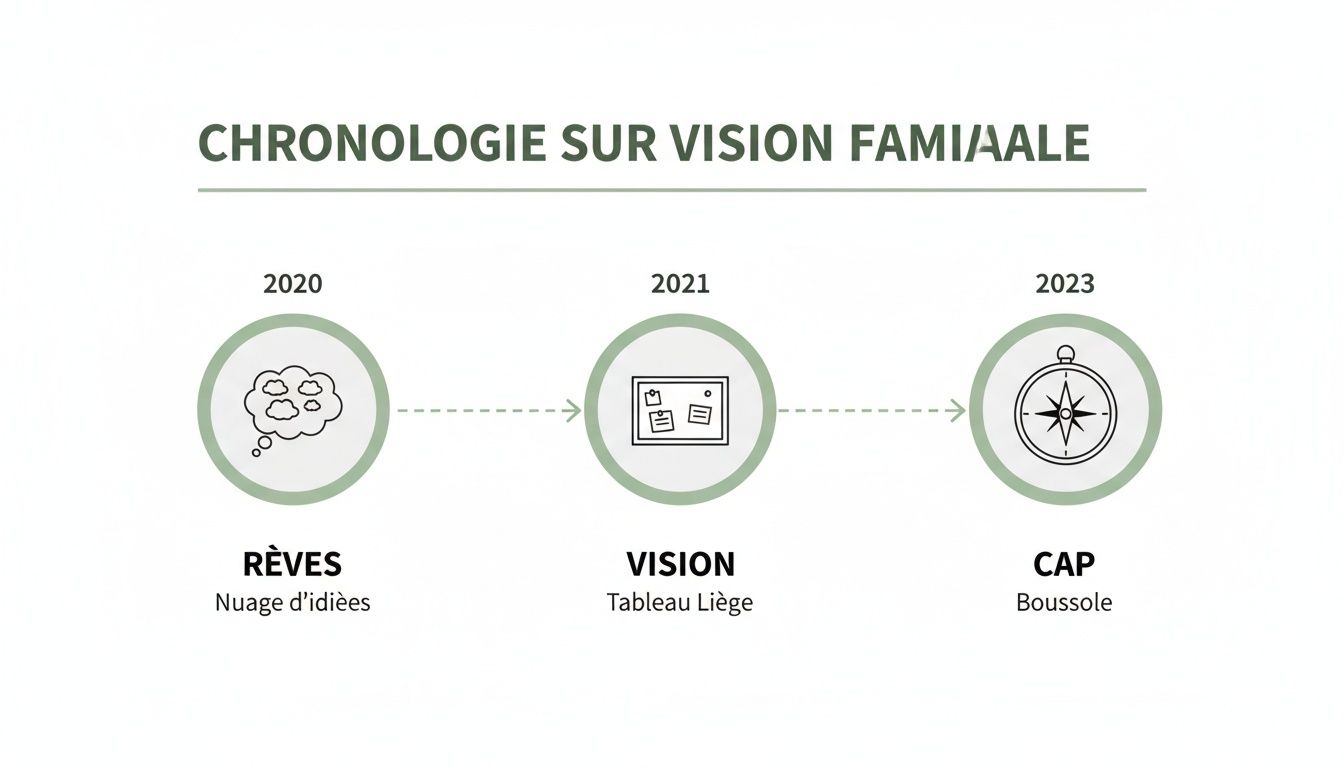
This journey, from dreams to vision and then to the goal, reminds us that every great success begins with a small idea that we dared to explore without being afraid of making mistakes.
Prototyping can be applied to almost anything:
- During a board game: "What if we invented a new rule, just for this game? We'll see if it's more fun."
- For a conflict between friends: "Okay, you're angry. Let's imagine three different ways to tell him/her how you feel. Which one do you want to try?"
- For a snack: "Oh no, we're out of chocolate. What could we use to make a totally crazy pancake recipe?"
The key is to celebrate effort and experimentation rather than perfection. This is how you help your child develop a growth mindset, where failure is no longer a catastrophe, but simply a normal and useful step in the creative process.
Organizing family brainstorming sessions
To make it a habit, why not start some family brainstorming sessions? No need to get out the whiteboard and markers. Think of it more as a fun activity where all ideas, even the most outlandish, are welcome. The goal is simple: to generate as many possibilities as possible, without any judgment.
Imagine the scene: it's time to plan the weekend. Instead of imposing a schedule, launch a challenge: "Come on, let's find 10 crazy ideas for our Saturday, even the ones that seem impossible!" You might end up with ideas like building a fort in the living room, having a backwards picnic (dessert first!) or organizing a funny face contest.
This simple exercise shows your child that their voice matters and that creativity is a team sport. They learn to listen to others, to build on their ideas, and not to be afraid to share their own. By creating this climate of trust, you give them the tools to dare, to create, and ultimately, to design their own life with confidence and boldness.
Nurturing ambition and resilience in the face of challenges
For a child to become the architect of their own life, they need two superpowers: ambition to transform their dreams into concrete actions, and resilience to get back up when things go wrong.
These skills aren't innate. They're cultivated daily, within a nurturing and supportive family environment. Our role as parents isn't to map out the path for them, but rather to provide them with a compass and a good pair of shoes for their own journey. In practical terms, this means celebrating their initiatives and transforming setbacks into lessons, all in the name of building rock-solid self-confidence.
Breaking down big dreams into small victories
For a child, ambition isn't about reaching for the moon, but rather daring to take that first step. The secret is teaching them to break down their big dreams into manageable and truly motivating steps. This is, in fact, the heart of the "Ambitious" chapter in our My Book Story journal.
Rather than aiming for a vague "being good at math," the goal can become "successfully completing one more exercise each day." This approach makes success much more attainable and, above all, more frequent.
- For a presentation you need to prepare: Break the work down into small tasks. Day 1: Choose a topic. Day 2: Find three interesting facts. Day 3: Create a great drawing to illustrate. And celebrate each completed step!
- To learn to ride a bike without training wheels: Set a simple goal, such as "pedal five meters without falling." Once you've done that, congratulate yourself, then try ten meters.
Celebrating small steps forward is key. It's not so much the final result that builds confidence, but the recognition of effort and perseverance. A simple "Well done, you didn't give up!" is often far more powerful than a compliment about the achievement itself.
This mindset of progress is at the heart of the " design for your life" concept. It fosters a taste for effort and pride in accomplishments. As a parent, your enthusiasm for every small step is the best motivation for your child.
Turning failure into a springboard
Resilience is undoubtedly one of the greatest gifts you can give a child. It's that magical ability to see an obstacle not as a wall, but as a step to reach even greater heights.
When your child faces frustration—whether it's a bad grade or a collapsing Lego tower—it's a golden opportunity. The goal isn't to avoid disappointment, but to help them analyze the situation without being overwhelmed by their emotions.
Example of a dialogue after a disappointment
- What we avoid: "Don't cry, it's not a big deal." (This sentence minimizes what he is feeling).
- What we try: "I see you're disappointed, and that's normal. What was the most difficult thing for you? And what if we thought about what we could try to do differently next time?"
This kind of conversation validates his emotions while guiding him towards a solution and learning. He then understands that effort is more important than perfection and that every mistake is a goldmine of information.
By encouraging his initiatives, such as entrusting him with organizing a family game night, you also foster his independence. He learns to plan, communicate, and manage unexpected situations. Giving him these small responsibilities shows him that you trust him. And this trust is the foundation of healthy ambition and unwavering resilience.
Establishing family rituals to reinforce learning

For the "designing your life" approach to truly take root, it needs to be seamlessly integrated into your daily routine. The idea isn't to add another constraint to already busy days, but rather to transform moments you already have into genuine opportunities for connection.
These little rituals create a reassuring family environment, a safe haven where your child feels listened to, understood, and valued. They are the glue that strengthens bonds while reinforcing their ability to manage emotions and express their creativity.
The emotional "check-in" of the evening
A simple yet incredibly effective ritual: the emotional check-in before bedtime. Five minutes is all it takes. Sit down with your child and simply talk about the ups and downs of their day. The goal isn't to solve everything immediately, but to offer a listening and compassionate ear.
This one-on-one helps him put words to his feelings and understand that all emotions are valid, even the unpleasant ones. It's fantastic practice for developing his emotional intelligence.
To start the conversation, you can try questions like:
- What amused you the most today?
- Was there ever a moment when you felt really proud of yourself?
- If you had to give your day a color, what would it be? And why?
- What are you most looking forward to doing tomorrow?
The weekend brainstorming session
What if you turned weekend planning into a creative workshop? The "brainstorming session" can become your little Friday evening or Saturday morning ritual. Take out a large sheet of paper, some colored pencils, and let everyone suggest activities, from the simplest to the most outlandish.
This isn't just a way to organize your free time. It's a mini-lesson in leadership and negotiation. Your child learns to express their desires, listen to those of others, and find common ground. That's what group life is all about!
By making these discussions a regular occurrence, you send him a powerful message: his opinion matters. He discovers that his voice can positively influence family life, which boosts his sense of belonging and self-confidence.
These habits only take a few minutes, but their effect on the atmosphere at home can be enormous. They transform the ordinary into moments that truly matter, allowing you to create a family life that reflects who you are, step by step.
We often ask ourselves these questions...
Embarking on an adventure like "designing your family life" can seem a little intimidating at first. It's normal to have some questions running through your mind. So, let's clear things up so you can start this experience with complete peace of mind.
Is my child too young?
Not at all! The period between 6 and 12 years old is actually ideal. At this age, children are like sponges, their creativity is overflowing, and they love exploring new ideas.
The approach was designed to be fun and accessible. It's not about career planning or complicated projects. Instead, it's about transforming concepts like vision and resilience into games, drawings, and lighthearted conversations. The goal is to help them discover what excites them and what gives them confidence.
How long will it take us?
Here's the good news: this method is incredibly flexible. No need to completely rearrange your schedule or block out entire hours. The idea is simply to integrate small moments of quality time into your daily routine.
- A few minutes a day: Just a quick "check-in" on the day's emotions before going to bed.
- 15 to 20 minutes per week: A short creative session to imagine weekend activities or discuss a mini-project that is close to their heart.
The key is consistency, not duration. A little, but often, is perfect.
The goal is never to add more pressure to anyone's shoulders. Rather, it's to create little bubbles of connection and creativity within the whirlwind of daily life. Every little step counts.
What if my child doesn't take to it?
Above all, don't force anything. If your child seems a little reluctant, it's a sign that you need to take a break. The most important thing is that it remains a shared pleasure, not a chore.
Try to understand what the problem is. Perhaps the format isn't right for him? Some children prefer to draw their ideas rather than write them down. Others express themselves more easily through role-playing than a face-to-face discussion. The important thing is to show him that you're there to listen, without judgment, and to find together the communication method that works best for him.
So, ready to design the family life that reflects yours? The My Book Story journal was designed to be the perfect companion on this adventure. Discover how our simple activities can nurture your child's confidence and imagination, week after week.