How to help your child express their emotions and grow up peacefully
Share
Learning to express emotions is a bit like learning to read or write: it's an essential skill that's built step by step. For a child between 6 and 12 years old, being able to put words to what they feel is the cornerstone of their self-confidence . It's what will give them the tools to navigate their daily life with greater serenity, from relationships at school to the small and big challenges life throws their way.
Why acknowledging your child's emotions is the first (and most important) step
Helping your child express what's on their mind is probably one of the greatest gifts you can give them. Between the ages of 6 and 12, their world expands rapidly. Friendships become more complex, academic pressure mounts, and they begin to see themselves differently. It's a period of intense growth, but also of great vulnerability.
As parents, we know this all too well: an emotion kept to ourselves doesn't magically disappear. On the contrary, it tends to transform, often into anxiety, behavioral problems, or simply a persistent feeling of unease. A child who can't say "I'm disappointed" or "I'm scared" might very well express it through anger or by withdrawing into themselves.
How to create a safe and trusting environment at home?
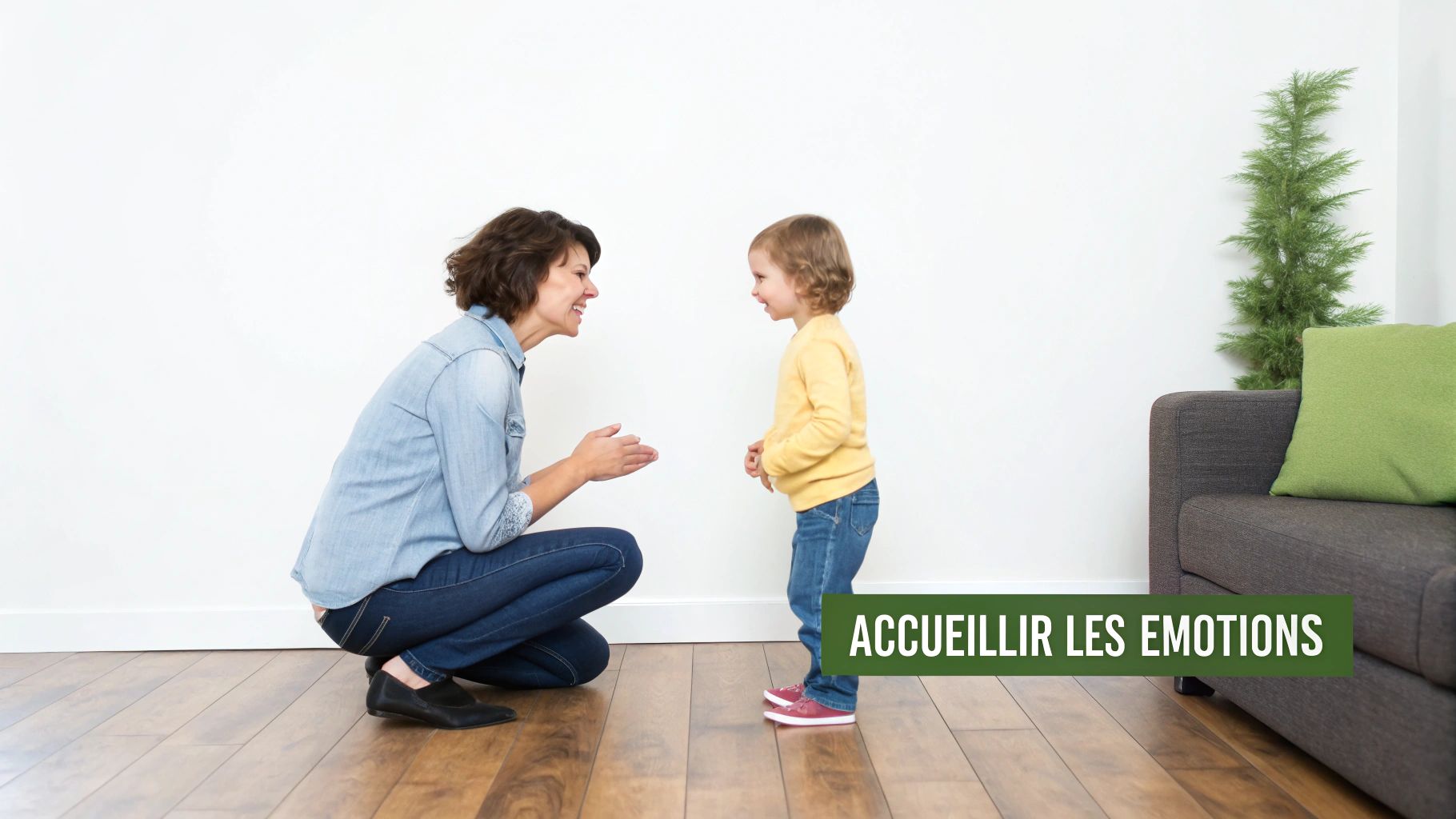
The starting point is to make your home a safe space where every emotion has the right to exist, without judgment. The idea is to make discussions about feelings as normal as talking about their school day. This doesn't mean you have to solve all their problems, but rather show them that what they're feeling is valid and that it matters to you.
Welcoming an emotion is like opening a window in a room where the air is heavy. It doesn't make the heat disappear instantly, but it allows the air to circulate and makes the atmosphere much more breathable.
Your role is that of a caring guide. By validating what your child is feeling, you send them incredibly powerful messages for their development:
"What you're feeling is normal." There are no good or bad emotions.
"You are not alone in this." I am here to listen to you.
"Your feelings matter to me." I'm interested in your inner world.
Each of these validations is a brick that builds the foundations of his self-confidence and well-being for years to come.
A direct impact on mental health, with supporting data
This approach isn't just a parent's intuition; its importance for children's mental health is very real. A 2023 study by Enabee revealed a sobering statistic: in France, 13% of children aged 6 to 11 are estimated to have at least one probable mental health disorder. For these growing youngsters, learning to express their emotions is therefore not an option, but a true necessity.
To delve deeper into the subject, the full report from Public Health France is a valuable resource. And if you wish to enhance your own skills, be aware that there are excellent early childhood training programs that can provide you with practical tools.
The art of finding the right words for what one feels
For a child to express what's going on inside, they need an essential tool: words. Often, their emotional vocabulary is limited to a few basics: "happy , " "sad,""angry." Our mission as parents is to help them go further, to explore the myriad nuances hidden behind these broad labels.
Helping your child build this inner dictionary is like giving them a real superpower.
Psychological research confirms it: simply naming an emotion precisely helps to lessen its intensity. A child who learns to say "I feel frustrated " rather than getting stuck on "I'm angry" has already taken a giant step. They gain perspective and begin to analyze their experience.
Words for the pains (and joys!) of everyday life
Forget formal lessons. Learning the vocabulary of emotions happens gradually, by integrating these new words into your everyday conversations. It's by hearing you use them in real-life contexts that your child will naturally adopt them.
Here are some suggestions for sowing these seeds on a daily basis:
In the evening, after school: Rather than the traditional "How was your day?", try a more subtle approach. "I get the feeling you're relieved that classes are over. Or maybe you're looking forward to going outside to play?"
During a board game: "I see you're a little disappointed to have drawn that card, that's normal. But you should also be proud of the strategy you've put in place!"
When reading a story or watching a film: Pause the frame! "Do you think the character feels betrayed by their friend? Or are they more worried about what will happen next?"
These small interventions transform ordinary moments into genuine opportunities for connection and learning, without ever seeming like it.
Tools to make the invisible visible
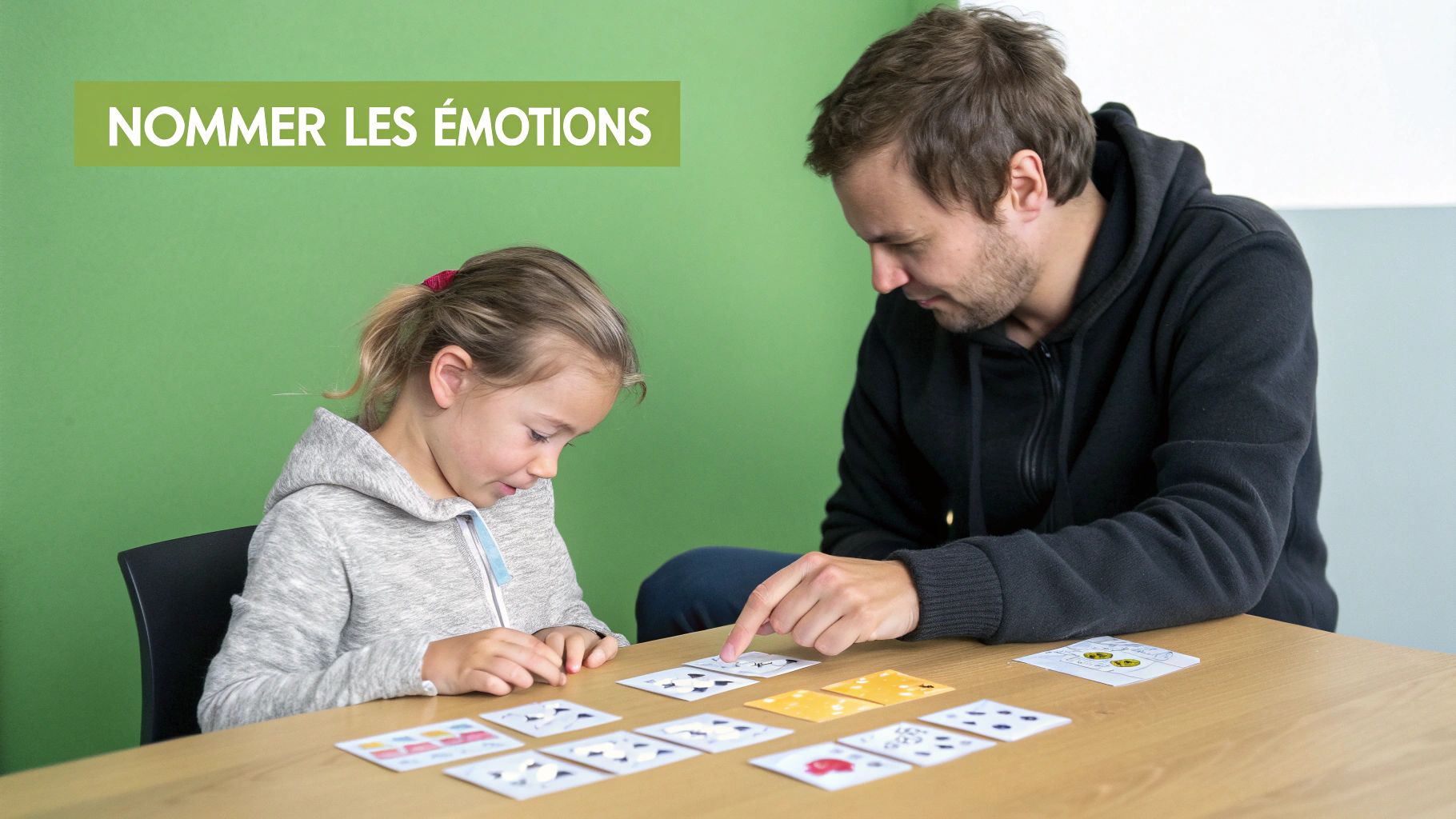
Sometimes, a visual aid can make all the difference. An "emotions wheel" or picture cards are excellent tools to help your child associate a word with a face or a situation.
Putting a name to an emotion is a bit like turning on the light in a dark room. What seemed immense and frightening suddenly becomes clearer, more identifiable, and much less overwhelming. It's the first step toward regaining control.
To help you get started, here is a small table to move from basic emotions to more specific feelings.
Nuancing emotions on a daily basis
This chart can serve as a reminder to enrich your discussions. The idea is to start with a simple emotion and show that there is a whole range of words to describe what we feel more subtly.
Basic emotion
More nuanced feelings to explore
Example of a sentence to use when talking about it with your child
Thrilled
Happy, excited, proud, serene, relieved, grateful
"I can see you're not just happy, you seem really proud of what you've built!"
"You look sad. Are you rather disappointed that the game is over?"
Angry
Frustrated, annoyed, irritated, furious, upset
"I understand you're angry. You feel frustrated because things aren't working out the way you want?"
Fear
Worried, anxious, frightened, nervous, fearful
"This film is a little scary. Do you feel worried for the hero?"
The goal is not to turn every conversation into a psychological analysis, but simply to give your child the keys to their own inner world.
By equipping him with a rich emotional vocabulary, you are giving him a gift that will serve him throughout his life. He will then be able to move from a simple "I'm fine" or "I'm not fine" to a more accurate and authentic expression of who he is.
Establishing family rituals to encourage open communication
For a child to truly dare to express their feelings, they need to feel safe and secure. This is where family rituals come into play. Far from being disguised interrogations, these are warm and predictable moments that make speaking more natural.
We're all used to the "So, how are you?" that automatically elicits a "yes." The idea here is to create small habits that transform sharing emotions into a playful and connecting experience. The goal? To make these conversations as normal as brushing your teeth before bed.
Inner weather, a simple and powerful ritual
One ritual that works wonderfully is the "inner weather" ritual. It's a very short moment, often during dinner or after school, where each family member shares their "weather" of the day.
The principle is simple: you use the metaphor of the weather to describe your mood. It's fun, very visual, and much less intimidating than searching for the right words for a complex feeling.
Child: "Today, at my house, it's sunny and bright! I did my math homework well."
Parent: "For me, it was rather cloudy with a few drops of rain, because I had a difficult day at work."
Child: "I'm having a little storm inside; I'm really frustrated with my building set, which keeps falling over."
This little game normalizes all emotions. There is no good or bad weather; there are just different times, and they all eventually pass.
By creating these regular moments of sharing, you show your child that you are truly interested in their inner world. You are not there to "fix" their troubles, but simply to listen and keep them company in their cloud. This is the foundation of trust.
The power of example: speak up about yourself too!
Your own attitude is his best model. If you never talk about what you feel, how can he learn to do so? Obviously, it's not about unloading everything, but about sharing simple emotions appropriate for his age.
By being authentic, you give them permission to be authentic in turn. A parent who says, "I'm a little tired and annoyed by the traffic tonight," shows them that even adults feel frustration, and that it's perfectly normal.
Ten minutes each evening to really connect
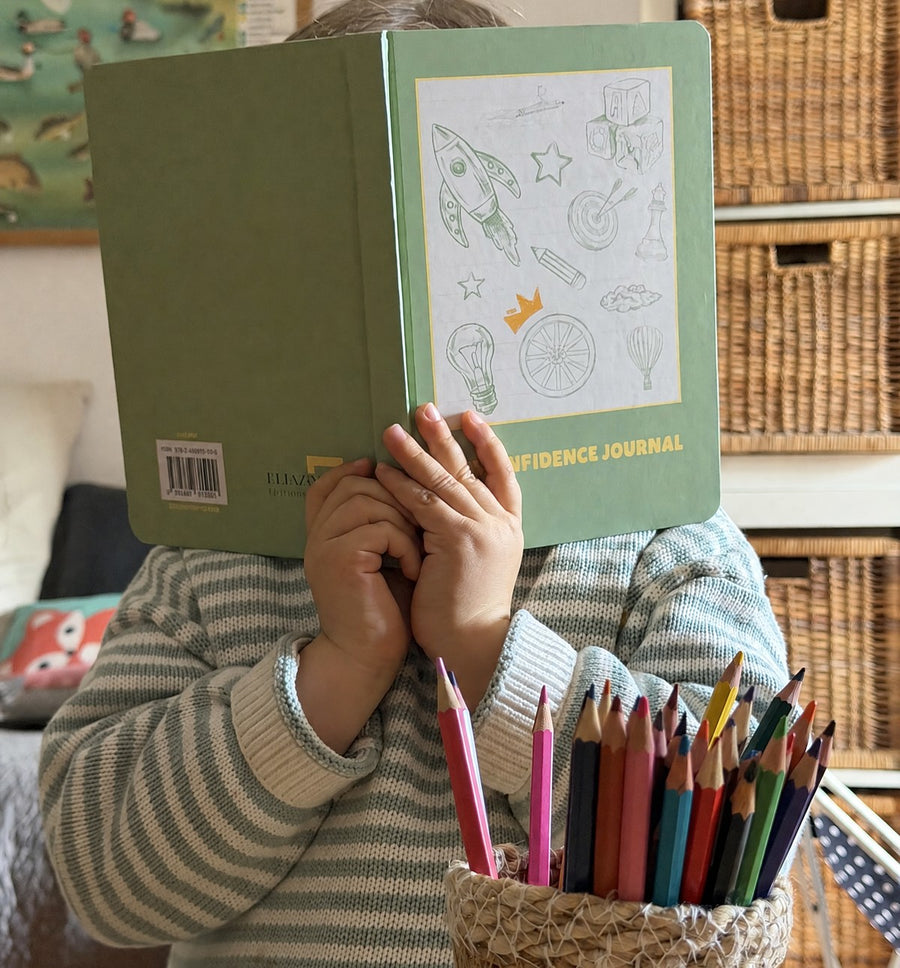
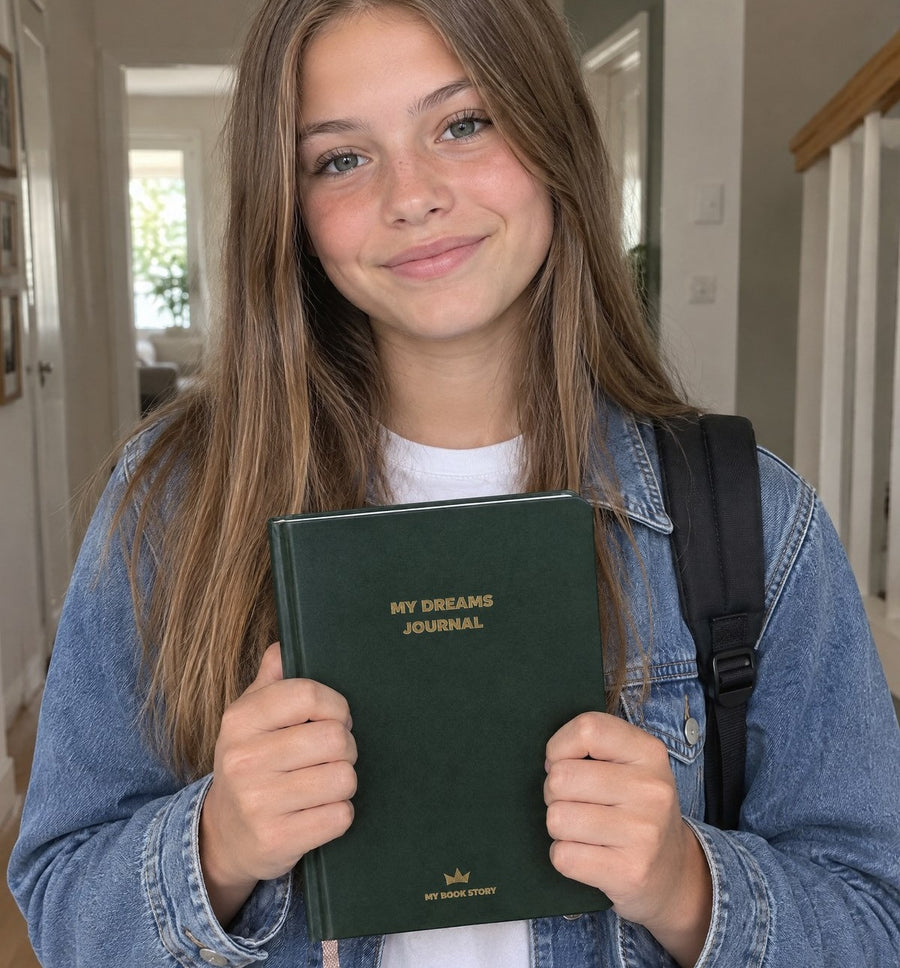
Bedtime is another precious ritual. Spending ten minutes writing in a journal together can become a special moment, just for the two of you. It's not a chore, but a quiet time to process the day's thoughts and emotions. A journal like My Book Story can guide this process with simple activities: circling your mood for the day, noting a small joy, drawing a picture…
This practice is all the more important because unexpressed emotions can weigh heavily on us. Between March 2020 and July 2021, 12% of French children and adolescents sought help for psychological reasons. Anxiety is observed to increase with age, as shown by data on the psychological needs of young people published by the DREES (Directorate of Research, Studies, Evaluation and Statistics). Consider these rituals as a gentle form of prevention.
Using play and creativity to explore feelings
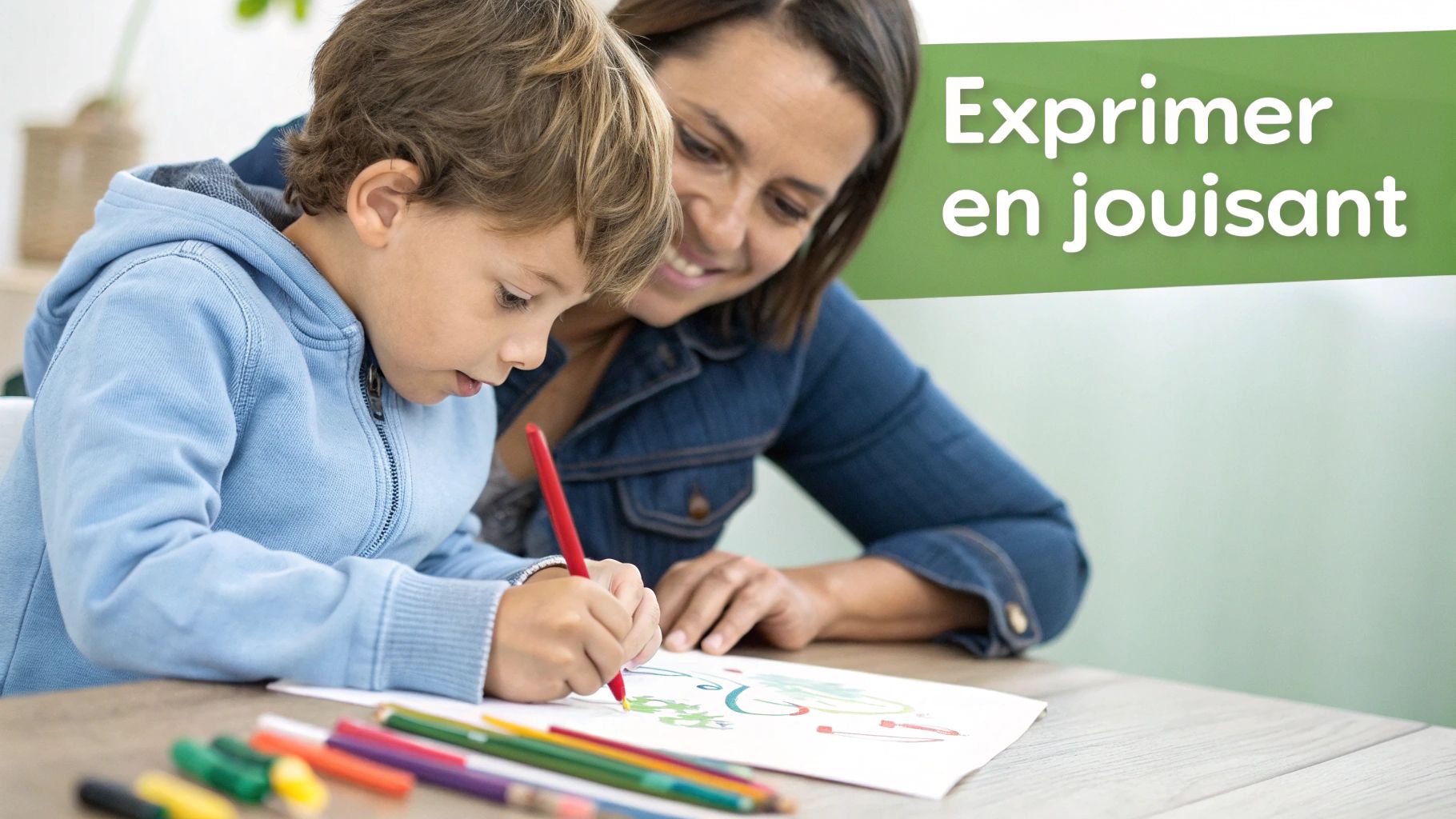
Sometimes words fail us, especially for a child. When emotions are too intense or too confusing to explain, play and creativity become invaluable tools. It's a gentler way to teach them how to express their feelings , without the pressure of having to analyze everything immediately.
Rather than forcing speech, we offer a roundabout way. Drawing, modeling, or puppet theatre then become a language in their own right, a way for your child to show you what is happening inside them.
Transforming emotions into concrete creations
You don't need to be an art therapist for this. The idea is simple: giving a shape, a color, or a story to an emotion immediately makes it less abstract, and therefore less frightening. It's a way to externalize it in order to better understand it.
Here are some very simple ideas to try at home:
Drawing the Anger Monster: Get out the markers and ask them to draw their anger. Is it a big red monster with sharp teeth? A black tornado? Putting this emotion on paper is a bit like getting it out of your system so you can face it, and sometimes even end up laughing at it.
Create a worry box: Take an old shoebox and decorate it together. Each night, your child can place a small note or drawing inside, representing a worry from the day. Closing the lid symbolically helps them put their worries aside for a good night's sleep.
Putting on a puppet show: Using old socks or their favorite toys, suggest they reenact a situation that bothered them, like an argument in the playground. This allows them to take a step back and imagine other ways to react, all within a safe environment.
By using play, the question is no longer "What's wrong?" but rather "Show me what you're feeling." This small difference changes everything. It removes the pressure of analysis, leaving room for raw, spontaneous expression.
The newspaper, a space for creative freedom
It is precisely with this in mind that a journal like My Book Story can be a wonderful tool. The right-hand page, intentionally left blank, is an open invitation to creativity. There are no rules, just space to let go.
This space can be used for a thousand things:
Draw the best moment of the day to remember it longer.
Scribbling out one's frustration after a bad grade or an argument.
Create a short comic strip where the hero overcomes a fear that is strangely similar to his own.
By incorporating these little creative rituals, your child gradually discovers that all their emotions have their place and that they have plenty of tools to manage them. They learn that drawing their sadness can make it a little easier and that transforming their fear into a funny character immediately makes it much less intimidating.
The newspaper, an ally for confidence and inner peace
Keeping a journal isn't just about words on paper. It's a true exercise for the heart and mind, a way to strengthen emotional intelligence. Far from being a simple secret diary, a well-thought-out journal becomes an inner sanctuary, a safe space where your child can express their thoughts, tame what's stirring within them, and, little by little, learn to feel better. It's a tangible gift you give them for their self-confidence.
This simple practice helps him understand how to express his emotions in a healthy way, transforming inner chaos into clearer thoughts. The idea isn't to solve all his problems for him, but to give him a tool so he can learn to do it himself, day after day.
Putting words to what we feel helps us become more autonomous
The first step to managing your emotions is simply knowing what you're feeling. A journal that offers a little activity like "Circle your mood today" may seem insignificant, but it's a fundamental exercise. It invites the child to stop for a moment and ask themselves: "How am I feeling right now?"
Developing this habit is invaluable, especially considering that emotional storms can begin early. A recent French study showed that 8.3% of children aged 3 to 6 have at least one probable mental health difficulty. Incorporating self-awareness rituals, such as journaling, helps build a solid foundation for the future.
The journal acts as a kind mirror. It doesn't judge the emotion, it reflects it. By seeing it written down, the child realizes that it's just information, not a tragedy. This is the beginning of gaining perspective and self-control.
Cultivate positivity and find your own wellness tips
Identifying your emotions is good. Knowing what to do with them is even better! And that's where journaling becomes a true personal coach. Asking your child to write down "a happy moment from their day" is an incredibly powerful gratitude practice. It trains their brain to see the positive, even when the day has been difficult.
Similarly, inviting him to choose a "wellness activity" gives him a magic wand to take action. Rather than experiencing an unpleasant emotion, he discovers that he has the power to do something to feel better.
In concrete terms, here's how these small actions build its ability to bounce back:
Gratitude: Remembering a joyful moment anchors a feeling of appreciation and shifts one's attention from problems to beautiful things.
Wellness strategies: Choosing an action like "giving a hug" or "listening to music" gives her a personal toolbox for calming herself down.
Free expression: A space to draw or write without constraint allows him to discharge the excess of emotions, without filter.
To help even more, seeking out moments of relaxation can prepare the ground for a more peaceful emotional process. Certain approaches, such as the benefits of infrared saunas, promote deep relaxation and can be a complementary aid for the whole family.
Ultimately, journaling is much more than just a hobby. It's a gentle, ongoing dialogue with oneself, transforming how your child sees and manages their inner world. Each completed page is a small victory for their future confidence and well-being.
Questions you often ask yourself about your child's emotions
Guiding your child through the maze of their emotions isn't always easy. It's perfectly normal to sometimes feel a little lost or wonder if you're reacting in the right way. Rest assured, all parents go through this. Here are a few tips for dealing with the most common situations.
What should I do if my child refuses to talk about what they are feeling?
The first golden rule: never force them to talk. If your child withdraws into silence, it's often their way of maintaining some control over a situation that overwhelms them. Insisting would be counterproductive.
Instead, suggest other ways for him to express himself. Drawing, modeling clay, or even figurines to reenact a scene can be wonderful alternatives. A simple "I'm here for you if you want to talk about it later" is enough. The important thing is that he knows the door is always open, without any pressure.
How to manage a major temper tantrum?
When an emotional storm hits, your calm is their best refuge. Safety is the top priority. Make sure that neither they nor anyone else can get hurt. Put away fragile items and simply be there for them.
Trying to reason with him in the midst of a crisis is pointless. At that moment, his rational brain is switched off. Simply acknowledge what he's experiencing with very simple words: "I can see you're very, very angry. It's a big anger."
Only once the storm has passed, when he is calm and peaceful again, will you be able to revisit what happened. The goal during a crisis is not to educate, but to offer a reassuring presence. Learning always happens afterward.
At what age can a child start a personal journal?
A guided journal like My Book Story is designed specifically for 6-12 year olds , as it grows with the child. There is no "perfect" age; it all depends on their maturity.
Between the ages of 6 and 8 , this will often be a special moment to share. You'll help them read the questions and write their answers. It's a wonderful opportunity to create a special bonding ritual just for the two of you.
Later, around 9-12 years old , he will become more independent and his notebook will be his private sanctuary. Your role will then evolve towards more discreet support, respecting his growing privacy.
He always tells me that "everything is fine"...
Ah, the famous "I'm fine" or "Everything's alright"! It's often a knee-jerk response that shuts down the conversation. To get around this barrier, try asking more specific and open-ended questions than the traditional "How was your day?"
Here are some ideas to start the conversation:
"Tell me about the funniest moment of your day."
"Was there anything a little annoying or difficult today?"
"What surprised you the most at recess?"
These more concrete questions invite him to remember a specific moment, which makes sharing much easier and more spontaneous.
By providing your child with suitable tools and a safe environment to express themselves, you give them the keys to better understand themselves and navigate their inner world. The My Book Story journal was designed to be this companion, transforming learning about emotions into a fun and creative adventure.