


Moving house, changing schools, welcoming a new sibling… For us adults, these are often exciting milestones. But for a child between 6 and 12 years old, even a small change can feel like a major upheaval. Their sense of security is shaken, and their feelings of well-being can be shaken. As parents, our role is to gently guide them through this transition and transform it into an opportunity for growth.
Understanding what is happening in one's mind in the face of change
For a child, stability is reassuring. It's their security. Their home, their friends at school, their daily routine... all of these form the pillars of their little world. When one of these pillars starts to shift, their entire equilibrium falters. This is why an event you find wonderful can, for them, be experienced with profound anxiety.
This feeling of insecurity isn't always obvious. A child who suddenly becomes very angry, clams up, or starts wetting the bed again isn't throwing a tantrum. It's their way, often clumsy, of expressing a fear or sadness they can't yet put into words.
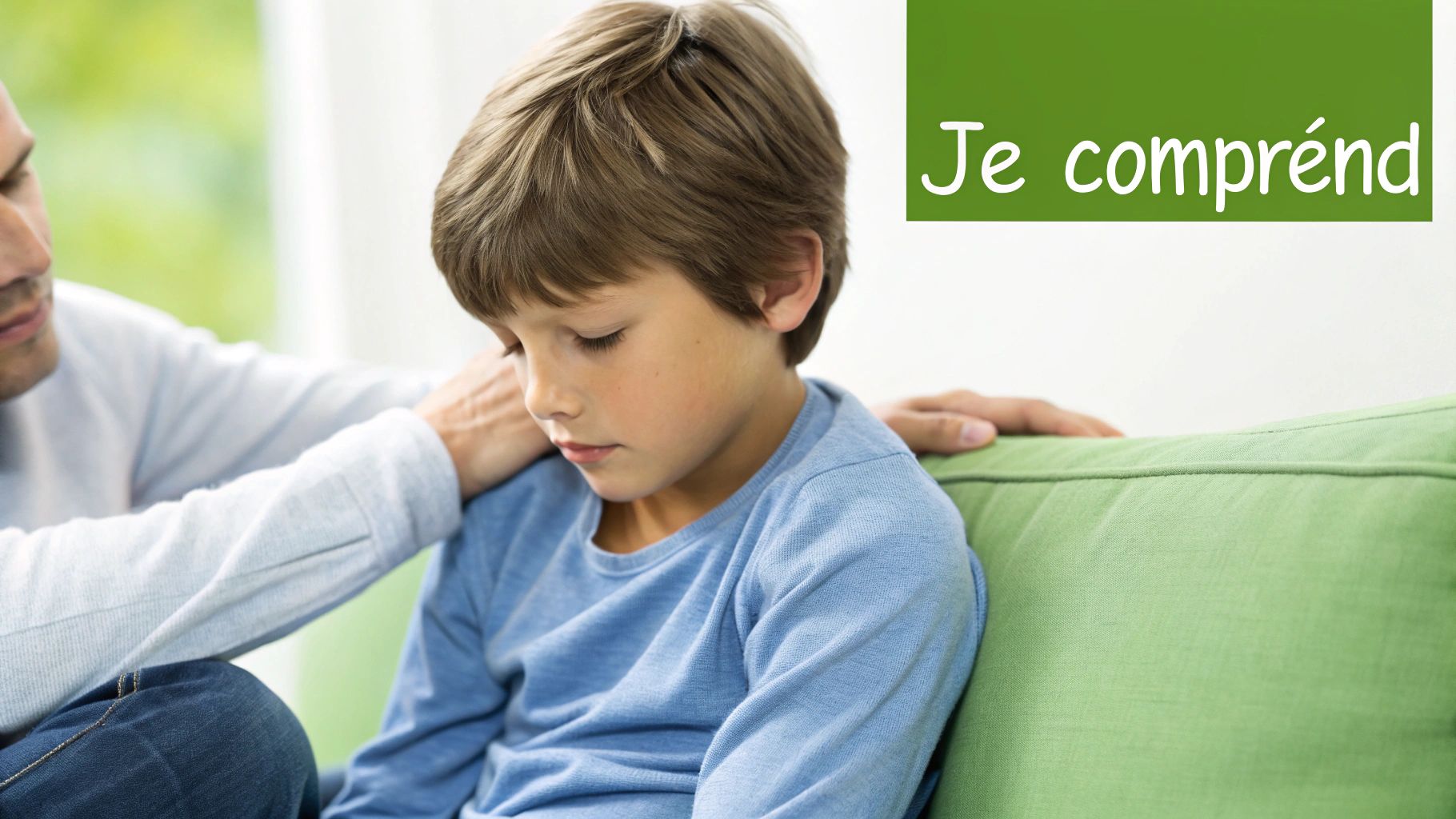
Learning to decode one's emotions
Your role as a parent is a bit like becoming an emotional translator. The key isn't to tell him "it's nothing," but rather to validate what he's feeling. A simple phrase like, "I can see that this move is making you sad, and it's normal to feel this way," can work wonders. It shows him that what he's feeling is legitimate, and above all, that he's not alone.
Here are some clues to better understand his reactions:
- Anger or irritability: Often hides anxiety about what is unknown, or a feeling of being unable to control anything.
- Silence or the need to isolate oneself: This is frequently a sign of great sadness or difficulty in expressing one's fears.
- Restless nights or a poor appetite: The body speaks volumes. These are very common stress signals during a major change.
Your calm will be her strongest anchor. By seeing you handle the situation with serenity, you send her a powerful message: even if everything around her is in flux, the family cocoon remains stable and secure.
Adapting to change: a gift for life
Teaching him how to manage these moments gives him a skill that will serve him throughout his life. Our world is changing rapidly, and knowing how to adapt has become essential for emotional well-being.
Moreover, it's no coincidence that France ranks 5th in Europe for disability-free life expectancy among women. This clearly demonstrates our ability to better manage transitions and our health over time. If this topic interests you, please feel free to consult the government's information on the subject. By helping her navigate this transition today, you're giving her valuable tools to face tomorrow's changes with much greater confidence.
Establish an open and secure dialogue
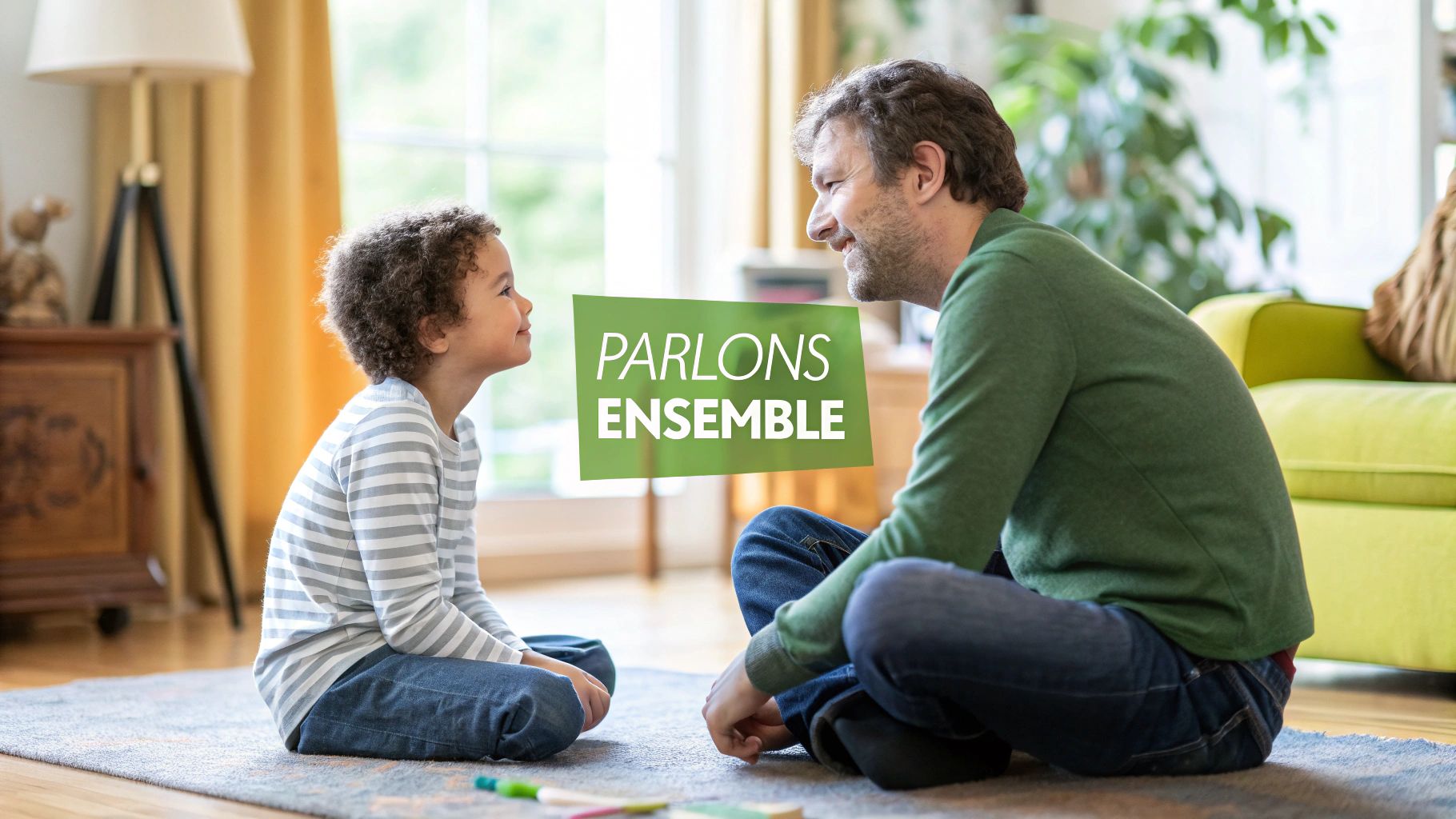
Communication is your best tool to help your child through a life change . But even before broaching the subject, the most important thing is to create an atmosphere of trust. Your child needs to feel they can tell you anything, without filtering, even emotions that might seem complicated or negative.
This kind of conversation can't be hastily arranged in the morning before school. Choose a time when you're truly available, without distractions. A quiet weekend afternoon, a walk in nature, or even bedtime are often perfect moments. The most important thing is that your child feels they have your undivided attention.
Choose the right words and really listen
The words you choose carry enormous weight. It's therefore crucial to adapt them to your child's age. Avoid details that might distress them or overly abstract concepts. The best approach is to speak simply and honestly.
And then there's listening. Real listening. It's a skill that can be developed. Listening to understand, not just to prepare your next sentence. When your child confides in you, get down to their level, look them in the eyes. Show them through your attitude that what they tell you matters a great deal.
Here are some practical tips to encourage sincere dialogue:
- Ask open-ended questions. Rather than a simple "How are you?" which often elicits a "yes," try: "I imagine you have lots of questions about our move. We can talk about it whenever you want, you know."
- Rephrase what he's feeling. By repeating his words with your own, you show him that you understand. "If I understand correctly, what worries you most is not seeing your friends every day anymore?"
- Validate their emotions without judgment. All emotions are legitimate. Avoid phrases like "Don't be sad" or "Don't be afraid." Try instead: "I understand that it makes you sad to leave this house; we have so many good memories here."
The goal isn't to "fix" his anxiety immediately. It's primarily to show him that he has the right to feel this way, and that you're there to listen. This validation is the first step towards him feeling understood and safe.
Transforming uncertainty into a family project
Involving your child in the process, even on a small scale, can completely change their perspective. When they feel their opinion matters, they no longer passively accept the situation; they become an active participant. This restores their sense of control, which is essential for their well-being.
Let's take the example of moving house. You can give them small tasks, adapted to their age:
- Draw up a plan of your future room.
- Choosing the color of a wall.
- Sort through your toys to decide which ones to donate.
- Prepare a "treasure box" with the items he absolutely wants to keep with him during the journey.
Every small decision you make together strengthens her sense of being part of the adventure. You're no longer just moving house; you're building the next chapter of your family life together. By making this life change a shared project, you show her that even in the face of the unknown, your family bond remains her greatest security.
Create anchor points through rituals

When life changes, your child's world can feel like it's turning upside down. Faced with uncertainty, family rituals are true lifelines. They are fixed, predictable points of reference that provide immense comfort.
Even the simplest habits send a powerful message: "Yes, things are changing around us, but the heart of our family remains the same." That's why it's so important to hold on to the traditions that matter to you.
Protect the habits that provide comfort.
Take a moment to think about what structures your days. The bedtime story, the big morning hug, Friday pizza night, the special weekend breakfast… All of this is much more than just a routine. These are the pillars upon which your child's emotional security rests.
During a transition period, make an effort to carve out these moments. Are you surrounded by boxes up to your neck? Take 20 minutes to stop and read a bedtime story. This simple gesture shows them that, regardless of the surrounding chaos, their need for connection and stability remains your top priority.
Advice for parents: rituals are never a waste of time, especially during times of change. Consider them the most valuable investment in your child's emotional well-being.
Invent new traditions together
In addition to preserving existing habits, why not see this change as an opportunity to create new traditions? The trick is to do it with your child. By involving them, they move from being a passive observer to an active participant in the change. This gives them back a sense of control, so valuable for their self-confidence.
This collaborative approach transforms the anxiety of the unknown into shared excitement. Instead of passively enduring the situation, he participates with curiosity and enthusiasm.
To help you visualize how this can be translated into concrete terms, here is a table with some ideas to adapt with your child!
Ritual ideas for each type of change
| Type of change | Transition Ritual (Before/During) | New ritual (After) |
|---|---|---|
| Moving | Organize a "farewell ceremony" at the old house where everyone shares a memory. | Launch a "discovery safari" to explore the new neighborhood with a treasure map. |
| Changing schools | Set up a "song of courage" to listen to on the journey during the first few weeks. | Plan a "new friends party" at home after a few weeks. |
| Arrival of a baby | Establish a "special big brother/big sister moment" every day, even if it's just 10 minutes . | To name him "official keeper of bedtime stories" for the baby. |
| Parental separation | Create a "message box" to communicate between the two houses. | Establish a specific and unique ritual for each house (e.g., pancake night at dad's). |
These rituals, old or new, are much more than simple activities. By involving your child in this way, you're not just managing a transition. You're teaching them an essential life skill: how to find and create joy and stability, even when everything around them seems to be in flux.
Creativity, a powerful lever for self-confidence
When a major life change disrupts their daily routine, children often struggle to put words to the whirlwind of emotions they experience. This is where creativity becomes a valuable ally. It opens a door for them to express their fears, doubts, and hopes in a healthy and positive way.
These creative activities are much more than just pastimes. They are true tools for self-development. Each completed drawing, each invented story, is a small victory that boosts self-confidence. Your child discovers that they have within themselves the resources needed to face the unknown.
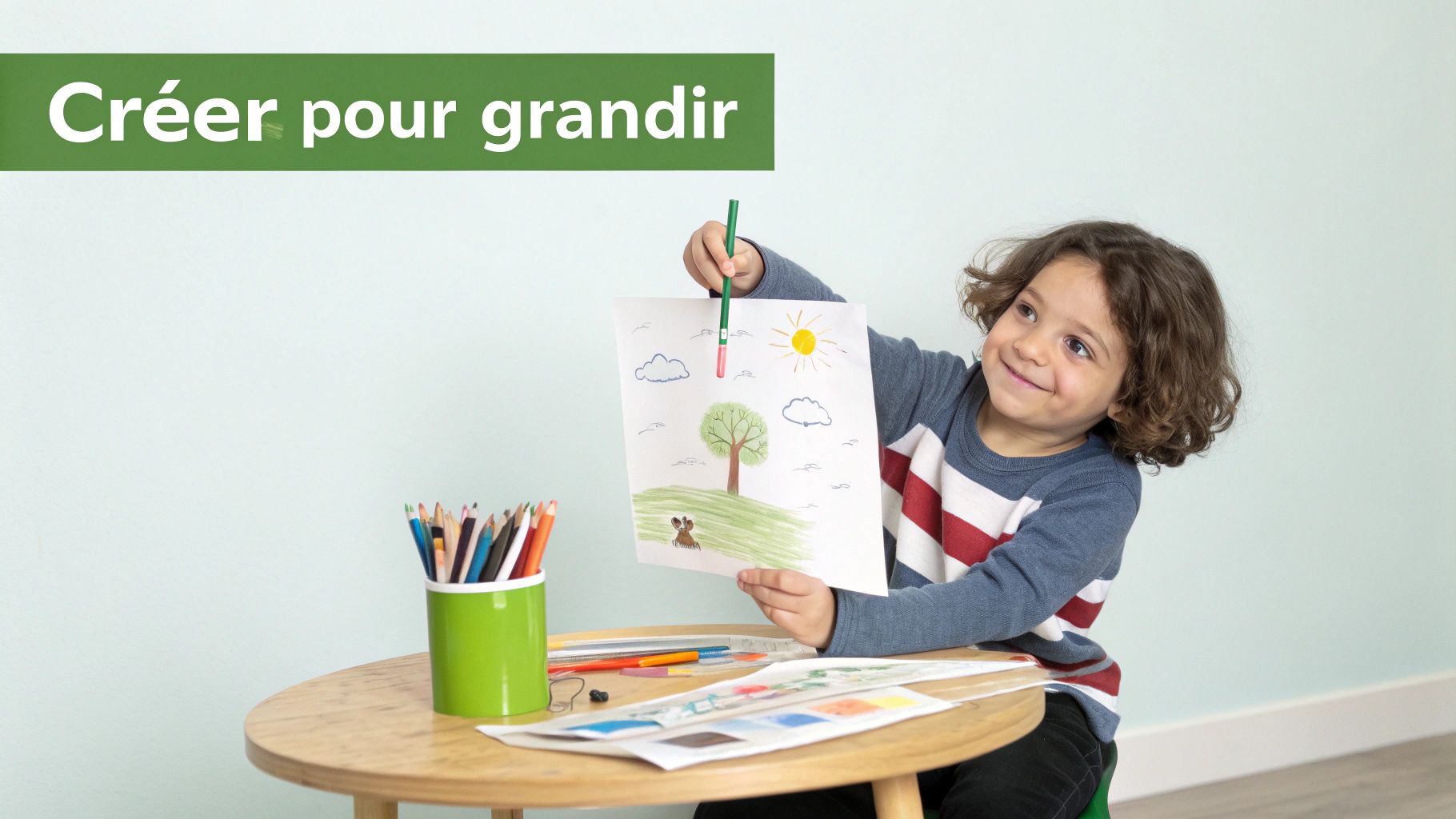
Giving shape and color to one's emotions
When feelings are too strong to explain, drawing, painting, or sculpting can take over. The idea is not to create a masterpiece, but simply to give concrete form to what is happening inside.
Try suggesting they draw their fear. What does it look like? Is it a big, scary monster or a tiny shadow lurking? Simply giving it a shape and colors can make it instantly less intimidating, easier to manage. It's a way to regain a little control.
By guiding your child through these moments, you are not just keeping them occupied. You are showing them that all their emotions, even the most unpleasant ones, have the right to exist and that they can even be transformed into something interesting.
A few creative workshops to help navigate change
Here are some very simple ideas to implement at home to gently support him/her through this transition.
- The Change Adventure Journal: Offer them a nice notebook that will become their travel journal. They can paste photos in it, draw important moments (the good and the not-so-good), write little notes, or just doodle. It's their own space, a safe place to recount their journey.
- The Hero's Story: Together, invent a story where the main character resembles your child and experiences a similar situation. How does he or she react? What are their superpowers for overcoming challenges? By projecting themselves into the story, your child often finds their own solutions without even realizing it.
- The happy memory box: Take a simple shoebox and decorate it together. Suggest that they put in objects, drawings, or little notes that remind them of happy times. When they're feeling down, opening this box can be a source of immediate comfort.
Each successful creative activity is concrete proof of his ability to overcome a difficulty. He learns through experience that he can transform a period of uncertainty into something positive and constructive.
This ability to adapt and draw on one's own resources is an immense gift for life. Moreover, French society as a whole demonstrates remarkable resilience. In 2024, life expectancy reached 80.0 years for men and 85.6 years for women , one of the highest increases in Europe. This longevity is partly due to our capacity to adapt and constantly improve how we manage life's challenges. To learn more, you can consult the INSEE data on this subject . By nurturing their creativity, you help them build this same inner strength.
What if we looked at things differently? Rather than an ordeal, this big change could very well be the start of an unforgettable family adventure. As a parent, your perspective on the situation is incredibly contagious. If you present this transition as an exciting new chapter to write together, you give your child permission to be curious and even a little brave.
Your optimism is the fuel for this transformation. The idea isn't to pretend sadness or difficulties don't exist, but to deliberately choose to highlight new possibilities. It's a small adjustment in words and attitude that can change absolutely everything.
Reinventing the story of change
The words we use have immense power; they shape our reality. Instead of dwelling on what you're leaving behind, steer family discussions toward everything you're about to discover. It's a small shift in vocabulary, but it can transform the entire emotional dynamic.
- Instead of referring to it as "the old room", why not call it the " future cabin " or the "new headquarters"?
- Rather than missing "the old school", we can imagine "the next school, full of new friends".
- We can also imagine the activities to come: "Can you believe it, we'll be right next to this big park where we can go cycling!"
By simply changing the setting of the story, you help your child visualize a positive future, something they can look forward to. They are no longer passively experiencing change; they are actively preparing for a new adventure.
Think of it this way: you are the guide of an exciting expedition. If you confidently show him the map of unknown territories, he will follow you with far less apprehension and much more excitement.
Turning the unknown into a playground
To make this adventure truly real, transform the stages of change into fun activities. The best remedy for feelings of powerlessness is active participation.
Some concrete ideas for parents:
- Organize a treasure hunt in the neighborhood. Prepare a short list of things to find: a playground, a bakery that smells good, a tree with a funny shape... The discovery immediately becomes more exciting.
- Create a family vision board. Take a large piece of cardboard and glue on photos, drawings, and words that represent everything you're looking forward to doing in your new life. This tool makes the positive aspects of the change concrete and inspiring.
- Call him "adventure reporter". Give him a small notebook or an old camera to document each step, like a journalist on a special assignment.
Change is a part of life. Our society itself is constantly evolving. For example, the structure of the French population is changing. As of January 1, 2025, France is estimated to have 68.6 million inhabitants , with a fertility rate that has never been so low. To learn more, you can consult the major population trends on ined.fr.
By teaching your child to see change as an opportunity, you give them valuable tools to confidently adapt to the world around them.
The questions you ask yourself about change
A life change , even a positive one, brings its share of questions for parents. It's perfectly normal to sometimes feel a little lost when faced with your child's reactions. Let's untangle the most frequently asked questions together to help you gain some clarity.
My child refuses everything outright, what should I do?
A flat refusal often reflects fear or a feeling of loss of control. The first and most important thing to do is to acknowledge your emotion, without judging or minimizing it.
Instead of trying to reassure him at all costs with a "No, you'll see, it's going to be great!", try to connect with what he's feeling. A simple phrase like "I can see that the idea of leaving your friends is really sad for you, and I understand" can make all the difference. It shows him that his feelings are valid and that you hear them.
Next, try to give him back some control over the situation. He didn't choose to move, that's a fact. But he can have a say in other things! Suggest that he choose the color of the walls in his new room, design the layout of his furniture, or decide on the menu for the first night in the new house. These small choices give him back a sense of control that is truly valuable.
Validating your child's feelings is not a sign of weakness. On the contrary, it's the foundation of their emotional security. You show them that they can count on you to understand them, even when things are difficult.
How can I tell if his reaction is normal or if I should be worried?
It's perfectly normal for a child to be sad, anxious, or even a little angry during a transition period. There's always an adjustment phase, and that's healthy.
However, certain signs should alert you if they persist beyond a few weeks.
- He isolates himself: He no longer wants to see his friends or participate in activities he used to love.
- His sleep is disturbed: He has difficulty falling asleep, has frequent nightmares or wakes up often during the night.
- Her academic performance is falling: You notice a sudden and unexplained drop in her grades or her ability to concentrate in class.
- His behavior changes radically: He becomes more aggressive, very anxious, or his sadness seems never to leave him.
If you observe these signs persistently, don't hesitate to discuss them with your doctor or consult a psychologist. Seeking help is taking care of your child, and yourself as well.
How far should he be involved in major decisions?
It's all about balance. Your child needs to feel that their opinion matters, but they need even more to know that adults are in charge and ensure their safety.
The major decisions that shape family life (choosing the city you move to, the future school, etc.) are yours to make. Placing such a burden on his shoulders would be a huge source of stress for him.
However, involve him fully in everything related to his personal life during this major change. For example, he can organize his going-away party with his friends, choose the precious items that will go in his "treasure box" for the move, or even plan your first walk to explore the new neighborhood. By entrusting him with these tasks, you nurture his need for independence without delegating responsibilities that are too heavy for his age.
My Book Story can be a wonderful companion during these times of transition. It's a journal that guides your child with simple and creative activities to help them put words to their emotions, build their self-confidence, and see this change as a new adventure. Discover how this journal can help them write the next chapter of their story .