


To help a child overcome their anxieties , it's essential to first understand one key thing: the goal isn't to magically make their fears disappear. The objective is to give them the right tools to confront and work through them. It's about building, step by step, a space where they feel they can be vulnerable without fear, where anxiety becomes an opportunity for growth and self-confidence.
Why does a child sometimes feel "stuck"?
Between the ages of 6 and 12 , a child's inner world develops at an incredible pace. It's a wonderful age, full of discoveries, but it's also a time when fears and anxieties can take root more easily. Their daily lives, which sometimes seem so simple to us, are actually full of challenges that we adults tend to underestimate.
These blockages can take all sorts of forms, sometimes surprising ones:
- The fear of failure at school , faced with this math problem that seems like an insurmountable mountain.
- Social anxiety in the schoolyard , where finding a place among others can seem terribly complicated.
- The difficulty in putting words to an emotion , like that famous knot in your stomach before sleeping, without knowing if it's anger, sadness, or something else.
Spot the subtle signs that don't lie
A child will very rarely come to you and say, "Mom, Dad, I feel stuck." Instead, they'll show it, often clumsily, through their behavior. A sudden change in mood, withdrawal, or a new reluctance to do something they used to enjoy—all of these can be clues. Your daughter, for example, who used to love drawing and who, overnight, refuses to touch her crayons for fear that her drawing won't be "perfect."
These reactions are not tantrums. They are the visible sign of an invisible battle. The child feels held back, as if facing a wall, and this frustration can easily spill over into anger or sadness.
This is precisely where the idea of helping him "free himself" takes on its full meaning. The idea is not to push him to overcome the obstacle, but to invite him to explore it, at his own pace, in an environment where he feels completely safe.
When vulnerability becomes a strength
Your role, as a parent, is to create this space of trust. The secret is to show them that talking about their fears isn't a sign of weakness, but rather, a tremendous act of courage. Instead of saying the classic "Don't be afraid," which tends to invalidate their feelings, try a phrase like: "I can see that this worries you. Would you like to talk about it, or perhaps we could draw together what scares you?"
This simple difference changes everything. The child learns that what they feel is legitimate and, above all, that they have the tools within themselves to understand it. This is where creative tools, like the My Book Story journal, become true allies. They offer a concrete way for the child to express what's weighing them down inside, whether through words, colors, or even scribbles. Without even realizing it, the first building blocks of emotional intelligence are being laid, building a foundation that will serve them throughout their life.
Recognizing the signs: when your child feels held back
The first step, and arguably the most important, is to understand what's really going on in your child's mind and heart. Sometimes, emotional blocks don't look like big crying spells. They're much more subtle, almost invisible. Your role, as a parent, is a bit like becoming a kind detective, on the lookout for small clues.
A child who feels stuck or held back will rarely express it in adult terms. They will show you. How? Through changes in their daily life. A sudden drop in grades at school, a loss of interest in soccer or drawing they used to love, or restless nights… These are often warning signs.
Going beyond simply asking "How are you?"
We all have that reflex. "How's school going?" And we almost always get the same answer: "Yes." End of discussion. To really find out what's going on, you have to change tactics and ask questions that open the door, without forcing the issue.
Here are some concrete ideas to try:
- "Tell me about the nicest thing that happened to you today. And the least nice thing?"
- "Is there anything that made you a little sad or angry this week?"
- "I get the feeling you're a little worried at the moment. Am I right? We can talk about it if you want."
By asking these kinds of questions, you show him that you're genuinely interested in his feelings. You help him understand that all his emotions are valid, even the most unpleasant ones.
Identifying emotional blocks in your child
This chart can help you differentiate between minor everyday difficulties and signs that might indicate a deeper emotional blockage.
| Observed behavior | Description | Potential warning sign |
|---|---|---|
| Mood swings | Your child goes from laughter to tears for no apparent reason or seems constantly irritable. | If these mood swings are intense, frequent, and have lasted for several weeks. |
| Social withdrawal | He avoids his friends, no longer wants to go to birthday parties, or prefers to stay alone in his room. | When he systematically refuses activities he used to enjoy. |
| Academic difficulties | His grades suddenly drop, he complains of not understanding or refuses to do his homework. | If this decline is not linked to a specific difficulty in a subject but to a general malaise. |
| Physical complaints | He often has stomach aches or headaches, especially before going to school or an activity. | If doctors have found no physical cause and the pain coincides with stressful events. |
| Sleep disorders | He has trouble falling asleep, has frequent nightmares or wakes up in the middle of the night. | When these disorders become chronic and affect his energy during the day. |
Keep in mind that these are just suggestions. The important thing is to observe changes that last over time.
When a behavior becomes a real signal
It's essential to put things into perspective. Feeling a little nervous before a presentation is perfectly normal. It's even healthy! But if this anxiety keeps him awake at night, kills his appetite, or isolates him from his friends for weeks, that's a different story. That's when you need to take action. These persistent signs tell us that your child might need a little help to free himself from what's weighing him down.
This simple decision tree can help you see things more clearly and know when to offer your help.
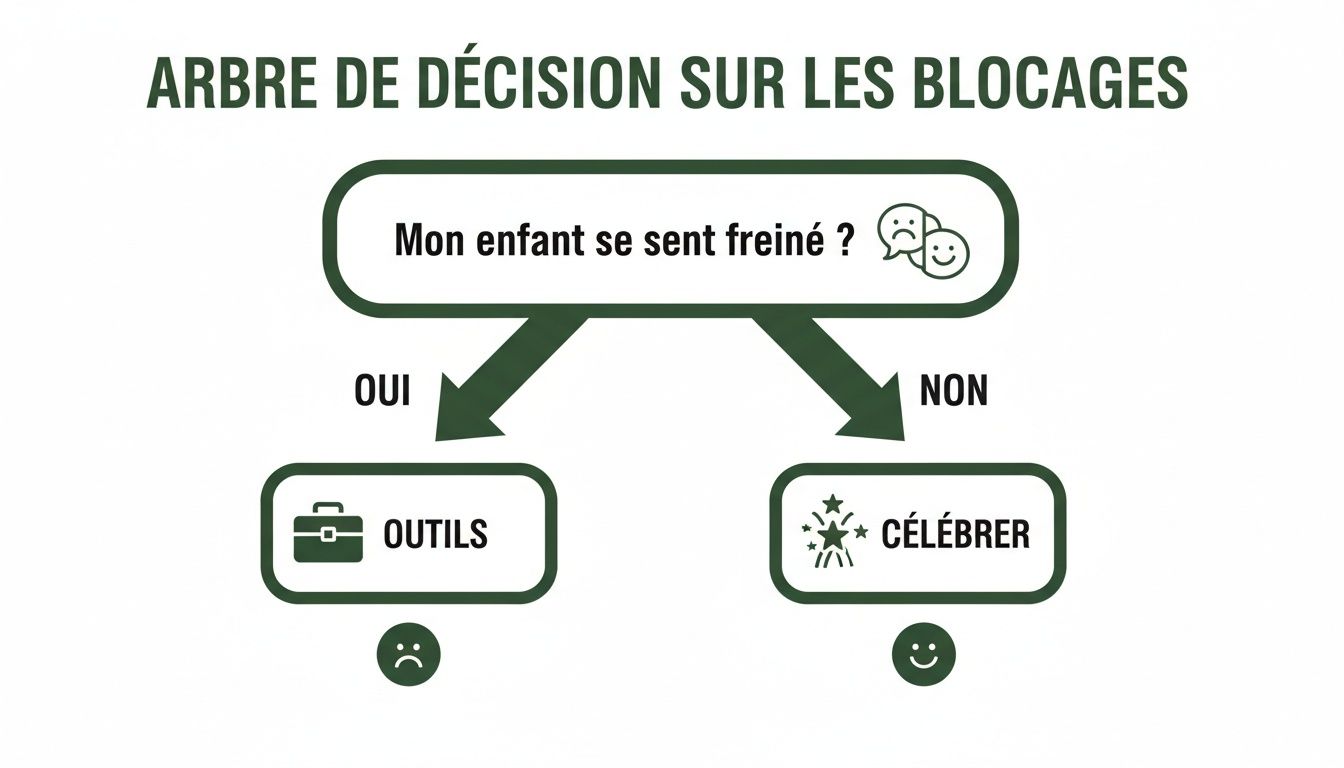
What I love about this image is that it reminds us of a simple thing: if your child seems stuck, it's time to give them tools. But if everything is going well, it's an opportunity to celebrate their strengths and boost their confidence.
Realizing there's a blockage isn't a parental failure. On the contrary, it's a fantastic opportunity to take action. It's the starting point for helping your child become more resilient and better understand themselves.
And rest assured, you are not alone. In France, according to a study on children's mental health , 13% of children aged 6 to 11 have at least one probable mental health disorder. These figures show us how crucial it is to be attentive and to talk openly about emotional well-being, starting from a very young age.
Establish a small ritual to release emotions
To help a child open up, consistency is your best ally. By turning the use of their journal into a small daily ritual, even if it's just 15 minutes , you create a safe space. A moment just for you where they know they can put anything down, without fear of judgment.
Far from being a chore, this time together should be a moment of connection. Think of it like a hot chocolate break after school, or just before bedtime stories, snuggled up under the covers. The idea is to create a safe space where their joys, anger, and fears are allowed to exist.

How can we liven up this moment?
The hardest part is often getting started. Your child won't always know what to say or draw, and that's perfectly normal. Your role isn't to give them the answers, but rather to guide them with open and supportive questions to help them look inward.
Imagine he opens his My Book Story notebook to a blank page. Here are a few tips to break the ice:
- "If your day were the weather, what would the weather be like in your heart right now? Bright sunshine, clouds, maybe a little thunderstorm?"
- "Tell me about a time today when you felt as strong as a superhero. And another time when you felt as small as an ant?"
- "Try to draw the color of your anger. What's it like? Does it sting? Is it soft? Does it take up a lot of space?"
These little questions help him to put images to his feelings in a playful way, without the pressure of having to do "right".
What if difficult emotions resurface?
Expect days when the pages fill with black, or a crying character. And you know what? That's great news! It means your ritual is working. Your child feels safe enough to express what's bothering them.
At this moment, your reaction is crucial. The mistake would be to immediately try to "fix" it or tell him, "No, it's not that bad." Instead, accept what he's showing you with empathy.
A drawing filled with rage isn't a problem to be solved; it's a story that needs to be heard. By validating their emotion ("I see you've used a lot of black on your page. Does it look like that's the color of your anger today?"), you send them a powerful message: what you're feeling is normal and important.
Instead of pushing him to move on, suggest he explore the emotion a little. Sometimes, simply naming it and drawing it is enough to make it less overwhelming. This is the first step towards him learning to break free from its grip.
The power of the "small victory"
Even on the gloomiest days, there's often a spark. Learning to recognize it—that's what developing resilience is all about. Your mission, should you choose to accept it, is to help her strengthen her ability to see the positive.
If your child tells you "everything was rubbish today", gently ask them to find the very, very small thing that wasn't so rubbish.
- The smile of the lady in the canteen?
- The dessert he loved?
- Having managed to tie his shoelaces all by himself?
Finding this small victory doesn't negate the day's difficulties. It simply teaches them not to let negativity take over. It's a mental habit that's cultivated little by little, day after day.
What if we played with our fears to better tame them?
Sometimes words aren't enough, especially with a child. No matter how hard you try to explain or reassure them, nothing works. That's where play and creativity become invaluable tools for accessing their inner world, gently and without overwhelming them. The idea is to transform a difficult moment into one of sharing and laughter.
Rather than confronting a fear head-on, which can be very overwhelming for a young child, a playful approach allows them to gently tame it. By transforming the anxiety into a character or a story, the child gains perspective and, above all, regains some control.
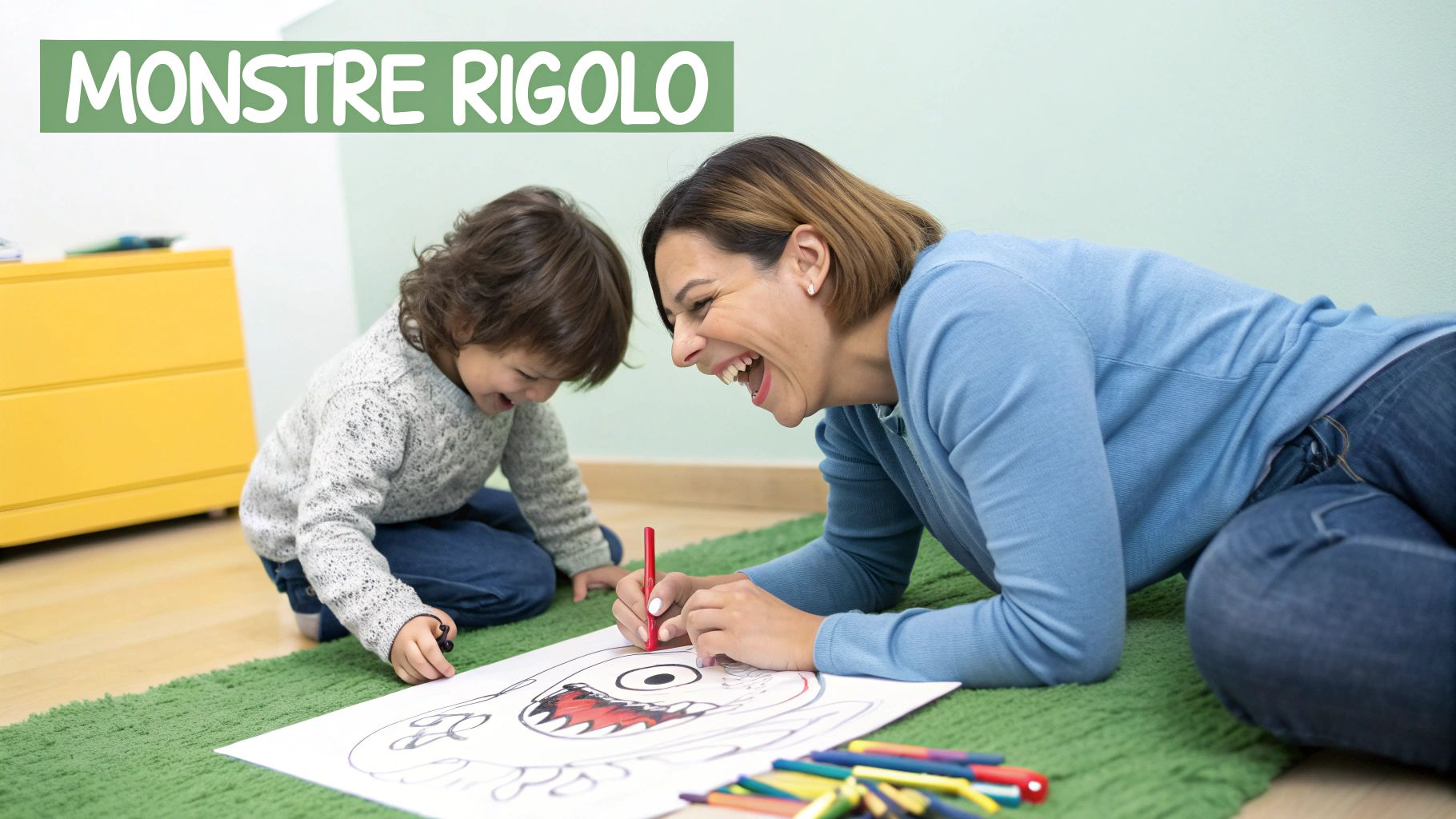
The Funny Monster Game
Here's a very simple activity, but one that I find incredibly effective. It's directly inspired by exercises found in creative journals and helps your child externalize their fear in order to better understand it.
The principle is simple: we're going to give a concrete form to what frightens him. Encourage him to draw his fear. Is it a big hairy monster? A small, slimy creature? It doesn't matter, let his imagination do the work.
Once the drawing is finished, it's time for the funniest part. Suggest that they come up with a completely ridiculous name for this monster. Imagine calling the fear of the dark "Stinky Sock" or pre-test anxiety "Gluttonous Chubby." Just naming it like that often makes people burst out laughing, and the fear instantly loses its power.
To delve deeper, you can ask him questions:
- What could possibly make this monster die laughing?
- What's his most disgusting favorite dish?
- If he had a ridiculous superpower, what would it be?
This little game transforms a paralyzing emotion into an absurd and much less frightening character. It's a very gentle way to help your child break free from the grip of their anxieties.
Humor is a powerful psychological tool. When a child learns to laugh at what scares them, they don't eliminate the emotion, they disarm it. They realize they are stronger than it.
Introducing these communication tools at a young age has become essential. A recent survey shows that nearly one in four young people report symptoms of anxiety or depression. To learn more, you can consult the full results on youth mental health . These figures remind us of the urgent need to equip our children so they can express and manage their emotions before they become overwhelmed.
The challenge of magical solutions
Here's another activity I love for developing mental flexibility: the "magic solutions" challenge. It's perfect for those little everyday hassles that can seem like a mountain for a child, like forgetting their homework book at school.
The goal here isn't to find the "right" solution, but to invent the most outlandish ones possible. Ask him: "Imagine you have a magic wand. Invent three completely crazy solutions to solve this problem!"
The answers could be:
- Send a super-fast carrier pigeon to retrieve the notebook.
- Use an invisibility potion to sneak into the school at night.
- Asking your cuddly toy to do your homework for you.
This exercise helps to defuse the situation and shows your child that there are always multiple ways to look at a problem. They learn to move beyond rigid thinking (like "it's a disaster") and explore a range of creative possibilities. By supporting them without judgment, you show them that imagination is a valuable tool for overcoming obstacles.
Building solid self-confidence, step by step
Helping your child overcome their obstacles is first and foremost a long-term effort to nurture their self-confidence, day after day. It's a bit like building a house: each small inner victory is a brick that strengthens the foundation.
Each page filled in a creative journal is concrete proof of their ability to overcome a small difficulty. A fear drawn and tamed, a solution imagined for a problem... all of this contributes to their self-esteem. They learn through experience, not theory, that they already have within them everything they need to cope. The goal isn't to create beautiful works of art, but to show them that their inner world is important and worth exploring.
Emphasize the journey, not just the destination
As parents, we often instinctively praise the result: the good grade, the goal scored in football, the "successful" drawing. That's fine, but to build confidence that withstands challenges, it's much more effective to value the effort and the process.
Rather than saying "That's really beautiful what you did!", which emphasizes a talent he may or may not have, try to be interested in how he did it.
Some concrete ideas to showcase your efforts:
- "I love how you chose these bright colors, it's clear it made you happy!"
- "I saw that this wasn't easy, but you persevered without giving up. I'm really proud of your dedication."
- "Tell me how you came up with this great idea. It's really clever!"
The difference is subtle, but enormous. You don't judge his performance, you celebrate his journey. He then understands that the most important thing is not perfection, but trying, progressing, and understanding what is happening inside him.
To make this ritual a springboard towards autonomy
By repeating these little creative rituals, your child is doing much more than just venting. Without even realizing it, they're building a real emotional toolbox for life. They're learning to put words to what they're feeling, to express it healthily, and, most importantly, to find their own solutions.
Each page of his journal becomes a mirror that reflects a positive image of himself: "I felt a lot of anger, I drew it, and now I feel better. I managed to do that all by myself." This is the beginning of emotional autonomy.
This process empowers him to free himself from his dark thoughts. Little by little, he will no longer systematically need you to calm down or reassure him. He will know that he can pick up his notebook and pencils and begin the work of feeling better. This is undoubtedly the greatest gift: giving him the certainty that he is capable, resilient, and resourceful.
Your role as a parent: to be the lighthouse in the storm
In this journey, never forget that the most powerful tool is you. Your patience, your non-judgmental listening, and your unconditional love are the true fuel that will help your child free themselves from what weighs them down.
Your mission is not to become his therapist, but to be his guide. A benevolent guide who holds the lantern to light his way, without ever forcing him to move forward.
This journey into the heart of emotions is a bit like a dance. There will be days when words and drawings overflow the pages of the notebook, and others when silence reigns. And that's perfectly normal. Respecting its rhythm sends a powerful message: I accept you as you are, with your joys as well as your silences.
Show him that you have clouds too
Don't be afraid to share your own little challenges. A simple "You know, I was a bit stressed at work today, it happens to everyone" can work wonders. You're showing them that complicated emotions aren't just for children.
He then realizes that even adults, whom he sees as superheroes, learn every day to navigate their own feelings. This puts his own struggles into perspective and makes him understand that he is not alone.
This kind of sharing builds immense trust. He learns from your example that vulnerability is not a weakness, but rather a strength.
The most important thing to remember is that by creating this space for dialogue and expression, you are doing much more than helping him overcome a passing fear. You are giving him tools for life, emotional skills that will make him stronger and more confident in the face of tomorrow's challenges.
By supporting him in overcoming his obstacles, you are giving him a priceless gift. You are teaching him that he already possesses everything within himself to face life's challenges, knowing that you will always be there, his safe haven.
The My Book Story journal was designed to support you in this wonderful mission. Discover this creative tool to watch your child grow in confidence and serenity by visiting our website .